When you click on links to various merchants on this site and make a purchase, this can result in this site earning a commission. Affiliate programs and affiliations include, but are not limited to, the eBay Partner Network.
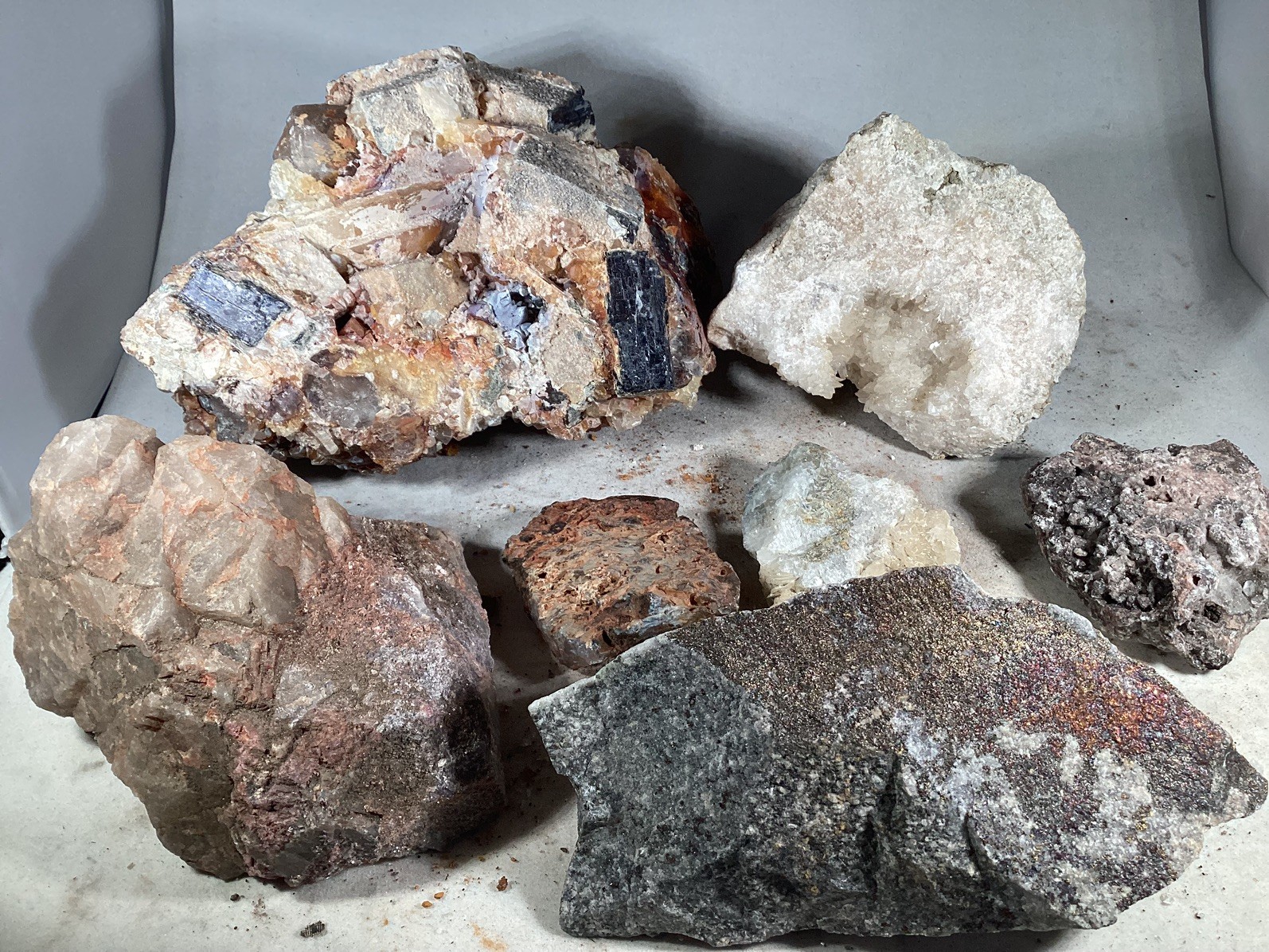
I'm going through a huge collection of rocks, minerals, crystals, ore, possible meteorites, and gems from an estate. These seem to have been collected in the mid 1900s in the western United States.I'm doing my best to take pictures and identify everything but I really don't have a clue. So whoever buys these will probably come away with a lot of value.Please be careful in handling these items since I do not know with certainty what each of them are. There is possible toxicity and radioactivity.This is just one of many lots to come, but I would also be interested in selling the whole thing to someone if they could give me 25% of what they think they can resell it for.Here are my best guesses based on books and AI on some of the items in this listing ( some items came with detailed descriptions and others have been identified by my local rock shop, but I have too many to id them all.I don't know exactly what the first mineral cluster is exactly, but it's really big and it's beautiful in person. here are a couple ai guesses based on two different image angles:
pegmatite matrix specimen, a classic rock type famous for growing large, beautiful crystals together.Based on the distinct shapes, textures, and colors, this piece features an incredible combination of several minerals:Black Tourmaline (Schorl): The long, dark, column-like blocks on the sides are classic black tourmaline crystals.Topaz / Quartz: The large, glassy, blocky tan-to-clear crystal clusters making up the core of the piece resemble highly-formed topaz or quartz formations.Mica & Feldspar: The surrounding lighter, flaky, and chalky material provides the host matrix binding the cluster together. or
This is a coarse-grained igneous pegmatite rock matrix hosting a cluster of distinct mineral crystals. Based on the different shapes, colors, and crystal habits present, it contains several classic pegmatite minerals:Smoky Quartz: The prominent, dark brownish-grey rounded crystal on the middle-left side. Feldspar (likely Microcline or Orthoclase): The large, tan/beige blocky crystalline structures making up the center and lower-middle sections of the rock. They exhibit flat cleavage faces. Quartz / Calcite Crystals: The smaller, lighter-colored crystalline pockets (such as the white, spiky clusters nestled in the vug on the right side). Iron Oxide/Limonite Staining: The patchy reddish-orange and yellowish tints spreading across the crystals are caused by natural iron weathering.Crystal geode with quartz or calcitemineral specimen consisting of clear, doubly-terminated crystals on a rock matrix, which strongly resembles Herkimer Diamond quartz.raw quartz crystal cluster on matrix with secondary mineral inclusions possibly pyriterough agate or chalcedony nodule, which is a form of microcrystalline quartzThis rock contains a rich concentration of sulfide minerals, most prominently pyrite (commonly known as "fool's gold") and potentially chalcopyrite or borniteraw mineral specimen featuring translucent quartz or calcite crystals growing alongside another mineral matrix.Everything is boxed up in a medium flat rate box. Wrapped up in bubble wrap and newspaper from the 1950s and cardboard to protect and fill the spaces.
#37
15.2 pounds