When you click on links to various merchants on this site and make a purchase, this can result in this site earning a commission. Affiliate programs and affiliations include, but are not limited to, the eBay Partner Network.
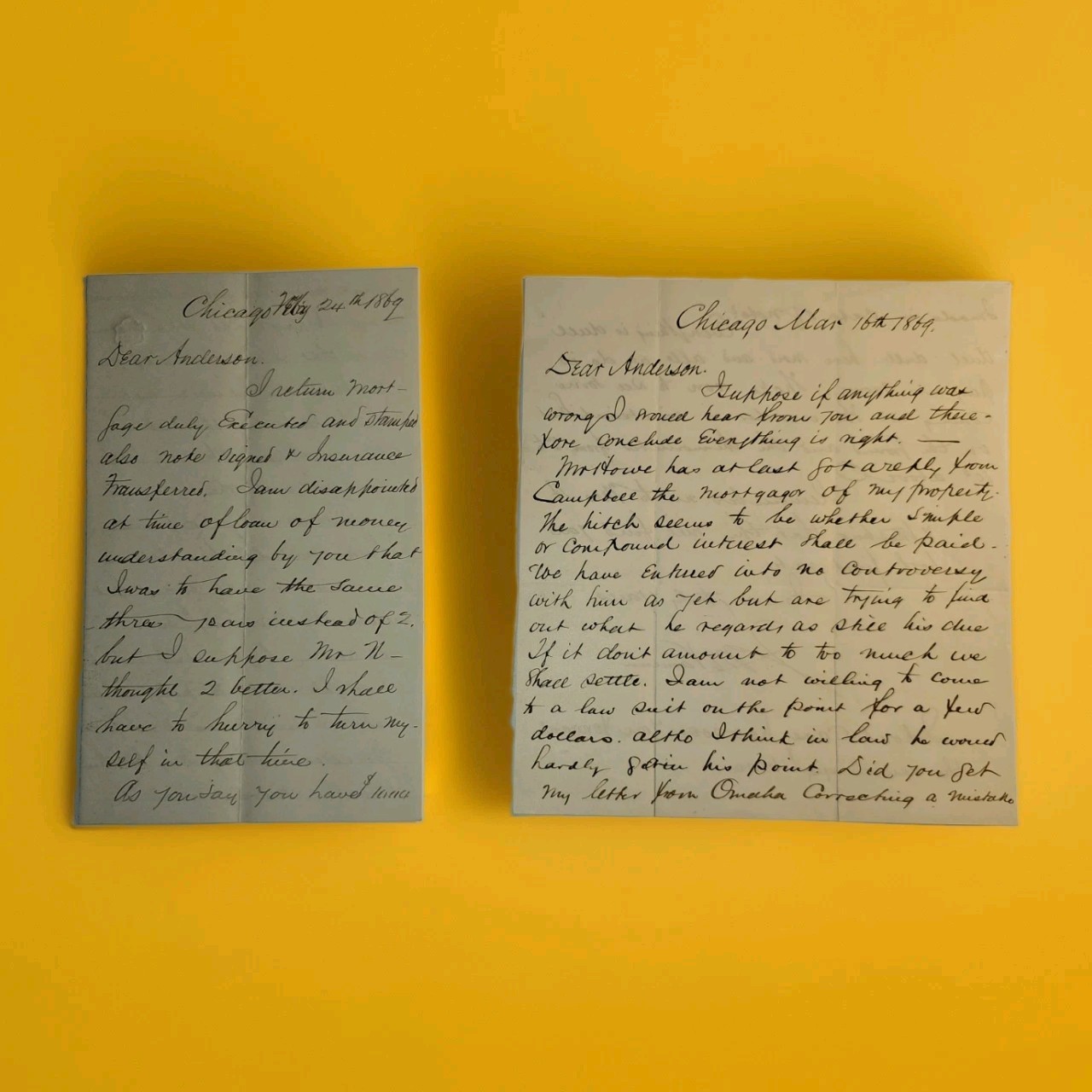
The letters are dated February 24, 1869 and March 16, 1869, and together form a closely connected piece of pre-Fire Chicago financial and real-estate history.
Varnum writes concerning a $3,000 private mortgage transaction, confirming the return of an executed and stamped mortgage, signed promissory note, and transferred insurance, while coordinating the movement of $2,000 through “my brother” so that he could meet another note coming due.
In the second letter, Varnum discusses a separate property dispute involving Campbell, identified as the mortgagor of his property, and Mr. Howe, who was communicating with Campbell on Varnum’s behalf. The issue centered on whether “Simple or Compound interest” should be paid. Varnum makes clear that he would prefer settlement to litigation, writing that he was unwilling to “come to a lawsuit on the point for a few dollars.”
One of the most evocative passages captures the economic mood of Chicago in early 1869:
“Everything is dull dull dull here now and all we do is pay out money. Hope soon to see some coming in.”
He also describes snow on the ground and temperatures ranging from approximately 3° to 10° above zero.
The correspondence is especially interesting in hindsight because it predates the Great Chicago Fire by just over two years. The fire began on the evening of October 8, 1871, burned through October 10, and destroyed a vast portion of the city’s central business district. These letters therefore preserve a firsthand glimpse of Chicago’s financial and property world before that catastrophe radically altered the city.
John M. Varnum
The writer is very likely John Marshall Varnum, born 1835/36, later of Boston, and compiler of the important family genealogy The Varnums of Dracutt, published in 1907.
John Marshall Varnum was a member of the prominent Varnum family of Massachusetts and a son of Sheriff Benjamin Franklin Varnum and Caroline Bradley Varnum. The family had longstanding connections in Middlesex County and the Boston-Lowell region. Varnum later devoted substantial effort to documenting the history and genealogy of the Varnum family, producing a substantial published family history.
The identification of the writer with John Marshall Varnum is very likely but not presented here as absolutely conclusive. The letters themselves are signed John M. Varnum / J. M. Varnum and are firmly datelined Chicago in 1869.
Benjamin Franklin Varnum
John Marshall Varnum’s father, Benjamin Franklin Varnum, was a prominent Massachusetts public official who served as sheriff and belonged to the historically important Varnum family of Dracut. The family had deep roots in colonial New England and produced a number of public officials, military figures, attorneys, and businessmen.
Other people mentioned
Anderson was the principal financial correspondent and appears to have been the lender or financial intermediary controlling the $3,000 mortgage funds.
Campbell is identified directly in the March letter as the mortgagor of Varnum’s property and was involved in the dispute over simple versus compound interest.
Mr. Howe appears to have acted as Varnum’s local intermediary or representative in negotiations with Campbell.
Varnum also refers to “my brother,” but the brother is not named in the manuscript and no identification is asserted here.
Historical significance
This pair offers an unusually detailed look at the mechanics of private lending and real-estate finance in Reconstruction-era Chicago, including:
- Mortgage-backed lending
- Promissory notes
- Insurance transferred as part of a financial arrangement
- Private movement of large sums of money
- Potential litigation over mortgage obligations
- Contemporary Chicago business conditions
- Winter weather in the city
- A firsthand glimpse of Chicago shortly before the Great Fire of 1871
The $3,000 principal represented a substantial sum in 1869, making this correspondence more than routine personal mail.
Both letters should remain together, as they form a coherent mini-archive documenting the same financial network within a period of only three weeks.
Condition: Original handwritten manuscript correspondence with expected age toning, folds, handling wear, and minor edge wear consistent with 19th-century paper. Please review all photographs carefully for exact condition.
An excellent piece for collectors of Chicago history, pre-Great Fire material, 19th-century banking and finance, mortgage history, manuscript Americana, genealogy, and Reconstruction-era business correspondence.