When you click on links to various merchants on this site and make a purchase, this can result in this site earning a commission. Affiliate programs and affiliations include, but are not limited to, the eBay Partner Network.
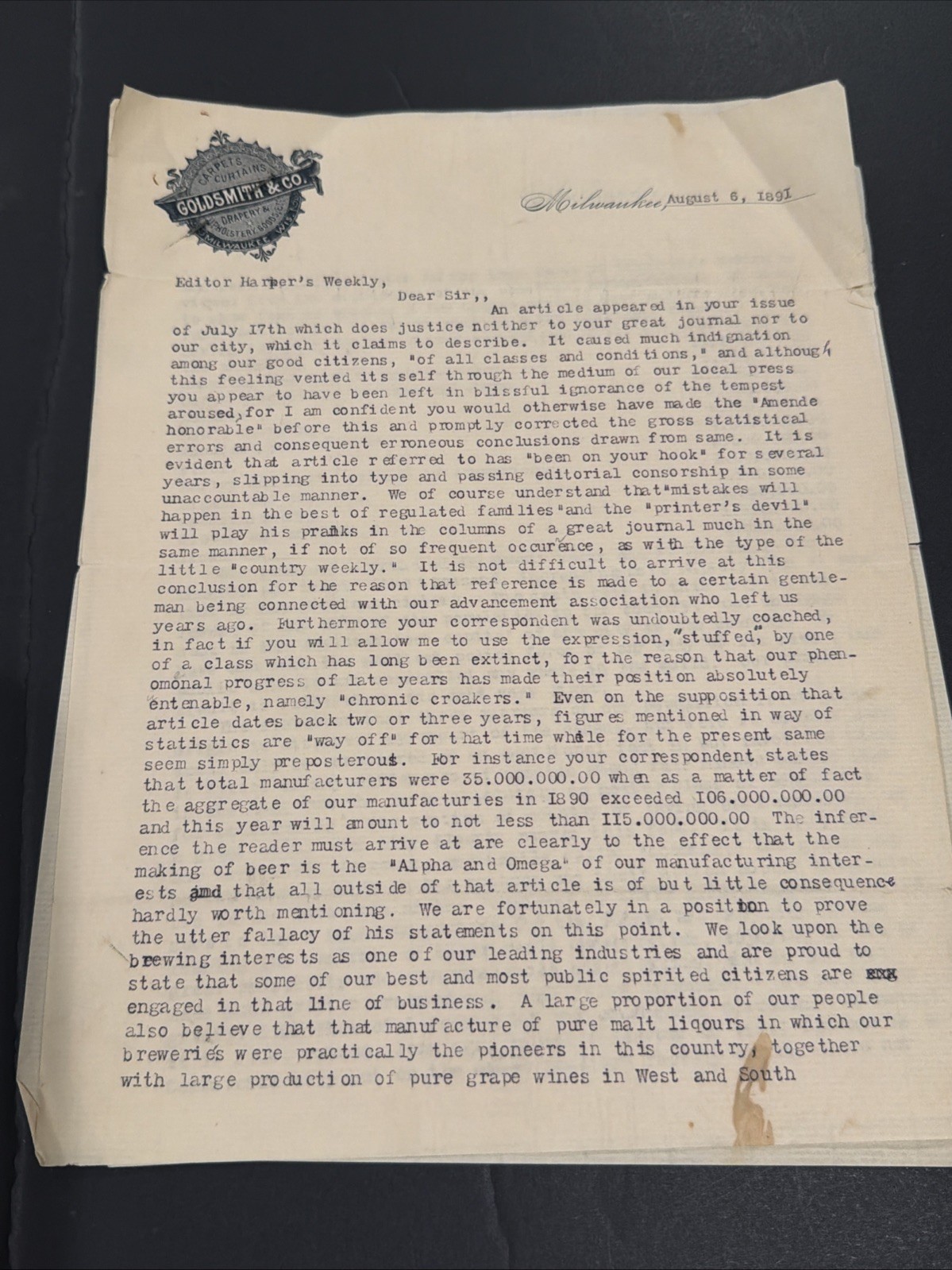
A remarkable, original 3-page typed manuscript letter dated August 6, 1891, written from Milwaukee, Wisconsin, on the engraved letterhead of Goldsmith & Co. (Carpets, Curtains, Drapery & Upholstery Goods). Addressed directly to the Editor of Harper's Weekly, this impassioned document serves as a direct rebuttal to an unflattering article published in the July 17th issue of the national weekly journal.
The author forcefully refutes outdated statistics and mischaracterizations of Milwaukee, offering an extraordinary primary-source snapshot of the city during the height of the Gilded Age.
Key Historical & Textual Highlights:
• Industrial Diversity vs. The Beer Myth: The writer confronts the common national stereotype that "the making of beer is the 'Alpha and Omega' of our manufacturing interests." While proudly defending brewing as a pioneer industry led by prominent citizens, the author provides a detailed statistical breakdown of Milwaukee's 1890 industrial output totaling over $106 million—itemizing meat packing ($11M), machinery ($5.5M), iron & brass ($8.5M), leather ($5.5M), clothing ($6.75M), flour, and tobacco.
• Tribute to German-American Immigrants: Features extensive commentary praising the character, conservatism, and unmatched craftsmanship of the city's vast German population, arguing that combining "the caution of the german with the progressive spirit of the yankee" laid the bedrock for the city's financial immunity from Eastern economic panics.
• Urban Growth & Architecture: Outlines the city's booming population (225,000), low debt, low death rate, and mentions the ongoing construction of two defining architectural landmarks: the Pabst Building and the Hotel Pfister.
• Chicago Rivalry: Explicitly notes that while Milwaukee ceased trying to rival Chicago as a pure commercial hub, it was rapidly overtaking it as a manufacturing center.
An exceptional piece of Wisconsin civic, labor, brewing, and German-American immigration history, ready for preservation or institutional display.