When you click on links to various merchants on this site and make a purchase, this can result in this site earning a commission. Affiliate programs and affiliations include, but are not limited to, the eBay Partner Network.
HIS STORY COLLECTIONS PRESENTS
Cultural Revolution Era Mao Zedong Portrait Badge
毛主席像章 — “Long Live Chairman Mao” — GBCA MS61 — 1966–1976
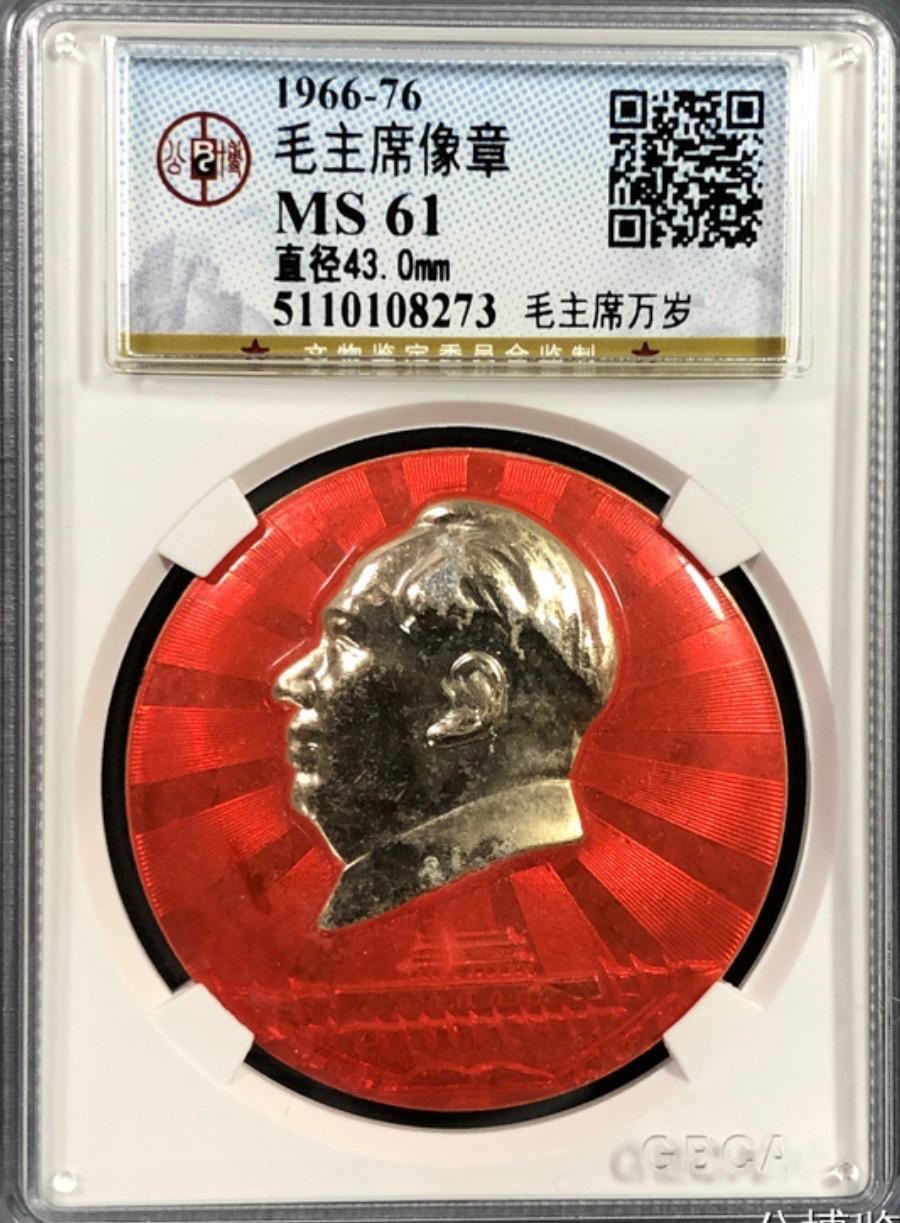
A striking historical badge from one of the most consequential periods of 20th-century Chinese history, this Mao Zedong portrait badge (毛主席像章) has been attributed by GBCA to the 1966–1976 Cultural Revolution period.
The badge features a left-facing portrait of Mao Zedong set against a vivid red radiating background. The reverse retains its original-style pin fitting and bears the inscription:
毛主席万岁
“Long Live Chairman Mao”
Professionally encapsulated and graded GBCA MS61, this piece measures approximately 43.0 mm in diameter.
⸻
THE STORY
The Mao Badge Phenomenon
During the Cultural Revolution, Mao Zedong portrait badges became one of the most recognizable objects of political culture in the People’s Republic of China.
Millions were manufactured in an extraordinary range of sizes, materials and designs. They were worn on clothing, exchanged between individuals, distributed by factories and institutions, and displayed as visible symbols of political loyalty.
The imagery was highly standardized in some respects—most prominently Mao’s profile or bust—but badge designs also incorporated:
* Radiating “sun ray” motifs
* Revolutionary red backgrounds
* Tiananmen imagery
* Political slogans
* Industrial and agricultural themes
* Revolutionary landmarks
As a result, Mao badges have become an important collecting field in their own right.
⸻
THE CULTURAL REVOLUTION, 1966–1976
The Cultural Revolution began in 1966 and continued until 1976.
It was a period of enormous political and social upheaval in China, during which Mao Zedong sought to reassert ideological influence and mobilize society against perceived political and cultural opponents.
Portrait badges became deeply associated with the visual culture of the movement.
Mao was frequently represented metaphorically as the “red sun”, and radiating designs such as the one appearing on this badge reflected that political symbolism.
Today, these objects are collected as surviving artifacts of modern Chinese political, social and material history.
⸻
DESIGN
Obverse
The front presents:
* A metallic left-facing portrait of Mao Zedong
* Bright red translucent or enamel-like background
* Strong radial “sun ray” design
* Architectural imagery along the lower portion
The bold contrast between the silver-colored portrait and red background gives the badge a particularly strong visual presence.
Reverse
The reverse retains:
* Pin attachment mechanism
* Raised central mounting area
* Chinese inscription
毛主席万岁
Literally:
“Long Live Chairman Mao”
This was one of the most recognizable political slogans of the Mao era.
⸻
ITEM DETAILS
Country: China
Period: People’s Republic of China
Historical Era: Cultural Revolution
Date Attribution: 1966–1976
Item: Mao Zedong Portrait Badge
Chinese: 毛主席像章
Reverse / Variety Inscription: 毛主席万岁
English Translation: “Long Live Chairman Mao”
Diameter: 43.0 mm
Certification Company: GBCA / 公博
Grade: MS61
Certification Number: 5110108273
Holder: GBCA encapsulated holder
⸻
CERTIFICATION
This badge has been professionally encapsulated and graded by GBCA (公博).
Certification No. 5110108273
The GBCA verification information identifies the piece as:
1966–76
毛主席像章
MS61
直径 43.0 mm
版式:毛主席万岁
The historical attribution, variety designation and grade presented in this listing follow the information supplied by the third-party certification service.
⸻
WHY THIS PIECE IS INTERESTING
This badge is more than a portrait collectible.
It is a surviving piece of the visual and political culture of 1960s–1970s China.
Its appeal spans several collecting fields:
* Cultural Revolution memorabilia
* Mao Zedong historical material
* Chinese political badges
* PRC history
* 20th-century Asian history
* Propaganda and visual culture
* Political ephemera
* Certified historical collectibles
The vivid red radial design also gives this example considerably more visual impact than many simpler Mao portrait badges.
⸻
HISTORICAL COLLECTOR NOTE
Mao badges were produced in very large numbers during the Cultural Revolution, but there are thousands of individual designs and varieties.
Their collectibility depends on factors such as:
* Design
* Issuing organization
* Inscription
* Material
* Size
* Production quality
* Condition
* Scarcity
* Historical association
The GBCA attribution “毛主席万岁” identifies this specific variety by its slogan.
No claim is made that the badge belonged to a particular historical individual or originated from a specific political event unless independently documented.
⸻
CONDITION
Certified GBCA MS61.
Visible characteristics include normal age-related surface marks and oxidation/tarnish consistent with a vintage badge of this period.
The original pin fitting appears present on the reverse.
Please inspect all photographs carefully. The photographed certified item is the exact piece offered.
⸻
AUTHENTICITY & IMPORTANT NOTICE
This item is offered as a GBCA-certified historical collectible.
The date, identification, variety and grade stated in this listing follow the information shown on the third-party certification holder and verification record.
His Story Collections does not independently guarantee attribution beyond the certification presented.
This item is offered solely as a historical collectible and artifact of 20th-century Chinese history. Its sale does not imply endorsement of the political ideology, personalities or historical events represented by the object.
⸻
HSC — PRESERVING PIECES OF HISTORY
At His Story Collections, we preserve objects that provide tangible links to the societies, movements and events that shaped history.
Some objects commemorate rulers. Others document conflict, ideology, commerce or everyday life.
Together, they allow history to be studied through the objects people actually made, carried and used.
Preserve the object. Study the history.