When you click on links to various merchants on this site and make a purchase, this can result in this site earning a commission. Affiliate programs and affiliations include, but are not limited to, the eBay Partner Network.
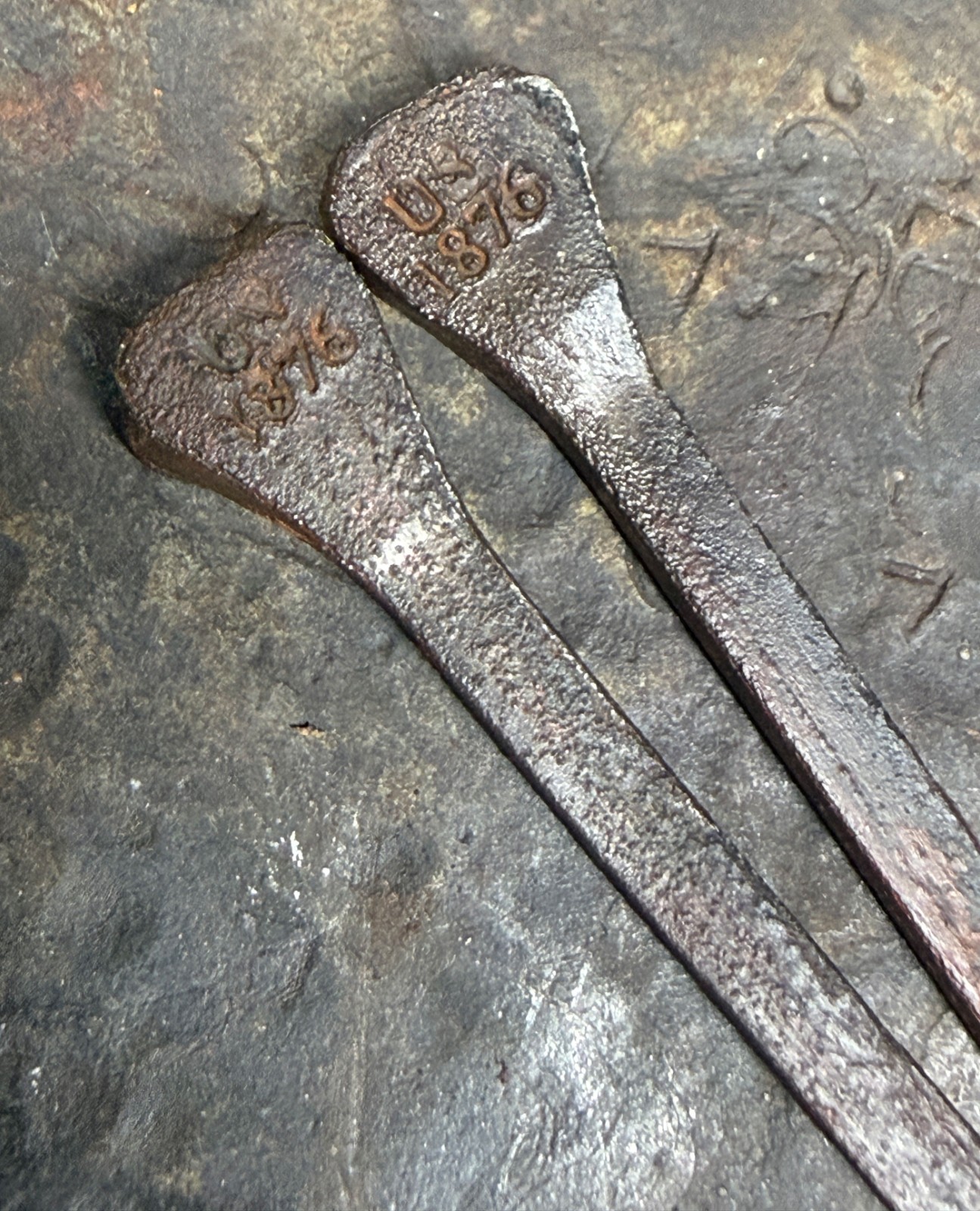
These artifacts were recovered during this survey along the road from Last Stand Hill to the Reno-Benteen defense site. Little Bighorn Battlefield — 2004 Tour Road Mitigation Survey. All nails are marked US 1876. Some are easier to read than others. Condition varies. Here is your chance to own a piece of General Custer history! Each purchase is 2 nails. I randomly grab two nails from the pile and send them. No picking and choosing please.
Battle History
By the morning of June 26, 1876, the Battle of the Little Bighorn had entered its second day. Lieutenant Colonel George A. Custer and five companies of the 7th U.S. Cavalry had already been overwhelmed to the north, though Major Marcus Reno and Captain Frederick Benteen still did not know the fate of their commander. What they did know was that they were surrounded.
The previous afternoon, Reno had led Companies A, G, and M across the Little Bighorn River in an attack against the southern end of the Lakota and Cheyenne village. Hundreds of Lakota and Cheyenne warriors quickly counterattacked, outflanking Reno's command and forcing his men into a defensive position in the timber. As the pressure mounted, Reno ordered a desperate retreat back across the river and up the bluffs. The chaotic withdrawal cost many lives, but the survivors reached the high ground where they joined Captain Frederick Benteen's battalion and the arriving pack train.
Throughout June 26, approximately 350 soldiers, scouts, packers, and civilians held this exposed position against repeated attacks by Lakota, Northern Cheyenne, and Arapaho warriors. The defenders hastily strengthened their line by digging shallow rifle pits and constructing breastworks from rocks, earth, and the bodies of fallen horses. Surgeons worked continuously to care for the wounded while ammunition, food, and medical supplies were carefully rationed.
Water quickly became one of the defenders' greatest challenges. Although the Little Bighorn River flowed below the bluffs, reaching it required descending exposed slopes under enemy fire. Several volunteers repeatedly risked their lives to carry water back to the wounded and exhausted men while everyone prepared for another assault.
The landscape of Reno Hill still reveals the story of both retreat and survival. Looking down the ravines toward the Little Bighorn River, visitors can trace the route Major Reno led Companies A, G, and M as they withdrew from the valley after being overwhelmed by hundreds of Lakota and Cheyenne warriors. The defensive line stretched across these bluffs, where Captain Thomas H. French's M Company initially occupied this sector before being ordered on June 26 to reinforce Captain Frederick Benteen's position. Captain Thomas McDougall's B Company then assumed responsibility for defending this portion of the line for the remainder of the siege.
Late on June 26, the attacks gradually diminished. Having secured one of the greatest victories in Plains Indian history, the Lakota and Cheyenne village broke camp and moved away from the battlefield. The following morning, General Alfred Terry's relief column reached Reno and Benteen's position and confirmed the devastating fate of Custer's command several miles to the north.
Although the Battle of the Little Bighorn is most often remembered as "Custer's Last Stand," the successful defense of Reno and Benteen's position was equally significant. Their determined stand prevented the complete destruction of the 7th U.S. Cavalry and preserved the eyewitness accounts that allow historians to reconstruct one of the most famous battles in the history of the American West. The story of the Little Bighorn is not only one of Custer's defeat, but also of the desperate defense that ensured others survived to tell what happened.
Little Bighorn Battlefield — 2004 Tour Road Mitigation Survey
Report: Scott, D.D. Archeological Mitigation of the Federal Lands Highway Program Plan to Rehabilitate Tour Road, Route 10, Little Bighorn Battlefield National Monument, Montana. NPS Midwest Archeological Center Technical Report No. 94, 2006.
This report's artifact inventory explicitly lists "Horseshoes" as a recovered artifact category alongside tack buckles, tack parts, boot nails, horseshoe nails and other horse-related equipment recovered during close-order metal detecting of the tour road corridor. Over 3000 artifacts were recovered during this survey along the road from Last Stand Hill to the Reno-Benteen defense site.