

|
Site Categories |
|
Featured Items |

Poodle, Spaghetti Trim, Ucagco


|
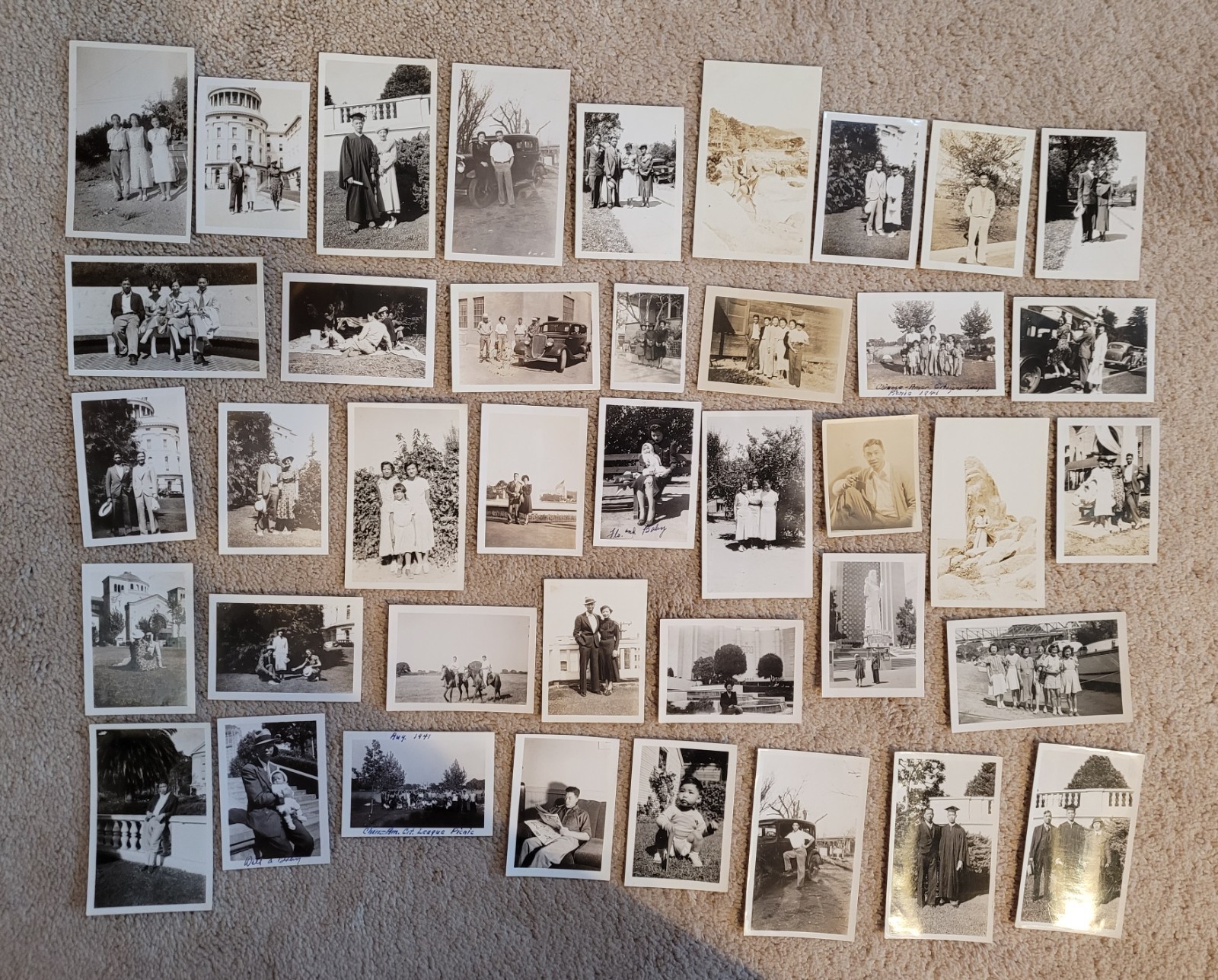
40 Vtg 1930s-40s Chinese American Snapshot Photos | Community Life Picnic League For Sale

When you click on links to various merchants on this site and make a purchase, this can result in this site earning a commission. Affiliate programs and affiliations include, but are not limited to, the eBay Partner Network.

40 Vtg 1930s-40s Chinese American Snapshot Photos | Community Life Picnic League:
$900.00
This is a wonderful collection of 40 historical photographs! The presence of inscriptions like \"Chinese-Am. Lit. League Picnic\" and dates like \"Aug. 1941\" suggests a rich context of Chinese-American community life during the 1930s and 1940s, a time of significant social and political change for the community.
Vintage 1930s-1940s Chinese American Snapshot Photo Collection This is a remarkable collection of approximately 40 original, vintage snapshot photographs documenting the vibrant community life of Chinese Americans in the 1930s and 1940s. These are real-photo paper prints, predominantly small-format, measuring less than 3 x 4 1/2 inches. Historical & Subject Matter Highlights: The collection offers a fascinating glimpse into the lives of Chinese-American families, students, and community members during a pivotal era for Asian Americans in the US. The photographs capture scenes of integration into American society while maintaining strong cultural and community bonds. Subjects include: Community Events: Several photos show large group gatherings, likely picnics or social functions. The most notable is a photo clearly inscribed: \"Chinese-Am. Lit. League Picnic Aug. 1941\". This detail is a significant piece of historical information, pointing to the existence of a literary or social organization during this period. Family Life & Portraits: Candid and posed shots of families, mothers with children (including at least one image with \"Bill and baby\" written on the front), and couples in contemporary American fashion. Automobiles & Travel: Several images feature vintage cars (sedans and what appear to be older Model A/T type vehicles) with groups of people, suggesting outings and an emerging middle-class lifestyle. Education & Milestones: At least two photos show a male graduate in a cap and gown with a young woman, likely documenting a graduation from college or high school. Architecture & Location: Several photos feature grand, columned buildings, possibly universities or institutional settings (one photo with a round, domed building). Another shows a distinctive church or temple-like building. A number of outdoor scenes feature lush, possibly Californian, foliage including palm trees.
Inscriptions & Condition: The majority of photos are in good condition for their age, with slight curling or minor corner wear typical of snapshots stored over decades. Crucially, many are annotated: Front Inscriptions: \"Aug. 1941,\" \"Chinese-Am. Lit. League Picnic,\" \"Bill and baby,\" and a faint signature \"Flo and Bobby\" on another portrait. Back Inscriptions/Stamps (Visible on the Backs Image): Many backs have handwritten numbers or faded stamps, including \"1931\" on one envelope/back, and various three-digit and four-digit codes (\"147A,\" \"505L,\" \"207,\" \"132\") potentially referencing negative or print batch numbers.
This archive provides a valuable primary source for studying Chinese-American history, fashion, and social organizations in the mid-20th century. A perfect find for collectors, historians, and researchers. he search results confirm that the 1930s and 1940s were a period of significant organization and political activism for the Chinese American community, particularly in California. Groups like the Chinese American Citizens Alliance (C.A.C.A.) were highly active, opposing discrimination and advocating for civil rights. The photos capture this community\'s social life during this historically crucial period. Key Historical & Subject Matter Highlights: The collection is a fascinating primary source illustrating the social and educational achievements of a generation of Chinese Americans: Documented Community Event: The most significant photo is clearly inscribed: \"Chinese-Am. Lit. League Picnic Aug. 1941\". While specific records of a \"Chinese-American Literary League\" are not easily found, this photograph provides direct evidence of an active, educated, and well-organized social/literary group within the community during the WWII era, likely based on the West Coast. This inscription dramatically increases the historical value. Education & Milestones: Multiple photos prominently feature a male graduate in a cap and gown, often alongside a female companion. Two clear images show two men in full graduation regalia, emphasizing academic achievement and aspirations. One image clearly shows a figure standing in front of a colossal statue, possibly the iconic \"The Star Maiden\" or \"The Court of Honor Statue\" from the 1939-1940 Golden Gate International Exposition (GGIE) in San Francisco. This would date that specific photograph to 1939 or 1940. Other architectural elements include a distinctive rotunda building (possibly a university hall like a library or museum in California) and a rock formation (possibly at a park or natural landmark).
Family & Social Life: The collection is rich in personal portraits: Posed shots of fashionable young men and women, couples, and families. Candid moments of a large group picnic in a grassy, wooded area. Several images of babies and toddlers, including an inscription for \"Bill and baby\" and another of a child seated outdoors with the caption \"Flo and Bobby\". Group photos with vintage automobiles, symbolizing mobility and prosperity.
Front Inscriptions: \"Aug. 1941,\" \"Chinese-Am. Lit. League Picnic,\" \"Bill and baby,\" and \"Flo and Bobby.\" Back Markings: The backs (as seen in the overview image) are numbered, with some mentioning \"1931\", which helps establish the early 1930s as the starting point for some of these photographs. Condition: Generally good vintage condition, with the expected toning, edge wear, and occasional corner damage typical of original snapshots from the period.
This archive is an incredibly rich and significant find for any collector or historian interested in 20th-century Chinese-American life, social history, education, and the rise of community organizations on the West Coast.
1. The Colossal Statue Photo Location: The Golden Gate International Exposition (GGIE) on Treasure Island, San Francisco. Date of Statue/Fair: The fair ran from 1939 to 1940. The group likely visited during its run, and the photo was later captioned with the date of the picnic or a later gathering. The Statue: The colossal figure is almost certainly \"Pacifica,\" the 80-foot theme statue of the GGIE, created by sculptor Ralph Stackpole.
2. The Rotunda and Columns Photo The collection showcases a Bay Area Chinese-American organization using two of the city\'s greatest international exhibition sites as backdrops for their social gatherings in the era immediately preceding U.S. entry into World War II. Continental Freemasonry or Liberal style Freemasonry[7][8] which has continued to evolve beyond these restrictions, particularly regarding religious belief and political discussion.
Women Freemasonry or Co-Freemasonry,[9][10] which includes organisations that either admit women exclusively (such as the Order of Women Freemasons and the Honourable Fraternity of Ancient Masons in the UK) or accept both men and women (such as Le Droit Humain). Women Freemasonry groups can lean Conservative or Liberal, requiring a religion or not as determined by their Grand Orient.All three traditions have evolved over time from their original forms and can all refer to themselves as Regular[11] and to other Grand Lodges as Irregular. The basic, local organisational unit of Freemasonry is the Lodge. These private Lodges are usually supervised at the regional level by a Grand Lodge or a Grand Orient. There is no international, worldwide Grand Lodge that supervises all of Freemasonry; each Grand Lodge is independent, and they do not necessarily recognise each other as being legitimate.The degrees of Freemasonry are the three grades of medieval craft guilds: Entered Apprentice, Journeyman or Fellow of the craft,[12][13] and Master Mason. The candidate of these three degrees is progressively taught the meanings of the symbols of Freemasonry and entrusted with grips, signs, and words to signify to other members that he has been so initiated. The degrees are part allegorical morality play and part lecture. These three degrees form Craft Freemasonry, and members of any of these degrees are known as Free-Masons,[14] Freemasons or Masons. Once the Craft degrees have been conferred upon a Mason, he is qualified to join various \"Concordant bodies\" which offer additional degrees. These organisations are usually administered separately from the Grand Lodges who administer the Craft degrees. The extra degrees vary with locality and jurisdiction. In addition to these bodies, there are further organisations outside of the more traditional rites of Freemasonry that require an individual to be a Master Mason before they can join.Throughout its history Freemasonry has received criticism and opposition on religious and political grounds. The Catholic Church, some Protestant denominations and certain Islamic countries or entities have expressed opposition to or banned membership in Freemasonry. Opposition to Freemasonry is sometimes rooted in antisemitism or conspiracy theories,[15][16] and Freemasons have been persecuted by authoritarian states.[17][18]
Masonic lodge
Main article: Masonic lodge
Italian lodge at Palazzo Roffia, Florence
Lodge in Palazzo Roffia, Florence, set out for French (Premiere Grand Lodge) ritualThe Masonic lodge is the basic organisational unit of Freemasonry.[19]
Lodge activities and meetingsThe Masonic Lodge meets regularly to conduct various activities. While practices vary by jurisdiction, Rite and local tradition, there are common elements across Freemasonry.[20]In many jurisdictions, Lodges conduct the usual formal business of any small organisation during regular meetings. This includes approving minutes, electing new members, appointing officers and taking their reports, considering correspondence, reviewing bills and annual accounts, and organising social and charitable events.[21]However, some Lodges, Rites and jurisdictions consider an opened Lodge to be a sacred space where profane business activities are strictly forofferden.[22] In these traditions, administrative matters are typically conducted either before the Lodge is formally opened, in a separate business meeting or handled by special committees outside of Lodge meetings.[23]
Depiction of Masons at work in Lodge in the \"three globes Lodge\" in Berlin, circa 1740. Free-Masons can be seen measuring globes and discussing various topics whilst holding masonic instrumentsWhether business is conducted during an opened Lodge or not, all Masonic meetings include ritual work and also educational activities such as: Performing Masonic ceremonies
Conferring Masonic degrees[21]
Receiving lectures on aspects of Masonic history or ritual[24]
Reading of Masonic papers (also called \"Piece of Architecture\" or \"Planche\" in some jurisdictions) - Can be on a wide variety of topics including Masonic, philosophical, technological or personal[25]
Philosophical discussions[26]
Research on a particular topic
Sharing personal Masonic experiences[27]
Proving proficiency to the Lodge to obtain a new degree (also called a wage increase)[28]At the conclusion of the meeting, the Lodge may hold a formal dinner, called Agape[29] or festive board, sometimes involving toasting and song.[30] These meetings are typically held in a Masonic temple, though other venues may occasionally be used.The bulk of Masonic ritual consists of degree ceremonies. Candidates for Freemasonry are progressively initiated into Freemasonry, first in the degree of Entered Apprentice. At some later time, in separate ceremonies, they will be passed to the degree of Fellow Craft; and then raised to the degree of Master Mason. In each of these ceremonies, the candidate must first take the new obligations of the degree, and is then entrusted with secret knowledge including passwords, signs and grips (secret handshakes) confined to his new rank.[31] Although these symbols and gestures are nominally secret, they are readily found in public sources, including those published by Masonic organisations themselves.[32][33]Another ceremony is the annual installation of the Master of the Lodge and his appointed or elected officers.[21] In some jurisdictions, an Installed Master elected, obligated, and invested to preside over a Lodge, is valued as a separate rank with its own secrets and distinctive title and attributes; after each full year in the chair the Master invests his elected successor and becomes a Past Master with privileges in the Lodge and Grand Orient.[34] In other jurisdictions, the grade is not recognised, and no inner ceremony conveys new secrets during the installation of a new Master of the Lodge.[35]Most Lodges have some sort of social functions, allowing members, their partners, and non-Masonic guests to meet openly.[36] Often coupled with these events is the discharge of every Mason\'s and Lodge\'s collective obligation to contribute to charity. This occurs at many levels, including in annual dues, subscriptions, and fundraising events; and may be organised at the local Lodge level, a regional/district level or at the Grand jurisdiction level. Masons and their charities contribute for the relief of need in many fields, such as education, health and old age.[37][38]Private Lodges, which serve as the foundational and most autonomous units within the broader structure of Freemasonry, form the backbone of the fraternity by exercising the exclusive authority to elect their own candidates for initiation as Masons or admission as joining Masons, often operating with localized jurisdictional privileges that may include sole rights over residents in proximity to their premises, thereby reinforcing both the independence and community-based nature of Masonic membership selection. There are non-local Lodges where Masons meet for wider or narrower purposes, such as in association with some hobby, sport, Masonic research, business, profession, regiment or college. The rank of Master Mason also entitles a Freemason to explore Masonry further through other degrees, administered separately from the basic Craft or \"Blue Lodge\" degrees described here, but generally having a similar structure and meetings.[39]There is much diversity and little consistency in Freemasonry because each Masonic jurisdiction is independent and sets its own rules and procedures while Grand Lodges have limited jurisdiction over their constituent member Lodges, which are ultimately private clubs. The wording of the ritual, the number of officers present, the layout of the meeting room, etc. varies from jurisdiction to jurisdiction.[39][40]Almost all officers of a Lodge are elected or appointed annually. Every Masonic Lodge has a Master, two Wardens, a treasurer and a secretary. There is also always a Tyler, or outer guard, outside the door of a working Lodge, who may be paid to secure its privacy. Other offices vary between jurisdictions.[39]Each Masonic Lodge exists and operates according to its own by-laws and the rules and regulations of its own Grand Orient or Grand Lodge, which elude any universally accepted definition and vary depending on the jurisdiction.[41]
Joining a lodge
Worshipful Master George Washington
Print from 1870 portraying George Washington as Master of his LodgeThe process of joining a Masonic lodge follows similar general patterns worldwide while preserving regional and local variations between individual Lodges, Jurisdictions, and traditions. Historically, candidates \"were not to be admitted but by unanimous consent,\" a principle that continues in many lodges today, while some other jurisdictions have developed different systems to counter a potential problematic situation with a single black ball system. Additionally, some Lodges use black cubes instead of black balls to avoid confusion.[42]
Initial approachIn the early days of Freemasonry, one had to be approached and \"co-opted\" to the Fraternity by an existing member but had to do it of his \"own free-will and accord\".[43] This tradition continues in many jurisdictions mainly in Europe, Africa and South America. However, other jurisdictions take an opposite approach, requiring a potential candidate to express an interest before being invited to join. Many obediences now allow those without prior Masonic connections to express interest through online forms or during public events such as Masonic exhibitions and open conferences.[44][45][46]A consistent rule throughout most Jurisdictions worldwide is that Freemasonry is not allowed to blindly recruit members. The prospective candidate must be qualified and either contacted by a member or reach out on his own.In some Lodges the candidate is allowed to meet the members of the lodge they wish to join before being proposed for initiation; this allows all of the members to meet and get an idea of the candidate. While in other Lodges it is strictly prohibited for a non-mason (profane) to meet the members of the Lodge (besides the Master and proposer) before initiation in order to protect the identity of the members.An old masonic term for the brother that proposes a candidate to a Lodge is that he becomes his \'Godfather\' after invitation. This term is found in one of the earliest Masonic exposures \"Reception of a Frey-Macon, 1737\": \"the recipient is led by the Proposer, who becomes his Godfather, into one of the Lodge\'s rooms, where there is no light, & where he is asked if he has the vocation to be received.\"[47]Sponsorship and investigationOnce initial contact is established, the candidate is typically introduced to the lodge through sponsorship, typically by finding two members to sign the petition, the top-line signer becoming the godfather. The sponsor assumes significant responsibility toward the lodge by presenting a non-Mason, evaluating the alignment between the candidate\'s aspirations and Masonic values. This preliminary phase can last from a few months to several years depending on the Lodge and jurisdiction and generally includes several informal meetings to establish mutual trust and clarify expectations.[48]Following this introduction, an investigation is generally started. Candidates can be invited to a series of interviews with various lodge officers or designated members. These meetings, often three in number, examine the candidate\'s profile, motivations, and compatibility with the lodge\'s philosophical orientation. The interviews also allow the candidate to ask questions and develop a clearer understanding of the commitment they are considering.[49]
Formal application and balloting
Variant of the Square and Compasses with the Masonic tripunctual abbreviation in its centreIf both the candidate and the lodge wish to proceed after these preliminary steps, a formal application may be proposed and seconded or announced in open Lodge and a more or less formal interview usually follows. If the candidate wishes to proceed, references are taken up during a period of notice so that members may enquire into the candidate\'s suitability and discuss it.[50]In many Jurisdictions a structured investigation is conducted by three members who do not personally know the candidate. These investigators meet individually with the applicant in different contexts with predetermined questions (or field of questions), examining their moral qualities, philosophical views, and ability to integrate into collective work or their Past, Present/future and Motivations. Each investigator then reports back to the lodge with their impressions, often expressing a favourable or unfavourable opinion. These preliminary interviews help both the lodge members and the candidate better understand each other before proceeding to the next stage.[51]Following these investigations, some individual Lodges, Rites or Jurisdictions can or must implement a significant procedural step known as passing under the blindfold or sometimes the Low Door.[11][52] This is not part of the initiation ceremony itself but rather a formal presentation of the candidate to the assembled lodge prior to any vote on admission. The candidate, blindfolded, is introduced to the lodge and must answer questions posed by the members. While previous investigators have reported the candidate\'s views, this direct questioning allows members to hear directly from the candidate and clarifies any uncertainties that may have arisen during the investigation process. Being blindfolded serves two purposes: it maintains the candidate\'s inability to identify lodge members if not admitted, and it allows the candidate to focus on the questions without being distracted by unfamiliar surroundings. It is only after this procedure that the lodge votes on the candidate\'s admission.[53][49]Finally, the Lodge takes an officially secret ballot on each application before a candidate is either initiated or rejected.[50] This ballot, traditionally using white balls (favourable) and black balls (unfavourable), gave rise to the expression \"blackballed\" to describe rejection. The exact number of adverse ballots (\"blackballs\") required to reject a candidate varies between Masonic jurisdictions.[54]
Eligibility requirementsMasonic jurisdictions maintain various eligibility requirements, which differ significantly between Anglo-American tradition and Liberal traditions:In Anglo-American style Freemasonry, exemplified by the United Grand Lodge of England and its recognised jurisdictions, candidates must typically: Be a man[55]
Be free-born men of mature age (usually 21 years, though some jurisdictions permit 18)[56]
Believe in a supreme being (though interpretation is left to the individual)
Be of good reputation and character[57]
Unmutilated (not followed in most jurisdictions anymore)[58]The question of freedom, a standard feudal requirement of mediaeval guilds, is nowadays one of independence: the object is that every Mason should be a proper and responsible person.[50] Thus, each Grand Lodge has a standard minimum age, varying greatly and often subject to dispensation in particular cases.Additionally, Grand Lodges in this tradition require a candidate to declare a belief in a supreme being (although every candidate must interpret this condition in his own way, as all religious discussion is commonly prohibited).In a few cases, the candidate may be required to be of a specific religion. The form of Freemasonry most common in Scandinavia (known as the Swedish Rite), and the Rectified Scottish Rite for example, only accepts Christians.[59][60]In Liberal style Freemasonry, exemplified by the Grand Orient de France, requirements have evolved to emphasise freedom of conscience, they include:[61] Be free-born of mature age
Be of irreproachable conduct[62]
Be of good reputation and character
No abdication of liberty[63]
No commitment incompatible with reason, honour, free conscience, or the laws of the country.[63]Some obediences have removed the requirement for belief in a supreme being, accepting atheists and agnostics. Many Liberal bodies now accept women, either in mixed-gender lodges or women-only lodges. The emphasis is placed on moral character, philosophical inquiry and commitment to human progress.[64][65]The diverse approaches to these fundamental requirements reflect the philosophical evolution within Freemasonry over time, with bodies following the Anglo-American style maintaining traditional rules (although still evolving) while Liberal traditions have adapted to changing social contexts.[66]After successful passage through the investigation process and favourable vote, the initiation ceremony marks the candidate\'s official entry into Freemasonry.
Progression through degreesThe time between degrees varies considerably across jurisdictions and individual Lodges. Depending on the specific lodge and jurisdictions, progression can be relatively quick—sometimes within a year to multiple years, while it is difficult to establish an average due to the wide ranges of style. Many Grand Lodges or Grand Orients have a minimum of one year in-between degrees. Being passed to the next degree depends on the requirements established by the individual Lodge and jurisdictions. These can include demonstrating proficiency through presentations of Masonic research papers, active participation in the Lodge, memorisation of the ritual or other masonic documents, reading books or even concrete Lodges
Main article: Grand Lodge
Freemason\'s Hall, London
Freemasons Hall, London, home of the United Grand Lodge of England
The Historical Grand Lodge of the Grand Orient de FranceGrand Lodges (sometimes termed Grand Orients) are independent and sovereign bodies that govern Masonry in a given country, state or geographical area (termed a jurisdiction). There is no single overarching governing body that presides over worldwide Freemasonry; connections between different jurisdictions depend solely on mutual recognition.[68][69]Estimates of the worldwide membership of Freemasonry in the early 21st century ranged from about two million to more than six million.[70][better source needed]The fraternity is administratively organised into independent Grand Lodges (or sometimes Grand Orients), each of which governs its own Masonic jurisdiction, which consists of subordinate (or constituent) Lodges.The United Grand Lodge of England (UGLE) remains the largest Masonic jurisdiction worldwide. However, its membership has declined dramatically, from about 500,000 members in the 1960s to approximately 170,000 in 2023.[71][72] The organisation is structured into various Provincial Grand Lodges at the local level. Similarly, the Grand Lodge of Ireland has experienced a steep decline, with membership falling from 100,000 in 1960 to around 19,000 members currently.[73]In the United States Masonic membership is organised in two systems, first through 51 “mainstream” Grand Lodges—one for each state plus the District of Columbia. While these Grand Lodges once boasted over 4 million members in 1957, membership has declined sharply. According to the Masonic Service Association of North America, current combined membership across these jurisdictions stands at approximately 875,000 members.[74]Additionally, there are 46 Prince Hall Grand Lodges in amity with UGLE, operating across various US states, as well as multiple Prince Hall style Grand Lodges that split off from the recognised group. Prince Hall Freemasonry is a historically African-American branch of Freemasonry that maintains its own separate Grand Lodge system parallel to the state Grand Lodge system.[75]Together these two systems—the “mainstream” Grand Lodges and Prince Hall Grand Lodges—make up for a total of 97 UGLE recognised Grand Lodges, sharing jurisdictions in the United States. They represent the main bodies of Masonic governance in the United States, though both have experienced significant membership declines since their mid-20th-century peaks.[76]In France the Grand Orient de France stands as the largest and most influential body in Liberal Freemasonry, with over 53,000 members across approximately 1,381 lodges. Unlike many Anglo-American jurisdictions that have experienced significant membership declines, the Grand Orient has demonstrated remarkable growth, increasing from 33,000 members in 1960 to 53,000 in 2023. This growth reflects the enduring appeal of its Liberal philosophical approach, which emphasises freedom of conscience, social progress, and intellectual inquiry. The Grand Orient has been particularly influential in French political and intellectual life, championing principles of secularism, democracy, and human rights throughout its history.[77]
Grand Lodges and Grand OrientsThere is no fundamental difference between a Grand Orient and a Grand Lodge; they are simply different terminologies for the same type of institution. The term \"Grand Orient\" was first popularised in 1773 when the Grand Lodge of France voted to rename itself the Grand Orient de France. The word \"Orient\" means \"East\" in Latin.[78]Both Grand Orients and Grand Lodges exist in all Masonic traditions, whether Liberal or Anglo-American. For example, the United Grand Lodge of England (an Anglo-American Masonic tradition) recognises the Grand Orient of Italy,[79] while the Grand Orient de France (a Liberal Masonic tradition) recognises the Grand Lodge of Italy.[80]
Recognition, amity and regularityRelations between Grand Lodges are determined by the concept of Recognition. Each Grand Lodge or Grand Orient maintains a list of other Grand Orients or Grand Lodges that it recognises.[81] When two Grand Lodges recognise and are in Masonic communication with each other, they are said to be in amity, and the brethren of each may visit each other\'s Lodges and interact Masonically. When two Grand Lodges are not in amity, inter-visitation is not allowed. There are many reasons one Grand Lodge will withhold or withdraw recognition from another, but the two most common are Exclusive Jurisdiction and Regularity.[82]
Exclusive jurisdictionExclusive Jurisdiction is a concept whereby normally only one Grand Lodge will be recognised in any geographical area. If two Grand Lodges claim jurisdiction over the same area, the other Grand Lodges will have to choose between them, and they may not all decide to recognise the same one. (In 1849, for example, the Grand Lodge of New York split into two rival factions, each claiming to be the legitimate Grand Lodge. Other Grand Lodges had to choose between them until the schism was healed.[11][83]) Exclusive Jurisdiction can be waived when the two overlapping Grand Lodges are themselves in amity and agree to share jurisdiction. For example, since the Grand Lodge of Connecticut is in amity with the Prince Hall Grand Lodge of Connecticut, the principle of Exclusive Jurisdiction does not apply, and other Grand Lodges may recognise both.[84] Likewise, the five distinct kinds of lodges in Germany have nominally united under one Grand Lodge in order to obtain international recognition.
Modern challenges and evolutionThe concept of Exclusive Jurisdiction has been significantly challenged in the United States with the increasing recognition of Prince Hall Grand Lodges, a branch of Freemasonry created for African Americans. Historically, many \"mainstream\" or Anglo-American US Grand Lodges refused to recognise Prince Hall Grand Lodges operating in their states, citing Exclusive Jurisdiction. However, this began to change in 1989 when the Grand Lodge of Connecticut extended recognition to its Prince Hall counterpart.[85][86]This initial recognition created a precedent for \"shared jurisdiction\" between mainstream and Prince Hall Grand Lodges, effectively modifying the traditional interpretation of Exclusive Jurisdiction. By 2024 most US Grand Lodges have recognised their Prince Hall counterparts, establishing a new norm where two Grand Lodges can legitimately operate within the same geographical area, provided they maintain mutual recognition and amity.[87]The evolution of this practice demonstrates how traditional Masonic principles can adapt to accommodate social progress while maintaining the fundamental aims of regular Freemasonry. Some jurisdictions have formalised this arrangement through written agreements that specifically outline the terms of shared jurisdiction.[88][89]
Regularity and Recognition Systems
Main article: Regular Masonic jurisdictions
Origins of the concept
First Freemason\'s Hall, 1809
Freemasons\' Hall in London, c. 1809The concept of \"regularity\" originated before the divide between Anglo-American and Liberal Freemasonry existed, first appearing in Payne\'s regulations as printed in Anderson\'s Constitutions. Regulation VIII reads: If any Set or Number of Masons shall take upon themselves to form a Lodge without the Grand-Master\'s Warrant, the regular Lodges are not to countenance them, or own them as fair Brethren and duly form\'d, nor approve of their Acts and Deeds; but must treat them as Rebels, until they humble themselves, as the Grand-Master shall in his Prudence direct, and until he approve of them by his Warrant, which must be signify\'d to the other Lodges, as the Custom is when a new Lodge is to be register\'d in the List of Lodges.[90]This early recognition system was used to determine whether a Lodge was trustworthy and not fraudulent, rather than to enforce doctrinal conformity.
Liberal and Anglo-American Recognition Systems
Interior of the Les Amis Philanthropes Liberal Masonic temple in Brussels, Grand Orient de BelgiqueBoth Liberal and Anglo-American traditions have developed their own interpretations of regularity, each evolving over time despite differing philosophical foundations. The modern understanding of these concepts crystallised after the 1877 constitutional reforms of the Grand Orient de France (GOdF), which embraced absolute freedom of conscience and removed mandatory belief in a Supreme Being.[91][92]
Anglo-American landmarks and their evolutionAnglo-American Freemasonry, exemplified by the United Grand Lodge of England (UGLE), bases its concept of regularity on adherence to \"landmarks\"—fundamental principles considered essential to Masonic identity. While often presented as immutable, these landmarks have undergone significant reinterpretation over time.[93]The religious requirement, initially revolutionary in the early 1700s for being strictly for Christians but welcoming all denominations during an era of sectarian strife, has gradually expanded. It evolved first to include all religions with a revealed scripture and the resurrection of the body after life, then to accept belief in any supreme being, and increasingly allows more personalised interpretations of spirituality whilst maintaining the requirement for some form of metaphysical belief.[94][95]Similarly, the principle of exclusive territorial jurisdiction has evolved in the United States, where many states now share jurisdiction between Prince Hall and mainstream Grand Lodges—a significant departure from historical practice.[89]Perhaps most telling is the evolution regarding women in Freemasonry. The UGLE, whilst maintaining gender separation within its own Lodges, formally acknowledged in 1999 that \"Freemasonry is not confined to men\" and recognised the legitimacy of women\'s Masonic orders, though without permitting intervisitation.[96] The UGLE now engages in collaborative charitable projects with women\'s Masonic organisations, representing a significant evolution from earlier positions that denied women could be legitimate Freemasons at all.No universal landmarks exist within Freemasonry. Each Grand Lodge or Grand Orient maintains its own set of Landmarks, with some bodies not codifying any specific landmarks whatsoever.[97] The practical reality of Masonic recognition hinges not on universal agreement about landmarks, but rather on ensuring that no recognised body violates the landmark principles held dear by the recognising jurisdiction. Within Anglo-American Freemasonry the shared rules for Recognition vary considerably, shaped by the particular Masonic tradition each Grand Lodge embraces. Three landmark systems have gained particular prominence within Masonic jurisprudence: the 1929 United Grand Lodge of England landmarks, which focus on governance and practical recognition requirements;[98] Albert Mackey\'s extensive 1858 catalogue of twenty-five landmarks, which comprehensively delineates administrative structures and principles;[99] and Roscoe Pound\'s streamlined 1911 approach, which distils Masonic landmarks to seven essential philosophical elements.[100]
Comparison of Major Masonic Landmark Systems Aspect UGLE (1929) Albert Mackey (1858) Roscoe Pound (1911)
Number of Landmarks 8 25 7
Religious Requirements Belief in a supreme being is required; scripture required on altar Belief in a supreme being and the resurrection required; book of law required on altar Belief in God; belief in persistence of personality; book of law required on altar
Gender Policy Exclusively male; no relationship with mixed Lodges Exclusively male; \"free born and of mature age\" Must be a man, free born, and of age
Governance Structure Grand Lodge has sovereign jurisdiction over Craft degrees Government by Grand Master; specific rights and prerogatives of Grand Master; Lodge governance by Master and Wardens Not specified as landmarks (considered customary law)
Core Principles No discussion of politics or religion; adherence to ancient landmarks, customs and usages Modes of recognition; secrecy; three degrees; Hiramic legend; equality of Masons; foundation in operative art Legend of third degree; secrecy; symbolism of operative artAs can be seen from this comparison, while there are common elements across all three landmark systems (belief in Deity, male-only membership, symbolic/speculative nature), there are significant differences in scope, detail, and emphasis. The UGLE system focuses primarily on governance and recognition requirements, Mackey\'s extensive list includes detailed administrative prerogatives, while Pound\'s streamlined approach emphasises the philosophical essentials.
Liberal landmarks and philosophical foundationsLiberal Freemasonry approaches regularity through a fundamentally different lens, tracing its philosophical foundations to earlier Masonic documents such as the Constitution of the Freemasons of Strasbourg in 1459,[101] which predates Anderson\'s Constitutions by over 250 years. Rather than viewing landmarks as fixed and immutable, Liberal Masonry sees them as principles open to democratic debate and evolutionary interpretation.The Grand Orient de France (GOdF), established in 1723 and renamed in 1773, serves as the gold standard in Liberal Masonic recognition. Recognition by the GOdF represents a significant achievement for any Grand Orient or Grand Lodge within the Liberal Masonic community, affirming their commitment to the principles of freedom of conscience and universal brotherhood. The GOdF maintains recognition agreements with Masonic bodies worldwide based on shared philosophical principles rather than adherence to particular core principles or landmarks.By contrast, Liberal Masonic bodies typically employ recognition criteria centred on:[102][103] Adherence to the principle of freedom of conscience (liberté de conscience), a core value established in the GOdF\'s landmark 1877 constitutional reform[104]
Commitment to the advancement of humanity through reason, justice, and fraternity
Independence from religious dogma or political control
Open examination of philosophical, social, and ethical questions
Recognition of the equality and autonomy of all Masonic bodies
Respect for the diversity of Masonic traditions and practices
Democratic governance with regular assemblies where policy is determined by voteThese principles reflect the Enlightenment values that informed early Freemasonry, emphasising human reason, freethought, progressive social engagement, and intellectual liberty.Furthermore, the Grand Orient de France famously describes what Freemasonry is in the first article of its constitution, deviation from these principles could lead a Grand Lodge to become un-recognised by the GOdF :[105] Freemasonry, an essentially philanthropic, philosophical and progressive institution, has for its object the search for truth, the study of morality and the practice of solidarity; it works for the material and moral improvement, the intellectual and social perfection of humanity. Its principles are mutual tolerance, respect for others and for oneself, and absolute freedom of conscience. Considering metaphysical conceptions as being exclusively within the domain of individual judgment of its members, it refuses all dogmatic affirmation. It attaches fundamental importance to secularism. Its motto is: Liberty, Equality, Fraternity.International Recognition NetworksBoth traditions have established complex international networks to facilitate recognition and cooperation. Many Liberal Grand Lodges participate in CLIPSAS, which adheres to less stringent recognition requirements than Anglo-American bodies. Founded in 1961 by eleven sovereign Masonic bodies, CLIPSAS has grown to include over 100 member obediences worldwide.[106] Though CLIPSAS\'s influence was challenged by the GOdF\'s withdrawal in 2019, it remains significant in facilitating Liberal Masonic relations globally. Other important Liberal Masonic international organisations include TRACIA (coordinating Liberal bodies across Europe and Latin America)[107] and UMM (uniting Mediterranean Masonic bodies).[108]Anglo-American Freemasonry operates primarily through bilateral recognition between Grand Lodges, with the UGLE, Grand Lodge of Scotland, and Grand Lodge of Ireland (collectively known as the \"Home Grand Lodges\") having particular influence within this system. The Conference of Grand Masters of North America provides another forum for Anglo-American Masonic cooperation, though without the formal recognition powers of CLIPSAS in the Liberal tradition.[109]
Other degrees, orders and bodies
See also: Masonic bodies and List of Masonic ritesBlue Lodges, known as Craft Lodges in the United Kingdom, offer only the three traditional degrees. In most jurisdictions, the rank of past or installed master is also conferred in Blue/Craft Lodges. Master Masons are able to extend their Masonic experience by taking further degrees, in concordant or other bodies whether or not approved by their own Grand Lodge.[citation needed][110]The Ancient and Accepted Scottish Rite is a system of 33 degrees, including the three Blue Lodge degrees administered by a local or national Supreme Council. This system is popular in North America, South America and in Continental Europe. In America the York Rite, with a similar range, administers three orders of Masonry, namely the Royal Arch, Cryptic Masonry and Knights Templar.[111]In Britain separate bodies administer each order. Freemasons are encouraged to join the Holy Royal Arch, which is linked to Mark Masonry in Scotland and Ireland, but completely separate in England. In England the Royal Arch is closely associated with the Craft, automatically having many Grand Officers in common, including Prince Edward, Duke of Kent, as both Grand Master of the Craft and First Grand Principal of the Royal Arch. The English Knights Templar and Cryptic Masonry share the Mark Grand Lodge offices and staff at Mark Masons\' Hall, London.[112] The Ancient and Accepted Rite (similar to the Scottish Rite), requires a member to proclaim the Trinitarian Christian faith, and is administered from Duke Street in London.[113] Conversely, the Societas Rosicruciana in Anglia is a fully independent esoteric organisation that requires members be United Grand Lodge of England Master Masons.In the Nordic countries the Swedish Rite is dominant; a variation of it is also used in parts of Germany.
Ritual and symbolism
Main article: Masonic ritual and symbolism
The Ottoman noble Ahmad Nami dressed in full Masonic attire in 1925
Freemasonry structure showing the symbols associated with the organisation
Part of a series on
Esotericism
Esoteric symbolism
Key conceptsRitesSocieties
Notable figuresRelated topics vteFreemasonry describes itself as a \"beautiful system of morality, veiled in allegory and illustrated by symbols\".[114] The symbolism is mainly, but not exclusively, drawn from the tools of stonemasons—the square and compasses, the level and plumb rule, the trowel, the rough and smooth ashlars, among others. Moral lessons are attributed to each of these tools, although the assignment is by no means consistent. The meaning of the symbolism is taught and explored through ritual,[39] and in lectures and articles by individual Masons who offer their personal insights and opinions.According to the scholar of Western esotericism Jan A. M. Snoek: \"the best way to characterize Freemasonry is in terms of what it is not, rather than what it is\".[115] All Freemasons begin their journey in the \"craft\" by being progressively \"initiated\", \"passed\" and \"raised\" into the three degrees of Craft, or Blue Lodge Masonry. During these three rituals, the candidate is progressively taught the Masonic symbols, and entrusted with grips or tokens, signs, and words to signify to other Masons which degrees he has taken. The dramatic allegorical ceremonies include explanatory lectures and revolve around the construction of the Temple of Solomon, and the artistry and death of the chief architect, Hiram Abiff. The degrees are those of \"Entered apprentice\", \"Fellowcraft\" and \"Master Mason\". While many different versions of these rituals exist, with various lodge layouts and versions of the Hiramic legend, each version is recognisable to any Freemason from any jurisdiction.[39]In some jurisdictions, the main themes of each degree are illustrated by tracing boards. These painted depictions of Masonic themes are exhibited in the lodge according to which degree is being worked and are explained to the candidate to illustrate the legend and symbolism of each degree.[116]The idea of Masonic brotherhood probably descends from a 16th-century legal definition of a \"brother\" as one who has taken an oath of mutual support to another. Accordingly, Masons swear at each degree to support and protect their brethren.[117] In most Lodges, the oath or obligation is taken on a Volume of Sacred Law, whichever book of divine revelation is appropriate to the religious beliefs of the individual brother (usually the Bible in the Anglo-American tradition). In Progressive continental Freemasonry, books other than scripture are permissible, a cause of rupture between Grand Lodges.[118]
History
Main article: History of Freemasonry
OriginsSince the middle of the 19th century, Masonic historians have sought the origins of the movement in a series of similar documents known as the Old Charges, dating from the Regius Poem in about 1425[119] to the beginning of the 18th century. Alluding to the membership of a lodge of operative masons[clarification needed], they relate it to a mythologised history of the craft, the duties of its grades, and the manner in which oaths of fidelity are to be taken on joining.[120] The 15th century also sees the first evidence of ceremonial regalia.[121]There is no clear mechanism by which these local trade organisations became today\'s Masonic Lodges. The earliest rituals and passwords known, from operative lodges around the turn of the 17th–18th centuries, show continuity with the rituals developed in the later 18th century by accepted or speculative Masons, as those members who did not practice the physical craft gradually came to be known.[122] The minutes of the Lodge of Edinburgh (Mary\'s Chapel) No. 1 in Scotland show a continuity from an operative lodge in 1598 to a modern speculative Lodge.[123] It is reputed to be the oldest Masonic Lodge in the world.[124]
Royal Arch Chapter in England, beginning of c20
View of room at the Masonic Hall, Bury St Edmunds, Suffolk, England, early 20th century, set up for a Holy Royal Arch convocationAlternatively, in 1803 German professor J. G. Buhle put forward the theory that Freemasonry may have been an outgrowth of Rosicrucianism,[125][126] an idea taken up by Thomas De Quincey.The first Grand Lodge, the Grand Lodge of London and Westminster, later called the Grand Lodge of England, was founded on St John\'s Day, 24 June 1717,[127] when four existing London Lodges met for a joint dinner. Over the next decade, most of the existing Lodges in England joined the new regulatory body, which itself entered a period of self-publicity and expansion. New lodges were created, and the fraternity began to grow.Over the course of the 18th century, as aristocrats and artists crowded out the craftsmen originally associated with the organisation, Freemasonry became fashionable throughout Europe and the American colonies.[128][129]Between 1730 and 1750 the Grand Lodge endorsed several significant changes that some Lodges could not endorse. A rival Grand Lodge was formed on 17 July 1751, which called itself the \"Antient Grand Lodge of England\" to signify that, in their opinion, these lodges were maintaining older traditions and rejected changes that the Premiere Grand Lodge had adopted. As an insult, the self proclaimed \"Antient Grand Lodge\" coined the term \"modern\" to designate the Premiere Grand Lodge (historians now use Premiere Grand Lodge and Antient Grand Lodge – to differentiate the two bodies).[130] These two Grand Lodges vied for supremacy until the Premiere Grand Lodge made a compromise with the antient Grand Lodge to return to a ritual that worked for both Grand Lodges. They re-united on 27 December 1813 to form the United Grand Lodge of England.[131][132]The Grand Lodge of Ireland and the Grand Lodge of Scotland were formed in 1725 and 1736, respectively, although neither persuaded all of the existing lodges in their countries to join for many years.[133][134]
18th-century Enlightenment
Goose and Gridiron, where the Grand Lodge of London and Westminster, later called the Grand Lodge of England, was foundedDuring the Age of the Enlightenment in the 18th century, Freemasons comprised an international network of like-minded men, often meeting in secret in ritualistic programs at their lodges. They promoted the ideals of the Enlightenment and helped diffuse these values across Britain and France and other places. British Freemasonry offered a systematic creed with its own myths, values and set of rituals. It fostered new codes of conduct—including a communal understanding of liberty and equality inherited from guild sociability—\"liberty, fraternity, and equality.\"[135] Scottish soldiers and Jacobite Scots brought to the Continent ideals of fraternity which reflected not the local system of Scottish customs but the institutions and ideals originating in the English Revolution against royal absolutism.[136] Freemasonry was particularly prevalent in France—by 1789, there were between 50,000 and 100,000 French Masons, making Freemasonry the most popular of all Enlightenment associations.[137]Jacob argues that Masonic lodges probably had an effect on society as a whole, for they \"reconstituted the polity and established a constitutional form of self-government, complete with constitutions and laws, elections and representatives\". In other words, the micro-society set up within the lodges constituted a normative model for society as a whole. This was especially true on the Continent: when the first lodges began to appear in the 1730s, their embodiment of British values was often seen as threatening by state authorities. For example, the Parisian lodge that met in the mid-1720s was composed of English Jacobite exiles.[138] Furthermore, freemasons all across Europe made reference to the Enlightenment in general in the 18th century. In French lodges, for example, the line \"As the means to be enlightened I search for the enlightened\" was a part of their initiation rites. British lodges assigned themselves the duty to \"initiate the unenlightened\". Many lodges praised the Grand Architect, the masonic terminology for the divine being who created a scientifically ordered universe.[139]On the other hand, the historian Robert Roswell Palmer noted that lodges operated separately and Masons politically did not act together as a group.[140] American historians note that Benjamin Franklin and George Washington were leading Masons, but the significance of Freemasonry in the revolution is a topic of debate.[141] Daniel Roche contests freemasonry\'s claims for egalitarianism, writing that \"the real equality of the lodges was elitist\", only attracting men of similar social backgrounds.[142]In long-term historical perspective, Norman Davies has argued that Freemasonry was a powerful force in Europe from about 1700 to the twentieth century. It expanded rapidly during the Age of Enlightenment, reaching practically every country in Europe, as well as the European colonies in the New World and Asia. Davies states, \"In the nineteenth century and beyond it would be strongly associated with the cause of Liberalism.\"[143] In Catholic lands it was anti-clerical and came under heavy attack from the Catholic Church. In the 20th century, it was suppressed by Fascist and Communist regimes. It was especially attractive to royalty, aristocrats, politicians and businessmen, as well as intellectuals, artists and political activists. Davies notes that prominent members included Montesquieu, Voltaire, Sir Robert Walpole, Wolfgang Amadeus Mozart, Johann Wolfgang von Goethe, Benjamin Franklin and George Washington.[144] Steven Bullock notes that in the late 18th century, English lodges were headed by the Prince of Wales, Prussian lodges by King Frederick the Great, and French lodges by royal princes. Napoleon as Emperor of the French selected his own brother as the Grand Master of France.[145]
Emergence of Continental or Liberal Freemasonry
Main article: Continental Freemasonry
Masonic initiation, Paris, 1745
Masonic initiation, Paris, 1745English Freemasonry spread to France in the 1720s, first as lodges of expatriates and exiled Jacobites, and then as distinctively French lodges that still follow the ritual of the Premier Grand Lodge of England. From France and England, Freemasonry spread to most of Continental Europe during the course of the 18th century. The Grande Loge de France was formed under the Grand Mastership of the Duke of Clermont, who exercised only nominal authority. His successor, Louis Philippe II, Duke of Orléans, reconstituted the central body as the Grand Orient de France in 1773. Briefly eclipsed during the French Revolution, French Freemasonry continued to grow in the next century,[146] at first under the leadership of Alexandre Francois Auguste de Grasse, Comte de Grassy-Tilly.
France
Further information: Freemasonry in FranceIn the 18th century liberal French politicians met together in Masonic lodges to develop some of the Enlightenment ideas that dominated the French Revolution of 1789.[147] Avner Halpern has traced French Freemasonry\'s major role in building France\'s first modern political party in 1901, the Radical Party. It used two Masonic devices: the \"civil leadership model\", which Freemasonry developed in late 19th century France, and the local Masonic congresses of the Grand Orient of France federations.[148]
Russia
Further information: History of Freemasonry in RussiaFreemasons had been active in Russia in the 18th century, working to introduce Enlightenment ideals; however, they were increasingly suppressed by the government.[149] According to Ludwick Hass, Freemasonry was officially illegal in Tsarist Russia, but would later be introduced by exiles who returned after the 1905 revolution. These individuals had been active Masons in Paris, where lodges were politically active in the new Radical Party. In Russia, the Freemasons supported constitutional liberalism and maintained ties with France while simplifying many of the ceremonial rituals. Their secret meetings became a centre of progressive ideals, attracting politicians and activists. The lodges initially supported World War I, promoting close ties with France. The liberal activist Alexander Kerensky, who came to political power with the overthrow of the tsars in 1917, was a Mason. The organisation collapsed as the Bolsheviks took power and was again outlawed.[150]
Italy
Further information: Freemasonry in ItalyAccording to Adrian Lyttelton, in the early 20th century, Freemasonry was an influential but semi-secret force in Italian politics; with a strong presence among professionals and the middle class across Italy, its appeal spread to the leadership of the parliament, public administration, and the army. The two main organisations were the Grand Orient and the Grand Lodge of Italy. They had around 25,000 members in some 500 lodges. Politically, they promoted Italian nationalism, focused on unification, and undermining the power of the Catholic Church. The Catholic Church was a vigorous opponent of unification, and thus of the Freemasons; various national governments would repeatedly alternate and backpedal between the anticlerical side and the Church side.[151] Freemasons took on the challenge of mobilising the press, encouraging public opinion and the leading political parties in support of Italy\'s joining of the Allies of the First World War in 1914–1915. In 1919 they favoured a League of Nations to promote a new post-war, universal order based upon the peaceful coexistence of independent and democratic nations.[152] In the early 1920s, many of Mussolini\'s collaborators, especially the leaders in organising the March on Rome, were Masons. The lodges hailed fascism as the saviour of Italy from Bolshevism; however, Mussolini decided he needed to come to terms with the Catholic Church, in the mid-1920s, outlawing Freemasonry.[153]
North America
Erasmus James Philipps, first Freemason in present-day Canada, Old Burying Ground (Halifax, Nova Scotia)The earliest known American lodges were in Pennsylvania. The collector for the port of Pennsylvania, John Moore, wrote of attending lodges there in 1715, two years before the putative formation of the first Grand Lodge in London. The Grand Lodge of England appointed a Provincial Grand Master for North America in 1731, based in Pennsylvania,[154] leading to the creation of the Grand Lodge of Pennsylvania.In Canada Erasmus James Philipps became a Freemason while working on a commission to resolve boundaries in New England and, in 1739 he became provincial Grand Master for Nova Scotia; Philipps founded the first Masonic lodge in Canada at Annapolis Royal, Nova Scotia.[155]Other lodges in the colony of Pennsylvania obtained authorisations from the later Antient Grand Lodge of England, the Grand Lodge of Scotland and the Grand Lodge of Ireland, which was particularly well represented in the travelling lodges of the British Army.[156][157] Many lodges came into existence with no warrant from any Grand Lodge, applying and paying for their authorisation only after they were confident of their own survival.[158]After the American Revolution independent US Grand Lodges developed within each state. Some thought was briefly given to organising an overarching \"Grand Lodge of the United States\", with George Washington, who was a member of a Virginian lodge, as the first Grand Master, but the idea was short-lived. The various state Grand Lodges did not wish to diminish their own authority by agreeing to such a body.[159]On 30 April 1789 Washington took his oath of office at his first inauguration upon a Bible belonging to St. John\'s Lodge No. 1 of New York.[160] Robert Livingston, Chancellor of the State of New York, also the first Grand Master of the Grand Lodge of Free and Accepted Masons of the State of New York, administered the oath.[161]
Prince Hall Freemasonry
Main article: Prince Hall FreemasonryPrince Hall Freemasonry exists because of the refusal of early American lodges to admit African Americans. In 1775, an African American named Prince Hall,[162] along with 14 other African American men, was initiated into a British military lodge with a warrant from the Grand Lodge of Ireland, having failed to obtain admission from the other lodges in Boston. When the British military Lodge left North America after the end of the Revolutionary War, those 15 men were given the authority to meet as a Lodge, but not to initiate Masons. In 1784, these individuals obtained a Warrant from the Grand Lodge of England (Premiere Grand Lodge) and formed African Lodge, Number 459. When the two English grand lodges united in 1813, all U.S.-based Lodges were stricken from their rolls—largely because of the War of 1812. Thus, separated from both English jurisdiction and any concordantly recognised U.S. Grand Lodge, African Lodge retitled itself as the African Lodge, Number 1—and became a de facto Grand Lodge. (This lodge is not to be confused with the various Grand Lodges in Africa.) As with the rest of US Freemasonry, Prince Hall Freemasonry soon grew and organised on a Grand Lodge system for each state.[163]Unlike other fraternal orders, there was never any blanket rule against the admission of men based on their race. Each lodge and grand lodge had their own rules, both written and unwritten. A few non-Prince Hall lodges did admit Blacks, with Angelo Soliman being one notable Masonic personality of African descent. Nonetheless, widespread racial segregation in 19th- and early-20th-century North America made it difficult for African Americans to join Lodges outside of Prince Hall jurisdictions.[citation needed]Today most (but not all) US Grand Lodges recognise their Prince Hall counterparts, and the authorities of both traditions are working towards full recognition.[164] The United Grand Lodge of England has no problem with recognising Prince Hall Grand Lodges.[165] While celebrating their heritage as lodges of African Americans, Prince Hall is open to all men regardless of race or religion.[166]
Latin America and Caribbean
Further information: Freemasonry in Latin America
Jamaican FreemasonryFreemasonry was imported to Jamaica by British settlers. In 1908 there were eleven recorded Masonic lodges, which included three Grand Lodges, two Craft lodges, and two Rose Croix chapters.[167] During slavery, the lodges were open to all \"freeborn\" men. After the full abolition of slavery in 1838, the Lodges were open to all Jamaican men of any race.[168] Jamaica also kept close relationships with Masons from other countries. Jamaican Freemasonry historian Jackie Ranston noted that: Jamaica served as an arms depot for the revolutionary forces when two Kingston Freemasons, Wellwood and Maxwell Hyslop, financed the campaigns of Simón Bolívar, the Liberator, to whom six Latin American Republics owe their independence\". Bolívar himself was a Mason, enjoying contacts with Brethren in Spain, England, France, and Venezuela until after gaining power in Venezuela, he prohibited all secret societies in 1828 and included the Freemasons.[168]The Spanish government outlawed Freemasonry in its overseas empire in the mid-18th century, and energetically enforced the ban. Nevertheless, many Freemasons were active in planning and plotting for independence.[169] Leaders with Freemason membership included Simón Bolivar, Grand Master Francisco de Miranda, José de San Martin, Bernardo O\'Higgins and many others.[170] The movement was important after independence was achieved in the 1820s.[171] In Brazil many prominent men were Freemasons, and they played a leading role in the abolition of slavery.[172]
MexicoFreemasons were leaders in liberalism and anticlericalism in 19th and 20th-century Mexico. Members included numerous top leaders.[173] The Freemasons were divided regarding relations with the United States, with a pro-U.S. faction supported by the American ambassador Joel Poinsett known as the \"Yorkinos\".[174][175] According to the historian Karen Racine, Freemasons in the presidency of Mexico included: Guadalupe Victoria, Valentín Gómez Farías, Antonio López de Santa Anna, Benito Juárez, Sebastián Lerdo de Tejada, Porfirio Díaz, Francisco I. Madero, Venustiano Carranza, Plutarco Elías Calles, Lázaro Cárdenas, Emilio Portes Gil, Pascual Ortiz Rubio, Abelardo L. Rodríguez and Miguel Alemán Valdés.[176]
Freemasonry in the Middle East
Further information: Freemasonry in the Middle EastAfter the failure of the 1830 Italian revolution, a number of Italian Freemasons were forced to flee. They secretly set up an approved chapter of Scottish Rite in Alexandria, a town already inhabited by a large Italian community. Meanwhile, the French Freemasons publicly organised a local chapter in Alexandria in 1845.[177] During the 19th and 20th century, Masonic lodges operated widely across all parts of the Ottoman Empire and numerous Sufi orders shared a close relationship with them. Many Young Turks affiliated with the Bektashi Order were members and patrons of Freemasonry. They were also closely allied against European imperialism. Many Ottoman intellectuals believed that Sufism and Freemasonry shared close similarities in doctrines, spiritual outlook and lodge in Asansol, India founded in 1873The first lodge formed in China was the Amity Lodge which constituted at Canton in 1767. In 1875, District Grand Lodge of China split into two Districts, Northern China, and Hong Kong and South China. During the second world war, All Masonic activity in Hong Kong was brought to a halt due to the Japanese invasion. After 1949, when the new Chinese government (Communist) was established, some lodges moved to Hong Kong or closed due to lack of new candidates.[179] Freemasonry is currently outlawed by the Chinese Communist Party in mainland China. It is permitted in Hong Kong. Freemasonry survived on the island of Taiwan and the Grand Lodge of China is based in Taipei.[180] Royal Sussex Lodge No. 501 was the first lodge established in Victoria City of Hong Kong on 29 April 1844. There are 20 (English Constitution) lodges under the District Grand Lodge of Hong Kong and Far East, United Grand Lodge of England that meet at Zetland Hall.[181]
Schisms
Racial schismThe relationship between English and French Freemasonry changed significantly during the formation of the United Grand Lodge of England in 1813. While the two jurisdictions maintained mutual recognition for several decades, events in the 1860s and 1870s led to a lasting division. In 1868 the Supreme Council of the Ancient and Accepted Scottish Rite of the State of Louisiana established itself within the jurisdiction of the Grand Lodge of Louisiana. This body was recognised by the Grand Orient de France but considered irregular by the Grand Lodge of Louisiana because it admitted Black members. The following year, shocked by the Grand Lodge of Louisiana\'s discrimination practices, the Grand Orient de France clarified and cemented its positions by passing a resolution declaring that \"neither colour, race, nor religion could disqualify a man from Masonry\". This prompted the Grand Lodge of Louisiana to withdraw recognition and influenced other American Grand Lodges to do the same.[182]
Theological schismA philosophical debate during the Lausanne Congress of Supreme Councils of 1875 led the Grand Orient de France to examine its foundational principles. Following a report by a Protestant pastor, they concluded that Freemasonry, not being a religion, should not require religious belief.[183] The Grand Orient revised its constitution to emphasise \"absolute liberty of conscience and human solidarity\", removing previous requirements regarding belief in the existence of God and the immortality of the soul. The United Grand Lodge of England subsequently withdrew recognition of the Grand Orient de France, possibly influenced by contemporary political tensions between France and Britain. This separation continues today.[65]
Evolution of stylesThis philosophical development led to a diversification within French Freemasonry. In 1894 some lodges formed the Grande Loge de France, maintaining reference to the Great Architect of the Universe while preserving many French Masonic traditions, representing a middle path between Liberal and Anglo approaches.[184] By 1913 the United Grand Lodge of England established relations with the newly formed \"Grande Loge Nationale Indépendante et Régulière pour la France et les Colonies Françaises,\" which aligned more closely with Anglo-American Masonic practices.[185][186]This diversification allowed French Freemasonry to develop along multiple paths. The Grand Orient de France continued as a significant intellectual and progressive force in French society. Its Liberal emphasis on freedom of conscience and social progress has been particularly influential in the development of secular democratic values throughout Europe and beyond,[citation needed] while Anglo-American bodies maintained their own distinct approach to Masonic principles.Modern Freemasonry encompasses three main approaches, which influence practice throughout Continental Europe:[187] Liberal[188] (or adogmatic/progressive) – Emphasising liberty of conscience and laïcité, particularly regarding separation of Church and State.[189]
Traditional – Following established French practices while maintaining requirement for belief in a supreme being.[190] The Grande Loge de France exemplifies this approach.
Conservative[191] – Following Anglo-American practices with mandatory belief in supreme being.[192][193]The term Continental Freemasonry historically described the diverse Masonic traditions that developed in Europe. While Albert Mackey\'s 1873 Encyclopedia of Freemasonry defined it from an Anglo-American perspective as lodges that \"retain many usages which have either been abandoned by, or never were observed in, the Lodges of England, Ireland, and Scotland,\"[194] a more balanced view recognises that these represent distinct philosophical approaches to Masonic principles.Today, Liberal Freemasonry encompasses traditions like the Grand Orient de France, which emphasises freedom of conscience and social progress, as well as bodies like the Grande Loge de France that maintain some traditional elements while embracing certain Liberal principles. These organisations have played significant roles in the development of democratic ideals, human rights, and social reform throughout Europe and Latin America, representing a dynamic interpretation of Masonic principles focused on human advancement and the betterment of society.[195][better source needed]Different approaches to recognition and interaction between Masonic bodies emerged in the 20th century. In 1961, several Grand Lodges and Grand Orients established the Centre de Liaison et d\'Information des Puissances maçonniques Signataires de l\'Appel de Strasbourg (CLIPSAS), creating an international forum for Masonic cooperation. CLIPSAS membership includes over 100 Masonic organisations worldwide, encompassing traditional, liberal, and mixed-gender organisations.[196]This development reflected different philosophical approaches to Masonic recognition. The United Grand Lodge of England maintains a policy of exclusive recognition based on specific criteria, including belief in a supreme being and male-only membership. In contrast, CLIPSAS member organisations generally practise open recognition, allowing interaction between diverse Masonic traditions.[197]These differing approaches to recognition have led to distinct networks of Masonic interaction, often characterised as Anglo-American and Liberal traditions, though this simplification does not fully capture the complexity of modern Masonic relationships.[193]Developments in the late 20th and 21st centuries indicate shifting perspectives within Anglo-American Freemasonry regarding women\'s organisations. In 1999 the United Grand Lodge of England officially acknowledged both The Order of Women Freemasons and the Honourable Fraternity of Ancient Freemasons (Freemasonry for Women) as legitimate Masonic bodies. While not extending formal recognition, UGLE maintains \"excellent working relationships\" with both Grand Lodges and collaborates with them on various initiatives, including joint participation in Open House London events at Freemasons\' Hall and university recruitment fairs.[198] This represents a significant evolution from earlier stricter positions and demonstrates increasing liberalisation and acceptance of diverse Masonic traditions.[199] Additionally, in 2018 UGLE released guidance explicitly welcoming transgender members and affirming that \"A Freemason who after initiation ceases to be a man does not cease to be a Freemason.\"[200]
Freemasonry and women
Main articles: Freemasonry and women and Co-FreemasonryThe status of women in the old guilds and corporations of medieval masons remains uncertain. The principle of \"femme sole\" allowed a widow to continue the trade of her husband, but its application had wide local variations, such as full membership of a trade body or limited trade by deputation or approved members of that body.[201] In Masonry, the small available evidence points to the less empowered end of the scale.[202]At the dawn of the Grand Lodge era, during the 1720s, James Anderson composed the first printed constitutions for Freemasons, the basis for most subsequent constitutions, which specifically excluded women from Freemasonry.[203] As Freemasonry spread, women began to be added to the Lodges of Adoption by their husbands who were continental masons, which worked three degrees with the same names as the men\'s but different content. The French officially abandoned the experiment in the early 19th century.[204][205] Later organisations with a similar aim emerged in the United States but distinguished the names of the degrees from those of male masonry.[206]Maria Deraismes was initiated into Freemasonry in 1882, then resigned to allow her lodge to rejoin their Grand Lodge. Having failed to achieve acceptance from any masonic governing body, she and Georges Martin started a mixed masonic lodge that worked masonic ritual.[207] Annie Besant spread the phenomenon to the English-speaking world.[208] Disagreements over ritual led to the formation of exclusively female bodies of Freemasons in England, which spread to other countries. Meanwhile, the French had re-invented Adoption as an all-female lodge in 1901, only to cast it aside again in 1935. The lodges, however, continued to meet, which gave rise, in 1959, to a body of women practising continental Freemasonry.[205]In general, Continental Freemasonry is sympathetic to Freemasonry among women, dating from the 1890s when French lodges assisted the emergent co-masonic movement by promoting enough of their members to the 33rd degree of the Ancient and Accepted Scottish Rite to allow them, in 1899, to form their own grand council, recognised by the other Continental Grand Councils of that Rite.[209] The United Grand Lodge of England issued a statement in 1999 recognising the two women\'s grand lodges there, The Order of Women Freemasons[210] and The Honourable Fraternity of Ancient Freemasons,[211] to be regular in all but the participants. While they were not, therefore, recognised as regular, they were part of Freemasonry \"in general\".[21][212] The attitude of most regular Anglo-American grand lodges remains that women Freemasons are not legitimate Masons.[213]In 2018 guidance was released by the United Grand Lodge of England stating that, in regard to transgender women, \"A Freemason who after initiation ceases to be a man does not cease to be a Freemason\".[214] The guidance also states that transgender men are allowed to apply.[214]
Anti-Masonry
Main article: Anti-Masonry
Masonic Temple of Santa Cruz de Tenerife, one of the few Masonic temples that survived the Franco dictatorship in SpainAnti-Masonry (alternatively called Anti-Freemasonry) has been defined as \"opposition to Freemasonry\",[215][216] but there is no homogeneous anti-Masonic movement. Anti-Masonry consists of widely differing criticisms from diverse (and often incompatible) groups who are hostile to Freemasonry in some form. Critics have included religious groups, political groups, and conspiracy theorists, in particular, those espousing Masonic conspiracy theories or the Judeo-Masonic conspiracy theory. Certain prominent Anti-Masons, such as Nesta Helen Webster, exclusively criticised \"Continental Masonry\", while considering \"Regular Masonry\" to be an honourable association.[217]There have been many disclosures and exposés dating as far back as the 18th century. These often lack context,[218] may be outdated for various reasons,[219] or could be outright hoaxes on the part of the author, as in the case of the Taxil hoax.[220]
Freemasonry Exposed - page 79 - an example of a 19th-century exposé that, when taken out of context, is criticised by anti-Masons as describing violence towards a candidateThese hoaxes and exposés have often become the basis for criticism of Masonry, often religious or political in nature or are based on suspicion of corrupt conspiracy of some form. The political opposition that arose after the American \"Morgan Affair\" in 1826 gave rise to the term Anti-Masonry, which is still in use in America today, both by Masons in referring to their critics and as a self-descriptor by the critics themselves.[221]
Religious oppositionFreemasonry has attracted criticism from theocratic states and organised religions that believe it is in competition with religion or perceive the fraternity\'s views or practices as heterodox; it has also long been the target of conspiracy theories that assert Freemasonry to be an occult and evil power.[222]
Christianity and Freemasonry
Main article: Christian attitudes towards FreemasonryAlthough members of various faiths cite objections, certain Christian denominations have had high-profile negative attitudes to Masonry, banning or discouraging their members from being Freemasons. The denomination with the longest history of objection to Freemasonry is the Catholic Church. The objections raised by the Catholic Church are based on the allegation that Masonry teaches a naturalistic deistic religion which is in conflict with Church doctrine.[223] More than 600 Papal pronouncements have been issued against Freemasonry.[224] The first was Pope Clement XII\'s In eminenti apostolatus, 28 April 1738; the most recent was Pope Francis in a letter by the Dicastery for the Doctrine of the Faith 13 November 2023.[225]The 1917 Code of Canon Law explicitly declared that joining Freemasonry entailed automatic excommunication and banned books favouring Freemasonry.[226]In 1983 the Church issued a new code of canon law. Unlike its predecessor the 1983 Code of Canon Law did not explicitly name Masonic orders among the secret societies it condemns. It states: \"A person who joins an association which plots against the Church is to be punished with a just penalty; one who promotes or takes office in such an association is to be punished with an interdict.\" This named omission of Masonic orders caused both Catholics and Freemasons to believe that the ban on Catholics becoming Freemasons may have been lifted, especially after the perceived liberalisation of Vatican II.[227] However, the matter was clarified when Cardinal Joseph Ratzinger (later Pope Benedict XVI), as the Prefect of the Congregation for the Doctrine of the Faith, issued a Declaration on Masonic Associations, which states: \"... the Church\'s negative judgment in regard to Masonic association remains unchanged since their principles have always been considered irreconcilable with the doctrine of the Church and therefore membership in them remains forofferden. The faithful who enroll in Masonic associations are in a state of grave sin and may not receive Holy Communion.\"[228] In 2023 Pope Francis reaffirmed the ban on Catholics becoming Freemasons stating the \"[...] irreconcilability between Catholic doctrine and Freemasonry [...]\"[229] in response to Julito Cortes, Bishop of Dumanguete, who stated concerns over the growing number of Freemasons in the Philippines.[230] The renewed ban cited both the 1983 Code of Canon Law, as well as the Guidelines made by a Bishops Conference in 2003.[230][231] For its part, Freemasonry has never objected to Catholics joining their fraternity. Those Grand Lodges in amity with the United Grand Lodge of England deny the Church\'s claims, stating that \"Freemasonry does not seek to replace a Mason\'s religion or provide a substitute for it.\"[21]In contrast to Catholic allegations of rationalism and naturalism, Protestant objections are more likely to be based on allegations of mysticism, occultism and even Satanism.[232][better source needed] The Masonic scholar Albert Pike is often quoted (in some cases misquoted) by Protestant anti-Masons as an authority for the position of Masonry on these issues.[233][better source needed] However, Pike, although undoubtedly learned, was not a spokesman for Freemasonry and was also controversial among Freemasons in general. His writings represented his personal opinion only, and furthermore, an opinion grounded in the attitudes and understandings of late 19th century Southern Freemasonry of the US. Notably, his book carries in the preface a form of disclaimer from his own Grand Lodge. No one voice has ever spoken for the whole of Freemasonry.[234]In 1993 the Southern Baptist Convention\'s Home Mission Board determined that some parts of freemasonry are incompatible with Christianity, while others are compatible, concluding that participation in freemasonry should be considered \"a matter of personal conscience\".[235] The topic of Freemasonry remains controversial within the convention. James L. Holly, president of Mission and Ministry to Men, published a three volume book series titled \"The Southern Baptist Convention and Freemasonry\", critiquing the report to the Southern Baptist Convention in addition to the influence of Gary Leazer, then Director of the Interfaith Witness Department of the North American Mission Board.[236] Gary Leazer published \"Fundamentalism and Freemasonry\", arguing that the convention\'s discussion of Freemasonry was influenced by Southern Baptist Convention conservative resurgence.The Free Methodist Church founder B.T. Roberts was a vocal opponent of Freemasonry in the mid-19th century. Roberts opposed the society on moral grounds and stated, \"The god of the lodge is not the God of the Bible.\" Roberts believed Freemasonry was a \"mystery\" or \"alternate\" religion and encouraged his church not to support ministers who were Freemasons. Freedom from secret societies is one of the \"frees\" upon which the Free Methodist Church was founded.[237]Since the founding of Freemasonry, many Bishops of the Church of England have been Freemasons, including Archbishop Geoffrey Fisher.[238] In the past, few members of the Church of England would have seen any incongruity in concurrently adhering to Anglican Christianity and practising Freemasonry. In recent decades, however, reservations about Freemasonry have increased within Anglicanism, perhaps due to the increasing prominence of the evangelical wing of the church. The former archbishop of Canterbury, Dr Rowan Williams, appeared to harbour some reservations about Masonic ritual, while being anxious to avoid causing offence to Freemasons inside and outside the Church of England. In 2003 he felt it necessary to apologise to British Freemasons after he said that their beliefs were incompatible with Christianity and that he had barred the appointment of Freemasons to senior posts in his diocese when he was Bishop of Monmouth.[239]In 1933 the Orthodox Church of Greece officially declared that being a Freemason constitutes an act of apostasy and thus, until he repents, the person involved with Freemasonry cannot partake of the Eucharist. This has been generally affirmed throughout the whole Eastern Orthodox Church. The Orthodox critique of Freemasonry agrees with both the Catholic and Protestant versions: \"Freemasonry cannot be at all compatible with Christianity as far as it is a secret organisation, acting and teaching in mystery and secret and deifying rationalism.\"[240]Regular Freemasonry has traditionally not responded to these claims, beyond the often-repeated statement that Freemasonry explicitly adheres to the principle that \"Freemasonry is not a religion, nor a substitute for religion. There is no separate \'Masonic deity,\' and there is no separate proper name for a deity in Freemasonry.\"[241]Christian men, who were discouraged from joining the Freemasons by their Churches or who wanted a more religiocentric society, joined similar fraternal organisations, such as the Knights of Columbus and Knights of Peter Claver for Catholics, and the Royal Black Institution for Protestants,[242] although these fraternal organisations have been \"organized in part on the style of and use many symbols of Freemasonry\".[242]There are some elements of Freemasonry within the temple rituals of Mormonism.
Islam and FreemasonryOttoman Caliph Mahmud I outlawed Freemasonry in the Ottoman Empire in 1748 and since that time Freemasonry was equated with atheism in the Ottoman Empire and the broader Islamic world.[243]Many Islamic anti-Masonic arguments are closely tied to antisemitic conspiracy theories, though other criticisms are made, such as linking Freemasonry to Al-Masih ad-Dajjal (the false Messiah in Islamic Scripture).[244][245] Syrian-Egyptian Islamic theologian Mūhammād Rashīd Ridâ (1865–1935) played the crucial role in leading the opposition to Freemasonry across the Islamic world during the early twentieth century.[246] Through his popular pan-Islamic journal Al-Manar, Rashid Rida spread anti-Masonic ideas which would directly influence the Muslim Brotherhood and subsequent Islamist movements, such as Hamas.[247] In article 28 of its Covenant, Hamas states that Freemasonry, Rotary and other similar groups \"work in the interest of Zionism and according to its instructions ...\"[248]Several predominantly Muslim countries have banned Freemasonry within their borders, while others have not. Turkey and Morocco have established Grand Lodges,[249] while in countries such as Malaysia[250][251] and Lebanon,[252] there are District Grand Lodges operating under a warrant from an established Grand Lodge. In 1972, in Pakistan, Zulfiqar Ali Bhutto, then Prime Minister of Pakistan, placed a ban on Freemasonry. Lodge buildings were confiscated by the government.[253]Masonic lodges existed in Iraq as early as 1917, when the first lodge under the United Grand Lodge of England (UGLE) was opened. Nine lodges under UGLE existed by the 1950s, and a Scottish lodge was formed in 1923. However, the position changed following the revolution, and all lodges were forced to close in 1965.[254] This position was later reinforced under Saddam Hussein; the death penalty was prescribed for those who \"promote or acclaim Zionist principles, including freemasonry, or who associate [themselves] with Zionist organisations.\"[244]
Political opposition
See also: Anti-MasonryIn 1799 English Freemasonry almost came to a halt due to Parliamentary proclamation. In the wake of the French Revolution, the Unlawful Societies Act banned any meetings of groups that required their members to take an oath or obligation.[255]The Grand Masters of both the Moderns and the Antients Grand Lodges called on Prime Minister William Pitt (who was not a Freemason) and explained to him that Freemasonry was a supporter of the law and lawfully constituted authority and was much involved in charitable work. As a result, Freemasonry was specifically exempted from the terms of the Act, provided that each private lodge\'s Secretary placed with the local \"Clerk of the Peace\" a list of the members of his lodge once a year. This continued until 1967, when the obligation of the provision was rescinded by Parliament.[255]Freemasonry in the United States faced political pressure following the 1826 kidnapping of William Morgan by Freemasons and his subsequent disappearance. Reports of the \"Morgan Affair\", together with opposition to Jacksonian democracy (Andrew Jackson was a prominent Mason), helped to fuel an anti-Masonic movement. The short-lived Anti-Masonic Party was formed, which fielded candidates for the presidential elections of 1828 and 1832.[256]
Erlangen Lodge revival, meeting in 1948
Lodge in Erlangen, Germany. First meeting after the Second World War with guests from the US, France and Czechoslovakia, 1948.In Italy Freemasonry has become linked to a scandal concerning the Propaganda Due lodge (a.k.a. P2). This lodge was chartered by the Grande Oriente d\'Italia in 1877, as a lodge for visiting Masons unable to attend their own lodges. Under Licio Gelli\'s leadership, in the late 1970s, P2 became involved in the financial scandals that nearly bankrupted the Vatican Bank. However, by this time the lodge was operating independently and irregularly, as the Grand Orient had revoked its charter and expelled Gelli in 1976.[257]Conspiracy theorists have long associated Freemasonry with the New World Order and the Illuminati, and state that Freemasonry as an organisation is either bent on world domination or already secretly in control of world politics. Historically, Freemasonry has attracted criticism and suppression from both the politically far right (e.g. Nazi Germany and Francoist Spain)[258][259] and the far left (e.g. the former Communist states in Eastern Europe).[260]Freemasonry is also viewed with distrust in some modern democracies.[261] In the UK, Masons working in the justice system, such as judges and police officers, were required to disclose their membership from 1999 to 2009.[262] While a parliamentary inquiry found that there had been no evidence of wrongdoing, the government believed that Masons\' potential loyalties to support fellow Masons should be transparent to the public.[261][262][263] The policy of requiring a declaration of masonic membership by applicants for judicial office (judges and magistrates) was ended in 2009 by Justice Secretary Jack Straw (who had initiated the requirement in the 1990s). Straw stated that the rule was considered disproportionate since no impropriety or malpractice had been shown as a result of judges being Freemasons.[264]Freemasonry is both successful and controversial in France. As of the early 21st century, membership is rising, but reporting of it in popular media is often negative.[261]In some countries anti-Masonry is often related to antisemitism and anti-Zionism. For example, in 1980 the Iraqi legal and penal code was changed by Saddam Hussein\'s ruling Ba\'ath Party, making it a crime to \"promote or acclaim Zionist principles, including Freemasonry, or who associate [themselves] with Zionist organisations\".[244] Professor Andrew Prescott of the University of Sheffield writes: \"Since at least the time of The Protocols of the Elders of Zion, antisemitism has gone hand in hand with anti-masonry, so it is not surprising that allegations that 11 September was a Zionist plot have been accompanied by suggestions that the attacks were inspired by a masonic world order\".[265]
Nazi Germany
Main article: Victims of Nazi Germany § Freemasons
See also: Liberté chérie and preserved records of the Reichssicherheitshauptamt (RSHA, Reich Security Main Office) show the persecution of Freemasons by Nazi Germany.[266] RSHA Amt VII (Written Records), overseen by Professor Franz Six, was responsible for \"ideological\" tasks, by which was meant the creation of antisemitic and anti-Masonic propaganda. While the number of victims is not accurately known, historians estimate that between 80,000 and 200,000 Freemasons were killed under the Nazi regime.[267] Masonic concentration camp inmates were classified as political prisoners and wore an inverted red triangle.[268] Hitler believed Freemasons had succumbed to Jews conspiring against Germany.[269][270]The forget-me-not flower was first used by the Grand Lodge Zur Sonne in 1926, as a Masonic emblem at the annual convention in Bremen, Germany. In 1938 a forget-me-not badge, made by the same factory as the Masonic badge, was chosen for the Nazi Party\'s Winterhilfswerk, the annual charity drive of the National Socialist People\'s Welfare (the welfare branch of the Nazi Party). This coincidence enabled Freemasons to wear the forget-me-not badge as a secret sign of membership.[271][272][273]After the Second World War the forget-me-not flower was used again as a Masonic emblem in 1948 at the first Annual Convention of the United Grand Lodges of Germany in 1948. The badge is now sometimes worn in the coat lapel by Freemasons around the world to remember all who suffered in the name of Freemasonry, especially those during the Nazi era.[274]
See also Ahiman Rezon
Adonhiramite Rite
Bohemian Grove (often subject to similar conspiracy theories)
Cagliostro
Carbonari
Chamber of Reflection
Deism (relation to Freemasonry)
Elias Ashmole
Emulation Lodge of Improvement
Esoteric Christianity (connections with some Masonic thought)
Founding Fathers of the United States, many were Masons
Freemasonry during World War I
Freemasonry in Asia
Freemasonry in Belgium
Freemasonry in Cuba
Freemasonry in the French Third Republic
French Rite
George Washington Masonic National Memorial
Gormogons
Grand College of Rites
Hermeticism (influence on some Masonic thought)
High Masonic degrees
House of the Temple
Job\'s Daughters International
John Theophilus Desaguliers
Joseph de Maistre
Knight Kadosh
La Chaîne d\'Union
Larmenius Charter
List of Freemasons (from original list, using annotated template)
List of general fraternities
List of Masonic buildings
List of Masonic Grand Lodges
Les Neuf Sœurs
Louis Claude de Saint-Martin (see also Martinism)
Masonic music
National Mexican Rite
National Sojourners
Observant Freemasonry
Order of the Amaranth
Philalethes
Philosophical Scottish Rite
Primitive Scottish Rite
Rainbow for Girls
Rite Opératif de Salomon
Rite of Memphis-Misraim
Rite of Strict Observance
Royal Order of Scotland
Schröder Rite
Shriners Hospitals for Children
Societas Rosicruciana (general article for the Rosicrucian societies)
Suppression of Freemasonry
Swedenborgian Rite
Thomas Dunckerley Meriden (/ˈmɛərədɪn/ MAIR-ə-din) is a city in New Haven County, Connecticut, United States, located halfway between the regional cities of New Haven and Hartford. The city is part of the South Central Connecticut Planning Region. In 2020, the population of the city was 60,850.[3]
History
Solomon Goffe House
Meriden Britannia electro-gold and silverplating factory, 1881
18th centuryMeriden was originally a part of the neighboring town of Wallingford. It was granted a separate meetinghouse in 1727, became a town in 1806 with over 1,000 residents. Meriden was incorporated as a city in 1867, with just under 9,000 residents. It was once proposed as the Connecticut state capital.[4] It was named for the village of Meriden, West Midlands, England, near Birmingham.The oldest house in town still standing, built by Solomon Goffe in 1711, became a museum in 1986. The building is the Solomon Goffe House.[4]The grave of Winston Churchill\'s great-great-great maternal grandfather, Timothy Jerome, can be seen today at what is now called \"Burying Ground 1720\" (Google Maps: 41.522877°N 72.787707°W) at the juncture of Dexter Avenue and Lydale Place. At the time the location was known as \"Buckwheat Hill\", and overlooked the salt-making estate for which Jerome had received a royal grant.[5] Timothy Jerome\'s son, Samuel, is the great-great-grandfather of Jennie Jerome, Winston Churchill\'s mother.[6][7]
19th century to World War II
Meriden, c. 1914In the second half of the 1800s, Meriden became a manufacturing center of note, with several companies forming, or relocating to the city, involved in the production of mainly silver, lamps and metalware, glassware, guns, and musical instruments. A substantial number of design and technology patents were secured.[8]
Silver and cutleryFor silver, the numerous companies included the Meriden Britannia Company (a predecessor of the International Silver Company with corporate HQ in Meriden),[9] Meriden earned the nickname \"Silver City\", due to the large number of silver manufacturers, and the International Silver Co. continued production until the early 1980s. Along with the silver companies, other producers of cutlery included the Meriden Cutlery Co. and Miller Bros. Cutlery.[10]In 1876, the Meriden Britannia Company made significant efforts at the Centennial Exposition in Philadelphia, and won the First place medal for plated wares. According to the Sotheby\'s sale house, \"The publicity of the award and the impression the firm made on the fair\'s 8 million visitors was continued by the catalogues and other intensive marketing; by the end of the 1870s Meriden Britannia Co. was considered the largest silverware company in the world.\"[11] A key design attributed to launching the company and the town\'s international name was the Buffalo Hunt with a smaller edition in the White House collection, Washington, DC. For some time the original Buffalo Hunt sculpture went missing, and in a shocking report by Bailey Wright in 2018, it was learned that it was recently \'missing\' actually in Meriden.[12][13]
Lamps and metalwareFor lamps and metalware, the companies with national and international markets included the Edward Miller & Co / Miller Company (1844–stopped manufacturing lighting c. 1980),[14] the Charles Parker Company, Handel Company,[15] and the Bradley & Hubbard Manufacturing Company (1852–1940), which also was widely known for producing metal-based products like decorative tables and andirons.
GlasswareFor glassware, the companies included the C.F. Monroe Company (1892–1916).[16] and the Meriden Flint Glass Company (1876–1892),[17][10]
Kitchen appliances and gunsManning, Bowman & Co. (1849–1945) centered its production in Meriden, and into the early 20th century became a nationally known producer of small electrical appliances and chrome ware.[18] Meriden was also the site of the production of Parker Brothers (guns), widely-known and traded by firearms enthusiasts. From 1905 to 1918, the Meriden Firearms Co. manufactured small arms from 1905 to 1918. The stock was owned by Sears, Roebuck & Company.[4]
Musical instruments including player pianosInternationally known companies Wilcox and White and the Aeolian Company were involved in the production of musical instruments north of the downtown area at Tremont and Cambridge Streets.[19] The Aeolian Company grew quickly forming production sites in other places and developed a music hall in New York. (The largest holder today of instruments and music rolls by the two companies is the Pianola Museum in Amsterdam, the Netherlands.)[20]
Graphic arts innovationMeriden also was an important site for graphic arts innovation. In 1888, the Meriden Gravure Company (in Meriden 1888–1989) was founded by Charles Parker and James F. Allen, and continued a previous printing operation by Parker. The company developed an expertise in high quality image reproduction, which initially was driven by the needs of the silver industry.[21]With the wealth of entrepreneurs during this time, several mansions and houses of note were built, particularly on Broad Street.[22][4]Of political and historical note, on March 7, 1860, Abraham Lincoln spoke in Meriden seeking the Republican presidential nomination.[23]
Isaac C. Lewis mansion (1868). Since 1950, the building has been used for other purposes.[4] Since 2012, it has been a mosque.
Meriden City Hall (1907) with Civil War monument in the foreground. This building replaced two previous designs (1869–1889 and 1889–1904, the latter destroyed by fire).[4]For public places, Hubbard Park in the Hanging Hills was financed by Walter Hubbard (of the Bradley & Hubbard company). The design for the park was originally conceived by Hubbard in consultation with the Olmsted Brothers, sons of Frederick Law Olmsted, America\'s foremost landscape architect. In 1900, Castle Craig on a peak was dedicated in the park.[24] In 1903, the Curtis Memorial Library, across from Meriden\'s city hall, was opened.[4]
Hollywood connection (1937–1950)From 1937 until 1947, the International Silver Company sponsored the Silver Theater, a national radio program broadcast via CBS in Hollywood. The radio program featured many Hollywood actors and actresses of the time like Jimmy Stewart and Rosalind Russell. Over 200 programs were produced.[25][26] In c. 1937–1945, several Hollywood stars, including Judy Garland, Ginger Rogers and Barbara Stanwyck, endorsed the company\'s 1847 Rogers Bros. silverware in print advertisements in LIFE magazine.[27][28]After World War II, in 1949–1950, The Silver Theatre was brought to television and broadcast on CBS, also with the International Silver Company as the sponsor. Guest stars included Eva Gabor, Kim Hunter, and Burgess Meredith.[29]
Legacy of Meriden\'s grand manufacturing eraA few thousand designs from this manufacturing era from Meriden are in museums and historical societies across the United States and into Europe, Australia and New Zealand.[10] Design objects from this era from Meriden have also been included in over 200 national and international exhibitions and expositions since the 1850s.[10] The 1930s tea urn by Eliel Saarinen for the Wilcox Silver Plate Co. / International Silver Company, Meriden, is the one design exhibited most and most published in design books as an international Modern design icon.[30][31]Some comparatively recent examples of Meriden designs in exhibitions include In pursuit of Beauty: Americans and the Aesthetic Movement at the Metropolitan Museum of Art in New York (1986–1987),[32] and more recently, Modernism in American Silver: 20th century design (2005–2006) in Dallas, Miami Beach, and Washington, DC, which highlighted downtown Meriden and the area\'s role as an important center of Modernist silver production.[33] In 19th century Modern (2011–2012) in Brooklyn, designs by the International Silver Company and the Napier Company, another Meriden manufacturer, were exhibited.[34] In November 2016 – November 2017, the city\'s iconic Napier penguin cocktail shaker was in an exhibition at the Dallas Museum of Art; the Napier penguin was the lead image of the show.[35]In summer 2017 alone, historical Meriden area design was exhibited in museum shows in at least Dallas, Newark, at the Museum of Modern Art in New York, the Cooper-Hewitt Smithsonian Museum in New York, the Gemeentemuseum in The Hague, The Netherlands, and the KunstHalle in Berlin, Germany.[30]With this level of attention, some special design objects from the era have become sought-after collector\'s items also at sale, sometimes due to their association with the commission or commissioner, or the status of the design, or being in the sought-after Modernism style. For example, a painted glass and metal table lamp by Bradley and Hubbard, (c. 1920) sold for US$14,950, doubling its estimate, at Christie\'s sale house in New York in 1999.[36] Later, a 14-inch, International Silver Company cocktail shaker (c. 1927) sold for US$21,600 tripling its estimate, at Christie\'s in New York in 2005.[37] A Parker gun made for a Russian czar before World War I, but never delivered, was reported to have been sold for US$287,500 in 2007.[4] In 2008, a rare Handel lamp sold for US$85,000.[38] On March 5–6, 2014 at Sotheby\'s in London, \"Al Capone\'s cocktail shaker\" made by the Meriden International Sterling Company (c. 1932) achieved over 33 times its estimate with a sale price of GBP50,000 (US$83,250 on the day).[39] Lastly, in 2014, at Sotheby\'s New York, a rare Paul Lobel-designed coffee service (c. 1934–1935) produced by the Wilcox Silver Plate Co. / International Silver Company sold for US$377,000.[40]
WWII–1970sIn 1939, Edwin Howard Armstrong, a network radio pioneer who invented FM radio, used West Peak in 1939 for the location of one of the first FM radio broadcasts. His original 70-foot-tall (21 m) radio mast still stands on the peak.[41] Currently West Peak is home to six FM broadcast stations, including WNPR,[42] WWYZ, WKSS, WDRC-FM, WMRQ-FM[43] and WHCN.During World War II, factories in Meriden worked three shifts (24 hours/day). On March 8, 1944, the War Manpower Commission gave Meriden the designation as \"National Ideal War Community\", and Jimmy Durante and Glenn Miller entertained those at the ceremony.[4]In addition to manufacturers that continued operations after World War II, starting in the later 1940s, the Miller Company, Burton Tremaine, Sr. and Emily Hall Tremaine firmly put Meriden on the international, 20th century art/design map. In December 1947, Meriden became known once again as a site of design innovation, now with Modern art, via the Miller Company Collection of Abstract Art and the organization of a Painting toward architecture exhibition which opened at Hartford\'s Wadsworth Atheneum[44] and later travelled to venues in 27 venues across the United States (1947–52). Substantial national media coverage reported on the exhibition. Painting toward architecture is considered one of the important art-design-architecture crossover exhibitions of the 20th century, tabling European influences for usage in the Post-World War II United States.[45] In the 1950s, the Miller Company Collection of Abstract Art was privatized to \"Mr & Mrs Burton Tremaine, Meriden, CT\" and numerous artworks were lent to hundreds of exhibitions nationally and internationally into the 1970s with this designation.[46]
Black-and-white Modernist facade of the Miller Company addition, designed by Philip Johnson, built in 1965.In 1965, the Miller Company addition on Center Street was completed. The black-and-white Modernist facade was designed by influential American architect Philip Johnson.[47][48]On April 27, 1976, Jimmy Carter campaigned at city hall and the Latin American Society for the nomination of the Democratic Party for President of the United States.[49]
1980s–presentIn 1981, the Ku Klux Klan was present in Meriden, holding various rallies in the first half of the year. At these rallies, Connecticut State Police would protect the KKK from anti-KKK protestors.[50] At a March 21, 1981, rally, where the KKK was showing support for a police officer who killed a Black person, protestors threw rocks at the KKK. Two protesters were injured.[51]In 1987, the Emily Hall Tremaine Foundation was founded by the noted art collector that partly worked in Meriden, before her death, with three focus areas: learning disabilities, the arts, and the environment.[52] The offices were located in downtown Meriden.[53] In c. 2010, the foundation offices were relocated to New Haven, near Yale University.[54]The Franciscan Sisters of the Eucharist have their mother house in Meriden, as do the Franciscan Brothers of the Eucharist. The headquarters of Eastern Mountain Sports is located in Meriden.
Geography
The Hanging Hills and Hubbard Park, and Meriden below (2003)
The Quinnipiac River as it winds through the Quinnipiac River Gorge in South MeridenAccording to the United States Census Bureau, the city has a total area of 24.1 square miles (62.5 km2), of which 23.8 square miles (61.5 km2) is land and 0.4 square miles (1.0 km2), or 1.66%, is water.Meriden is a showcase for a number of prominent peaks of the Metacomet Ridge, a mountainous trap rock ridgeline that stretches from Long Island Sound to nearly the Vermont border. Notable peaks in Meriden include the Hanging Hills (West Peak, East Peak, South Mountain, and Cathole Mountain); Lamentation Mountain, Chauncey Peak, and Besek Mountain. Castle Craig, a city landmark for over a century, was constructed among the Hanging Hills in Hubbard Park.The Quinnipiac River courses through the southwest quadrant of the city, known to area residents as \"South Meriden\", where it meanders through a gorge lined with several exposed sandstone and brownstone cliffs. Harbor Brook (originally named Pilgrim Harbor Brook) cuts through the town from the northeast to the southwest before emptying into Hanover Pond, an impoundment on the Quinnipiac River in South Meriden.
Principal communities Meriden Center
South MeridenDemographics
See also: List of Connecticut locations by per capita income
Historical population Census Pop. Note %±
1820 1,309 —
1870 8,893 —
1880 15,540 74.7%
1890 21,652 39.3%
1900 24,296 12.2%
1910 27,265 12.2%
1920 29,867 9.5%
1930 38,481 28.8%
1940 39,494 2.6%
1950 44,088 11.6%
1960 51,850 17.6%
1970 55,959 7.9%
1980 57,118 2.1%
1990 59,479 4.1%
2000 58,244 −2.1%
2010 60,868 4.5%
2020 60,850 0.0%
U.S. Decennial Census[55]As of the 2010 census, there were 60,868 people in Meriden, with a population density of 2558 persons per square mile. There were 23,922 households (2009–2013). The average household size was 2.49 and the average family size was 3.10. Husband-wife households account for 41% of all households. The population under 5 years (2010) was 6.7%, under 18 years (2010) was 23.9%, and 65 years and over was 12.9%. The female population was 51.6% compared to the male population at 48.4% (2010).[56]The racial makeup of the city in 2010 was 73.5% White, 9.7% Black or African American, 0.5% Native American, 2.1% Asian, 0.1% Pacific Islander, 10.7% from other races, and 3.5% from two or more races. Hispanic or Latino of any race were 28.9% of the population. In 2009–2013, 9.7% of the population was foreign-born.[57][56]For 2009–2013, the median household income was $52,590. The per capita income for the city was $26,941. The median value of owner-occupied housing units was $188,400. The home ownership rate was 61.8%. The high school graduation or higher rate was 83.6% (age 25+) and the bachelor\'s degree or higher rate was 19.1% (age 25+), and 14.4% of people were below the poverty line.[56]
Political affiliation
Voter registration and party enrollment as of October 27, 2020[58]
Party Active voters Inactive voters Total voters Percentage
Democratic 11,160 1,572 12,732 34.34%
Republican 4,946 501 5,447 14.69%
Unaffiliated 15,332 3,033 18,365 49.54%
Minor parties 478 50 528 1.42%
Total 31,916 5,156 37,072 100%
GovernmentUntil 1980, the city had a Mayor-Council (\"strong mayor\") structure. The last full-time strong mayor was Walter Evilia, a Republican and a former State Representative. Dana Miller was appointed the first city manager.[59][60] The City Charter was last amended in 1994, giving the then largely ceremonial position of mayor more influence over city governance, including appointments to all boards and commissions and other positions within the appointing power of the City Council,[61] as well as line-item veto over city budgets.[62]The current mayor, Kevin Scarpati, became the youngest popularly-elected mayor in the city\'s history, winning the 2015 election race by 78 votes against mayor Manny Santos, who had been the first Republican elected as mayor in nearly 30 years (the last being Walter Evilia). In 2018, Manny Santos ran an unsuccessful election for U.S. Congress in the 5th Congressional House District.[63]The city gained notoriety in government and political circles when in 2014, at the urging of newly elected mayor, Manny Santos, plaintiffs sued to remove appointees of boards and commissions and corporation counsel.[64] Ultimately, the ruling by the state Supreme Court to vacate the appointments followed that of a lower court order. The appointments had been made by former mayor, Michael Rohde. In its ruling, the court noted, per the city charter, that the city council can appoint a corporation counsel, but only on the recommendation of the mayor, who at the time was Manny Santos.[65]
Arts and culture
Points of interest
Looking west from city hall to the Downtown Area, Meriden, CT. The Civil War monument (1873) is to the right, and the Hanging Hills are in the distance to the right. Photo in 2007.
The Curtis Memorial Library building (2007)
Red Bridge, one of no more than fifteen lenticular pony truss bridges remaining in Connecticut.[66] Civil War monument (1873) in front of the Meriden City Hall. 158 men from Meriden who died in the war are listed.[4]
Curtis Memorial Library (1903), which is an example of Neo-Classical architecture and on the National Register of Historic Places[67] The building now houses the Augusta Curtis Cultural Center[68]
Giuffrida Park offers many opportunities for outdoor recreation, with a variety of hiking trails and a lake.[69]
Historical cemeteries: Meetinghouse Hill Burying Ground (end of Ann Street), Meriden\'s first burial ground used 1727–1771; and Broad Street Cemetery (402 Broad Street), the second burial ground first used in 1771, includes a Revolutionary War commemoration plaque[4]
The Home National Bank building on Colony Street designed by the prominent, historical American architecture firm McKim, Mead & White[4]
Hubbard Park, about 1800 acres, part of the Hanging Hills, including Castle Craig on the National Register of Historic Places[70]
Meriden Main Post Office (1907), designed by James Knox Taylor on the National Register of Historic Places[71]
The Miller Company addition on Center Street, with black-and-white Modernist facade designed by influential American architect Philip Johnson in 1965[4][72]
Moses Andrews House (c. 1760), on the National Register of Historic Places[73]
Old Traffic Tower
Red Bridge (c. 1890) on the National Register of Historic Places[66]
Site of the former Jedediah Wilcox mansion (built 1870), 816 Broad Street. Demolished in the late 1960s, a parlor room from the mansion was saved and is exhibited in the Metropolitan Museum of Art in New York[74][75]
Solomon Goffe House (1711), on the National Register of Historic Places[76]
Ted\'s Restaurant, known for its steamed cheeseburger, a modified version of the cheeseburger, invented in the early 1900s[77]
Portions of the Mattabesett Trail and the Metacomet Trail, both part of the New England National Scenic Trail, pass through Meriden. Local trails are being developed as the Meriden Linear Trails. Two sections are complete – the 2006-opened Quinnipiac River Gorge Trail and the 2013-completed Hanover Pond Trail – both of which use the railbed of the abandoned Meriden, Waterbury and Connecticut River Railroad.[78]
Meriden Mall
Gallery 53, 53 Colony Street, home of the Arts & Crafts Association of MeridenEducation
Board of Education building, formerly Meriden High SchoolThe Meriden Board of Education operates several public schools:[79]
Public elementary schools (K–5) John Barry
Benjamin Franklin
Nathan Hale
Hanover
Thomas Hooker
Casimir Pulaski
Israel Putnam
Roger ShermanMiddle schools (6–8) Lincoln (public)
Washington (public)
Edison (public)High schools Francis T. Maloney (public)
Orville H. Platt (public)
H. C. Wilcox (CT technical high school system)[80]Other schools in the area include the Catholic high schools Xavier High School (boys) and Mercy High School (girls) in neighboring Middletown. The private schools Cheshire Academy and Choate Rosemary Hall are in adjacent Cheshire and Wallingford respectively.The former St. Stanislaus Catholic K–8 School, established in 1897 by people who immigrated from Poland,[81] closed in 2015.[82]
MediaAt one time The Meriden Daily Journal served as the community newspaper. Currently the Meriden Record Journal serves the communities of Meriden, Wallingford, Cheshire, and Southington and is located on South Broad Street by the Wallingford town city of Meriden is located on Interstate 91, which provides access to Hartford, Springfield, and New Haven. Interstate 691 provides access to Interstate 84 and connects to points west like Waterbury. The Wilbur Cross Parkway (Connecticut Route 15) travels in a southwestern direction connecting to towns and cities like Wallingford, New Haven, and towards New York City. The parkway becomes the Berlin Turnpike (also Connecticut Route 15) on the northern end of Meriden. U.S. Route 5 passes through the city as North and South Broad Street.
Meriden Transit Center in 2017
RailroadMeriden Transit Center is located in downtown Meriden on the New Haven–Springfield Line, which runs between cities of New Haven and Springfield via Hartford. It is served by CT Rail Hartford Line commuter rail service, as well as Amtrak Hartford Line, Northeast Regional, Valley Flyer, and Vermonter inter-city rail service.The Meriden, Waterbury and Connecticut River Railroad opened between Cromwell and Waterbury via Meriden in 1888–89. Passenger service west of Meriden to Waterbury ended in 1917, while Connecticut Company streetcars used the line between Meriden and Middletown until 1931. A portion of the line in Meriden remained in use for freight until 1976.[84]
BusBeginning in 1784, Meriden had a stop on the New Haven-Hartford Stage Coach[85] on Route 5 near the intersection of East Main Street. Years later, the same stop served as the bus stop for Greyhound and Peter Pan buses. Meriden had four daily departures to/from Hartford/Boston, and four daily departures to/from New Haven/New York City daily from the 1970s through 2007, when intercity bus service ceased serving Meriden.Meriden is linked to the Connecticut Transit System, Connecticut\'s extensive public transit bus network. Three bus lines loop throughout the city of Meriden once per hour. The \"B\" bus route departs the Meriden railroad station for the southern terminus of Kohls Plaza, connecting for New Haven; the \"A\" bus route departs the rail station for the northern terminus of Meriden Square with connections to New Britain and Hartford; and the east/west \"C\" bus travels along East Main and West Main Streets, with a handful of departures to Middletown and Waterbury.
AirportsMeriden Markham Municipal Airport is the city-owned airport, located 3 miles (4.8 km) south of the city center on the border of South Meriden and Yalesville, and serves private and charter planes. Bradley International Airport (BDL) in Windsor Locks and Tweed New Haven Airport (HVN) in East Haven are the closest commercial airports to Meriden.
Notable peopleSince 1975, the Meriden Hall of Fame organization has issued recognitions. In the Meriden City Hall, plaques pay tribute to the inductees.[86]
Arts and humanities Beau Billingslea (born 1944), actor[87]
Gary Burr (born 1952), American musician, songwriter, and record producer, primarily in the country music genre[88]
Miguel Cardona (born 1975), educator, United States Secretary of Education[89][90]
Tomie dePaola (1934–2020), author and illustrator of over 200 children\'s books[91][4]
Jennifer DiNoia (born 1982), singer and stage actress
Isabella Doerfler (1883–1954), artist who worked for the Federal Arts Project[92]
Philip Dunning (1889–1968), playwright and theatrical producer[93]
Addie C. Strong Engle (1845–1926), author, publisher[94]
Ben Homer songwriter, composer and arranger who composed the tune to the hit song Sentimental Journey[95]
Rob Hyman (born 1950), rock musician and founding member of The Hooters[96]
Joe Marinelli (1957) Actor
Conrad Henry Moehlman, professor of church history and author[97]
Rosa Ponselle (1897–1981), acclaimed opera singer[98][99]
Charlotte J. Sternberg (1920–2003), painter[100]Science and technology Vincent Lamberti (1927–2014), lab researcher whose work resulted in 118 patents, most notably the development of Dove soap. He grew up in Meriden, later moving to Upper Saddle River, New Jersey[101]Military Kevin Lacz (born 1981), Former United States Navy SEAL who served two tours in the Iraq War. Also an actor, author, public speaker and physician assistant
Muriel Phillips (1921–2022), US Army nurse in World War II who served in Europe (Battle of the Bulge)[102]
Joseph Pierce (1842–1916), Union Army corporal who was born in China and fought in the Civil War
David Pekoske (born 1955) Recipient of Homeland Security Distinguished Service Medal
Erik Vargas (born 1989), U.S. Army Ranger who won three international sniper competitions (2021, 2022, 2023) representing the United States. He also won the U.S. Army Small Arms Championship in 2020. Served four combat tours in Afghanistan in his early career.Business William Yale, tin ware merchant, largest manufacturer in Meriden in the early 19th centuryPolitics Levi Yale, abolitionist, postmaster, and justice of the peaceSports John Jenkins (born 1989), National Football League defensive tackle (Miami Dolphins; college football: University of Georgia, Mississippi Gulf Coast Community College; Maloney High School, Meriden)[103][104][105]
Kid Kaplan (1901–1970), world champion featherweight boxer[106]
Al Niemiec (1911–1995), Major League Baseball player[107]
Gary Waslewski (born 1941), Major League Baseball player (1967–1972)[108][109]Miscellaneous Francisco Acevedo (born 1968), serial killerIn popular culture A season 5 episode of the Discovery Channel series A Haunting, called \"The Uninvited\", takes place in Meriden in 2007.
The 1989 Robert De Niro–starring film Jacknife was shot in Meriden. Several town sites are seen throughout the film, including Castle Craig at Hubbard Park, a historic house on Linsley Avenue, as well as film locations in the greater region.[110]
|
|
Related Items:
Lot 40+ VTG Fridge Magnets GRANDMA COTTAGE CORE 70s 80s Travel Vacation $39.95
Vtg Hand Embroidered Linen Round Tablecloth 40" Blue Floral Crochet Lace Topper $29.00
Vintage 70s Simplicity 5047 Sewing Pattern Size 40 Mens Vest & Shirts Retro CUT $22.99
|
|
|
Shopping Cart  |

|
Recently Viewed |
|
Latest Items |
|
Facebook |
Secure Websites

|
