When you click on links to various merchants on this site and make a purchase, this can result in this site earning a commission. Affiliate programs and affiliations include, but are not limited to, the eBay Partner Network.
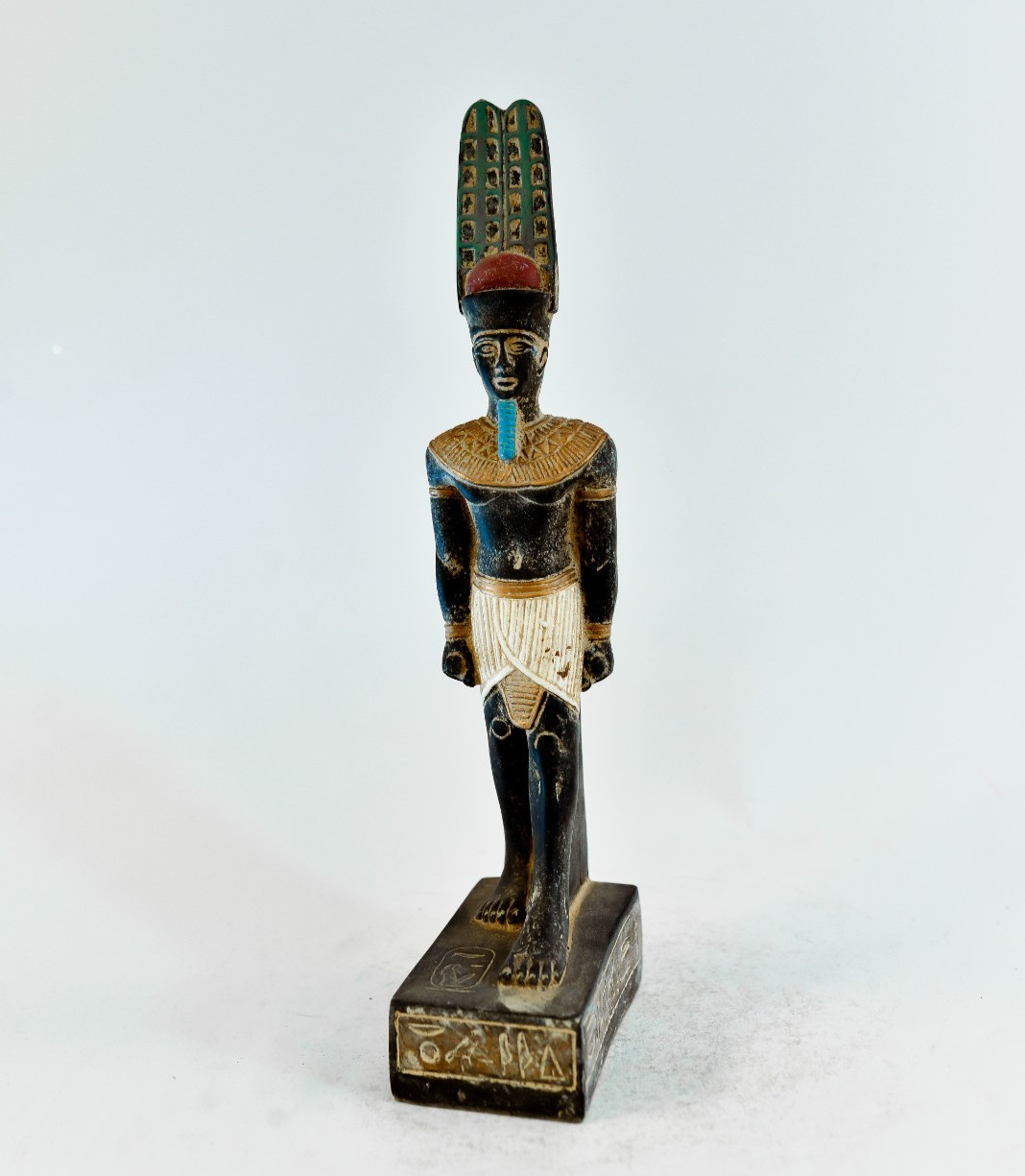
“All statues and decorative pieces are intended solely for decoration and celebrating ancient Egyptian heritage.They are not related to energy, spirituality, or any similar beliefs.”The statue blends molded elements with handmade finishing touches, creating an authentic appearance inspired by ancient Egyptian craftsmanshipHeight: 10.8 inchesWidth: 2 inchesDepth: 3.4 incheswe ship with DHL Express
History
Amun (also Amon, Ammon, Amen, Ancient Egyptian: jmn, reconstructed [jaˈmaːnuw]; Greek Ἄμμων Ámmōn, Ἅμμων Hámmōn) was a major ancient Egyptian deity who appears as a member of the Hermopolitan Ogdoad. Amun was attested from the Old Kingdom together with his wife Amaunet. With the 11th dynasty (c. 21st century BC), Amun rose to the position of patron deity of Thebes by replacing Montu.
After the rebellion of Thebes against the Hyksos and with the rule of Ahmose I (16th century BC), Amun acquired national importance, expressed in his fusion with the Sun god, Ra, as Amun-Ra or Amun-Re.
Amun-Ra retained chief importance in the Egyptian pantheon throughout the New Kingdom (with the exception of the \"Atenist heresy\" under Akhenaten). Amun-Ra in this period (16th to 11th centuries BC) held the position of transcendental, self-created creator deity \"par excellence\"; he was the champion of the poor or troubled and central to personal piety. His position as King of Gods developed to the point of virtual monotheism where other gods became manifestations of him. With Osiris, Amun-Ra is the most widely recorded of the Egyptian gods.
As the chief deity of the Egyptian Empire, Amun-Ra also came to be worshipped outside Egypt, according to the testimony of ancient Greek historiographers in Libya and Nubia. As Zeus Ammon, he came to be identified with Zeus in Greece.