When you click on links to various merchants on this site and make a purchase, this can result in this site earning a commission. Affiliate programs and affiliations include, but are not limited to, the eBay Partner Network.
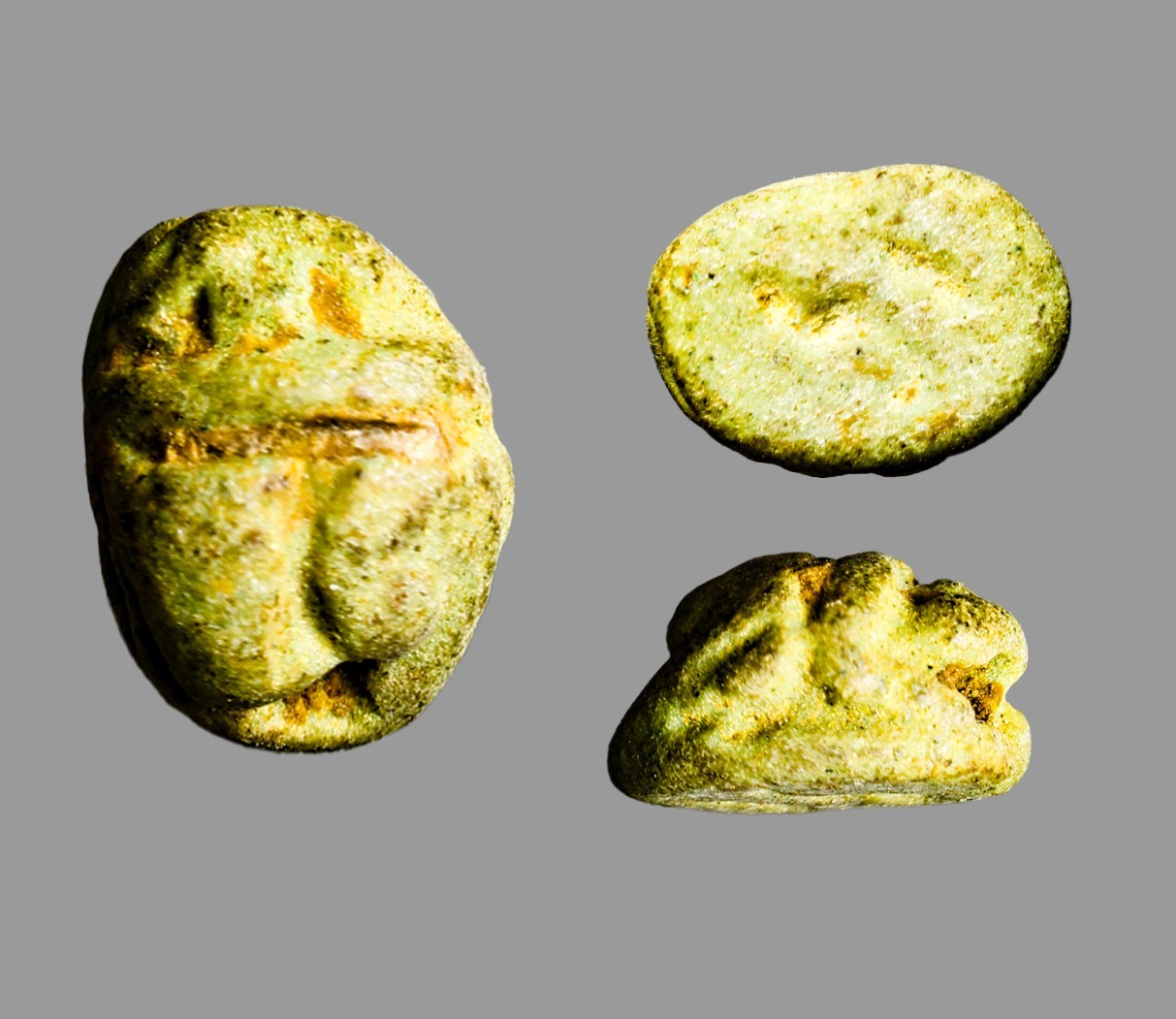
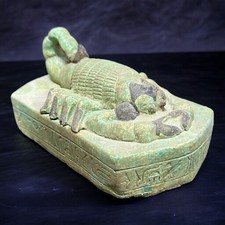
Ancient Egyptian Glazed Steatite / Faience Scarab Beetle Amulet (11mm — c. 1550–664 BC)
Authenticity & Guarantee
Certification: Certified Authentic — includes signed Certificate of Authenticity (COA) with full provenance documentation.
Provenance: Ex-private European collection, legally acquired from international sales; Ancient Egyptian / Nile Valley Sphere.
Item Specifications & Exact Dimensions
Object: Hand-Carved Glazed Steatite / Faience Scarab Beetle Amulet Bead (Khepri Symbol)
Culture / Period: Ancient Egypt (New Kingdom to Late Period Era)
Date Range: Circa 1550 BC – 664 BC (c. 16th – 7th Century BC)
Length: 11 mm
Material: Carved Steatite / Faience with Apple-Green Glaze
Form & Architecture: Naturalistic hand-carved dung beetle (Scarabaeus sacer) profile featuring a distinct clypeus head, pronotum division, and folded elytra wing lines; flat underside matrix; pierced longitudinally along the central axis for mounting as a swivel ring bezel or necklace pendant
Condition: Exceptional, complete ancient condition. Crisp carved dorsal features, intact longitudinal perforation, preserved under an authentic soft apple-green glaze with pale sandy-cream burial encrustations. Free of modern restoration or tooling.
HISTORICAL CONTEXT & TYPOLOGICAL LORE
Egyptian Solar Symbolism & Khepri Rebirth
In ancient Egyptian theology, the scarab beetle (Scarabaeus sacer) was sacred to Khepri, the deity representing the rising sun and self-creation. Observing the beetle rolling balls of dung across the desert sands, Egyptians saw a direct reflection of the sun god pushing the solar disk across the sky. Consequently, scarab amulets became the ultimate ancient Egyptian symbol of renewal, protection, and eternal life.
Amuletic Bead Engineering & Swivel Ring Mounts
Scarabs measuring 11mm were crafted in royal and temple workshops using steatite carved stone fired with copper-rich siliceous glazes. Longitudinally pierced from end to end, these compact amulets were mounted on metal wire to form swivel signet rings, strung into elaborate beaded collars, or bound into linen burial wrappings to safeguard the heart and soul against spiritual harm.
Typological Analysis & Exact Classification
Primary Class: Ancient Egyptian Religious Amulet / Sacred Glyptic Bead
Sub-Class: Longitudinally Perforated Carved Scarab Bead Class
Manufacturing Technique: Hand-carved steatite stone fired with a copper-based alkaline glaze.
Comparable Archaeological Examples & Museum Accession Numbers
Petrie Museum of Egyptian Archaeology (UC11204): New Kingdom glazed steatite scarab amulet with intact longitudinal stringing hole.
British Museum (Accession No. EA64210): Ancient Egyptian green glazed scarab beetle bead.
Metropolitan Museum of Art (Accession No. 26.7.742): Small Egyptian glazed scarab with carved elytra and pierced axis.
1-4