When you click on links to various merchants on this site and make a purchase, this can result in this site earning a commission. Affiliate programs and affiliations include, but are not limited to, the eBay Partner Network.
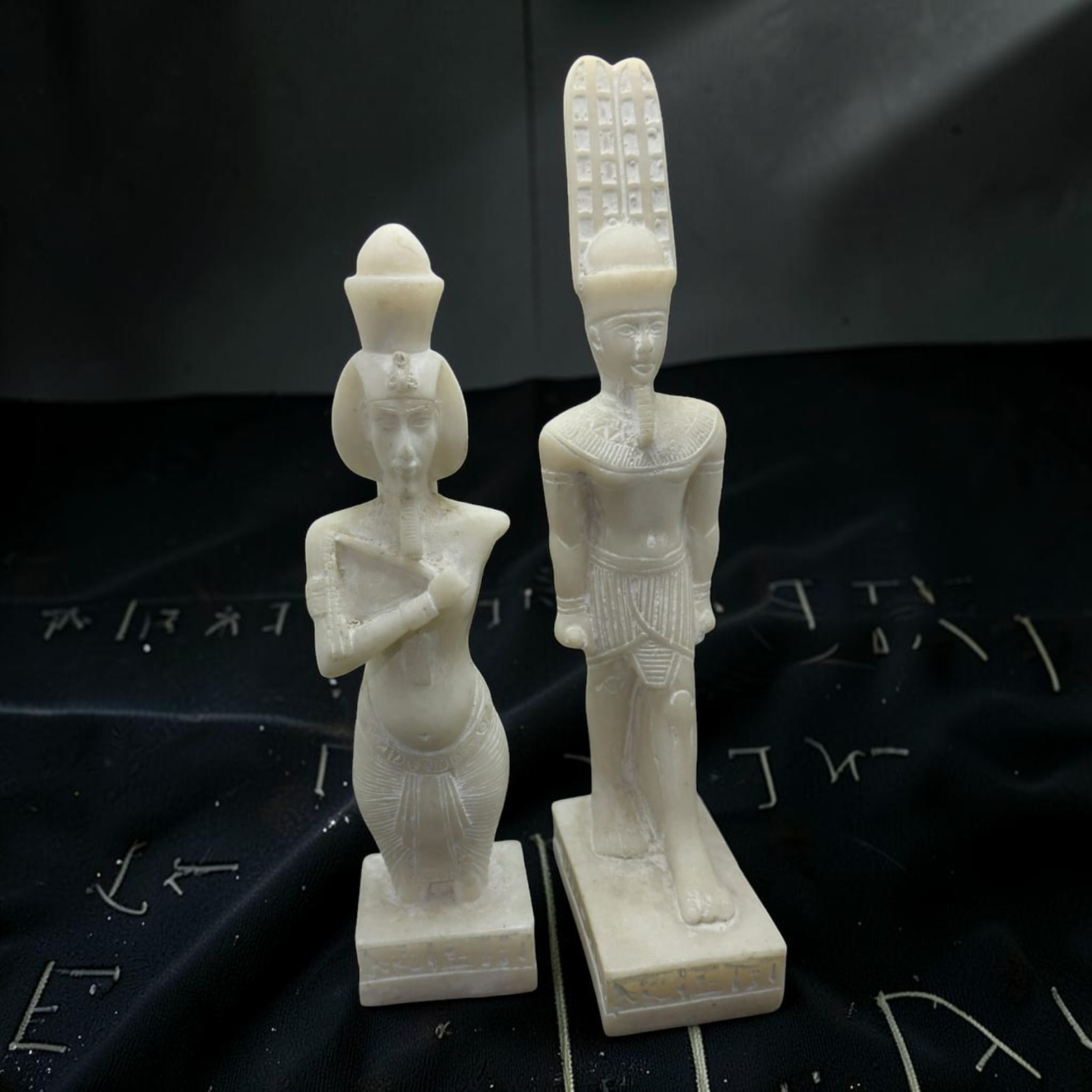
Ancient Egyptian Rare Pharaonic King Akhenaten and God Amun Ra Statues BCDescription
Amun
- **Amun** was a god who originated as a force often associated with air/the unseen at certain stages, and later became one of the most important state deities.
- The Temple of Amun in **Thebes** (Kurnak) was a massive religious and political center.
Ra
- **Ra** is the god associated with the sun (and the sun as a symbol of creation and order).
Amun-Ra (fusion)Over time, the attributes of Amun merged with those of Ra, becoming known as **Amun-Ra**:- The “supreme” power of Amun- Along with the light of Ra and his power of life and creation through the sun- Thus, Amun-Ra became the “King of the Gods” in the eyes of many Egyptians, especially during the Theban period.
Why was Amun-Ra politically important?
- The priests of Amun-Ra in Thebes possessed wealth and influence.
- Because the king needed “religious legitimacy,” the support of the priests became crucial for the kings of the state.
Egypt Before Akhenaten: A State Linked to Traditional GodsBefore Akhenaten\'s reign, the worship of many gods was prevalent:- Amun-Ra (especially in Thebes)- Isis, Osiris, Horus, and other deities- In addition to extensive rituals for gods associated with nature, kings, life, and death
The king offered sacrifices to the gods, demonstrating that he \"maintained Ma\'at\" (order/justice/harmony).
Akhenaten (often referred to as Amenhotep IV before the change) began his reign as king in a state with a traditional religious center.
Akhenaten\'s Central IdeaAkhenaten promoted the worship of a single, central god associated with the sun, whose name/image was: **Aten** (the sun as the life-giving force).
At this stage, the interpretation becomes:- Amun-Ra represents the “great legacy,” the priests, and the old influence.- Akhenaten wanted a new center of religion and spiritual authority around Aten.
Religious Shift: How did the demotion of Amun-Ra begin in practice?
Changing Names and Religious IdentityAmong the most important signs are:- Changing the king’s name to reflect his new allegiance to Aten (and implicitly rejecting the worship/symbolism of Amun).- Shifting the focus in writings and inscriptions from “Amun-Ra” and its associated figures to “Aten.”
# Decline of Amun-Ra RitualsOver the years:- Official references to Amun sometimes diminished.- Resources and celebrations were redirected towards Aten.- Since the priests were part of the system, this is interpreted as a political-religious clash.
The point here is not that Akhenaten “abolished all the gods instantly” across Egypt, but rather that the official direction clearly shifted towards Aten and marginalized the older traditions associated with the Theban centers.
The New Capital: A Political Movement Linked to Religion
One of the biggest keys to understanding the relationship between Akhenaten and Amun-Ra:
- Akhenaten founded/built a new city near Tell el-Amarna (often associated with the worship of Aten).
- With this move:
- He moved the center of worship away from Thebes and the Temple of Amun.
- He created a new \"royal/religious\" center directly linked to Akhenaten\'s vision.
Therefore, it wasn\'t just a matter of \"belief,\" but also a redistribution of power.
How did the new religious art and language emerge?
When a new ideology takes hold of a state, it manifests in:- The way the king and the gods are depicted.- The style of inscriptions and sculptures.- The formulation of prayers.
During Akhenaten\'s time, we find artistic features different from what came before: - The king and his family are often depicted in a more realistic/different way.- There is a focus on the \"sun disk\" and its effects (Aten) and how it gives life.
This reflects the state\'s adoption of a new religious discourse.
Where exactly does Amun-Ra fit into the story of Akhenaten?
Here, Amun-Ra represents the “old guard” of the official religion:
- Amun-Ra, along with Thebes, symbolizes the religious and economic past.
- When Akhenaten establishes Aten as the new apex, Amun-Ra is relegated to the sidelines in official ceremonies.
Therefore, the relationship between the two is understood as a struggle over:
1) Who holds the center of religious “legitimacy”?
2) Who controls the wealth and the priesthood?
3) Is the king the direct intermediary for the new worship, or is the old priesthood the intermediary?
---
The End of the Aten Experiment: Did Akhenaten Achieve Complete Victory?
The experiment did not last long compared to other eras.
After Akhenaten\'s death, the situation gradually reverted to tradition:- Many historical accounts indicate that the worship of Aten declined.- The influence of the priests and old institutions began to be restored.- The effects of the Amarna period were later dealt with: either by removing symbols, rewriting texts, or reducing the impact of the new doctrine.
Thus, Akhenaten\'s actions became a \"religious revolution,\" and the old balance was restored.
9) Why are there multiple interpretations of what Akhenaten did?
Because the matter is very complex, historians have offered several possible reasons (all of which may be partial):- A genuine spiritual/philosophical inclination towards Aten- A political desire to break the influence of the priests of Amun- An internal power struggle within the state- Economic and administrative factors (a redistribution of wealth).Size :As Shown At Pictures.Our Guarantee 👌That the Item Will Delivered to You As Shown in Pictures Therefore we recommend that you see the picture well and then take your decision and take your responsibility.
Shipment ✈️ :DHL Fast Shipping 4-12 Days with track number - We Offer Combine Shipping 📦
Returns : 🔁I check myself each product and sell only the best quality products. In any case, if you are not satisfied with the product, first, please contact me and I will do everything to your 💯 satisfaction.