When you click on links to various merchants on this site and make a purchase, this can result in this site earning a commission. Affiliate programs and affiliations include, but are not limited to, the eBay Partner Network.
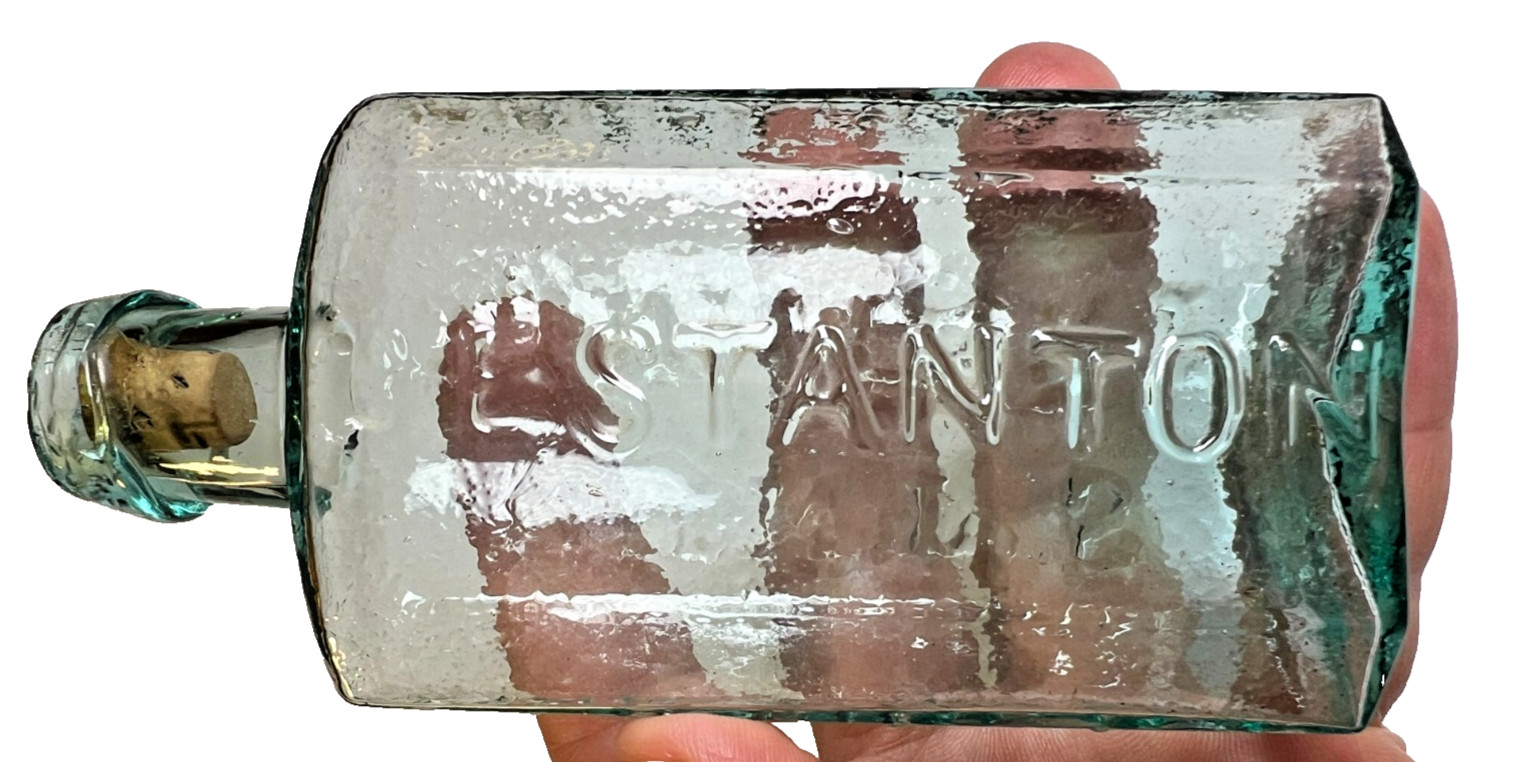
Very early Hunt’s Liniment bottle from Sing Sing, New York, embossed with the scarce C.E. STANTON proprietor name on the reverse panel. This represents the earliest known embossing in the Hunt’s Liniment series, dating to approximately 1830–1836, prior to the product’s standardization under the more familiar R.D. Stanton name during its wider commercial period.
Blown in aqua glass and standing approximately 4.75 inches tall, this example features a true open pontil scar and a hand-tooled applied lip, both fully consistent with early 1830s manufacture. The embossing is exceptionally strong and crisp, particularly on the side panels, with bold, deeply struck lettering that remains sharply legible. The panels themselves show slight unevenness from hand finishing—an expected and desirable trait of early free-blown bottles.
The glass character is outstanding. Heavy seed bubbling and pronounced whittling are present throughout the body, creating an animated interior effect when held to light—almost as if bubbles are suspended mid-motion. This visual depth is a direct result of early sand stock and minimal refining in the furnace and is a hallmark feature collectors seek in true pontiled medicines. It is glass that looks alive, something later machine-made examples simply cannot replicate.
The bottle is bright, clean, and shiny, with no chips, no cracks, and no interior ghosting or staining, an uncommon level of preservation for an open-pontiled medicine bottle of this age. A small white potstone inclusion is present on the reverse; it cannot be felt to the touch, does not radiate, and has no impact on structural integrity or display. The base shows a fully exposed open pontil, and the lip retains visible hand-tooling marks, reinforcing the early, pre-standardized manufacture. All original crude glass character remains intact.
Front panel is embossed HUNT’S LINIMENT / SING SING – N.Y.; the reverse panel shows the full C.E. STANTON name in raised letters. These earliest examples were filled and corked by hand and shipped by riverboat along the Hudson River, sold through general stores and local apothecaries before national advertising and standardized bottle production took hold. The C.E. Stanton embossing reflects a short-lived proprietorship phase before the mold was updated for R.D. Stanton distribution.
Why C.E. STANTON Matters
This is not the commonly encountered Stanton variant. Most collectors are familiar with bottles embossed R.D. STANTON, which were produced and distributed widely between roughly 1837–1847. A bottle embossed C.E. STANTON signals an earlier, transitional period in the brand’s history.
Collectors generally accept the following sequence:
C.E. Stanton — earliest proprietorship (circa 1830–mid 1830s)
R.D. Stanton — expansion and wider commercial distribution (late 1830s–1840s)
Generic or paper-labeled examples — later production
This example represents that brief experimental window when Hunt’s Liniment expanded beyond strictly local Hudson Valley distribution but had not yet entered its fully standardized commercial phase.
What Was Hunt’s Liniment Made Of?
While no complete C.E. Stanton formula survives, period advertisements and comparable Hudson Valley remedies of the 1820s–1840s are remarkably consistent. The likely composition included:
Opium tincture (laudanum) – pain relief
Alcohol/ethanol – solvent and warming agent
Turpentine – stimulant liniment
Ammonia or sal ammoniac – rubefacient
Camphor – cooling numbness and scent
Oil base (olive or whale oil) – carrier
Occasional additions may have included mustard oil or opodeldoc-style soap. In plain terms: a narcotic combined with irritants that tricked the nerves into relief—and yes, it worked because opium works.
What Was It Sold to Treat?
Hunt’s Liniment was a broad-spectrum cure-all advertised for:
Rheumatism, gout, neuralgia, lumbago
Sprains, strains, bruises
Burns, scalds, frostbite, chilblains
And extensive horse use—sore hooves, harness chafing, and work-related inflammation
In a Hudson Valley economy built on horses, wagons, canals, and ferries, animal liniment sales were a major revenue source.
Life in Sing Sing & the Hudson Valley, 1830s
Sing Sing in the 1830s was a quarry town tied directly to river commerce. Prisoners quarried the famous Sing Sing marble used in New York City construction while steamboats moved goods—and medicine—up and down the Hudson. Medical entrepreneurs like Stanton sold remedies to river travelers in a world with no modern pain relief, no germ theory, and brutal physical labor as daily life.
Doctors bled patients. Patent medicines rubbed in opium and warmth. Guess which one people preferred.
Why This Bottle Matters
This bottle comes from the pre-standardization phase of American medicine:
Before national advertising
Before industrial glass uniformity
Before refillable molds and mass production
Before the shift from C.E. Stanton to R.D. Stanton
You’re holding:
It’s small—but it carries the weight of early American medical entrepreneurship.
Height: approx. 4.75 inches
Condition: Excellent — bright, clean, and damage-free with open pontil base, hand-tooled applied lip, heavy seed bubbling, and original early glass character fully intact.