When you click on links to various merchants on this site and make a purchase, this can result in this site earning a commission. Affiliate programs and affiliations include, but are not limited to, the eBay Partner Network.
Cascade Lager — San Francisco, California — Circa 1910
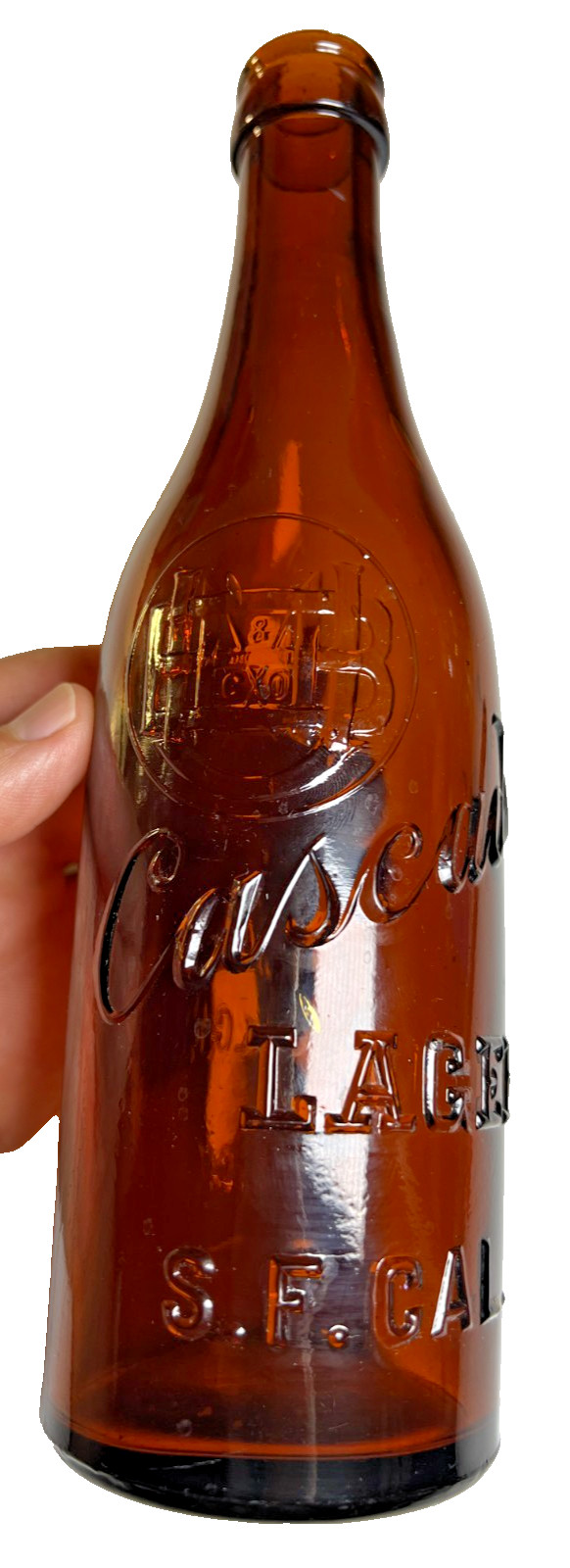
This bottle has serious shelf presence: deep glowing amber glass, an unusually elaborate circular monogram, enormous sweeping script, and embossing so bold that it nearly looks carved rather than molded.
Offered here is a scarce early Cascade Lager beer bottle from San Francisco, California, measuring approximately 9 inches tall. It dates from the brief transitional period when American bottle factories were moving from hand finishing to early automatic production.
My best precise dating is:
Circa 1908–1912 — Most Likely About 1910
The crown-cap finish, bottle form, amber glass, strong mold work, and transitional manufacturing characteristics all support that narrow range. Although the crown is crude enough to resemble a hand-applied finish, the bottle appears more likely to have been produced by a very early bottle-making machine. Early machinery did not immediately create the perfectly uniform bottles associated with later mass production. Some retained irregular seams, heavy glass, uneven mouths, bubbles, and other wonderfully “handmade-looking” characteristics.
That makes this bottle a terrific physical record of the moment when glassmaking was stepping out of the Victorian workshop and into the modern industrial age.
Embossing
The front is boldly embossed:
CascadeLAGERS.F. CAL.
Above the script is an elaborate circular company monogram that appears to incorporate:
H & B Co.
The monogram is exceptionally deep and dimensional, with its letters layered across a framework-like design inside a raised circular border. Depending on the viewing angle, different portions of the design emerge from the amber glass.
The enormous flowing Cascade script is the real showstopper. Its tall loops, sweeping curves, and raised strokes give the bottle a level of graphic appeal normally associated with an original lithographed sign. Below it, LAGER and S.F. CAL. are rendered in bold block capitals.
This was packaging designed to advertise the product even after its paper label had disappeared.
The Maker and Brand
This was a proprietary bottle made for the San Francisco concern marketing Cascade Lager, represented by the circular H & B Co. monogram.
The full legal identity behind that monogram is not plainly spelled out on the bottle, and surviving information about this comparatively obscure regional brand is limited. I would therefore describe it as an H & B Co. Cascade Lager bottle rather than attaching it to a better-known San Francisco brewery without firm documentation.
That obscurity is part of its appeal. It was not a nationally distributed beer bottle produced by the millions for a major surviving brand. It represents one of the numerous local brewers, bottlers, and beer distributors that served San Francisco during the city’s remarkable rebuilding era.
The actual glass container may have been produced by a regional bottle works under contract. The proprietary embossing identified the bottle as the property of the Cascade concern and helped discourage competitors from reusing it.
What It Originally Contained
“Lager” refers to a beer fermented and matured at cooler temperatures using bottom-fermenting yeast. It generally produced a cleaner and more stable beverage than many warm-fermented beers of the preceding period.
San Francisco had an especially active brewing culture created largely by German and Central European immigrants. Local breweries offered traditional lagers alongside the distinctively Californian product commonly called steam beer, which could be produced without the elaborate refrigeration equipment traditionally required for lager brewing.
Cascade Lager was likely sold through saloons, restaurants, hotels, groceries, and neighborhood beer distributors. A bottle such as this would have been filled, crown capped, labeled, packed into a wooden case, and delivered locally. Empty bottles had commercial value and were commonly collected, washed, and refilled.
The nearly complete absence of the heavy horizontal “case wear” frequently found on returnable bottles suggests that this example experienced relatively little repeated handling.
An Early Crown-Top Bottle
The crown finish is an important dating and technological feature.
William Painter patented the crown cork closure in 1892, and it steadily replaced cork-and-wire beer closures during the following decades. A thin metal crown cap lined with cork could be crimped securely around the bottle’s projecting lip, creating an inexpensive and dependable seal for carbonated beverages.
This bottle’s crown is distinctly early and irregular. It does not have the perfectly standardized appearance of a bottle from the 1920s or later. Its slightly crude contours are consistent with the transitional bottle production seen around the opening years of the 20th century.
Because the bottle appears to be very early machine production, I would avoid advertising the crown as definitively hand applied. The more accurate—and equally fascinating—description is:
Crudely formed early machine-made crown finishSan Francisco Around 1910
This bottle dates from one of the most extraordinary periods in San Francisco history.
Only a few years earlier, the catastrophic 1906 earthquake and fire had destroyed enormous sections of the city. The disaster ruptured water mains, crippled firefighting efforts, displaced hundreds of thousands of residents, and consumed entire commercial districts. Breweries, bottlers, hotels, saloons, factories, and warehouses were among the countless businesses damaged or destroyed.
Yet San Francisco rebuilt with breathtaking speed. By approximately 1910, the city was crowded with construction, new commercial buildings, electric streetcars, telephones, automobiles, and freshly rebuilt entertainment districts. Former residents returned, new workers arrived, and saloons once again became neighborhood gathering places.
Local beer helped fuel both the literal workforce and the city’s renewed social life. A bottle of Cascade Lager might have been opened by a construction laborer after a long shift, served across the bar in a rebuilt saloon, or delivered by horse-drawn wagon to a neighborhood grocery.
The decade would culminate in San Francisco’s magnificent 1915 Panama-Pacific International Exposition, organized partly to celebrate the completion of the Panama Canal and partly to announce that the city had recovered from the 1906 catastrophe.
Technology, Medicine and Politics
This bottle comes from a world becoming recognizably modern—but not quite modern enough to feel comfortable.
Electric lighting and telephones were spreading rapidly. Electric streetcars moved residents across San Francisco, while automobiles began competing with horses, wagons, and pedestrians. Motion pictures were developing into mass entertainment, experimental radio communication was advancing, and powered flight was still a breathtaking novelty.
In medicine, germ theory and antiseptic practices were increasingly accepted, but antibiotics did not yet exist. Physicians could use X-rays, first demonstrated in the 1890s, but many infections that are routinely treated today could still prove fatal. Food and beverage producers faced growing public demands for cleaner facilities and more honest labeling following the federal Pure Food and Drug Act of 1906.
Politically, California entered its Progressive Era. Reformers challenged railroad influence, political machines, unsafe working conditions, and corporate control. California women won the right to vote in 1911, nine years before national ratification of the 19th Amendment.
Against all that social and technological change, the humble beer bottle was also being transformed: hand blowing and individually finished mouths were rapidly giving way to automatic machines, standardized crown caps, and modern high-volume bottling lines.
Glass and Manufacturing Character
The bottle is made from rich amber glass, a practical choice for beer because darker glass offered some protection from light exposure that could damage the flavor.
Notable features include:
- Rich glowing amber color
- Exceptionally bold three-dimensional embossing
- Large flowing Cascade script
- Intricate circular H & B Co. monogram
- Early crown-cap finish
- Transitional early machine manufacture
- Heavy glass construction
- Clean, bright, highly reflective surfaces
- Minor natural irregularities associated with early production
The amber becomes especially luminous when placed near a window or illuminated from behind. The deeply raised lettering catches highlights at nearly every angle, making it an excellent display bottle even without its original paper label.
Measurements
- Height: Approximately 9 inches
- Color: Rich amber
- Finish: Early crown top
- Origin: San Francisco, California
- Date: Circa 1908–1912; most likely approximately 1910
Condition
The bottle is in excellent, bright display condition.
- No cracks
- No haze
- No staining
- No repairs
- No distracting scratches
- No obvious return-case or rack wear
- Bright, clean, shiny glass
- Exceptionally strong and dimensional embossing
There is a tiny localized patch of shallow flea bites along the top edge of the crown lip, shown closely in the finger-point photographs. These are small but present and should be noted. They do not significantly detract from the bottle’s impressive overall appearance.
A particularly handsome survivor from San Francisco’s post-earthquake rebuilding period, combining scarce regional brewing history, bold advertising graphics, beautiful amber color, and transitional bottle-making technology.