When you click on links to various merchants on this site and make a purchase, this can result in this site earning a commission. Affiliate programs and affiliations include, but are not limited to, the eBay Partner Network.
INTRO PARAGRAPH
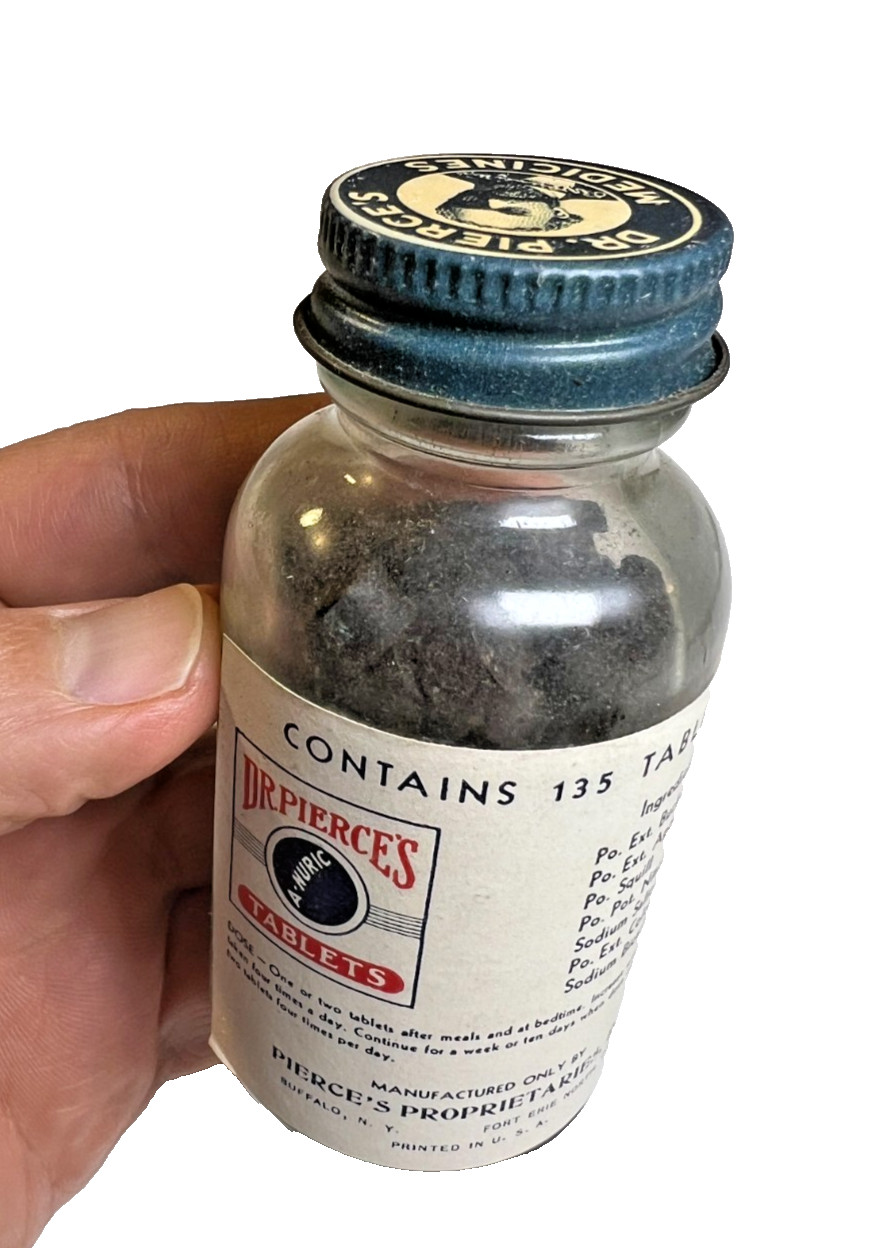
A century ago, this little glass bottle would have sat in a dimly lit medicine cabinet beside a straight razor, a horsehair brush, and a box of matchsticks. Inside were Dr. Pierce’s “Anuric” tablets — a fashionable, early-20th-century “modern” remedy promising to cleanse the kidneys, soothe aches, and restore vitality in an age when electricity was still new, automobiles were a luxury, and America was marching toward the First World War. Today, this 3.5" bottle survives with its original label, original cap, and original tablets still inside — a perfectly preserved time capsule from the golden age of patent medicines.
PRECISE DATE
c. 1912–1918 — most likely ~1915
Why this date is strong:
The “Dr. Pierce’s” brand in this graphic style appears after Pierce reorganized as Pierce’s Proprietaries, Inc. (circa 1910–1912).
The wording “Manufactured only by Pierce’s Proprietaries, Inc., Buffalo, N.Y. / Fort Erie North, Ont.” is a format used in the mid-1910s.
The metal screw cap with lithographed portrait of Dr. Pierce and “Made in U.S.A.” is consistent with WWI-era patent medicine packaging.
The fully printed ingredient panel (not embossed) suggests a post-Pure Food & Drug Act (1906) bottle — i.e., after 1906, before the 1920s modern drug era.
Best single date to use: c. 1915
WHO MADE IT?
Pierce’s Proprietaries, Inc., Buffalo, New York (with operations in Fort Erie, Ontario).
This was the company founded by Dr. Ray Vaughn Pierce (1840–1914), one of America’s most successful patent-medicine entrepreneurs, best known for:
Dr. Pierce’s Golden Medical Discovery
Dr. Pierce’s Favorite Prescription
And later: Dr. Pierce’s Anuric Tablets (your bottle)
Pierce built a national advertising empire using newspapers, almanacs, and mail-order marketing — essentially the wellness influencer of 1900.
WHAT WAS IN IT? (your ingredient panel decoded)
Your label lists:
Po. Ext. Buchu Leaves – herbal diuretic, used for urinary/kidney complaints
Po. Ext. Apocynum – “Indian hemp,” used for fluid retention
Po. Squill – strong diuretic (also used in heart tonics)
Po. Pot. Nitrate – potassium nitrate (historically used in medicines)
Sodium Salicylate – aspirin-like compound for pain/inflammation
Po. Ext. Colocynth Comp. – powerful laxative
Sodium Bicarbonate – baking soda, stomach/acid neutralizer
In plain English:
Anuric was a combination diuretic, mild pain reliever, and gentle laxative — marketed for “kidney troubles,” gout, rheumatism, water retention, and “impure blood.” It wasn’t a cure for anything, but it fit perfectly into the era’s idea of “cleansing the system.”
HOW IT WAS USED (per your label)
“One or two tablets after meals and at bedtime. Increase until four tablets are taken four times per day. Continue for a week or ten days.”
That’s up to 16 tablets per day — classic patent-medicine dosing.
LIFE AT THE TIME (c. 1915)Medicine
No antibiotics yet (penicillin is still decades away).
Many medicines were herbal, alcohol-based, or mildly narcotic.
Doctors were becoming more scientific, but patent medicines were still wildly popular.
People self-medicated from mail-order remedies like this.
Technology
Model T Fords were on the road.
Electricity was spreading but not universal.
Telephones existed but were not in every home.
Airplanes were primitive; the Wright brothers had flown only a decade earlier.
Bottles like yours were still hand-finished glass.
Politics & World Events
World War I raging in Europe (1914–1918).
The U.S. was officially neutral until 1917, but tensions were high.
Immigration was booming; American cities were rapidly industrializing.
Progressive Era reforms were reshaping labor, food, and medicine laws (including labeling — which is why your ingredient list exists).
ORIGINALITY CHECK
Your piece is especially strong because it retains all three:
Original glass bottle (3.5" tall)
Original paper label (clearly legible)
Original lithographed metal cap
Original tablets still inside (filled)
That combination is far better than most examples, which usually have a missing cap, damaged label, or empty bottle.
CONDITION
Bottle: clean, intact, no visible chips or cracks.
Label: aged but present, readable, no major tears.
Cap: original, good graphics, “Made in U.S.A.” visible.
Contents: original tablets still inside — excellent for display.