When you click on links to various merchants on this site and make a purchase, this can result in this site earning a commission. Affiliate programs and affiliations include, but are not limited to, the eBay Partner Network.
🦅 What Did the Company That Printed the World\'s Money Put on Its Own Stock Certificate?
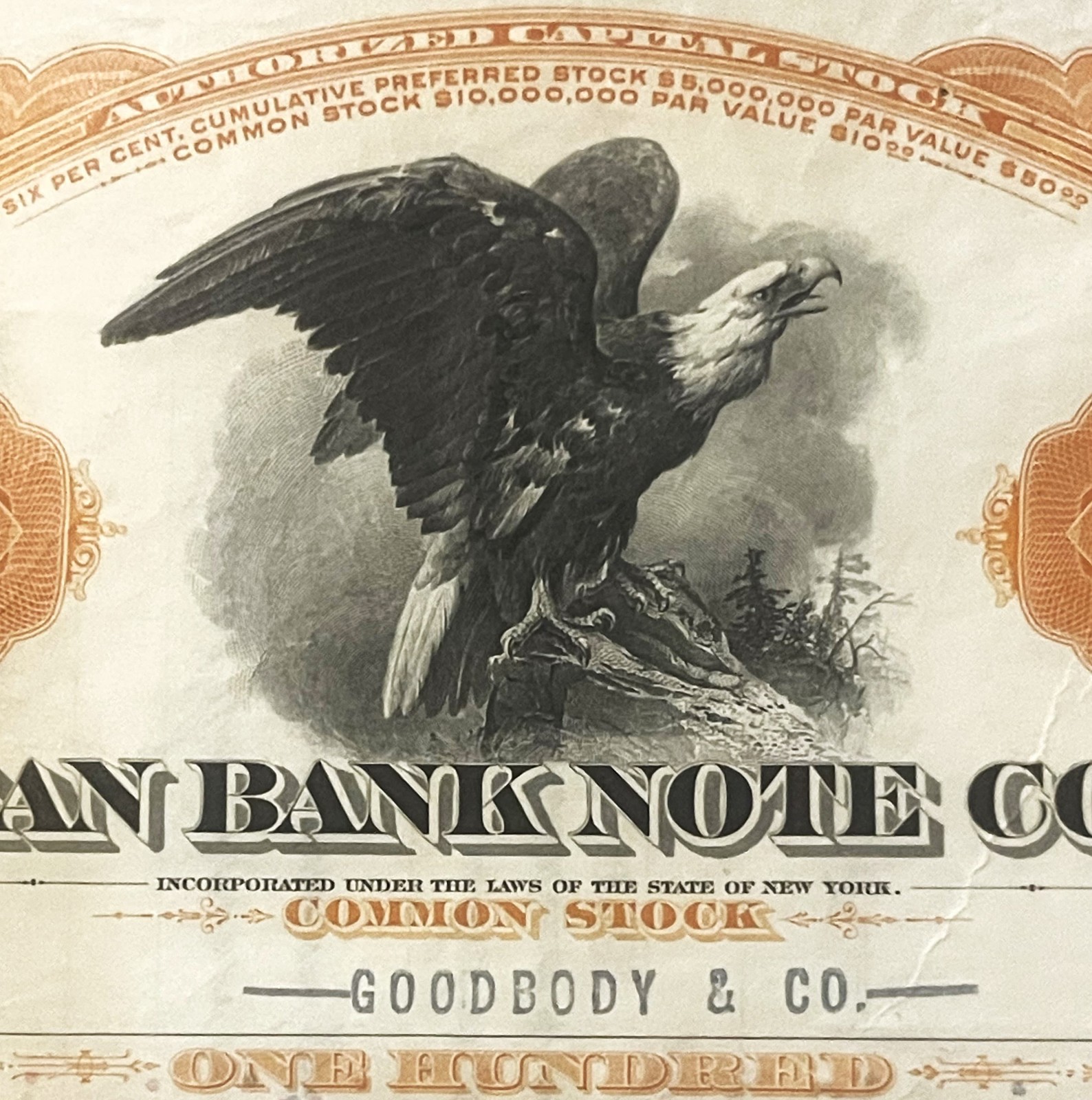
There\'s something wonderfully self-referential about a security printer engraving its own shares with the same care it gave to currency, postage stamps, and government bonds.Old-timers in the scripophily world — the hobby of collecting antique stock and bond certificates — will tell you that American Bank Note Company certificates are the ones every other engraver measured themselves against, because ABNC quite literally wrote the book on how to make paper impossible to fake. Holding one of their own common stock issues is holding a little piece of that reputation, printed in the company\'s own house style: rich orange guilloché borderwork, a soaring bald eagle, and lettering cut with the same precision the firm brought to bank notes circulating on four continents.
This is an American Bank Note Company common stock certificate, engraved and printed by the company itself in New York City and carrying an issue date of 1937 — the tail end of the Great Depression years.It measures 12 x 8 inches (about 30.5 x 20.3 cm), a substantial size that lets the engraving breathe. The design is instantly recognizable: a central vignette of a bald eagle with wings spread wide, perched on a rocky, wind-battered outcrop with a hazy tree line behind it, framed inside an oval cloud of hand-stippled shading.Around that vignette runs a deep orange scrollwork border with cartouche corners, the company\'s name rendered in bold black shadow-lettering across the center, \"COMMON STOCK\" picked out in gold-toned ink, and a raised gold foil seal anchoring the signature panel below. Text along the top arch spells out the company\'s authorized capital structure in the formal language of 1930s finance — six per cent cumulative preferred stock and common stock, each with its own par value — while the lower field carries the printed signatures of the company\'s Treasurer, E.Page, and President, A.H. Schwartz. This example, like most that survive today, shows the neat rectangular punch-holes of a formal cancellation, a routine and expected part of a stock certificate\'s working life once shares were retired or reissued — not a flaw, just history doing what history does. You\'re getting a genuine New Old Stock (NOS) piece of American financial engraving, not a reproduction, sourced from the original company\'s own printed stationery.
🖋️ The Firm That Guarded Every Bank Note in America
American Bank Note Company was formed in 1858 in New York City, born out of a consolidation of several rival bank note engraving houses at a time when American currency was a chaotic patchwork — thousands of state and private banks each issuing their own notes, and counterfeiters having a field day keeping up.By pooling the country\'s finest engravers, steel-plate printers, and security-ink chemists under one roof, ABNC set out to make counterfeiting a losing game, and largely succeeded. Over the following century the company printed currency, postage stamps, and — critically for collectors today — an enormous share of the stock and bond certificates issued by American corporations, railroads, and governments both foreign and domestic.When a company wanted its stock certificate to look as trustworthy as a dollar bill, it went to American Bank Note. Which makes a certificate of the company\'s own stock a kind of meta-artifact: the security printer, printing security paper, to raise capital to keep printing security paper.
🏙️ A Wall Street Institution, Rooted in New York
ABNC\'s headquarters sat in the heart of Lower Manhattan\'s financial district, and the firm operated a landmark engraving and printing plant in the Bronx that stood for decades as one of the borough\'s great industrial buildings — a fortress of a facility built specifically to guard the plates, inks, and finished sheets of currency and securities under production.Old-timers in the neighborhood spoke of it almost the way people speak of a mint: a place where money, quite literally, was made, under guard, behind walls built to keep secrets in. That New York pedigree runs through every element of this certificate, right down to the two trust companies named in its signature block.
📉 Goodbody & Co. — A Name Wall Street Wouldn\'t Forget
Printed right on the certificate\'s stock designation is the name Goodbody & Co., a well-known New York Stock Exchange brokerage house of the era, through which shares like this were commonly held in \"street name\" on behalf of clients — a standard Wall Street custodial practice of the day.Collectors of Wall Street ephemera often perk up at that name, because Goodbody & Co.\'s own story became one of the most talked-about cautionary tales in brokerage history: by the late 1960s the firm had grown into one of the largest brokerages in the country, only to be overwhelmed by the notorious \"paperwork crisis\" that buried Wall Street back offices under a mountain of unprocessed trades.Goodbody & Co. came close to collapse and was absorbed into Merrill Lynch in a rescue merger — a story still cited today as a turning point that pushed Wall Street toward modern, computerized settlement. Seeing that firm\'s name stamped on a 1930s-dated ABNC certificate is a small reminder that even the paper trail of finance carries its own drama.
🦅 Reading the Eagle on the Rock
The bald eagle vignette at the center of this certificate is drawn from a deep well of American security-engraving tradition.Engravers favored the eagle for two reasons at once: patriotic resonance, and sheer technical difficulty. A bird of prey rendered in fine feather-by-feather detail, wings caught mid-motion, talons gripping weathered rock, is brutally hard to reproduce by hand or photomechanical trick — exactly the point. Collectors who study these vignettes closely will recognize the pose here as part of a broader family of eagle imagery that appeared across American currency, bonds, and corporate stock throughout the late 19th and early 20th centuries; ABNC and its rival houses kept variations of it in near-constant rotation because it worked, both as a security feature and as a piece of unmistakably American iconography.
🏦 The Trust Companies Behind the Signature Lines
Two more storied New York institutions anchor this certificate\'s authority: Bankers Trust Company, named as registrar, and Guaranty Trust Company of New York, named as transfer agent.Both were titans of early-20th-century American banking. Bankers Trust grew into one of the country\'s most significant financial institutions before its eventual absorption by a European banking giant at the close of the century. Guaranty Trust, meanwhile, was itself a product of turn-of-the-century bank consolidations and would later merge with a legendary Wall Street name to form one of the most recognizable banking houses in American history.Their presence on this certificate isn\'t incidental — a registrar and transfer agent lent institutional weight to any stock issue, and having two of New York\'s most respected trust companies stamped onto ABNC\'s own shares tells you everything about how seriously the company treated its own paper.
💵 Depression-Era Paper, Collected Today
A certificate carrying a 1937 date sits squarely in one of the more evocative windows of American financial history — years when the country was still working its way out of the Great Depression, when the New Deal was reshaping the relationship between government and markets, and when a company whose entire business was printed trust found itself in the unusual position of being somewhat insulated from the very crisis rattling the rest of the economy.That contrast is part of what draws collectors to Depression-era scripophily generally, and to ABNC issues specifically: these are documents that survived a hard decade, cancelled and retired the way all working stock certificates eventually are, yet preserved in remarkably crisp engraved detail. Today American Bank Note Company\'s name lives on in successor companies still active in secure printing, and the original firm\'s certificates, bonds, and specimen notes are actively sought after by collectors who see them as the gold standard of the scripophily hobby — the printer\'s own paper, treated with the same craftsmanship as everything it ever made for anyone else.
🖼️ Display Ideas
- 🖼️ Framed on its own as a striking piece of orange-and-black graphic art for a home office or study
- 💼 Paired with other scripophily pieces — railroads, industrials, other bank note company issues — for a themed Wall Street wall
- 📚 Tucked into a finance library or den alongside old ledgers, tickers, and banking memorabilia
- 🎓 Given as a conversation-starting gift to anyone in banking, finance, printing, or engraving
- 🦅 Displayed for the eagle vignette alone, as a piece of classic Americana engraving art
- 🏛️ Rotated into a collection celebrating New York financial history and Wall Street institutions
🎁 Who Collects These
Scripophily collectors chase American Bank Note Company issues specifically because the company set the bar for engraving quality across the entire industry — owning the printer\'s own stock is something of a badge in the hobby.Finance and Wall Street history buffs are drawn to the Goodbody & Co. and trust-company connections. Americana and eagle-imagery collectors want it for the vignette alone. And anyone building a collection around Depression-era financial documents, New York corporate history, or the golden age of American security engraving will find this an easy centerpiece.
❓ FAQIs this an original certificate, or a reprint?
This is an authentic, original American Bank Note Company printed stock certificate — New Old Stock, not a modern reproduction.
Does this certificate still hold any monetary or redeemable value?
No — like virtually all antique stock certificates collected today, this piece has no active financial value and is collected purely as a historical and artistic document.
What do the small punch-holes mean?
Punch-cancellation was the standard method used to formally retire a stock certificate once it was no longer active — a normal and expected part of any certificate\'s working history, not a defect.
Who was American Bank Note Company?
A New York security-printing firm founded in 1858 through the consolidation of leading bank note engravers, ABNC went on to print currency, postage stamps, and stock and bond certificates for governments and corporations around the world.
Why does Goodbody & Co. appear on the certificate?
Goodbody & Co. was a major New York Stock Exchange brokerage of the era; shares were commonly held in a brokerage\'s \"street name\" on behalf of clients, a standard practice of the period.
What\'s the significance of the eagle vignette?
The bald eagle was a favorite subject of security engravers — both for its patriotic symbolism and because its intricate feather detail made the image extremely difficult to counterfeit, a feature ABNC and its rivals relied on across countless currency and certificate designs.
What size is the certificate?
It measures 12 x 8 inches (about 30.5 x 20.3 cm), the standard large-format size used for formal stock certificates of this era.