When you click on links to various merchants on this site and make a purchase, this can result in this site earning a commission. Affiliate programs and affiliations include, but are not limited to, the eBay Partner Network.
🦅 What company prints the money... and then prints stock in itself?
I\'ve handled a lot of scripophily over the years — railroad bonds, mining shares, oil ventures that never pumped a drop — but there\'s something different about holding a stock certificate issued by the American Bank Note Company.This isn\'t a certificate ABN printed for some other outfit down the street. This is the printer\'s own paper, in its own name, backed by its own engravers. When the company whose entire business was making documents impossible to fake decided to sell shares of itself, you can bet the result is one of the most beautifully engraved pieces of corporate Americana ever put on paper.
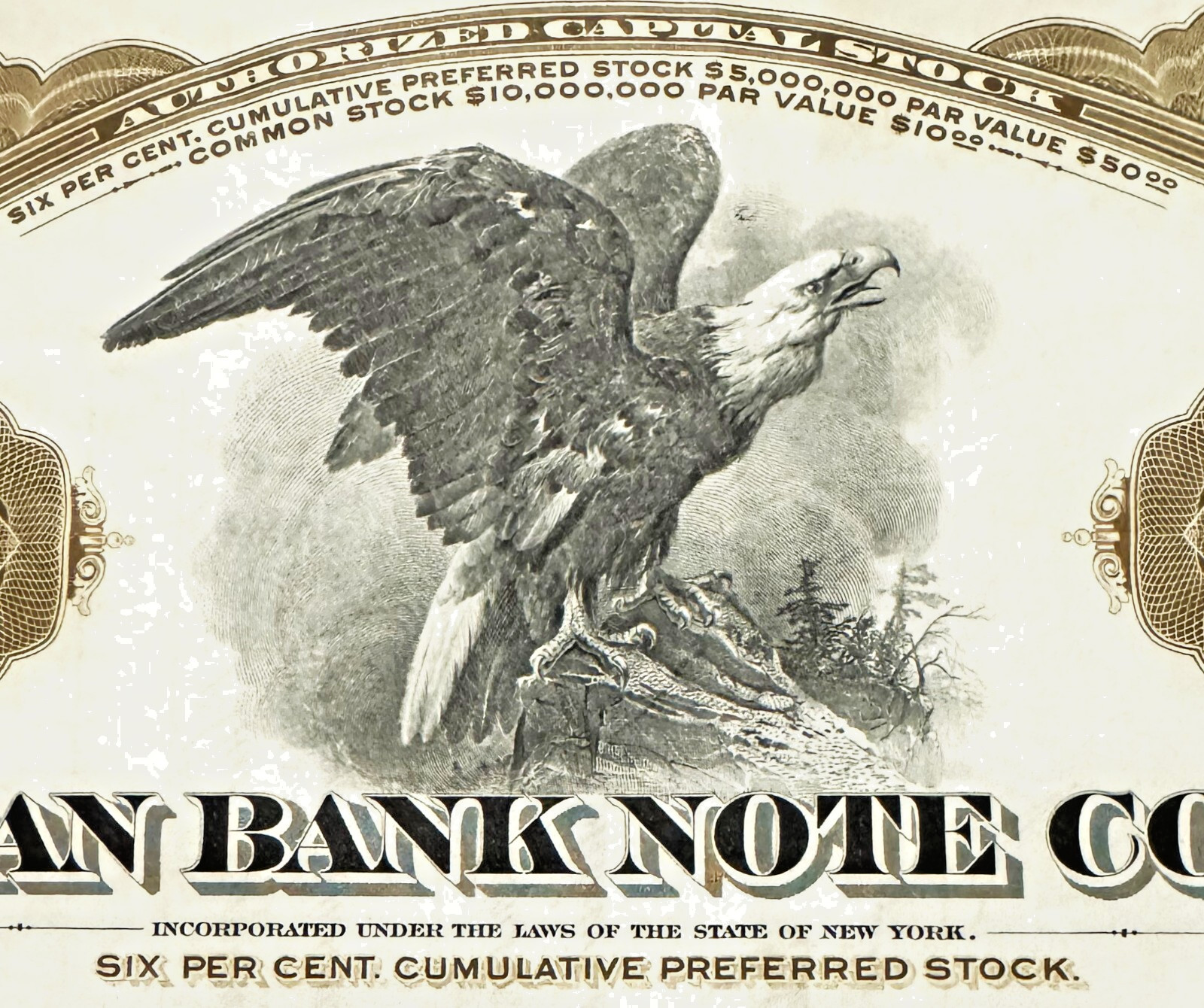
This is an original American Bank Note Company Six Per Cent Cumulative Preferred Stock certificate, incorporated under the laws of the State of New York, printed in a rich brown border with the company\'s signature bald eagle vignette perched on a rocky outcrop, wings spread, head turned skyward.The certificate\'s authorized capital is engraved right across the top of the design — Preferred Stock at $5,000,000 (par value $50 per share) and Common Stock at $10,000,000 (par $10 per share) — the same capital structure carried across this whole issue of certificates. Sized at roughly 12\" x 8\", it carries the ornate guilloché border work, the fine-line engraving, and the counterfeit-resistant detailing that were the company\'s stock-in-trade — quite literally.This is an issued certificate from ABN\'s own preferred stock series, made out to a holder and punch-cancelled — a genuine survivor of the golden age of engraved securities rather than a modern reprint. Dealers who work with this brown ABN issue regularly note that most surviving examples they\'ve handled date from the 1930s, with the occasional find from the 1940s, so a wide window of the 1920s through the 1960s fairly brackets the type without pinning a single year to it.
🖋️ The Company That Engraved Trust Itself
American Bank Note Company was born on April 29, 1858, when seven of the country\'s leading bank-note engraving firms — Toppan, Carpenter & Co.; Rawdon, Wright, Hatch & Edson; Danforth, Perkins & Co.; Jocelyn, Draper, Welch & Co.; Wellstood, Hay & Whitney; Bald, Cousland & Co.; and John E.Gavit — merged into one house in the aftermath of the Panic of 1857. But the company\'s engraving pedigree runs deeper than that merger. Its lineage traces back to Murray, Draper, Fairman & Company, founded in 1795 by Robert Scot, who was appointed the very first official engraver of the United States Mint. In other words, the hands behind this certificate\'s eagle descend, craft-wise, from the hands that engraved the earliest coinage of the young republic.
When the Civil War broke out, ABN and the National Bank Note Company were contracted by the U.S.Treasury to print the original \"Demand Notes\" — the first federal paper currency, the very notes that earned the nickname \"greenbacks\" for the green ink on their reverse. Decades later, from 1879 to 1894, ABN held the contract to print United States postage stamps, closing out that chapter with the beloved 1892–93 Columbian Exposition commemoratives, among the most cherished stamp issues ever produced in this country, before the government brought stamp printing in-house at the Bureau of Engraving and Printing.ABN simply pivoted outward from there, eventually supplying currency, stamps, and security paper to more than 100 countries around the world — with a particular specialty in Latin American currencies for nations including Mexico, Brazil, Costa Rica, Ecuador, Haiti, and Cuba.
🏙️ New York\'s Engine Room of Engraved Trust
American Bank Note kept its headquarters in Lower Manhattan, close by the exchanges and brokerages it served — starting at the Merchants Exchange Building on Wall Street, then moving through Broadway, Trinity Place, and finally Broad Street.But the true workhorse of the company was its 1908 printing plant up in the Bronx. By the 1960s, that Bronx plant was said to process over five million pieces of paper a day and print roughly half of all securities traded on the New York Stock Exchange — an almost unbelievable share of the paperwork behind Wall Street itself, alongside stock and bond certificates, checks, traveler\'s checks, letters of credit, lottery tickets, and even food stamps.Both the American Bank Note Company Building on Broad Street and the Bronx printing plant have since been designated New York City Landmarks, with one also listed on the National Register of Historic Places — a rare honor for buildings whose real business was ink and paper.
🔐 Lore Passed Down Among Engravers and Collectors
Old-timers in the security-printing trade tell a wonderful story about ABN\'s obsession with beating the counterfeiters at their own game: the company is said to have kept an official in-house \"counterfeiter\" on staff, working from a locked office in the plant tower, whose entire job was to try to copy ABN\'s own products.Whenever he succeeded, the story goes, the company would respond by upgrading its engraving, its paper stock, or its inks — turning its own worst enemy into its best quality-control tool. Collectors and former employees have also passed down the detail that every sheet of paper moving through the plant was counted a full 33 times between raw material and finished certificate, with any rejects fed straight into a furnace rather than risk them leaving the building.Whether every digit of that lore is exact, it captures something true and worth preserving: this was a company that treated a piece of paper like it was a matter of national security — because, in a very real sense, it often was.
That seriousness had a darker side, too.Local legend around the Bronx plant holds that it was deliberately targeted in a 1977 bombing precisely because of its role printing currency for Latin American governments — a reminder that the paper this company produced carried real geopolitical weight far beyond Wall Street.
📉 From Engraved Certificates to a Vanished Trade
The very product this certificate represents — the ornately engraved paper stock certificate — is part of why American Bank Note Company itself eventually faded.As securities markets moved to electronic record-keeping through the late 20th century, the demand for engraved certificates collapsed; by the 1990s, nearly all stock ownership had gone digital, and by 1999 the company filed for Chapter 11 bankruptcy as the security-printing business it had defined for well over a century essentially disappeared.Its successor emerged from a later reorganization as ABCorp, still active today in payment cards and secure authentication — a very different business from the one that engraved eagles and guilloché borders by hand. Which is exactly why pieces like this one matter now: they\'re physical relics of a printing craft and a Wall Street paperwork culture that no longer exists in this form anywhere.
🖼️ Display Ideas
- 🦅 Framed alone as a single statement piece — the eagle vignette holds its own on an office or study wall
- 💼 Matted and hung in a home office or trading room for instant old-Wall-Street character
- 📜 Paired with green and orange American Bank Note common stock certificates for a full engraved color set
- 🏛️ Grouped with other scripophily — railroad, mining, or Gilded Age issues — for a broader financial-history wall
- 🎓 Given as a gift to a finance, economics, or history-minded collector who\'ll appreciate the engraving story behind it
- 📚 Kept in an archival sleeve as a study piece for anyone interested in security printing and engraving history
🎁 Who Collects These
Scripophily collectors seek out American Bank Note Company\'s own certificates specifically because the company is the printer, making these something of a \"maker\'s mark\" piece within the hobby — the engraver signing its own work, in effect.Beyond dedicated scripophily hobbyists, this certificate draws in Wall Street and finance history buffs, collectors of engraved Americana and eagle imagery, philatelists who know ABN from its stamp-printing years, and anyone furnishing a home office or study who wants a genuine piece of 20th-century American financial history rather than a reproduction print.It also makes a memorable gift for a history-minded friend or family member — the kind of thing that comes with a real story attached.
❓ FAQIs this an original certificate or a reprint?
This is an original, issued American Bank Note Company certificate from the company\'s own preferred stock series — never a modern reproduction.
What does \"cumulative preferred\" mean on this certificate?
It means holders were entitled to a six percent dividend each fiscal year, and if any year\'s dividend went unpaid, it accumulated and had to be paid in full before common stockholders received anything — a stronger protection than ordinary preferred shares carried.
Why would a bank note printing company sell its own stock?
Like any large corporation, ABN needed capital to fund plant expansion, equipment, and operations — in this case, financing a company that itself became a giant printer of currency, stamps, and securities for governments and businesses around the world.
How old is this certificate?
Certificates of this brown, eagle-vignette design were issued across the 1920s through the 1960s, with the majority of surviving examples dating from the 1930s.Without a legible date on an individual piece, the exact year can\'t be pinned down further, but the design and printing style place it firmly within that mid-20th-century window.
Does the eagle vignette have any special significance?
It reflects the patriotic, trust-conveying imagery American Bank Note Company used across its currency, stamp, and certificate work — the same engraving tradition that produced the nation\'s earliest paper money and postage.
Is the certificate framed?
It\'s sold as a flat, unmounted certificate ready for you to frame or archive as you prefer.
Will the certificate I receive match the one photographed exactly?
You\'ll receive a genuine example of this American Bank Note Company preferred stock issue — same design, era, engraving, and eagle vignette — as part of this historic series.
These are issued instruments rather than blanks. Certificates of this type were filled in for a holder in ink, countersigned by the transfer agent and registered by the registrar, then punch- or cut-cancelled when they were redeemed and retired. Expect financial writings, markings, stamps, hole punches and staple holes as part of the life of the instrument: endorsements and signatures, transfer-agent and registrar stamps, revenue or documentary tax stamps, cancellation punches, staple holes from being bound into a transfer book, pencil ledger notations. That is the paper trail of a security that actually did its job, and it is what separates a document that lived from a blank that never did. No two are alike: holder details, serial numbers, dates, signatures, stamps and punch patterns vary from example to example, so the photographs show the type rather than the exact sheet that ships.