When you click on links to various merchants on this site and make a purchase, this can result in this site earning a commission. Affiliate programs and affiliations include, but are not limited to, the eBay Partner Network.
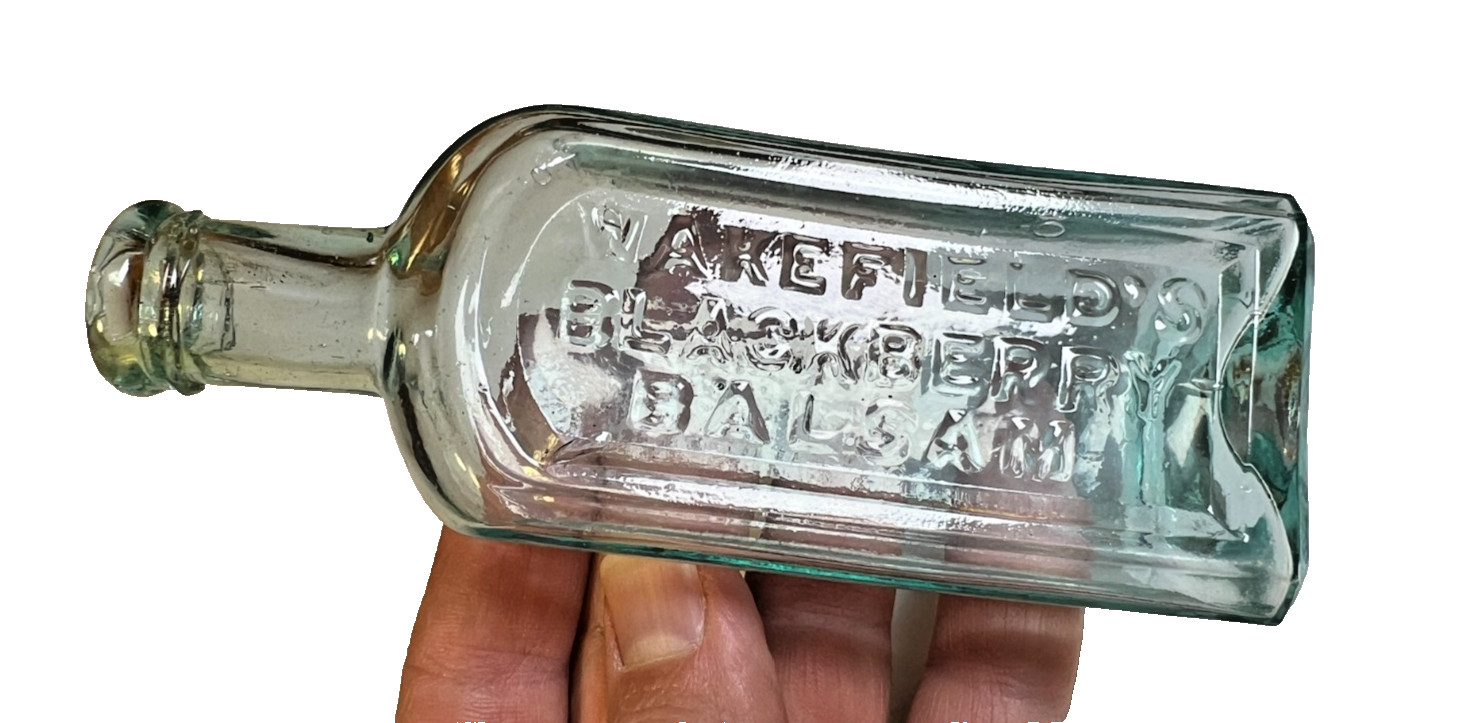
Offered here is a true early variant of Wakefield’s Blackberry Balsam, a beautifully crude post-hinge mold, blown-in-mold medicine bottle from the 1860s–1870s. This is the scarcer applied-top version—thicker, more irregular, and far more visually striking than the later tooled-lip examples.
Features & Attributes• Applied “oozing” top
Hand-tooled and wonderfully asymmetrical — the classic early pharmaceutical look.
• POST-HINGE mold construction
The base shows the characteristic circular or oval “post” outline, a transitional style used after hinge molds but before cup-bottom molds. These molds dominate the late Civil War into early Reconstruction period.
• Strong aqua color with whittled glass
Loaded with seed bubbles, stretch marks, and crude character.
• 5 inches tall
The classic small-size blackberry balsam format.
• Sharp panels and crisp shoulders
A highly attractive shelf display.
Condition — Absolutely Mint
Zero chips
Zero cracks
No haze, no stain
No interior residue
No ground wear
Glass is bright, clean, and shiny
Whittling and tool marks are strongly visible
You won’t upgrade this one.
Historical Context — Why Blackberry Balsam Mattered
Blackberry balsam was one of the most relied-upon mid-19th-century remedies. Families kept it in the pantry, soldiers carried it in campaign kits, and physicians prescribed it regularly for:
Dysentery
Diarrhea
Stomach and bowel complaints
“Summer disorders” in children
Cramps and inflammation
Food-borne illnesses (“cholera morbus”)
The remedy worked because:
Blackberry root & berry are rich in tannins (natural astringents)
The formula almost always contained 20–40% alcohol
Often flavored or fortified with clove, cinnamon, nutmeg, or even small amounts of laudanum
Essentially, this was an alcoholic blackberry medicinal tonic trusted at a time when clean water, modern antibiotics, and germ theory were not yet widely available.
Where Wakefield’s Blackberry Balsam Came From
Wakefield’s remedies were produced by H.H. Wakefield & Co., a mid-19th-century American patent-medicine manufacturer operating out of:
Cincinnati, Ohio, and
Chicago, Illinois
Both cities were major hubs for early drug manufacturing and river/rail distribution.
Wakefield products spread throughout:
This bottle — with its post-hinge base, applied top, and crude character — dates firmly to c.1865–1875, the transitional period from hinge to post-hinge molds.
The United States During This Era (1860–1875)Technology
Your bottle was born in a rapidly modernizing America:
Railroads expanded explosively.
Telegraph lines connected cities like a proto-internet.
Steam power fueled factories, riverboats, and medicine bottlers.
Photography became widespread.
Petroleum kerosene replaced whale oil for lighting.
Chemistry advanced rapidly — standardizing early pharmaceuticals.
Glassmaking transitioned from pontil scars → hinge molds → post-hinge molds → cup-bottom molds.
Your bottle falls squarely into this transitional mold technology period.
Politics
This era spans:
Patent medicines thrived because no meaningful regulation existed until 1906.
Medicine & Society
Your bottle predates:
Families depended on remedies like Wakefield’s for real and constant health needs.
Why POST-HINGE Wakefield Bottles Are Desirable
Collectors love these because:
The mold type dates them precisely to the late Civil War / Reconstruction years
Applied tops are much earlier and far more desirable
Embossed balsams are highly collectible
Beautiful crude aqua bottles display extremely well
They bridge the gap between early pontiled medicines and later machine-mades
This specific example — post-hinge, applied top, whittled, mint — is a top-shelf specimen.