When you click on links to various merchants on this site and make a purchase, this can result in this site earning a commission. Affiliate programs and affiliations include, but are not limited to, the eBay Partner Network.
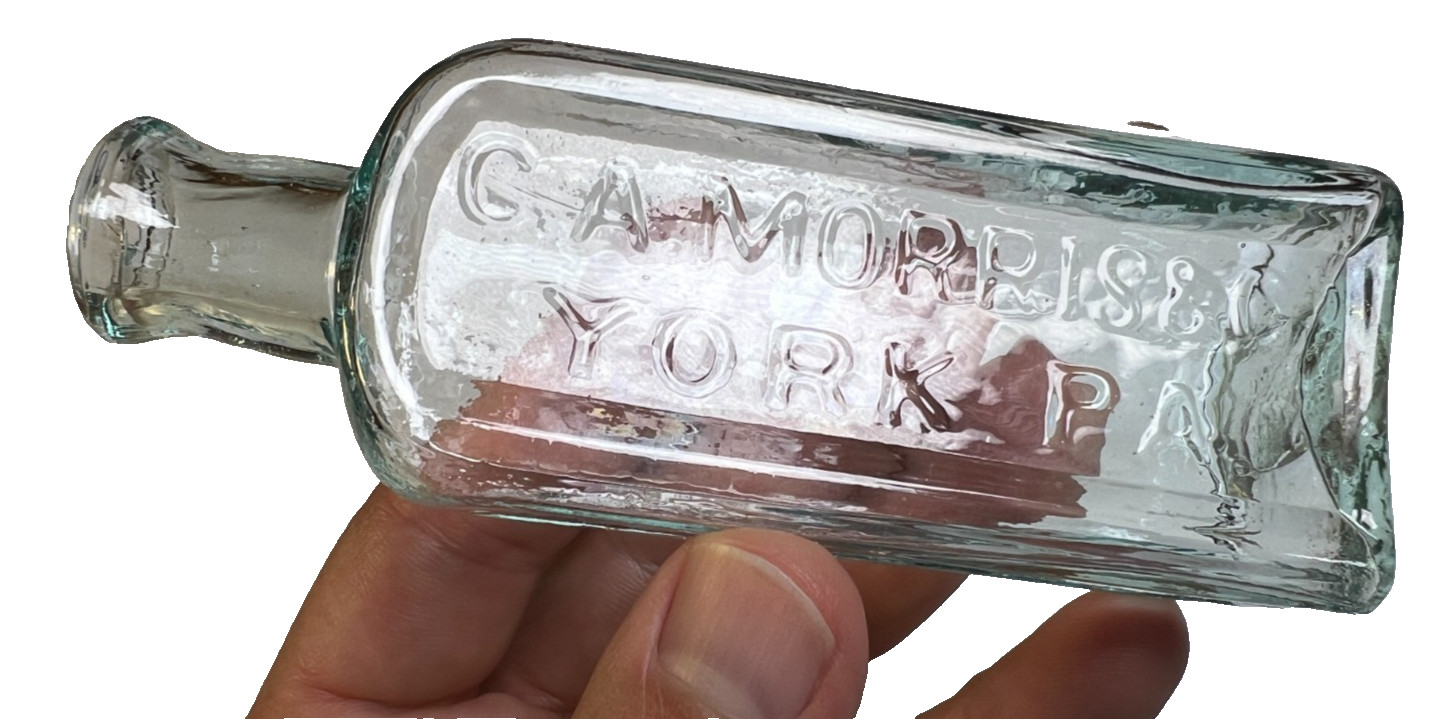
Outstanding pre-Civil War aqua medicine bottle boldly embossed:
C. A. MORRIS & CO.
YORK, PA.
This scarce York druggist bottle dates approximately 1855–1860, with circa 1858 being the best single-date estimate. Its age is supported by the distinct glass pontil scar, individually formed rolled lip, heavy glass character, abundant wavy annealing lines, and wonderfully irregular surface texture.
Charles A. Morris and the York Drug Business
The “C.A. Morris” named on this bottle was Charles A. Morris, born December 9, 1792, and deceased April 10, 1874. Morris became part of York’s merchant community during the early 19th century, initially entering business with his father-in-law in 1817. His drug concern reportedly traced its beginning to 1823, making it one of York’s oldest and longest-lived commercial institutions.
Morris operated on East Market Street, close to the commercial center of York. His establishment was much more than a modern prescription counter. A mid-19th-century druggist supplied medicines, chemicals, herbs, extracts, oils, pigments, dyes, perfumes, soaps, brushes, spices, and numerous household preparations. In many communities, the druggist also served as an informal medical adviser when a physician was unavailable or too expensive.
Historical records confirm C.A. Morris & Co. was operating as a York druggist by the 1850s. One county history records a young employee entering the firm in March 1859. The business was later succeeded by William Smith & Co., although the Morris drug concern continued in various forms for generations. History of York County
Charles Morris was also a prominent civic figure. He and his brother-in-law, Samuel Small, became major contributors to York’s Children’s Home, constructed in 1867 to care for children affected by the Civil War.
A Remarkable Civil War Connection
When Confederate forces occupied York in June 1863, Morris’s East Market Street drug business was searched for medical supplies. According to local historical accounts, drugs had been concealed from the Confederate troops and were later used to treat wounded Union soldiers following the Battle of Gettysburg.
A period inscription reportedly remained on the third floor of the Morris building:
“Rebels in York June 28 1863 / Gettysburg July 3rd and 4th 1863.”
This bottle was probably manufactured shortly before those extraordinary events. While it cannot be proven that this particular bottle remained in the store during the occupation, it is a surviving container from the same Morris drug establishment and period. Prospect Hill Cemetery biography of Charles A. Morris
What Did It Contain?
Because the original paper label and contents are gone, the exact preparation cannot responsibly be identified. Its compact 4.5-inch size and narrow medicinal form suggest it probably held a liquid preparation dispensed in relatively small quantities.
Possibilities include:
- A medicinal tincture or herbal extract
- Camphorated oil or liniment
- Laudanum or another opium-based preparation
- Paregoric
- Cough or digestive medicine
- Flavoring or aromatic essence
- A concentrated chemical preparation compounded by the druggist
Many medicines were prepared directly behind the counter. The druggist weighed ingredients, crushed herbs with a mortar and pestle, dissolved compounds in alcohol or water, and poured the completed preparation into bottles selected according to the quantity purchased.
The bottle probably carried a paper label identifying its contents and directions. That label would have been pasted across an unembossed panel or over part of the face. The permanent molded wording advertised the dispensing druggist and ensured that the Morris name remained visible even after the disposable paper label disappeared.
The Bottle as Advertising
An embossed bottle was an expensive and deliberate form of 19th-century advertising. C.A. Morris & Co. had to commission a private mold bearing the firm’s name and location, then purchase bottles in sufficient numbers to justify their manufacture.
Each time a household placed the bottle on a medicine shelf, reused it, or returned it for another preparation, the name C.A. Morris & Co., York, PA remained in view. It functioned as packaging, store identification, and a miniature glass advertisement all at once.
The prominent city name also projected local authority. At a time before federal regulation of medicines, customers relied heavily upon the reputation of a familiar druggist. Putting the firm’s full name and York location directly into the glass was effectively a pledge that Morris stood behind whatever preparation the bottle contained.
Early Glass Manufacture
This bottle was produced in a mold but completed individually by hand. After the body was blown, a pontil rod was attached to the bottom so the glassworker could hold the bottle while finishing its mouth. Removing that rod left the visible glass pontil scar on the base.
The mouth was then worked into its rounded, rolled form while the glass remained hot. Minor irregularities are expected because neither the lip nor the pontil operation was fully mechanized.
The extensive waviness, annealing lines, texture, and optical distortion are especially attractive. These are not condition issues. They resulted from differences in glass temperature, thickness, cooling, and hand finishing. Turned in the light, the bottle has the wonderfully fluid appearance collectors associate with genuinely early American glass.
Life Around 1858
When this bottle stood on the shelf at Morris’s York drugstore, James Buchanan occupied the White House and the country was moving toward civil war. York was a busy south-central Pennsylvania market town connected to Baltimore and Harrisburg by turnpikes and the growing railroad system.
Downtown streets were traveled by pedestrians, horses, carts, and wagons. Most homes were illuminated with candles or oil lamps. Water had to be drawn or carried, food preservation was limited, and infectious disease remained a constant concern. Germ theory had not yet been widely accepted, and antiseptic medical practice was still years away.
A visit to Morris’s drugstore would have been a sensory experience. Shelves and cabinets held glass jars, drawers of dried botanicals, imported oils, chemicals, powders, and brilliantly colored compounds. The air might have carried the mingled aromas of alcohol, camphor, peppermint, turpentine, spices, and medicinal herbs.
Prepared prescriptions existed, but many customers simply described their symptoms to the druggist. Remedies could contain ingredients now recognized as dangerous—including opium, mercury compounds, chloroform, and powerful botanical extracts. Regulations and standardized dosages were minimal. The reputation and practical knowledge of the local pharmacist were therefore enormously important.
Only a few years later, York would experience the Civil War firsthand. Confederate troops occupied the town in June 1863, and wounded soldiers from Gettysburg soon required enormous quantities of medicines, bandages, food, and shelter. Charles Morris’s hidden medical supplies reportedly became part of that relief effort.
Exceptionally Rare Condition
Early pontiled druggist bottles were working containers, not decorative keepsakes. They were carried home, stored in cupboards, repeatedly handled, and frequently discarded when empty. Many surviving examples were excavated from privies, wells, dumps, or building sites and consequently have staining, scratches, chips, cracks, or permanently dulled surfaces.
This example is remarkably different.
Attic mint! The bottle has apparently survived approximately 165–170 years without the wear normally associated with an early medicine container.
Condition:
- No chips
- No cracks
- No scuffs
- No haze
- No distracting stain
- Bright, clean, and shiny
- Beautiful natural aqua coloration
- Abundant original waviness and crude glass texture
- Excellent glass pontil and hand-finished rolled lip
Finding this particular York druggist bottle is difficult in any condition. Finding one with its original brilliance, clear embossing, undamaged lip, intact pontil, and essentially unworn surfaces is substantially more challenging. Its preservation allows the collector to see the glass much as it would have appeared when it left the glasshouse during the late 1850s.
Height: Approximately 4.5 inches.
A superior example combining a scarce Pennsylvania druggist, documented local history, early pontiled manufacture, remarkable Civil War-era associations, and truly exceptional condition.