When you click on links to various merchants on this site and make a purchase, this can result in this site earning a commission. Affiliate programs and affiliations include, but are not limited to, the eBay Partner Network.
1840 ROWAND'S TONIC MIXTURE VEGETABLE FEBRIFUGE PONTIL BOTTLE PHILADA AQUA
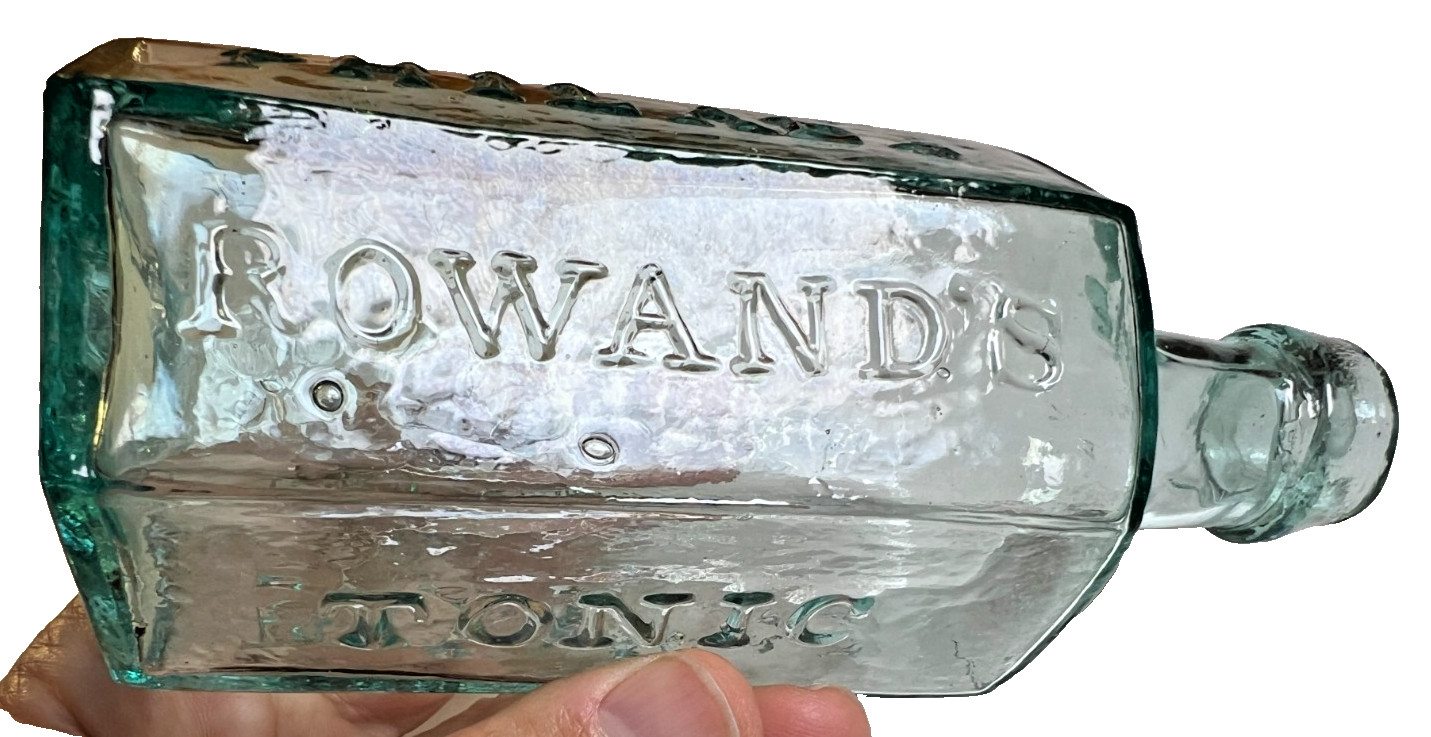
Spectacular early American ROWAND'S TONIC MIXTURE OR VEGETABLE FEBRIFUGE patent medicine bottle, dating to approximately 1830s.
This is an absolutely exceptional example — blowpipe pontiled, hand finished, heavily whittled, six-panel embossed and preserved in ATTIC MINT condition.
Measures approximately 6" tall.
The six individual panels are boldly embossed:
FEBRIFUGE
PHILADA
The glass is a beautiful brilliant ice-blue/aqua and displays an extraordinary amount of early manufacturing character. There is heavy, heavy hammered whittle throughout, numerous annealing lines, bubbles and irregularities in the glass. This bottle is exceptionally crude — exactly the character collectors want to see in an early American medicine.
The embossing is very strongly struck, standing out beautifully on all six panels.
The deeply indented hexagonal base retains its open/blowpipe pontil scar, while the neck terminates in a thick, crude hand-applied and hand-fashioned tapered lip.
The dating is supported by both the bottle's construction and contemporary advertising.
Rowand's preparation was advertised by the 1830s under the name “Rowand's Tonic Mixture or Vegetable Febrifuge,” essentially the exact wording embossed across this bottle.
Period advertisements from 1840 continue to use that name. By 1842, however, advertisements prominently describe the preparation as “Rowand's Improved Tonic Mixture.”
This bottle does not say “Improved.” Combined with its extremely early blowpipe pontil, applied lip and crude hand-blown manufacture, approximately 1840, with a likely production window of roughly 1838–1841, is an excellent date for this specimen.
ROWAND'S TONIC MIXTURE
Dr. John R. Rowand of Philadelphia, Pennsylvania marketed his Tonic Mixture or Vegetable Febrifuge principally as a remedy for fever and ague — the recurring chills and fever commonly associated with malaria.
A “febrifuge” was a preparation intended to prevent or reduce fever.
Period advertising claimed that Rowand's preparation restored proper action between the stomach, liver and other important bodily functions. The medicine became sufficiently well known that Rowand was already publishing warnings about counterfeit and imitation preparations during the 1830s.
The remarkable six-sided embossing was therefore more than decoration. The bottle itself became an unmistakable advertisement:
ROWAND'S TONIC MIXTURE OR VEGETABLE FEBRIFUGE PHILADA
AMERICA WHEN THIS BOTTLE WAS MADE
This bottle dates to an extraordinary period in American history.
Around 1840, Martin Van Buren was President of the United States, and the country was still suffering the economic consequences of the Panic of 1837. The famous 1840 presidential campaign between Van Buren and William Henry Harrison was underway, with Harrison's enormously successful “log cabin and hard cider” campaign helping carry him to the presidency.
Technology was changing rapidly, but everyday America remained remarkably different from the world that would exist only a few decades later.
Samuel Morse's famous Washington-to-Baltimore telegraph demonstration was still four years away. Photography itself was essentially brand new. Railroads and steam transportation were expanding rapidly, but there was no national rail network, telephone, electric lighting or automobile.
Medicine was equally different.
Germ theory was not yet understood. Antibiotics did not exist, and practical surgical anesthesia had not yet been introduced. The famous public demonstration of ether anesthesia in Boston would not occur until 1846.
Physicians still relied heavily upon botanical preparations, purging, bloodletting and compounds that today would be considered primitive. Malaria and other recurring fevers were genuine threats in large portions of the United States, creating a tremendous market for medicines such as Rowand's Vegetable Febrifuge.
This bottle therefore survives from the very early American patent-medicine era — more than 20 years before the Civil War.
CONDITION
ATTIC MINT / MUSEUM-QUALITY CONDITION.
Absolutely beautiful, brilliant and sparkling.
NO CHIPS.
NO CRACKS.
NO BRUISES.
NO FLASHES.
NO REPAIRS.
NO STAINING.
NO HAZE.
The numerous annealing lines, bubbles, irregularities and intensely hammered surface are original manufacturing characteristics and give this bottle extraordinary character.
The amount of whittle and crudeness is exceptional, and the embossing is remarkably strong.
A superb approximately 186-year-old Philadelphia medicine bottle combining a blowpipe pontil, applied lip, brilliant ice-blue aqua glass, six embossed panels, tremendous whittle and remarkable condition.
A genuinely top-shelf early American medicine bottle.