When you click on links to various merchants on this site and make a purchase, this can result in this site earning a commission. Affiliate programs and affiliations include, but are not limited to, the eBay Partner Network.
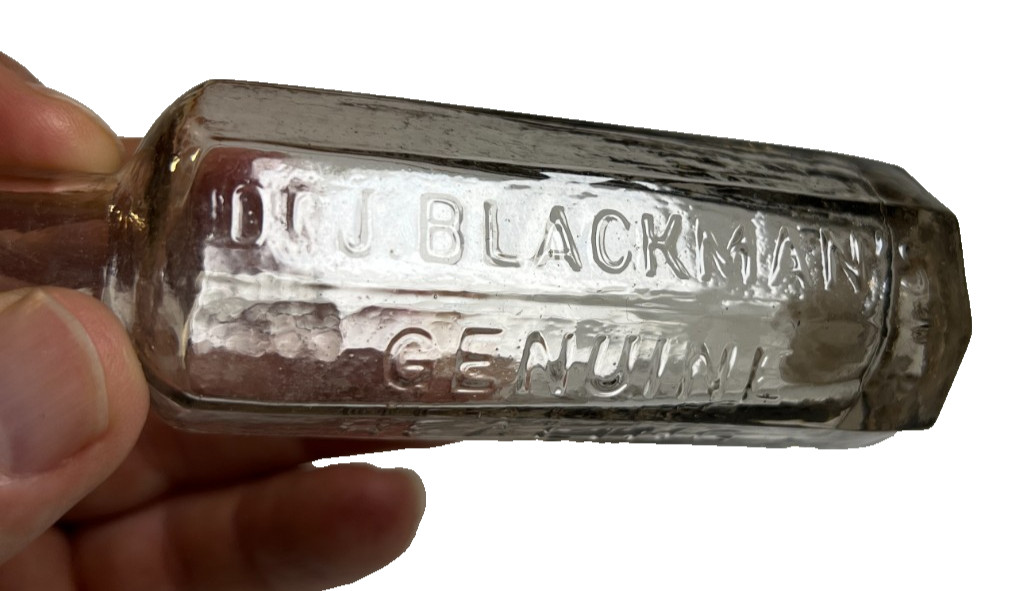
This is a very attractive early patent medicine bottle, and it has several features collectors like: an open rod pontil scar, a rolled lip, crisp embossing, and excellent glass with no stain or haze. The heavy whittled glass and octagonal form are exactly what collectors expect from a mid-19th century proprietary medicine.
Identification
Embossed:
DR. J. BLACKMAN\'S
GENUINE
HEALING
BALSAM
Height: approximately 4½ inches (a smaller size than the more common 5–5½\" example)
Glass: Clear Flint Glass
Finish: Rolled lip
Base: Open rod pontil
Condition: Excellent—no chips, cracks, stain or haze.
Precise Date
Based on the combination of:
- open rod pontil
- rolled lip
- heavy crude glass
- embossed proprietary medicine style
- documented advertising
This bottle was almost certainly made circa 1857–1861, with 1858–1860 being the most likely production window. Advertisements for Dr. Blackman\'s Healing Balsam are documented by December 1857, and open-pontiled examples like yours represent the earliest production.
Where was it made?
The medicine originated in New London, Connecticut.
Researchers have documented that Dr. J. Blackman\'s Genuine Healing Balsam first appears in New London before later production shifted to M. L. Fitkins & Brothers of Rochester, New York after the Civil War. The early pontiled bottles—including yours—belong to the New London period.
Who was Dr. J. Blackman?
Like many \"Doctor\" proprietors of the era, Blackman was less a practicing physician than an entrepreneur selling a proprietary (\"patent\") medicine.
The mid-1800s were filled with similar nationally advertised remedies:
- Dr. Jayne
- Dr. Townsend
- Ayer
- Brandreth
- Hostetter
- Holloway
Most relied heavily upon newspaper advertising rather than scientific evidence.
What was \"Healing Balsam\"?
The word Balsam sounded medicinal and reassuring during the nineteenth century.
It generally referred to a soothing preparation intended to heal both internal and external ailments.
Although exact surviving formulas for Blackman\'s medicine are scarce, medicines of this class commonly contained combinations of:
- alcohol
- balsam fir
- balsam copaiba
- camphor
- herbs
- essential oils
- occasionally opium or morphine derivatives
- aromatic resins
- sugar or syrup
Such ingredients could suppress coughing, dull pain, calm digestion, and create the impression of a powerful cure.
What did it claim to cure?
Advertising of the period promoted Healing Balsam for an astonishing range of ailments, including:
- coughs
- colds
- consumption (tuberculosis)
- bronchitis
- sore throat
- asthma
- chest complaints
- rheumatism
- stomach disorders
- bowel complaints
- wounds
- burns
- ulcers
- Like most patent medicines, it was marketed as nearly universal in usefulness.Why emboss the bottle?
By the 1850s counterfeit medicines had become a major problem.
Embossing:
DR. J. BLACKMAN\'S GENUINE HEALING BALSAM
served several purposes:
- discouraged counterfeiters
- advertised the medicine long after use
- assured customers they were buying the \"genuine\" product
The prominent word GENUINE was especially important—imitations were common.
Your BottleYour example is particularly desirable because it has:
✓ Open rod pontil
✓ Rolled lip
✓ Strong embossing
✓ Nice whittle to the glass
✓ Heavy mold character
✓ Excellent clarity
✓ No stain
✓ No haze
✓ No damage
Those qualities place it well above average.
Technology in America (1858–1860)Your bottle was made during a fascinating period.
Americans were witnessing:
- rapid railroad expansion
- widespread telegraph service
- steam-powered factories
- clipper ships still crossing oceans
- gas street lighting in cities
- photography becoming affordable
- the first practical sewing machines
- factories beginning mass production of glass bottles
Glass was still blown entirely by hand.
Each bottle was:
- gathered from a furnace
- blown into a mold
- removed
- attached to a pontil rod
- finished by hand
- Every example is therefore slightly different.Medicine during the period
Doctors still believed in treatments such as:
- bloodletting
- mercury compounds
- calomel
- opium
- quinine
- herbal extracts
The germ theory of disease had not yet been widely accepted.
Hospitals lacked:
- antibiotics
- antiseptic surgery
- X-rays
- anesthesia beyond ether and chloroform
Patent medicines filled the gap by promising relief where conventional medicine often could not.
Politics (1858–1860)America stood on the brink of civil war.
Major events included:
- Lincoln-Douglas debates (1858)
- John Brown\'s raid on Harpers Ferry (1859)
- Abraham Lincoln elected President (1860)
- Southern states beginning secession
The nation was deeply divided over slavery, and newspapers were filled with political debate alongside advertisements for medicines like Blackman\'s Healing Balsam.
What was happening in New London, Connecticut?During the late 1850s New London remained one of New England\'s busiest maritime communities.
Important developments included:
- a thriving whaling industry, though beginning its decline
- coastal and international shipping
- expanding railroad connections
- shipbuilding and marine commerce
- increasing manufacturing
The city was transitioning from a traditional seaport into a more industrial economy.