When you click on links to various merchants on this site and make a purchase, this can result in this site earning a commission. Affiliate programs and affiliations include, but are not limited to, the eBay Partner Network.
C.H. Graves & Sons "Hub Punch"Boston, Massachusetts
Circa 1879-1888
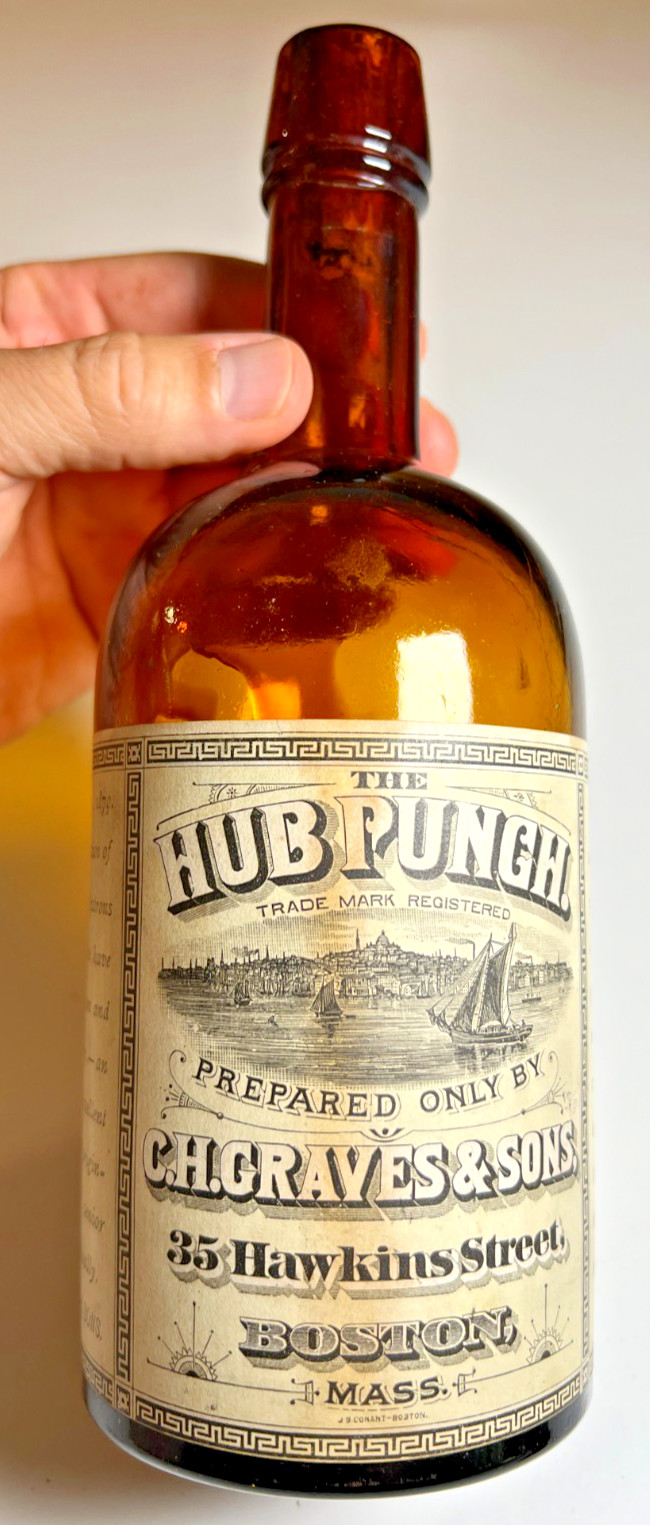
Standing approximately 9.25 inches tall, this handsome amber liquor bottle is a remarkable survivor from Boston's Gilded Age. It retains its original cork, beautifully preserved wraparound paper labels, and even a small amount of the original dried contents resting on the shoulder above the label.
The bottle remains in outstanding condition with no chips, no cracks, excellent glass clarity, and exceptionally crisp graphics.
Condition
Excellent antique condition.
- No chips.
- No cracks.
- Original cork remains in place.
- Outstanding original paper labels with strong contrast and very light wear.
- Small amount of dark amber dried original contents visible on the shoulder above the label.
- Clean, attractive display piece.
About Hub Punch
Before bottled cocktails, before canned mixed drinks, and decades before prohibition, Americans entertained guests with prepared punches.
Hub Punch was exactly what its name suggests—a premium ready-to-mix punch concentrate named after Boston's famous nickname, "The Hub."
Rather than mixing rum, brandy, citrus, sugar, and spices yourself, customers simply purchased a bottle of Hub Punch, chilled it on ice, diluted it with water or lemonade as instructed on the label, and served it at parties, clubs, hotels, and holiday gatherings.
The side label even instructs:
"Set the Punch on ice one hour before using, and on opening, use half water or lemonade."
That little instruction instantly transports you into an elegant Boston parlor around 1880.
C.H. Graves & Sons
Charles H. Graves & Sons operated from 35 Hawkins Street, Boston, one of the city's important wholesale liquor districts during the late nineteenth century.
The company specialized in:
- imported liquors
- cordials
- wines
- rum
- whiskey
- proprietary punches
The label proudly advertises that the foreign liquors and cordials were their own direct importations, emphasizing purity and authenticity—major selling points in an era when adulterated liquor was unfortunately common.
Dating the Bottle
Several clues place this bottle quite precisely.
- The side panel references July 1, 1879, thanking customers for their patronage.
- The front proudly states "Trade Mark Registered," reflecting the growing importance of federal trademark protection after the 1870s.
- The applied paper label design, embossed bottle, amber glass color, and tooled finish are all characteristic of the early to mid-1880s, with production likely continuing into the late 1880s.
A very reasonable manufacturing date is:
circa 1880-1885.
Beautiful Boston Artwork
One of the most desirable features is the engraved cityscape.
The illustration depicts Boston Harbor with sailing vessels approaching the city skyline. Rising above everything is the distinctive dome of the Massachusetts State House, completed only a few decades earlier and already serving as Boston's most recognizable landmark.
It's a wonderful piece of advertising art that instantly identifies the product with Boston—the "Hub of the Universe."
Life in Boston When This Bottle Was Sold
Imagine Boston around 1882.
Horse-drawn wagons rumbled over granite streets while clipper ships and steamships crowded Boston Harbor. Electric lighting was only beginning to appear. Telephone service was still a novelty. Wealth created by shipping, banking, and manufacturing transformed the city into one of America's commercial capitals.
This bottle may have stood behind the polished mahogany bar of a grand hotel, inside an upscale restaurant, or on the sideboard of a Beacon Hill mansion awaiting an evening gathering. Guests in tailored suits and elegant dresses would have enjoyed Hub Punch chilled with blocks of harvested New England ice—a luxury made possible by Boston's thriving ice trade.
The Bottle
Even after the decorative paper labels were applied, the glass was embossed:
THE HUB PUNCH
REGISTERED
C.H. GRAVES
This combination of embossed advertising and elaborate wraparound labels made the bottle difficult to counterfeit while giving it tremendous shelf appeal.
Collectibility
Complete labeled liquor bottles from this era are considerably scarcer than ordinary embossed whiskey bottles.
Collectors appreciate:
- original cork
- complete labels
- embossed bottle underneath
- Boston advertising
- illustrated harbor scene
- original contents residue
- excellent overall preservation
Finding all of those characteristics together is becoming increasingly difficult.