When you click on links to various merchants on this site and make a purchase, this can result in this site earning a commission. Affiliate programs and affiliations include, but are not limited to, the eBay Partner Network.
a.imagelink {color:#0000FF;} a:hover.imagelink {color:#0000FF;} a:visited.imagelink {color:#800080;} a.imagelink img.saleimage { border: 2px solid #0000FF; } a:visited.imagelink img.saleimage { border: 2px solid #800080; } Antique Original Japanese Woodblock Print Woman Carrying Child by Keisai Eisen c. 1825-30
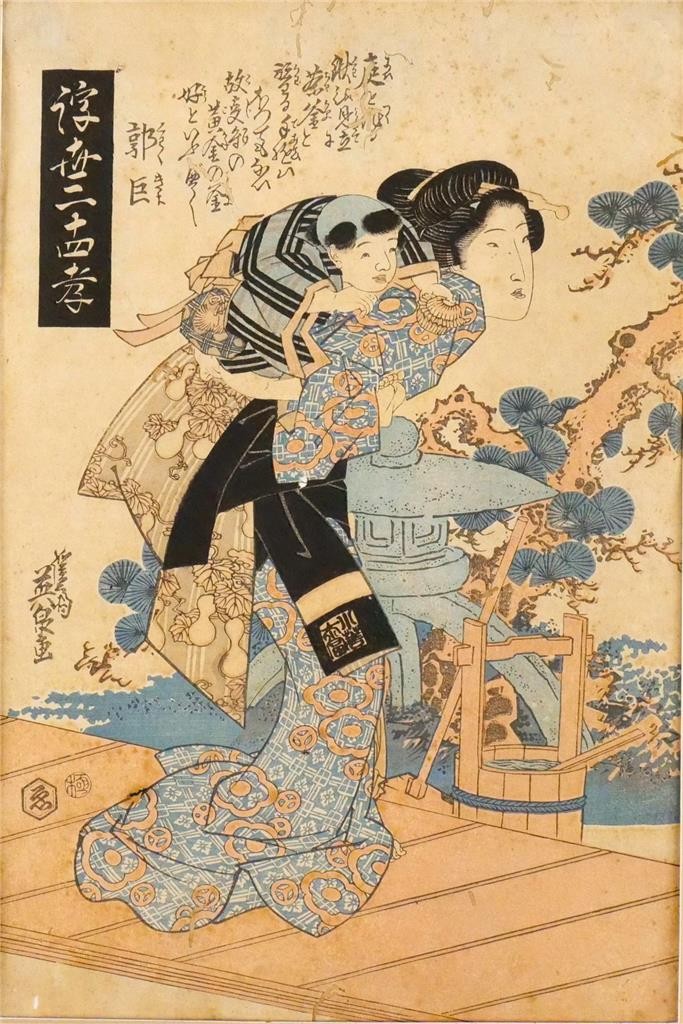
Presented is a beautiful original Japanese full oban-size woodblock print created by the renowned artist of the Edo period, Keisai Eisen (1790-1848), also known as Ikeda Eisen.
The print depicts a young woman carrying a child on her back, walking on a boardwalk in her garden. There are typical for a Japanese garden stone lantern called ishidoro, and a wooden bucket with a ladle for watering the plants. The title of the print reads "Guojo (Kakukyo)" from the series Twenty-four Examples of Filial Devotion in the Floating World (Ukiyo nijushiko).
The print was made using the traditional Japanese woodblock technique somewhere between 1825 and 1830, during the lifetime of Eisen. It is signed with his full name ("Keisai Eisen ga", or painted by Keisai Eisen). There is also Igaya Kan'emon publisher's seal and a censor's seal.
Keisai Eisen (渓斎 英泉, 1790–1848) was a Japanese ukiyo-e artist who specialised in bijin-ga (pictures of beautiful women). His best works, including his ōkubi-e ("large head pictures"), are considered to be masterpieces of the "decadent" Bunsei Era (1818–1830). He was also known as Ikeda Eisen and wrote under the name of Ippitsuan.
AUTHOR: Keisai (Ikeda) Eisen
TITLE: "Guojo (Kakukyo)"
SERIES: Twenty-four Examples of Filial Devotion in the Floating World (Ukiyo nijushiko)
CREATED: c.1825-20
PAPER: washi paper
METHOD OF PRINTING: Woodblock printing
PRINTED: c. 1825-30
PUBLISHER: Igaya Kan'emon
OVERALL FRAME SIZE: 19" by 13.75"
PRINT SIZE: Oban 15" X 10"
There is some toning, foxing, and wormholes. The paper Japanese printmakers used was not "rice paper" as it is usually called. However, in the old days, they often used rice powder to whiten the paper. That attracted bookworms. The print is framed in a wooden frame from the 1960s to 1970s with double matting. There is no glass..
Get images that
make Supersized seem small.
THE simple solution for sellers.
Track Page Views With
Auctiva's Counter