When you click on links to various merchants on this site and make a purchase, this can result in this site earning a commission. Affiliate programs and affiliations include, but are not limited to, the eBay Partner Network.
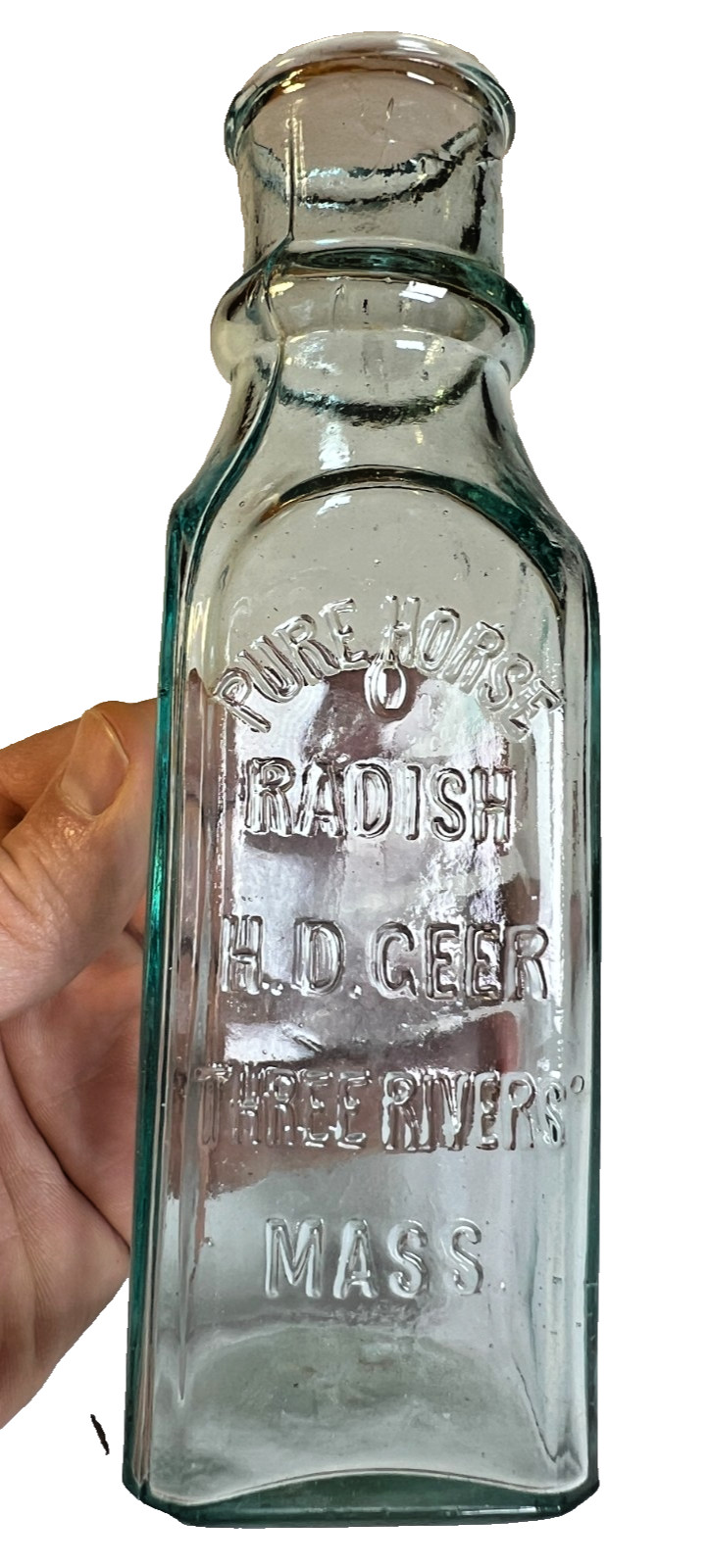
This is an outstanding example of a late 19th-century embossed horseradish bottle from H.D. Geer of Three Rivers, Massachusetts, a village known in its day for small-batch food producers and purveyors of preserved vegetables. These bottles are coveted both for their architectural shape and for their bold, billboard-style embossing—and this one wears its history like a badge of honor.
Features & Details
Embossed text:
PURE HORSERADISH
H.D. GEER
THREE RIVERS
MASS.
Height: approx. 7 inches
Form: Square body with chamfered corners, transitioning to a ringed collar / flared top—a classic design used for early horseradish bottles because the wide mouth accommodated chunky, freshly-grated root.
Color: Strong aqua with excellent clarity and classic 19th-century bubbles, whittling, and waviness.
Base: Smooth, subtly domed; typical of later hand-blown mold use.
Condition: Very good antique condition with no major chips or cracks noted. Clean and shiny overall. Just some settled dust on the interior floor.
H.D. GEER OF THREE RIVERS, MASSACHUSETTS — A WINDOW INTO A 19th-CENTURY CONDIMENT MAKERWho Was H.D. Geer?
H.D. Geer was one of the many small-scale New England food processors operating in the late 19th century—likely between the 1870s and 1890s, which aligns with both the bottle’s manufacturing style and the rise of commercial horseradish packing.
Three Rivers, Massachusetts, a village within Palmer, sat in an advantageous position:
It had access to rich farm country for root crops.
It sat along important rail lines and rivers, making distribution practical.
The area had ongoing industrial energy, with mills, tanneries, and small factories forming a backbone of the local economy.
Small condiment makers like Geer didn’t run giant factories; they often operated a family-scale business—sometimes attached to a general store, a farm, or a small processing shop. They bought or grew horseradish roots, grated them (a task that made the whole building smell like a battle between vinegar and wasabi), and packed the mixture into hand-blown glass bottles like yours.
Geer’s bottles survive because they were heavy, durable, and meant to be reused—but most were discarded once broken, so embossed survivors are treasured today.
Condiments in the Late 1800s: A Surprisingly Big Deal
In the 19th century, condiments were not luxuries—they were food preservation tools, flavor boosters, and sometimes medicinal stand-ins.
Horseradish in Particular
Horseradish had become wildly popular in America for several reasons:
Refrigeration didn’t exist yet
Fresh vegetables spoiled quickly, but horseradish root kept for months and stayed potent.
Vinegar-based mixes acted as preservatives
Horseradish grated into vinegar stayed edible and flavorful for a long time.
It was “medicine” in the Victorian mindset
People believed horseradish cleared the blood, improved digestion, and cured everything from “ague” to melancholy.
It paired with traditional foods
Salted meats, boiled dinners, oysters, and fish—staples of the era—were brought to life by spicy condiments.
Your bottle would have held something roughly like today’s prepared horseradish: grated root in vinegar, maybe with a pinch of salt or sugar.
Other common condiments of the time
Mustard (stone-ground, spicy, and often homemade)
Pickled onions and vegetables
Relishes (before the term was standardized)
Ketchup—but not tomato ketchup! Mostly mushroom or walnut ketchups early in the century
Vinegar infusions
Glass bottles were ideal because they kept these preparations bright and untainted.
Technology in the Era the Bottle Was Made
We’re talking about a period when technology was undergoing a sizzle of innovation—right as rural America was being pulled into modernity.
Glassmaking Technology
Your bottle was:
Hand-blown in a mold, not machine-made
Finished with a tooled lip
Made before automatic bottle machines (Owens machines) took over after 1903
This type of bottle required:
The little asymmetries, waviness, bubbles, and striations in the glass are all signatures of real human hands at work.
General Technology of the Region
Steam power ran factories and mills in Palmer, Three Rivers, and the surrounding towns.
Railroads were the nerve system—able to ship condiments, root crops, and glass bottles across New England.
Telegraph connected towns far faster than mail.
Electricity was just beginning to appear in larger cities, but rural towns relied on kerosene, candles, and gaslight.
In kitchens of the era, tools were simple:
Root graters and hand-cranked grinders
Enamelware or stoneware mixing bowls
Iceboxes (if you had the luxury)
Cast iron everything
It was a world transitioning from 18th-century rusticity to 20th-century industrial convenience.
Politics & Social Life in Massachusetts at the Time
The bottle’s era was shaped by post–Civil War industrial growth, local immigration waves, and the shifting identity of New England towns.
Political Climate
Reconstruction had ended, but its aftershocks shaped national politics.
Massachusetts was a Republican stronghold, emphasizing industry, modernization, and education.
Labor movements were growing—factory workers in New England mills were organizing for safer conditions and shorter hours.
Local Life in Three Rivers
Three Rivers was a mill village, and daily life orbited around:
Work shifts
Church gatherings
Small markets
Local taverns
Seasonal farming
Immigrant communities—particularly Irish, French-Canadian, and Polish—were establishing themselves in the region, influencing cuisine and culture. Horseradish was already beloved in many of those traditions, which may have boosted Geer’s market.
Home Life
Most families lived simply by modern standards:
Condiments like horseradish weren\'t mere add-ons—they were essential tools for making preserved, salted, or bland foods more exciting and more digestible.
Why All This Matters for this Bottle...
A bottle like this isn’t just packaging. It’s a piece of:
Regional New England food history
Early American condiment industry
Pre-automation glass craftsmanship
Small-town entrepreneurship
Daily domestic life in the 19th century
When someone holds this bottle, they’re holding a slice of:
Steam-powered New England
Mill-town bustle
A little condiment shop that once filled bottles by lamplight
A kitchen where horseradish was a prized flavor and “refrigeration” meant a block of ice delivered once a week
No wonder collectors love these.