When you click on links to various merchants on this site and make a purchase, this can result in this site earning a commission. Affiliate programs and affiliations include, but are not limited to, the eBay Partner Network.
ANTIQUE c1910-1917 FAVORITE PIQUA WARE MIAMI #8A CAST IRON SKILLET THIN WALL
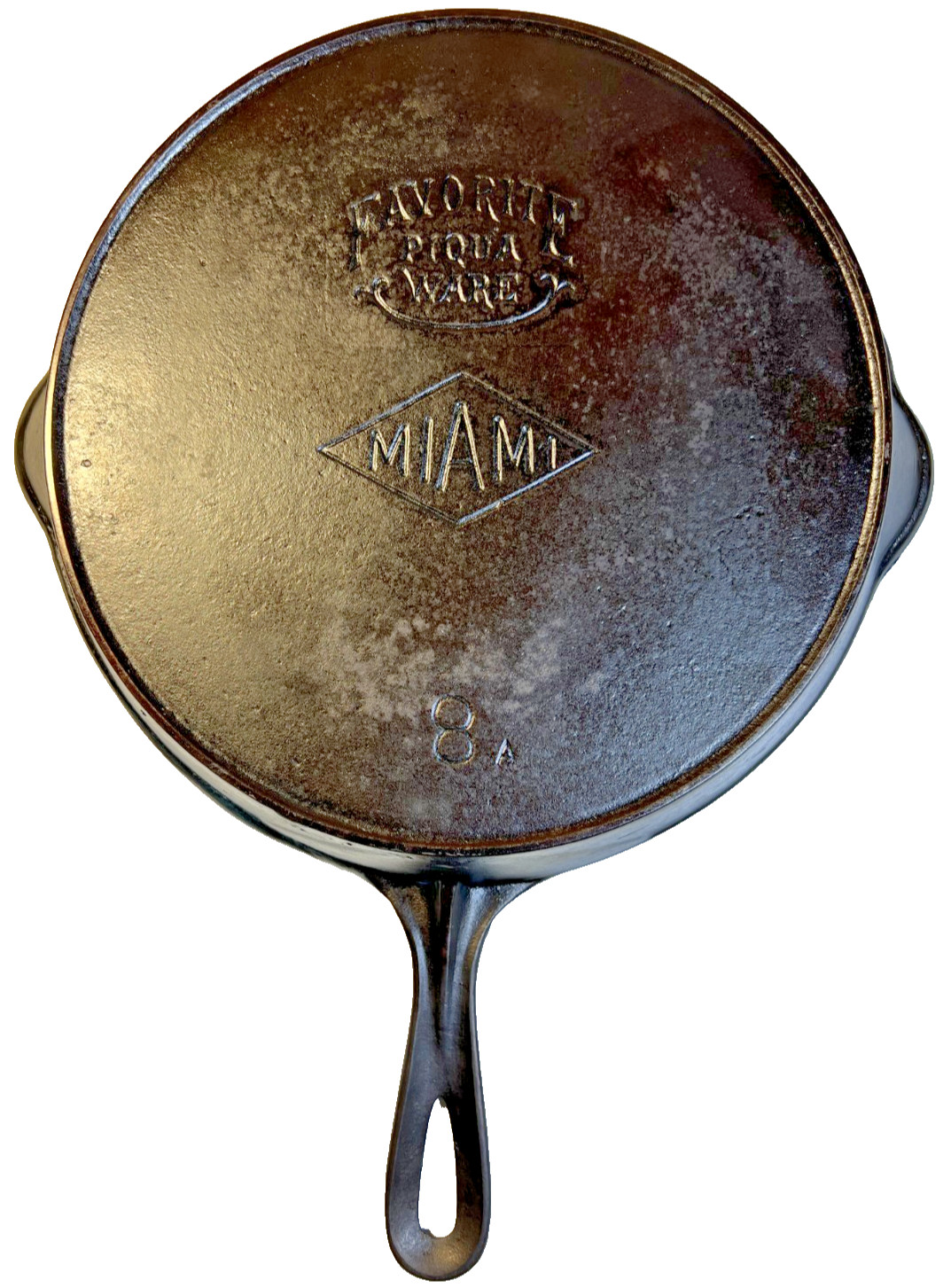
An exceptionally refined and beautifully restored early American cast iron skillet from the golden age of Midwestern foundry craftsmanship. This dual-marked example carries both the iconic “Favorite Piqua Ware” logo and the diamond “MIAMI” mark, placing it within an especially desirable early production era of Favorite Stove & Range Company.
This skillet is a stunner.
Fresh from a careful electrolysis tank restoration, it has been thoughtfully re-seasoned with three coats of grapeseed oil and finished with a final curing of Crisco shortening, producing a deep black antique patina that looks absolutely luxurious in person. The cooking surface is astonishingly smooth — truly silky and almost glass-like to the touch. You would be hard-pressed to find a finer cooking floor on any skillet.
What immediately separates this skillet from ordinary cast iron is the incredible quality of the casting itself. The walls are remarkably thin — approximately the thickness of a U.S. nickel — yet the pan remains rigid, balanced, and beautifully engineered. At only 3.6 pounds for a nearly 10-inch skillet, this is precision cookware from an era when foundries competed on elegance and craftsmanship, not sheer mass.
Modern cast iron often feels crude beside these early Favorite castings. This skillet feels refined.
Precise Date
This skillet most likely dates to approximately 1910–1917, making it:
- Well over 100 years old
- Officially an antique by international customs standards
- A genuine pre-World War I piece of American industrial history
The combination of:
- “Favorite Piqua Ware” logo
- Diamond “MIAMI” trademark
- Pattern number “8A”
- Extremely thin-wall construction
- Smooth machined cooking surface
- Graceful early handle design
…firmly places it in Favorite’s premium early production years.
About The Maker
Favorite Stove & Range Company was among the elite American cast iron foundries of the late 19th and early 20th centuries, standing alongside legendary names such as:
- Griswold Manufacturing
- Wagner Manufacturing Company
Based in Piqua, Favorite became known for producing cookware that was smoother, lighter, and more refined than much of its competition. Their skillets are beloved today because they combine antique authenticity with cooking performance that still rivals modern premium cookware.
The “Miami” diamond mark references Ohio’s historic Miami Valley region and appears on many of Favorite’s earlier, more collectible pieces.
Condition
- No cracks
- No chips
- No repairs
- Fresh professional electrolysis restoration
- Re-seasoned with grapeseed oil and Crisco
- Gorgeous deep black finish
- Exceptionally smooth interior cooking surface
- Very flat: Only the faintest tiny countertop tick detectable on glass (remedied with three sheets of computer paper, a single business card is too thick)
- Tiny original casting flaw along upper wall from manufacturing (see finger-point photo)
- 3.6lbs
Why Collectors Love Early Favorite Skillets
Collectors and serious cooks chase these early Favorite castings because they offer:
- Extremely smooth cooking surfaces
- Lightweight elegant handling
- Thin responsive walls
- Superior heat control
- Excellent balance
- Premium machining and finishing
- Beautiful early-American typography and logos
This skillet represents cast iron from the era before mass-production shortcuts took over.
Life During The Period
When this skillet was made:
- Henry Ford was revolutionizing manufacturing
- Gas and coal kitchen ranges were replacing open-hearth cooking
- Silent films were becoming America’s new entertainment obsession
- Airplanes were still astonishing new technology
- The United States was entering the industrial machine age
- World War I loomed on the horizon
Ohio itself was one of America’s great manufacturing powerhouses — dense with foundries, railroads, machine shops, and industrial innovation. Pieces like this were built to survive daily use for generations, and this one clearly has.