When you click on links to various merchants on this site and make a purchase, this can result in this site earning a commission. Affiliate programs and affiliations include, but are not limited to, the eBay Partner Network.
Charles Dickens Samuel Haydon manuscript concerning the lost clay bust of Dickens by Samuel Joseph, with Basil Hall connections.
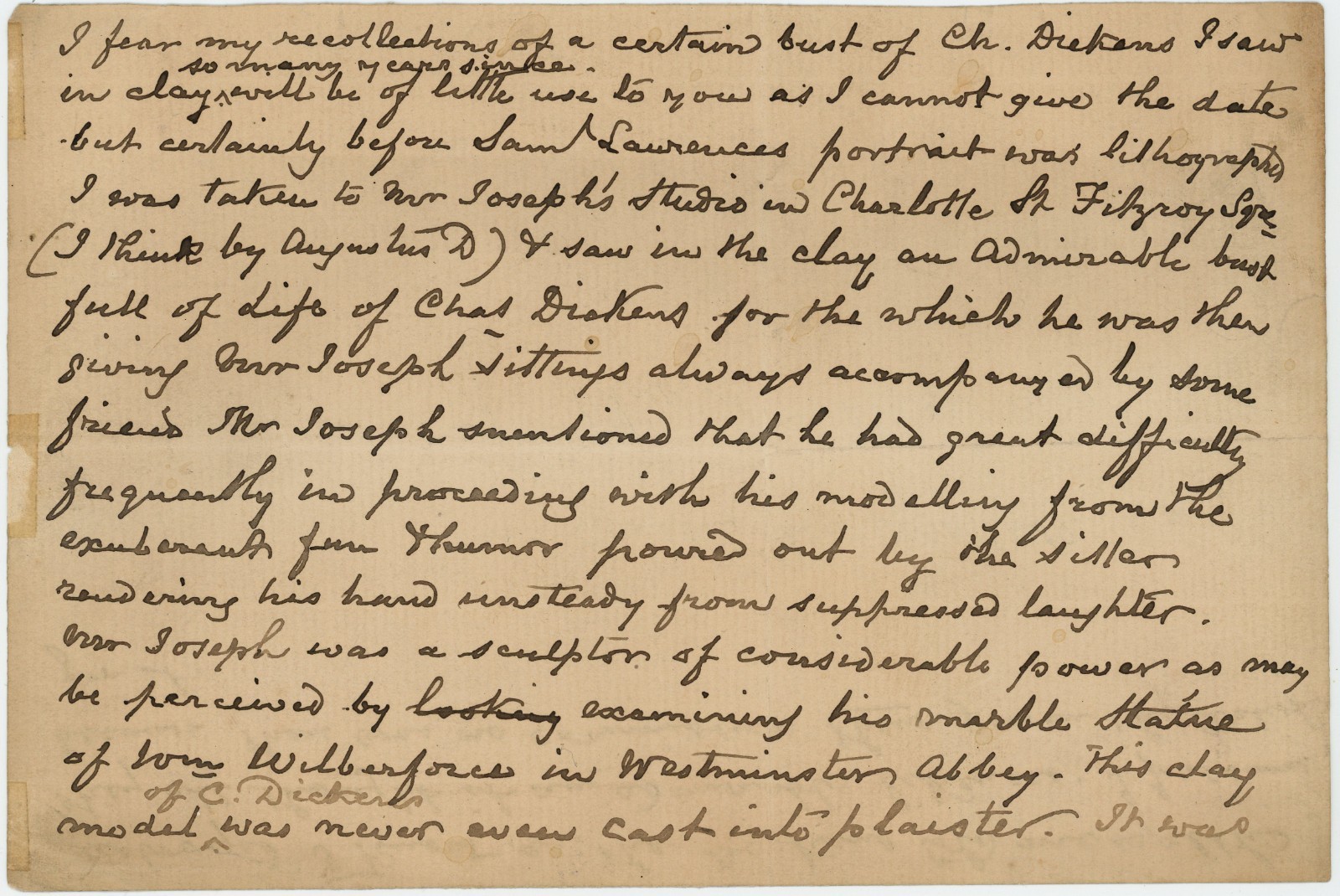
Original 19th century handwritten manuscript reminiscence, identified in pencil on the reverse as “Samuel Haydon’s Reminiscence of Chas Dickens.” The manuscript records an important Charles Dickens association account relating to Dickens sitting for a clay bust by the sculptor Samuel Joseph at Joseph’s studio in Charlotte Street, Fitzroy Square, London.
The manuscript records Haydon’s recollection of seeing the bust while still in clay, describing it as an “admirable bust full of life of Chas Dickens.” It also includes a firsthand anecdote concerning Dickens during the sittings, stating that Joseph had difficulty continuing the modelling because of the “exuberant fun & humour poured out by the sitter,” which made the sculptor’s hand unsteady from suppressed laughter.
The manuscript further states that Joseph’s clay model of Dickens was never even cast into plaster and was later destroyed, despite being regarded by the Dickens family as an admirable likeness. The content relates to one of the lost early sculptural portraits of Charles Dickens and preserves a written record of a vanished Dickens portrait from life.
The manuscript appears to correspond directly with known Dickens scholarship concerning the lost Samuel Joseph bust of Charles Dickens. Published Dickens research records that Basil Hall, an admirer of Dickens, commissioned or requested the bust by Samuel Joseph, and that Dickens arranged sittings for Joseph in 1841. A known Basil Hall letter to Dickens dated March 29, 1841 asks Dickens to allow Hall’s friend, the sculptor Joseph, to model a bust of him. That same context also mentions Angus Fletcher, another sculptor associated with an early bust of Dickens, which appears to fit the unclear “Angus...” reference in this manuscript.
Samuel James Bouverie Haydon was a sculptor, medallist, painter, and early photographer with a direct connection to the Dickens family. Haydon is known for producing a bust of John Dickens, Charles Dickens’s father. The Charles Dickens Museum holds a plaster bust of John Dickens by Haydon, confirming Haydon’s artistic connection with the Dickens family.
The manuscript also praises Samuel Joseph as a sculptor of considerable ability, specifically referencing Joseph’s marble statue of William Wilberforce in Westminster Abbey. Joseph was a respected Victorian sculptor, known for portrait busts and public sculpture, and his Wilberforce statue remains one of his best-known works.
This manuscript connects Charles Dickens, Samuel Haydon, Samuel Joseph, Basil Hall, John Dickens, Angus Fletcher, Samuel Laurence, early Dickens portraiture, Victorian literary history, 19th century sculpture, and Dickensiana.
Approximate Transcription:
“I fear my recollections of a certain bust of Ch. Dickens I saw in clay, so many years since, will be of little use to you as I cannot give the date but certainly before Saml Lawrence’s portrait was lithographed. I was taken to Mr Joseph’s studio in Charlotte St Fitzroy Sqre ... & saw in the clay an admirable bust full of life of Chas Dickens for the which he was then sitting. Mr Joseph’s sittings always accompanied by some friend. Mr Joseph mentioned that he had great difficulty frequently in proceeding with his modelling from the exuberant fun & humour poured out by the sitter rendering his hand unsteady from suppressed laughter. Mr Joseph was a sculptor of considerable power as may be perceived by examining his marble Statue of Wm Wilberforce in Westminster Abbey. This clay model was never even cast into plaster. It was destroyed I know as the Dickens told me so, although they all thought it an admirable likeness. I presume because there was no commission then given the Artist for it.”
Historical Importance:
This manuscript is identified as Samuel Haydon’s reminiscence of Charles Dickens. It records a firsthand recollection of Dickens sitting for Samuel Joseph. It concerns a lost clay bust of Dickens that was apparently never cast and no longer survives. It matches known published Dickens research regarding Basil Hall’s request that Dickens sit for Samuel Joseph. It links directly to Haydon’s known Dickens family connection through his bust of John Dickens. It preserves a firsthand detail of Dickens’s humor and conversation during a sitting from life. It also connects several figures in early Dickens portraiture, including Samuel Joseph, Basil Hall, Samuel Haydon, Angus Fletcher, and Samuel 8 x 5 inches.
Condition:
Original antique manuscript sheet with age toning, folds, handling wear, light soiling, and minor edge wear as shown. Pencil identification to reverse. Please review all photographs carefully for condition.
Keywords:
Charles Dickens manuscript, Samuel Haydon, Samuel James Bouverie Haydon, Samuel Joseph sculptor, Basil Hall letter, John Dickens, Angus Fletcher, Samuel Laurence, Dickens family, lost Dickens bust, Charles Dickens portrait, Victorian literature, Victorian manuscript, literary manuscript, Dickensiana, autograph material, 19th century manuscript, Westminster Abbey, William Wilberforce statue, Fitzroy Square, Charlotte Street, Victorian sculpture, literary history, English literature collectible, antique manuscript, Charles Dickens memorabilia.
Shop, Sell, or Consign
Explore Our store