When you click on links to various merchants on this site and make a purchase, this can result in this site earning a commission. Affiliate programs and affiliations include, but are not limited to, the eBay Partner Network.
\"Shoot if you must, this old gray head, But spare your country\'s flag, she said.\" — John Greenleaf Whittier.
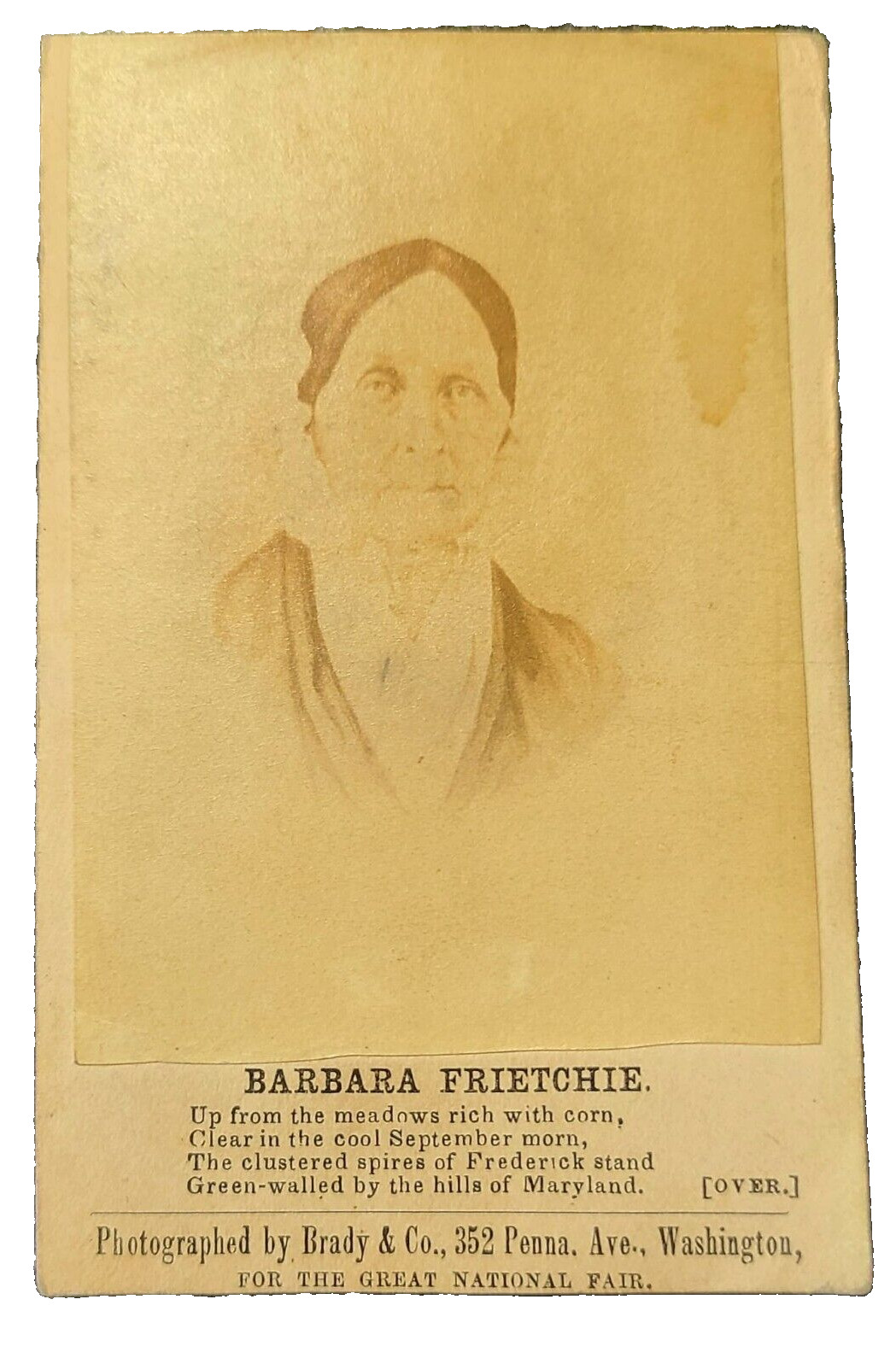
The heroine of John Greenleaf Whittier\'s poem \"Barbara Frietchie\" (based on a real person: Barbara Fritchie) is pictured here on this Carte de Visite, front and back .
Recently uncovered from a private collection this amazing photo was taken by Mathew Brady, one of the country\'s most prolific civil war photographer, notable for taking pictures of Abraham Lincoln and Robert E Lee among others. It is affixed to a small card, with Brady\'s information on the bottom and the Whittier poem on the back.
Mrs. Fritchie became an icon of the North, pushing away what was rumored to be a civil war general while she was well into her 90\'s, and protecting the country\'s flag.
Barbara Frietchie gained fame for telling T. J. \"Stonewall\" Jackson to harm her rather than the Union flag at the time he entered Frederick, Maryland. The Whittier poem was published in Nov. 1863 and it was printed with the carte to raise money for the war effort. The Great Central (Sanitary) Fair in Philadelphia opened in 1864. (Lincoln addressed the fair in 6/16/1864). This card has a handwritten note on the reverse dating it to March 30, 1864.
There are very few exemplars that appear to have survived of this photo. The example of Mrs Fritchies picture on her wikipedia page stems from the Brady photo, and utilizes an example in possession by the library of congress.
Up from the meadows rich with corn,
Clear in the cool September morn,
The clustered spires of Frederick stand
Green-walled by the hills of Maryland.
Round and about them orchards sweep,
Apple and peach tree fruited deep,
Fair as a garden of the Lord
To the eyes of the famished rebel horde;
On that pleasant morn of early fall
When Lee marched over the mountain wall,
Over the mountains winding down,
Horse and foot into Frederick town.
Forty flags with their silver stars,
Forty flags with their crimson bars,
Flapped in the morning wind: the sun
Of noon looked down, and saw not one.
Up rose old Barara Frietchie then,
Bowed with her fourscore years and ten;
Bravest of all in Frederick town,
She took up the flag the men hauled down;
In her attic window the staff she set,
To show that one heart was loyal yet.
Up the the streecame the rebel tread,
Stonewall Jackson riding ahead.
Under his slouched hat left and right
He glanced; the old flag met his sight.
\"Halt!\"--the dust-brown ranks stood fast.
\"Fire!\"--outblazed the rifle-blast.
It shivered the window, pane and sash;
It rent the banner with seam and gash.
Quick, as it fell, from the broken staff
Dame Barbara snatched the silken scarf;
She leaned far out on the window sill,
And shook it forth with a royal will.
\"Shoot, if you must, this old grey head,
But spare your country\'s flag!\" she said.
A shade of sadness, a blush of shame,
Over the face of the leader came;
The nobler nature within him stirred
To life at the that woman\'s deed and word;
\"Who touches a hair of yon grey head
Dies life a dog! March on!\" he said.
All day long through Frederick street
Sounded the tread of marching feet:
All day long that free flag tost
Over the head of the rebel host.
Ever its torn folds rose and fell
On the loyal winds that loved it well;
And through the hill-gaps sunset light
Shone over it with a warm good-night.
On a 1943 car trip to the Camp David (called Shangri-La during World War II), Winston Churchill recited this entire poem from memory to President Franklin D. Roosevelt, Eleanor Roosevelt and Harry Hopkins as they traveled through Frederick, Maryland.
The 35-Star Flag: This would be the flag that Barbara Frietchie supposedly waved from an upper window to show her devotion to the Union as the Confederate troops, under General Stonewall Jackson, marched north through the town of Frederick, Maryland in the Civil War.
This Flag became the Official United States Flag on July 4th, 1863. A star was added for the admission of West Virginia (June 20th, 1863) and was to last for 2 years. The two Presidents to serve under this flag were Abraham Lincoln (1861-1865) and Andrew Johnson (1865-1869).