When you click on links to various merchants on this site and make a purchase, this can result in this site earning a commission. Affiliate programs and affiliations include, but are not limited to, the eBay Partner Network.
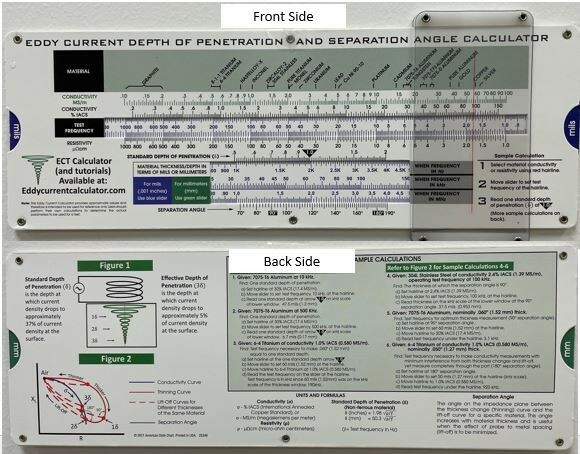
Eddy Current Slide RuleCalculator
To watch a short video on YouTube, just search \"Eddy Current Slide Rule Calculator\"
Also visit eddycurrentcalculator.com for more ways to usethe slide rule.
Whether you’re an NDT Student, EddyCurrent Trainee or ASNT Level III, this UPDATED slide-rule calculator will saveyou lots of time and make you look like an ET wizard!!TheEddy Current Calculator is an analog computer that uses logarithmic scales tocalculate various parameters used in Eddy CurrentTesting.Ifyou get one, you’ll have to keep a close eye on itbecause your Eddy Current buddies will try and take it from you!
This ECT calculator is an updatedversion of a slide rule that has been around for decades, and has enhancedinstructions for ease of use, and also additional graphics (Standard Depth ofPenetration, Effective Depth of Penetration, Conductivity Curve, LiftoffCurves, Thinning curve, and Separation Angles). These graphics help theuser reinforce understanding of the interaction between conductivity,thickness, depth of penetration, and separation angle, which is useful tosuppress the effect of liftoff when making conductivity and thicknessmeasurements. Remember, you can pick a lot of different frequencies toperform a test, but using the OPTIMUM frequency can help improve the accuracyof measurements, while reducing the effect of lift-off.
With the Eddy Current Calculator,you can quickly determine the following for any non-ferrous metal:
·The test frequency needed to make aspecific depth equal to 1δ, in Hz, kHz, or MHz
·Prime and F90 frequencies foroptimal flaw detection for surface OR tubing inspections
·The thickness (in. or mm) in amaterial at which the separation angle (the angle on the impedance planebetween the thinning curve and the lift-off curve) is equal to 90°
·The frequency for optimal thicknesstesting of a material having a known nominal thickness, to achieve a separationangle of 90°
·The frequency necessary to makeconductivity measurements with minimum interference fromboth thickness changes and lift-off yet measure completely through the part (180°separationangle).
There are six tutorial samplecalculations on the back of the Eddy Current Calculator (with answers provided)that the user can practice with to ensure they understand how to operate theEddy Current Calculator. Additional tutorials and loads of other free ECTinformation available at eddycurrentcalculator.com.
One of the reasons the Eddy CurrentCalculator is a great learning tool for eddy current enthusiasts, is that whenlearning how to operate the calculator, the user is constantly observing theinterrelationships between test frequency, test part thickness, and test partconductivity for a variety of materials. Because of this, users develop askill that allows them to perform fast mental calculations and also developafeelfor the reasonableness of an answer.The slide ruleprovides information on many test variables at once, not just one or twovariableslike most apps. The batteries never go bad either.
Another problem with apps is thatyou don\'t what formulas the app answers are based on. Theeddycurrentcalculator.com website provides all of the formulas the slide ruleis based on, so you can confirm your slide rule calculations with the providedformulas.
Search Words:Eddy Current Training Testing ECTElectromagnetic ET Testing Formula Formulas Math Slide Rule Rules SlideruleSliderules Slide-Rule Calculations Calculator standard effective depth ofpenetration SDP separation phase angle spread test frequency lift-off lift offliftoff Nondestructive Testing Evaluation NDT NDE NDI Inspection Air Force NavyPower Plants Nuclear BOP Balance of Plant Eddyfi Zetec Olympus Uniwest NortekNortec Miz Stavely Echoram Corestar Core-star energy Foerster Arago Lenz Lenz’sLaw Faraday analog logarithm logarithms logarithmic instrument probe machineeclipse scientific CGSB ASNT formula formulas formulae physics