When you click on links to various merchants on this site and make a purchase, this can result in this site earning a commission. Affiliate programs and affiliations include, but are not limited to, the eBay Partner Network.
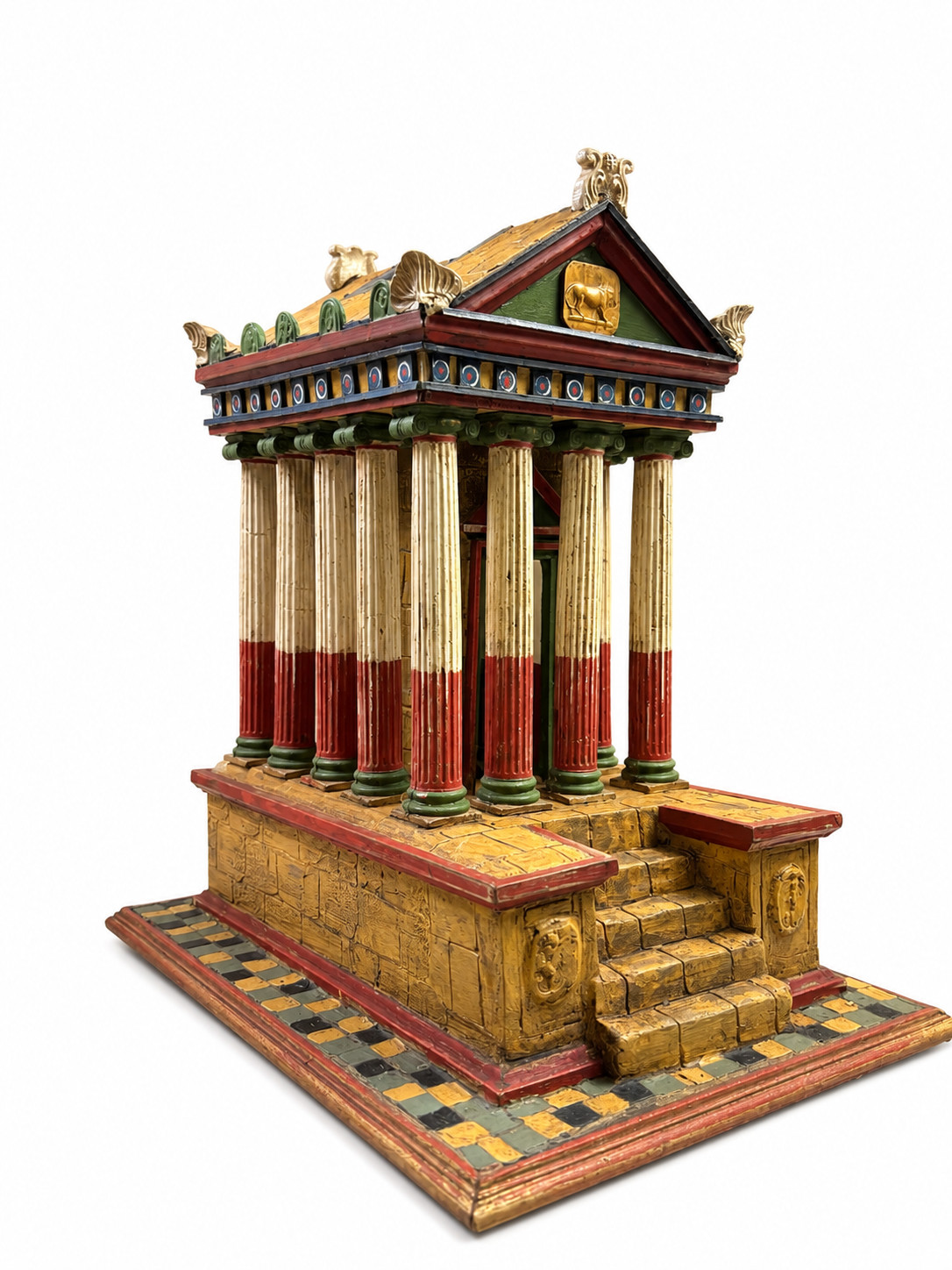
“Grand Tour architectural model, conceived as a historicist interpretation of a temple dedicated to Horus, inspired by the sacred architecture of Ptolemaic Egypt (332–30 BCE).”
A handcrafted Grand Tour architectural model representing a temple dedicated to Horus, conceived as a historicist interpretation of the sacred architecture of Ptolemaic Egypt (332–30 BCE). Executed in carved wood and plaster with hand-applied polychromy, the model draws upon the Greco-Roman Hellenistic architectural vocabulary that emerged from the fusion of Classical and Egyptian traditions during the Ptolemaic period.
The composition is raised upon a handcrafted mosaic podium with gilded borders, supporting a stylobate approached by a central ceremonial stair. The principal elevation is formed as a tetrastyle pronaos with fluted columns carrying a molded entablature beneath a triangular pediment. The roofline is enriched with acroteria, while antefix-inspired ornaments and Egyptian decorative motifs articulate the eaves and ridge, reflecting the hybrid architectural language characteristic of Ptolemaic religious monuments.
Beyond the pronaos lies the naos, containing the cult image of Horus. A centrally positioned oculus, incorporated into the roof directly above the sanctuary, admits natural light into the interior, illuminating the cult statue and emphasizing the spatial hierarchy of the sacred chamber. This architectural feature forms an integral part of the model’s design and demonstrates an informed interpretation of light as a symbolic element within ancient religious architecture.
Throughout the model, architectural surfaces are textured to evoke ashlar masonry, while molded relief panels, polychrome architectural members, and sculptural ornament contribute to a composition that balances Classical proportion with Egyptian iconography. Rather than reproducing a single documented monument, the model presents a scholarly architectural synthesis inspired by the monumental temples of Ptolemaic Egypt and the tradition of nineteenth-century Grand Tour architectural models produced for collectors, antiquarians, and academic study.
Dimensions:Height: 14 in. (35.6 cm)Width: 9½ in. (24.1 cm)Depth: 13¼ in. (33.7 cm)