When you click on links to various merchants on this site and make a purchase, this can result in this site earning a commission. Affiliate programs and affiliations include, but are not limited to, the eBay Partner Network.
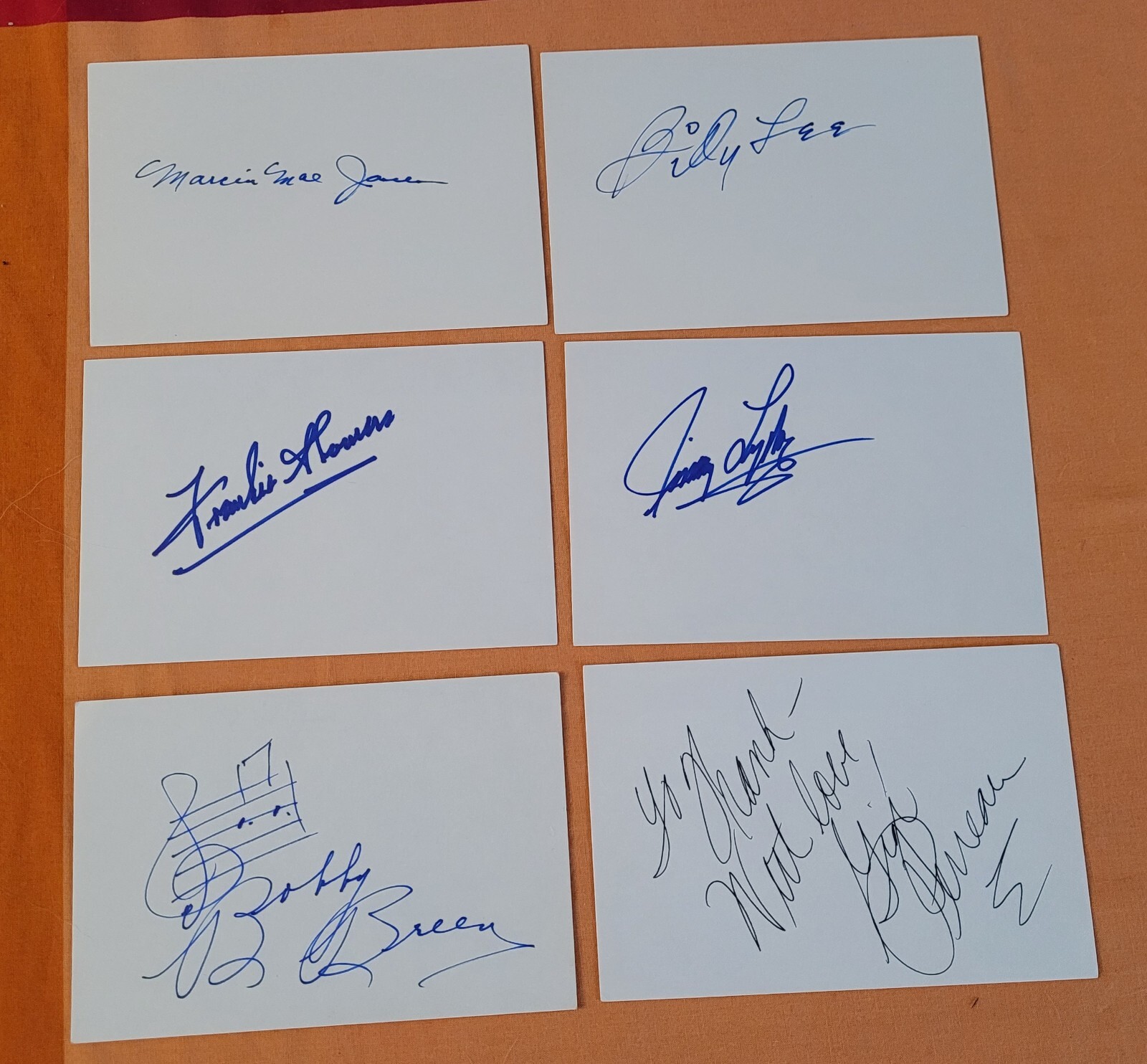
This amazing lot of vintage autographed cards features some of the most beloved child actors of all time. Each card is a unique piece of Hollywood history, signed by the stars themselves. You\'ll find famous names like
BOBBY BREENFRANKIE THOMASGIGI PERREAUBILLY LEEJIMMY LYDONMARCIA MAE JONESLEE AAKERTED DONALDSONTINA YOTHERSSANDRA DESCHERJAY UNDERWOODMARGARET O\'BRIENMARGARET O\'BRIENJOHNNY SHEFFIELDTOMMY BUTCH BONDEDITH FELLOWSJEAN SIMMONSJUNE LOCKHARTJON PROVOSTTONY DOWGIGI PERREAUThese cards are a must-have for any serious collector of Hollywood memorabilia. They are all original and authentic, with signatures that have been verified by experts. Don\'t miss your chance to own a piece of the golden age of Hollywood with this incredible collection of autographed cards.Ghislaine Elizabeth Marie Thérèse Perreau-Saussine was born in Los Angeles to French-born Robert and Eleanor Child Perreau-Saussine.[1]Gerald and Gigi Perreau in a trailer for Enchantment.Her elder brother Gerald (stage name Peter Miles) and, to a lesser extent, her younger sisters Janine and Lauren, also had a measure of success in film and on television. Gigi and Gerald appeared together in the 1948 film Enchantment. She and Janine portrayed sisters on screen in 1951\'s Week-End with Father.[2]
CareerPerreau achieved success as a child actress in a number of films. She got into the business quite by accident. Her older brother Gerald was trying out for the part of the title character\'s son in Madame Curie (1943). Because their mother could not find a babysitter, she took Gigi along.[3] The two-year-old, who could speak French, got the (uncredited) part of Madame Curie\'s daughter Ève (while Gerald would have to wait a year to make his film debut in Passage to Marseille).[3]Perreau with Sal Mineo signing autographs at the 1956 premiere of The Man in the Gray Flannel SuitShe also played the daughter of Claude Rains and Bette Davis\'s characters in the 1944 film Mr. Skeffington (1944). In Shadow on the Wall (1950), she starred as the sole witness to a murder. As the \"top child movie actress for 1951\", the then ten-year-old was given the keys to the city of Pittsburgh by its mayor, and later Pennsylvania governor, David L. Lawrence. She was the youngest person to be so honored.[4] Perreau played the rebellious teen daughter of Fredric March in 1956\'s The Man in the Gray Flannel Suit. However, her film career lost momentum as she became an adult, so she turned to television.
In 1959, she played a friend of character Mary Stone (Shelley Fabares) on ABC\'s The Donna Reed Show, and had a supporting role in the sitcom The Betty Hutton Show on CBS, with her brother Gerald. In 1960, Perreau and Robert Harland performed as Sara Lou and Lin Proctor, a young couple from the east who have eloped and are heading west, in the ABC western series Stagecoach West episode \"The Land Beyond\", with Wayne Rogers and Robert Bray. Also in 1960, Perreau was cast as Julie Staunton in the episode \"Flight from Terror\" of the ABC adventure series The Islanders, set in the South Pacific. She was cast in two episodes, \"Don Gringo\" (1960) and \"The Promise\" (1961), of the Nick Adams ABC western series The Rebel. In 1961, she played Mary Bettelheim in the episode \"The Twelfth Hour\" of the ABC/Warner Brothers television crime drama The Roaring 20s. She was cast in a recurring role on ABC\'s Follow the Sun series from 1961–1962 as a secretary, Katherine Ann \"Kathy\" Richards. She guest-starred on The Rifleman in 1960 and 1961.[5] She made two guest appearances on Perry Mason: in 1958 as title character and defendant Doris Bannister in \"The Case of the Desperate Daughter\" and in 1964 as nurse Phyllis Clover in \"The Case of the Sleepy Slayer.\" In 1964, she also co-starred as Lucy, a beleaguered homesteader, on an episode of Gunsmoke titled \"Chicken\". In 1970, she appeared on the sitcom The Brady Bunch in the episode \"The Undergraduate\", portraying a math teacher who becomes the object of puppy love by Greg Brady, one of her students. On 12/17/1974 she appeared as Iris Cooley on Adam-12
In the 2000s, she provided her voice in the animated films Fly Me to the Moon (2008), A Turtle\'s Tale: Sammy\'s Adventures (2010) and Crash: The Animated Movie (2017), and acted in Time Again (2011).
Personal lifePerreau, 19, married 35-year-old Emil Frank Gallo, a business executive, in 1960; it was the first marriage for both parties.[6] They had two children: Gina Maria Gallo Paris, a filmmaker, and Robert Anthony Gallo, a guitarist. They divorced in 1967.
She wed Gene Harve deRuelle in 1970, a production manager and son of director Harve Foster, with whom she had two additional children: Danielle deRuelle Bianco and Keith deRuelle. Her second marriage ended in 2000.
AffiliationsPerreau is an alumna of Immaculate Heart High School in Los Angeles and has taught drama classes there. As of 2010, she was a member of the board of directors of both the Donna Reed Foundation for the Performing Arts and the Will Geer Theatricum Botanicum and is the vice-president of the Drama Teachers Association of Southern California.[7]
She was a drama teacher for Meghan Markle. She was a guest of ITN at Markle\'s wedding in 2018 and was recognised by her in the crowd.[8]
HonorsOn February 8, 1960, Perreau was awarded a star on the Hollywood Walk of Fame for her work in television.[9]
On March 14, 1998, she was honored by the Young Artist Foundation with its Former Child Star \"Lifetime Achievement\" Award in recognition of her outstanding achievements within the entertainment industry as a child actress.[10]
FilmographyYear Title Role Note1943 Madame Curie Ève Curie Uncredited1944 Two Girls and a Sailor Jean as a child UncreditedMr. Skeffington Fanny at age 2 As Ghislaine PerreauThe Seventh Cross Annie Roeder UncreditedThe Master Race Baby As Ghislaine PerreauDark Waters Girl Uncredited1945 God Is My Co-Pilot Robin Lee Scott UncreditedVoice of the Whistler Bobbie Yolanda and the Thief Gigi As Ghislaine Perreau1946 To Each His Own Virgie Ingham UncreditedHigh Barbaree Young Nancy UncreditedAlias Mr. Twilight Susan As Gi-Gi Perreau1947 Song of Love Julie Green Dolphin Street Veronica 1948 The Sainted Sisters Beasley girl UncreditedEnchantment Lark as a Child 1949 Family Honeymoon Zoe Roseanna McCoy Allifair McCoy Song of Surrender Faith Beecham My Foolish Heart Ramona 1950 Shadow on the Wall Susan Starrling Never a Dull Moment Tina For Heaven\'s Sake Item 1951 The Lady Pays Off Diane Braddock Reunion in Reno Margaret \'Maggie\' Angeline Linaker Week-End with Father Anne Stubbs 1952 Has Anybody Seen My Gal? Roberta Blaisdell Bonzo Goes to College Betsy 1955 There\'s Always Tomorrow Ellen 1956 The Man in the Gray Flannel Suit Susan Hopkins Dance with Me, Henry Shelley 1958 The Cool and the Crazy Amy Wild Heritage \'Missouri\' Breslin 1959 Girls Town Serafina 1961 Look in Any Window Eileen Lowell Tammy Tell Me True Rita 1967 Hell on Wheels Sue Journey to the Center of Time Karen White 1977 High Seas Hijack Patricia Haber English version2008 Fly Me to the Moon Amelia Voice, uncredited2010 A Turtle\'s Tale: Sammy\'s Adventures Whale Voice2011 Time Again Old Lady 2017 Crash: The Animated Movie Grandma Swift VoiceTelevision creditsYear Series Episode Role Notes1958 Perry Mason \"The Case of the Desperate Daughter\" Doris Bannister 1959 Alfred Hitchcock Presents \"Graduating Class\" Gloria Barnes aired December 271960 Rawhide \"Incident at Poco Tiempo\" Sister Joan 1960 The Rifleman \"Heller\" Daughter Heller 1961 The Rifleman \"Deathtrap\" Daughter VickyLee William Aaker (September 25, 1943 – April 1, 2021)[1] was an American child actor, producer, carpenter, and ski instructor known for his appearance as Rusty of \"B-Company\" in the 1950s television program The Adventures of Rin Tin Tin. He was the final surviving cast member of the series. In 1952, Lee Aaker appeared in Desperate Search with Howard Keel and Keenan Wynn.
Early yearsAaker\'s mother, Mrs. Myles Wilbour,[2] was the owner of a dancing school in Los Angeles.[3] (Another source says that she \"ran a children\'s theatre academy\" and that when Aaker was 4, she had him \"singing and dancing at local clubs.\")[4]
FilmOn television as a young child, he started appearing uncredited at the age of 8 in films such as The Greatest Show on Earth (1952) and High Noon (1952).[1] He quickly moved to featured status by the end of that year.
He showed talent as the kidnapped \"Red Chief\" in a segment of the film O. Henry\'s Full House (1952) and another kidnap victim as the son of scientist Gene Barry in The Atomic City (1952).
In 1953, he co-starred in the John Wayne western classic Hondo (1953) as the curious blond son of homesteader Geraldine Page.[1]
He also appeared in other film styles such as the film noir thriller Jeopardy (1953) with Barbara Stanwyck, the horse opera drama Arena (1953) with Gig Young, and the comedies Mister Scoutmaster (1953) with Clifton Webb and Ricochet Romance (1954) with Marjorie Main.
TelevisionIn 1953–54, Aaker was among the many child actors who auditioned for the role of \"Jeff Miller\" on the original 1954 Lassie series, which later aired as Jeff\'s Collie. That role went to Tommy Rettig. Two weeks later, Aaker won the role of \"Rusty\" on The Adventures of Rin-Tin-Tin, co-starring James Brown (1920–1992) as Lieutenant Ripley \"Rip\" Masters.[1]
Aaker and Rettig were friends, and both shows were popular with audiences. The two actors and the two star dogs appeared together in a photograph used on the cover of the July 2, 1955 issue of TV Guide.[3]: 236
Later yearsAaker told a newspaper reporter that when he reached the age of 21, he was paid a $10,000 lump sum (equivalent to $98,200 in 2023) by the studio that produced Rin Tin Tin \"and he spent the rest of the \'60s traveling around the world \'as sort of a flower child.\'\"[5] Unable to find work as an adult actor, Aaker got involved as a producer and later worked as a carpenter.[1]
Personal lifeIn the late 1960s, Aaker was married to Sharon Ann Hamilton for two years.[4] He resided in Mammoth Lakes, California, for many years and was the first adaptive sports instructor for Disabled Sports Eastern Sierra at Mammoth Mountain.[1]
According to Paul Petersen, an advocate for former child actors, Aaker experienced poverty toward the end of his life, and had struggled for years with substance abuse. Petersen said Aaker had suffered a stroke and died in Maricopa County, Arizona, near the city of Mesa, on April 1, 2021, and was listed as an \"indigent decedent\". Petersen was arranging Aaker\'s burial.[6] As a US Air Force veteran during the Vietnam War, he was buried at the National Memorial Cemetery of Arizona in Phoenix.
RecognitionIn 2005, Aaker won the Golden Boot Award[7] as Kids of the West.
FilmographyFilmYear Title Role Notes1951 Benjy Benjy 1952 The Greatest Show on Earth Boy Uncredited1952 Something to Live For Alternate Boy Uncredited1952 My Son John Boy Scenes deleted1952 No Room for the Groom Donovan 1952 High Noon Boy Uncredited1952 The Atomic City Tommy Addison 1952 O. Henry\'s Full House J. B. Dorset aka Red Chief (The Ransom of Red Chief) 1952 Desperate Search Don Heldon 1952 Hans Christian Andersen Little Boy Uncredited1953 Jeopardy Bobby Stilwin 1953 Take Me to Town Corney Hall 1953 Arena Teddy Hutchins 1953 Mister Scoutmaster Arthur 1953 A Lion Is in the Streets Johnny Briscoe Uncredited1953 Hondo Johnny Lowe 1954 Ride Clear of Diablo Boy Uncredited1954 The Raid Larry\'s Friend Uncredited1954 Her Twelve Men Michael Elliott Uncredited1954 Ricochet Romance Timmy Williams 1954 Destry Eli Skinner 1954 Black Tuesday Little Boy Uncredited1957 The Challenge of Rin Tin Tin Rusty 1963 Bye Bye Birdie Student leader TelevisionYear Title Role Notes1952 Your Jeweler\'s Showcase Episode: \"Teacher of the Year\"1953 Fireside Theatre Sandy Episode: \"The Boy Down the Road\"1953–1954 The Ford Television Theatre Tony Evans / Joey 3 episodes1953–1955 Letter to Loretta Jimmy Preston / Myron 2 episodes1954 Schlitz Playhouse of Stars Episode: \"Pearl-Handled Guns\"1954 General Electric Theater Tim Kelly Episode: \"Wild Luke\'s Boy\"1954–1959 The Adventures of Rin Tin Tin Rusty 164 episodes1955 The Adventures of Spin and Marty on Walt Disney Presents Russell 1955 The Lone Ranger Tommy Righter Episode: \"The School Story\"1955 Screen Directors Playhouse Cowhide Episode: \"The Brush Roper\"1956–1957 The Ford Show, Starring Tennessee Ernie Ford (two Christmas episodes, with Rin Tin Tin) 1957 Tales of the 77th Bengal Lancers Govinda Episode: \"The Glass Necklace\"1959 The Millionaire Tommy Spencer Episode: \"Millionaire Henry Banning\"1959 Rescue 8 Billy Episode: \"Runaway\"1959–1961 The Donna Reed Show Walter the Wizard / Kenny 2 episodes1959–1962 Disneyland Willy / Chuck Taylor 4 episodes1960 Make Room For Daddy Charles Crane Episode: \"Rusty Meets Little Lord Fauntleroy\"1963 The Lucy Show Cadet Blake Episode: \"Lucy and the Military Academy\"References
Isadore Borsuk (November 4, 1927 – September 19, 2016), better known as Bobby Breen, was a Canadian-born American actor and singer. He was a popular male child singer during the 1930s and reached major popularity with film and radio appearances.[1]
Early lifeBreen was born Isadore Borsuk[2][3] on November 4, 1927[4] (according to some sources he was born in 1928)[3][5] in Montréal, Canada, the son of Hyman (Chaim) and Rebecca Borsuk. His parents were poor Jewish immigrants from Russian Empire. They, along with Breen\'s three older siblings (Gertrude, Sally, and Michael), migrated from Kiev to Montreal, Quebec, Canada, in 1927.[6] Soon after, they relocated to Toronto. His singing talent as a boy soprano was discovered at age three by his sister Sally, herself an aspiring musical student who was several years his senior. While their parents did not show any particular interest, Sally decided to help him achieve stardom.[7] With the assistance from her music teacher, Breen got a chance to perform in front of an audience in a nightclub. Soon, he began winning prizes in theatre competitions, providing significant amount of income to the poor family. Due to his gained popularity, the two siblings decided to look for work and recognition in the United States. Financed by Sally, they traveled to Chicago by bus in 1934,[8] where he began working with people such as Gloria Swanson and Milton Berle in local theater productions.[9] Breen later relocated to New York City.[10] The foreign-sounding last name of Borsuk had been anglicised to Breen prior to their arrival in the United States.[7]
Child star at RKO
Bobby Breen and Henry Armetta in Let\'s Sing Again (1936)Breen went to Hollywood in 1935, where he received singing lessons from a vocal coach. Film producer Sol Lesser, who had discovered Jackie Coogan, signed Breen to RKO Radio Pictures.[10] Around this time, he became a regular performer on Eddie Cantor\'s weekly radio show in 1936,[11] where his talents as a boy soprano were appreciated by the listeners. Prior to the release of his first motion picture, Let\'s Sing Again, he was compared to other child stars of the era such as Freddie Bartholomew and Shirley Temple. In terms of his vocalist abilities, he was described as a combination of Allan Jones, Nelson Eddy and Al Jolson. His debut saw him being top-billed with Henry Armetta as his co-star.[12] He sang La donna è mobile, among other songs, in the movie.[13] He also signed a contract with Decca Records and had moderate success with a series of 78 rpm records in the late 1930s.[14] The title song from Let\'s Sing Again (Decca 798) would become a national hit, charting at #14 in the summer of 1936. By the 21st century, Breen was the only male artist with a pre-World War II hit record still living (Rose Marie, who charted as an eight-year-old in 1932 with \"Say That You Were Teasing Me\", died in 2017, a year after Breen).
Satisfied with his debut for the studio, RKO signed a deal with him for three additional movies. He was cast in another musical later the same year called Rainbow on the River, co-starring May Robson and Alan Mowbray. He sang Ave Maria and the film\'s title song Rainbow on the River.[15] Kurt Neumann, who had directed Breen in his first two pictures, worked with him for the last time in Make a Wish in 1937. His co-star was Basil Rathbone.[16] In a 1938 article, he was referred to as one of the rare cases of child actors succeeding in an adult-dominated industry.[17]
By the time he had completed filming Escape to Paradise in 1939, his voice was gradually changing due to puberty.[18] As a result, he retired from the film industry, despite being originally contracted for two additional movies,[19] and instead focused on his education at Beverly Hills High School. He described the sudden voice change in a 1977 article:
When you\'ve been a child star and suddenly find yourself with a husky voice, it\'s hard to convince agents that you\'re not over the hill. I stopped singing at 16 because of the huskiness and took up the piano. I had the knack for it, but never wanted to be a concert pianist. I just wanted to be back in the world I\'d known all my life.[20]
His popularity did not immediately wane during his hiatus, receiving mail from numerous fans across the United States and United Kingdom.[21] He briefly returned to the screen in 1942 to appear as himself in Johnny Doughboy, starring Jane Withers.[22][23][24] As an adult, he expressed skepticism about children working in the entertainment industry.[25]
In the militaryBreen enlisted in the infantry in the U.S. Army during World War II. He and fellow Hollywood actor Mickey Rooney were soon assigned to entertain the troops, despite him having retired from show business.[26] Breen was hospitalized in France in 1945 towards the end of the war.[27] For his war efforts, he was awarded the Bronze Star Medal.[28]
Adult yearsAfter his discharge from the U.S. Army, in 1946, he initially struggled to find work as he returned to show business. He did some theatre work [28] as well as some radio appearances in New York during this period.[29] Because of his voice having changed since becoming an adult, he took singing lessons to reinvent himself by adapting to a new tenor singing style.[30]
Throughout the 1950s and 1960s, he worked as a singer in nightclubs and as a musical performer in stock theatre, later serving as a guest pianist for the NBC Symphony Orchestra on radio, and hosting a local TV show in New York. He also recorded briefly for the Motown label, singing on two singles and produced an unreleased album in 1964 called Better Late Than Never. Berry Gordy had hoped for Breen to become his first white contracted artist, but ultimately changed his mind because the singer did not suit the type of music Motown produced.[31][32] In 1953, Breen appeared on ABC\'s reality show, The Comeback Story, to explain how his career nose-dived as he entered his teen years and how he fought to recover.[33]
Since the 1970s, he and his wife Audrey had been working in Florida as entrepreneurs, booking agents and producers arranging musical shows performed by various entertainers at smaller, affordable venues. The business idea is called a \"condominium circuit\".[11][20] In later years, it has focused on hiring aged stars of the past, including Debbie Reynolds, Mickey Rooney and Ann Blyth.[34]
Personal lifeIn November 1948, he went missing while on a private flight from Waukesha, Wisconsin, to Hayward, Wisconsin.[2] Several planes went searching for him for a day and a half before it was discovered that he had been staying at a hotel anonymously without telling anyone. He was fined 300 U.S. dollars.[35]
Breen married fashion model Jocelyn Lesh on November 9, 1952.[36] The couple had a son, Hunter Keith Breen, in 1954. Four years later, the marriage became unsustainable, with Jocelyn claiming that he had physically injured her. They went their separate ways, but the divorce was not finalized until February 1961.[37] He married the president of the City of Hope National Medical Center, Audrey Howard, in around 1962.[34][38]
He lived with his family in Tamarac, Florida, and worked as the owner/operator of Bobby Breen Enterprises, a local talent agency. Starting in 2002, he made occasional concert appearances.[39]
His sister Sally died in 1999. That same year, he underwent bypass surgery due to blocked arteries in his heart.[40]
DeathHe died of natural causes in Pompano Beach, Florida, on September 19, 2016, three days following the death of his wife.[4]
AwardsOn February 12, 2012, he was the recipient of the \"Forest Trace Honorary Octogenarian: Turn Back Time\" award.[41]
Filmography
With Louise Beavers in Rainbow on the River (1936)Year Title Role1936 Let\'s Sing Again Billy GordonRainbow on the River Philip Ainsworth1937 Make a Wish Chip Winters1938 Hawaii Calls Billy CoulterBreaking the Ice Tommy Martin1939 Fisherman\'s Wharf Tony RomaWay Down South Timothy Reid JrEscape to Paradise Roberto Ramos1942 Johnny Doughboy HimselfTed Donaldson (August 20, 1933 – March 1, 2023) was an American actor.
Early yearsBorn in Brooklyn, New York, Donaldson was the son of singer-composer Will Donaldson and Josephine M. Donaldson née Plant. His mother died when he was 4+1⁄2 months old.[1] His stepmother was radio organist and composer Muriel Pollock.[2] He attended the Professional Children\'s School in New York City.[3]Peggy Ann Garner and Ted Donaldson in A Tree Grows in Brooklyn (1945)CareerDonaldson began his acting career in December 1937 when he appeared in an NBC radio show.[3] In 1941, he played Tiny Tim in a week-long serialized version of Dickens\' A Christmas Carol that was presented on Wheatena Playhouse.[4]
As an 8-year-old, Donaldson portrayed Harlan in the Broadway stage production of Life With Father.[5] In 1943, he performed alongside Gregory Peck in the play Sons and Soldiers.[2]
The performance led to a starring role as Arthur \"Pinky\" Thompson in his first movie, Once Upon a Time (1944), opposite Cary Grant and Janet Blair. Columbia Pictures put him under contract after the film was finished. In 1945, Donaldson was cast in A Tree Grows in Brooklyn, which marked the directorial debut of Elia Kazan.[2]
Donaldson also starred as Danny Mitchell in the 1940s Rusty series of eight films about a German Shepherd dog.[2]
From 1949 to 1954, he played Bud, the son of Robert Young\'s character in the radio version of Father Knows Best.[6] He was offered the same role on the television version of the series, but turned it down, saying, \"I didn\'t want to be typed. I didn\'t want to be a 21-year-old playing a 15- or 16-year-old kid. I wanted to do other things.\"[2] As an adult, he recalled that \"one of the two or three most stupid things I have not done because not only would the salary have been very nice for five years, but the residuals would have also.\"[2]
He retired from acting in 1976.
As an adult, Donaldson worked as an acting teacher and as a bookseller.[7] In his later years, Donaldson gave a number of interviews about his film career.[8]
In January 2023, Donaldson suffered a fall in his Echo Park apartment. He died of complications from the fall on March 1, 2023, at the age of 89.[7]
FilmographyOnce Upon a Time (1944) as Arthur \"Pinky\" ThompsonMr. Winkle Goes to War (1944) as BarryA Tree Grows in Brooklyn (1945) as Neeley NolanA Guy, a Gal and a Pal (1945)Adventures of Rusty (1945) as Danny MitchellThe Return of Rusty (1946)Personality Kid (1946)For the Love of Rusty (1947) as Danny MitchellThe Son of Rusty (1947)The Red Stallion (1947) as Joel CurtisMy Pal (1947)Pal\'s Adventure (1948)My Dog Rusty (1948)Rusty Leads the Way (1948)The Decision of Christopher Blake (1948)Rusty Saves a Life (1949)The Green Promise (1949) as Phineas MatthewsRusty\'s Birthday (1949)Phone Call from a Stranger (1952)Flight Nurse (1953) (uncredited)Wiggle Your Ears (1956) (uncredited)
Our Gang (also known as The Little Rascals or Hal Roach\'s Rascals) is an American series of comedy short films chronicling a group of poor neighborhood children and their adventures. Created by film producer Hal Roach, also the producer of the Laurel and Hardy films, Our Gang shorts were produced from 1922 to 1944, spanning the silent film and early sound film periods of American cinema. Our Gang is noted for showing children behaving in a relatively natural way; Roach and original director Robert F. McGowan worked to film the unaffected, raw nuances apparent in regular children, rather than have them imitate adult acting styles. The series also broke new ground by portraying white and black children interacting as equals during the Jim Crow era of racial segregation in the United States.[1]
The franchise began in 1922 as a silent short subject series produced by the Roach studio and released by Pathé Exchange. Roach changed distributors from Pathé to Metro-Goldwyn-Mayer (MGM) in 1927, and the series entered its most popular period after converting to sound in 1929. Production continued at Roach until 1938, when the Our Gang production unit was sold to MGM, where production continued until 1944. Across 220 short films and a feature-film spin-off, General Spanky, the Our Gang series featured more than 41 child actors as regular members of its cast.
As MGM retained the rights to the Our Gang trademark after buying the series, the Roach-produced Our Gang sound films were re-released to theaters and syndicated for television under the title The Little Rascals.
The Roach-produced Little Rascals shorts (1929–1938) are currently owned by Chicken Soup for the Soul Entertainment (through Halcyon Studios), which manages the copyrights as well as theatrical and home video and streaming releases, while Paramount Global (through King World Productions) owns the television distribution rights to the 1929–1938 Roach-era shorts for broadcast and cable. Meanwhile, MGM\'s Our Gang series (1938–1944) is currently owned by Warner Bros. through Turner Entertainment Co.
Any short released before 1929 is public domain, owing to the Copyright Law of the United States.
New productions based on the shorts have been made over the years, including the 1994 feature film, The Little Rascals, released by Universal Pictures.
Series overviewUnlike many motion pictures featuring children and based in fantasy, producer/creator Hal Roach rooted Our Gang in real life: most of the children were poor, and the gang was often at odds with snobbish \"rich kids\", officious adults, parents, and other such adversaries.[1]
Directorial approachSenior director Robert F. McGowan helmed most of the Our Gang shorts until 1933, assisted by his nephew Anthony Mack. McGowan worked to develop a style that allowed the children to be as natural as possible, downplaying the importance of the filmmaking equipment. Scripts were written for the shorts by the Hal Roach comedy writing staff, which included at various times Leo McCarey, Frank Capra, Walter Lantz, and Frank Tashlin, among others.[2] The children, some too young to read, rarely saw the scripts; instead, McGowan would explain the scene to be filmed to each child immediately before it was shot, directing the children using a megaphone and encouraging improvisation.[2]
When sound came in at the end of the 1920s, McGowan modified his approach slightly, but scripts were not adhered to until McGowan left the series. Later Our Gang directors, such as Gus Meins and Gordon Douglas, streamlined the approach to McGowan\'s methods to meet the demands of the increasingly sophisticated movie industry of the mid-to-late 1930s.[2] Douglas, in particular, had to streamline his films, as he directed Our Gang after Roach halved the running times of the shorts from two reels (20 minutes) to one reel (10 minutes).[2]
Finding and replacing the castAs children aged out of their roles, they were replaced by new children, usually from the Los Angeles area. Eventually Our Gang talent scouting employed large-scale national contests in which thousands of children tried out for an open role. For example, Norman Chaney (\"Chubby\"), Matthew Beard (\"Stymie\"), and Billie \"Buckwheat\" Thomas all won contests to become members of the cast: Chaney replaced Joe Cobb, Beard replaced Allen Hoskins (\"Farina\"), and Thomas replaced Beard.[3][4][5]
Even when there was no talent search, the studio was bombarded by requests from parents who were sure their children were perfect for the series. Among them were the future child stars Mickey Rooney and Shirley Temple, neither of whom made it past the audition.[6]
African-American and other minority cast members
The theatrical poster for the 1927 Our Gang comedy Baby Brother, in which Allen \"Farina\" Hoskins (center) paints a Black baby with white shoe polish so that he can sell him to a lonely rich boy, Joe Cobb (right), as a baby brotherThe Our Gang series, produced during the Jim Crow era, is notable for being one of the first in cinema history in which African Americans and White Americans were portrayed as equals. The five black child actors who held main roles in the series were Ernie Morrison, Eugene Jackson, Allen Hoskins, Matthew Beard and Billie Thomas. Ernie Morrison was, in fact, the first black actor signed to a long-term contract in Hollywood history[7] and the first major black star in Hollywood history.[8]
The African-American characters have often been criticized as racial stereotypes.[9][10] The Black children spoke (or were indicated as speaking via text titles in the case of the silent entries) in a stereotypical \"Negro dialect\", and several controversial gags revolved directly around their skin color: Matthew Beard\'s Stymie character sweating jet-black ink,[11] Billie Thomas\'s Buckwheat character being given fake \"white measles\" instead of dark ones and supposedly turned into a monkey,[12][13] and so forth. One early Our Gang short, Lodge Night (1924), revolves around the kids forming a parody club based on the Ku Klux Klan (though the Black children are still allowed to join).[14]
In their adult years, actors Morrison, Beard, and Thomas defended the series, arguing that the white characters in the series were similarly stereotyped: the \"freckle-faced kid\", the \"fat kid\", the \"neighborhood bully\", the \"pretty blond girl\", and the \"mischievous toddler\". In an interview on Tom Snyder\'s The Tomorrow Show in 1974, Matthew Beard said of his time in the series that \"I feel it was great. Some of the lines I had to say I didn\'t like, but I never look at it like that. I just try to look at it as mostly a fun thing. We were just a group of kids who were having fun.\"[15] In a separate interview, Ernie Morrison stated, \"When it came to race, Hal Roach was color-blind.\"[16]
Despite the stereotyping and racial gags, Our Gang\'s integrated cast caused it to be disliked by certain theater owners in the southern United States.[14] Early in the existence of Our Gang, these theater owners complained to Pathé that Morrison and Hoskins had too much screen time and their prominence in the shorts would offend white audiences.[14] A later Our Gang spin-off film, Curley (1947), was banned by the Memphis, Tennessee censor board for showing black and white children in school together, a characteristic common to even the earlier shorts.[17] Other minorities, including Asian Americans Sing Joy, Allen Tong (also known as Alan Dong), and Edward Soo Hoo, as well as Italian-American actor Mickey Gubitosi (later known as Robert Blake), were depicted in the series with varying levels of stereotyping.[18]
History
Left to right: Ernie \"Sunshine Sammy\" Morrison, Andy Samuel, Allen \"Farina\" Hoskins, Mickey Daniels and Joe Cobb in a 1923 still from one of the earliest Our Gang comedies1922–1925: early yearsAccording to Roach, the idea for Our Gang came to him in 1921, when he was auditioning a child actress to appear in a film. The girl was, in his opinion, overly made up and overly rehearsed, and Roach waited for the audition to be over. After the girl and her mother left the office, Roach looked out of his window to a lumberyard across the street, where he saw some children having an argument. The children had all taken sticks from the lumberyard to play with, but the smallest child had the biggest stick, and the others were trying to force him to give it to the biggest child. After realizing that he had been watching the children bicker for 15 minutes, Roach thought a short film series about children just being themselves might be a success.[19]
Our Gang also had its roots in an aborted Roach short-subject series revolving around the adventures of a black boy called \"Sunshine Sammy\", played by Ernie Morrison.[20] Theater owners then were wary of booking shorts focused on a black boy,[20] and the series ended after just one entry, The Pickaninny, was produced.[20] Morrison\'s \"Sunshine Sammy\" instead became one of the foci of the new Our Gang series.
Under the supervision of Charley Chase, work began on the first two-reel shorts in the new \"kids-and-pets\" series, to be called Hal Roach\'s Rascals, later that year. Director Fred C. Newmeyer helmed the first pilot film, entitled Our Gang, but Roach scrapped Newmeyer\'s work and had former fireman Robert F. McGowan reshoot the short. Roach tested it at several theaters around Hollywood. The attendees were very receptive, and the press clamored for \"lots more of those \'Our Gang\' comedies.\" The colloquial usage of the term Our Gang led to its becoming the series\' second (yet more popular) official title, with the title cards reading \"Our Gang Comedies: Hal Roach presents His Rascals in...\"[21] The series was officially called both Our Gang and Hal Roach\'s Rascals until 1932, when Our Gang became the sole title of the series.
The first cast of Our Gang was recruited primarily of children recommended to Roach by studio employees, with the exception of Ernie Morrison, who was already under contract to Roach. The other Our Gang recruits included Roach photographer Gene Kornman\'s daughter Mary Kornman, their friends\' son Mickey Daniels, and family friends Allen Hoskins, Jack Davis, Jackie Condon, and Joe Cobb. Most early shorts were filmed outdoors and on location and featured a menagerie of animal characters, such as Dinah the Mule.
Roach\'s distributor Pathé released One Terrible Day, the fourth short produced for the series, as the first Our Gang short on September 10, 1922; the pilot Our Gang was not released until November 5. The Our Gang series was a success from the start, with the children\'s naturalism, the funny animal actors, and McGowan\'s direction making a successful combination. The shorts did well at the box office, and by the end of the decade the Our Gang children were pictured on numerous product endorsements.
The biggest Our Gang stars then were Ernie Morrison as Sunshine Sammy, Mickey Daniels, Mary Kornman, and Allen Hoskins as little Farina, who eventually became the most popular member of the 1920s gang[22] and the most popular black child star of the 1920s.[23] A reviewer wrote of the Farina character — depicted as female though played by a male child[24] — in Photoplay: \"The honors go to a very young lady of color, billed as \'Little Farina.\' Scarcely two years old, she goes through each set like a wee, sombre shadow.\"[25] Daniels and Kornman were very popular and were often paired in Our Gang and a later teen version of the series called The Boy Friends, which Roach produced from 1930 to 1932. Other early Our Gang children were Eugene Jackson as Pineapple, Scooter Lowry, Andy Samuel, Johnny Downs, Winston and Weston Doty, and Jay R. Smith.
1926–1929: new faces and new distributorsAfter Ernie, Mickey and Mary left the series in the mid-1920s, the Our Gang series entered a transitional period. The stress of directing child actors forced Robert McGowan to take doctor-mandated sabbaticals for exhaustion,[26] leaving his nephew Robert A. McGowan (credited as Anthony Mack) to direct many shorts in this period. The Mack-directed shorts are considered among the lesser entries in the series.[27] New faces included Bobby Hutchins as Wheezer, Harry Spear, Jean Darling and Mary Ann Jackson, while stalwart Farina served as the series\' anchor.
Also at this time, the Our Gang cast acquired an American Pit Bull Terrier with a ring around one eye, originally named Pansy but soon known as Pete the Pup, the most famous Our Gang pet. In 1927, Roach ended his distribution arrangement with the Pathé company. He signed on to release future products through the newly formed Metro-Goldwyn-Mayer, which released its first Our Gang comedy in September 1927. The move to MGM offered Roach larger budgets and the chance to have his films packaged with MGM features to the Loews Theatres chain.
Some shorts around this time, particularly Spook Spoofing (1928, one of only two three-reelers in the Our Gang canon), contained extended scenes of the gang tormenting and teasing Farina, scenes which helped spur the claims of racism, which many other shorts did not warrant. These shorts marked the departure of Jackie Condon, who had been with the group from the beginning of the series.Jackie Cooper in the 1930 short School\'s Out1928–1931: entering the sound eraStarting in 1928, Our Gang comedies were distributed with phonographic discs that contained synchronized music-and-sound-effect tracks for the shorts. In spring 1929, the Roach sound stages were converted for sound recording, and Our Gang made its \"all-talking\" debut in April 1929 with the 25-minute film Small Talk. It took a year for McGowan and the gang to fully adjust to talking pictures, during which time they lost Joe Cobb, Jean Darling and Harry Spear and added Norman Chaney, Dorothy DeBorba, Matthew \"Stymie\" Beard, Donald Haines and Jackie Cooper.
Cooper proved to be the personality the series had been missing since Mickey Daniels left and was featured prominently in three 1930/1931 Our Gang films: Teacher\'s Pet, School\'s Out, and Love Business. These three shorts explored Jackie Cooper\'s crush on the new schoolteacher Miss Crabtree, played by June Marlowe. Cooper soon won the lead role in Paramount\'s feature film Skippy, and Roach sold his contract to MGM in 1931. Other Our Gang members appearing in the early sound shorts included Buddy McDonald, Clifton Young, and Shirley Jean Rickert. Many also appeared in a group cameo appearance in the all-star comedy short The Stolen Jools (1931).
Beginning with the short When the Wind Blows, in 1930 background music scores were added to the soundtracks of most of the Our Gang films. Initially, the music consisted of orchestral versions of then-popular tunes. Marvin Hatley had served as the music director of Hal Roach Studios since 1929, and RCA employee Leroy Shield joined the company as a part-time musical director in mid-1930. Hatley and Shield\'s jazz-influenced scores, first featured in Our Gang with 1930s Pups is Pups, became recognizable trademarks of Our Gang, Laurel and Hardy, and the other Roach series and films.
Another 1930 short, Teacher\'s Pet, marked the first use of the Our Gang theme song, \"Good Old Days\". Originally composed by Shield for use in Laurel & Hardy\'s first feature, Pardon Us,[28] \"Good Old Days,\" featuring a notable saxophone solo, served as the series\' theme until 1938.[28] Shield and Hatley\'s scores supported Our Gang\'s on-screen action regularly through 1934, after which series entries with background scores became less frequent.
In 1930, Roach began production on The Boy Friends, a short-subject series which was essentially a teenaged version of Our Gang. Featuring Our Gang alumni Mickey Daniels and Mary Kornman among its cast, The Boy Friends was produced for two years, with fifteen installments in total.The gang races rich-kid Jerry Tucker in their makeshift fire engine in the 1934 short Hi\'-Neighbor!1931–1933: transitionJackie Cooper left Our Gang in early 1931 just before another wave of cast changes: Farina Hoskins, Chubby Chaney, and Mary Ann Jackson all departed a few months afterward. Our Gang entered another transitional period, similar to that of the mid-1920s. Matthew Beard, Wheezer Hutchins, and Dorothy DeBorba carried the series during this period, aided by Sherwood Bailey and Kendall McComas, who would play Breezy Brisbane. Unlike the mid-1920s period, McGowan sustained the quality of the series with the help of the several regular cast members and the Roach writing staff. Many of these shorts include early appearances of Jerry Tucker and Wally Albright, who later became series regulars.
New Roach discovery George McFarland joined the gang as Spanky late in 1931 at the age of three and remained an Our Gang actor for eleven years, except for a brief break in summer 1938. At first appearing as the tag-along toddler of the group, and later finding an accomplice in Scotty Beckett in 1934, Spanky quickly became Our Gang\'s biggest child star. He won parts in a number of outside features, appeared in many of the now-numerous Our Gang product endorsements and spin-off merchandise items, and popularized the expressions \"Okey-dokey!\" and \"Okey-doke!\"[29]
Dickie Moore, a veteran child actor, joined in the middle of 1932 and remained with the series for one year. Other members in these years included Mary Ann Jackson\'s brother Dickie Jackson, John \"Uh-huh\" Collum, and Tommy Bond. Upon Dickie Moore\'s departure in mid 1933, long-term Our Gang members such as Wheezer (who had been with Our Gang since the late Pathé silents period) and Dorothy left the series as well.
1933–1936: new directionsRobert McGowan, burned out from the stress of working with the child actors, had as early as 1931 tried to resign as producer/director of Our Gang.[26] Lacking a replacement, Hal Roach persuaded him to stay on for another year.[26] At the start of the 1933–34 season, the Our Gang series format was significantly altered to accommodate McGowan and persuade him to stay another year.[26] The first two entries of the season in fall 1933, Bedtime Worries and Wild Poses (which featured a cameo by Laurel and Hardy), focused on Spanky and his hapless parents, portrayed by Gay Seabrook and Emerson Treacy, in a family-oriented situation comedy format similar to the style later popular on television. A smaller cast of Our Gang kids—Matthew Beard, Tommy Bond, Jerry Tucker, and Georgie Billings—were featured in supporting roles with reduced screen time.
An unsatisfied McGowan abruptly left after Wild Poses. Coupled with a brief suspension in McFarland\'s work permit,[30] Our Gang went into a four-month hiatus, during which the series was revised to a format similar to its original style and German-born Gus Meins was hired as the new series director.[26]
Hi-Neighbor!, released in March 1934, ended the hiatus and was the first series entry directed by Meins, a veteran of the once-competing Buster Brown short subject series. Gordon Douglas served as Meins\'s assistant director, and Fred Newmeyer alternated directorial duties with Meins for a handful of shorts. Meins\'s Our Gang shorts were less improvisational than McGowan\'s and featured a heavier reliance on dialogue.[31] McGowan returned two years later to direct his Our Gang swan song, Divot Diggers, released in 1936.
Retaining McFarland, Matthew Beard, Tommy Bond, and Jerry Tucker, the revised series added Scotty Beckett, Wally Albright, and Billie Thomas, who soon began playing the character of Stymie\'s sister \"Buckwheat\", though Thomas was a male. Semi-regular actors, such as Jackie Lynn Taylor, Marianne Edwards, and Leonard Kibrick as the neighborhood bully, joined the series at this time. Tommy Bond and Wally Albright left in the middle of 1934; Jackie Lynn Taylor and Marianne Edwards would depart by 1935.
Early in 1935, new cast members Carl Switzer and his brother Harold joined Our Gang after impressing Roach with an impromptu musical performance at the studio commissary. While Harold would eventually be relegated to the role of a background player, Carl, nicknamed \"Alfalfa\", eventually replaced Scotty Beckett as Spanky\'s sidekick. Matthew Beard as Stymie left the cast soon after, and the Buckwheat character morphed subtly into a male. That same year, Darla Hood, Patsy May, and Eugene Lee as Porky joined the gang. Scotty Beckett departed for a career in features (he returned in 1939 for two shorts, Cousin Wilbur and Dog Daze).
The final Roach yearsOur Gang was very successful during the 1920s and the early 1930s. However, by 1934, many movie theater owners were increasingly dropping two-reel (20-minute) comedies like Our Gang and the Laurel & Hardy series from their bills and running double feature programs instead. The Laurel & Hardy series went from film shorts to features exclusively in mid 1935. By 1936, Hal Roach began debating plans to discontinue Our Gang until Louis B. Mayer, head of Roach\'s distributor MGM, persuaded Roach to keep the popular series in production.[32] Roach agreed, producing shorter, one-reel Our Gang comedies (ten minutes in length instead of twenty). The first one-reel Our Gang short, Bored of Education (1936), marked the Our Gang directorial debut of former assistant director Gordon Douglas and won the Academy Award for Best Short Subject (One Reel) in 1937.
As part of the arrangement with MGM to continue Our Gang, Roach received the clearance to produce an Our Gang feature film, General Spanky, hoping that he might move the series to features as was done with Laurel & Hardy.[32] Directed by Gordon Douglas and Fred Newmeyer, General Spanky featured characters Spanky, Buckwheat, and Alfalfa in a sentimental, Shirley Temple-esque story set during the American Civil War. The film focused more on the adult leads (Phillips Holmes and Rosina Lawrence) than the children and was a box office disappointment.[33] No further Our Gang features were made.George McFarland, Darla Hood, and Carl Switzer in the \"Club Spanky\" dream sequence from the 1937 short Our Gang Follies of 1938.After years of gradual cast changes, the troupe standardized in 1936 with the move to one-reel shorts. Most casual fans of Our Gang are particularly familiar with the 1936–1939 incarnation of the cast: Spanky, Alfalfa, Darla, Buckwheat, and Porky, with recurring characters such as neighborhood bullies Butch and Woim and the bookworm Waldo. Tommy Bond, an off-and-on member of the gang since 1932, returned to the series as Butch beginning with the 1937 short Glove Taps. Sidney Kibrick, the younger brother of Leonard Kibrick, played Butch\'s crony, Woim.
Glove Taps also featured the first appearance of Darwood Kaye as the bespectacled, foppish Waldo. In later shorts, both Butch and Waldo were portrayed as Alfalfa\'s rivals in his pursuit of Darla\'s affections. Other popular elements in these mid-to-late-1930s shorts include the \"He-Man Woman Haters Club\" from Hearts Are Thumps and Mail and Female (both 1937), the Laurel and Hardy-ish interaction between Alfalfa and Spanky, and the comic tag-along team of Porky and Buckwheat.
Roach produced the final two-reel Our Gang short, a high-budget musical special entitled Our Gang Follies of 1938, in 1937 as a parody of MGM\'s Broadway Melody of 1938. In Follies of 1938, Alfalfa, who aspires to be an opera singer, falls asleep and dreams that his old pal Spanky has become the rich owner of a swanky Broadway nightclub where Darla and Buckwheat perform, making \"hundreds and thousands of dollars\".
As the profit margins continued to decline owing to double features,[34] Roach could no longer afford to continue producing Our Gang. However, MGM did not want the series discontinued and agreed to take over production. On May 31, 1938, Roach sold MGM the Our Gang unit, including the rights to the name and the contracts for the actors and writers, for $25,000 (equal to $541,135 today).[35] After delivering the Laurel and Hardy feature Block-Heads, Roach also ended his distribution contract with MGM, moving to United Artists and leaving the short-subjects business. The final Roach-produced short in the Our Gang series, Hide and Shriek, was his final short-subject production.
The MGM eraThe Little Ranger was the first Our Gang short to be produced in-house at MGM. Gordon Douglas was loaned out from Hal Roach Studios to direct The Little Ranger and another early MGM short, Aladdin\'s Lantern, while MGM hired newcomer George Sidney as the permanent series director. Our Gang would be used by MGM as a training ground for future feature directors: Sidney, Edward Cahn and Cy Endfield all worked on Our Gang before moving on to features. Another director, Herbert Glazer, remained a second-unit director outside of his work on the series.
Nearly all of the 52 MGM-produced Our Gangs were written by former Roach director Hal Law and former junior director Robert A. McGowan (also known as Anthony Mack, nephew of former senior Our Gang director Robert F. McGowan). Robert A. McGowan was credited for these shorts as \"Robert McGowan\"; as a result, moviegoers have been confused for decades about whether this Robert McGowan and the senior director of the same name at Roach were two separate people.
The last few of the Roach comedies featured Alfalfa Switzer as the lead character; Spanky McFarland had departed from the series just before its sale to MGM.[36] Casting his replacement was delayed until after the move to MGM, at which point MGM rehired McFarland.[37]
In 1939, Mickey Gubitosi (later known by the stage name of Robert Blake) replaced Eugene \"Porky\" Lee, who had matured too quickly.[38] Tommy Bond, Darwood Kaye, and Alfalfa Switzer all left the series in 1940, and Billy \"Froggy\" Laughlin (with his Popeye-esque trick voice) and Janet Burston were added to the cast. By the end of 1941, Darla Hood had departed from the series, and Spanky McFarland followed her within a year. Billie Thomas as Buckwheat remained in the cast until the end of the series as the sole holdover from the Roach era.
Overall, the Our Gang films produced by MGM were not as well-received as the Roach-produced shorts had been, largely due to MGM\'s inexperience with the brand of slapstick comedy that Our Gang was famous for, and to MGM\'s insistence on keeping Alfalfa, Spanky, and Buckwheat in the series as they became teens.[38] The MGM entries are considered by many film historians, and the Our Gang children themselves, to be lesser films than the Roach entries.[39] The children\'s performances were criticized as stilted and stiff, their dialogue being recited instead of spoken naturally. Adult situations often drove the action, with each film often incorporating a moral, a civics lesson, or a patriotic theme.[38] The series was given a permanent setting in the fictitious town of Greenpoint, and the mayhem caused by the Our Gang kids was toned down significantly.
Exhibitors noticed the drop in quality, and often complained that the series was slipping. When six of the 13 shorts released between 1942 and 1943 sustained losses rather than turning profits,[40] MGM discontinued Our Gang.[41] The final short was Dancing Romeo, which was released on April 29, 1944 (as an MGM Miniature, not an Our Gang comedy).
Since 1937, Our Gang had been featured as a licensed comic strip in the UK comic The Dandy, drawn by Dudley D. Watkins. Starting in 1942, MGM licensed Our Gang to Dell Comics for the publication of Our Gang Comics, featuring the gang, Barney Bear, and Tom and Jerry.[42] The strips in The Dandy ended three years after the demise of the Our Gang shorts, in 1947. Our Gang Comics outlasted the series by five years, changing its name to Tom and Jerry Comics in 1949. In 2006, Fantagraphics Books began issuing a series of volumes reprinting the Our Gang stories, mostly written and drawn by Pogo creator Walt Kelly.
Later years and The Little Rascals revivalThe Little Rascals television packageWhen Roach sold Our Gang to MGM, he retained the option to buy the rights to the Our Gang trademark, provided he produced no more children\'s comedies in the Our Gang vein. In the late 1940s, he created a new film property in the Our Gang mold and forfeited his right to buy back the name Our Gang to obtain permission to produce two Cinecolor featurettes, Curley and Who Killed Doc Robbin. Neither film was critically or financially successful, and Roach turned to re-releasing the original Our Gang comedies.
In 1949, MGM sold Roach the back catalog of 1927–1938 Our Gang silent and talking shorts, while retaining the rights to the Our Gang name, the 52 Our Gang films it produced, and the feature General Spanky. Under the terms of the sale, Roach was required to remove the MGM lion studio logo and all instances of the names or logos \"Metro-Goldwyn-Mayer\", \"Loew\'s Incorporated\", and Our Gang from the reissued film prints. Using a modified version of the series\' original name, Roach repackaged 79 of the 80 sound Our Gang shorts as The Little Rascals. By all accounts available, none of the former child stars were ever paid a cent in residuals from this, despite the substantial profits netted.[citation needed] Monogram Pictures and its successor, Allied Artists, reissued the films to theaters beginning in 1950.[43] Allied Artists\' television department, Interstate Television, syndicated the films to TV in 1954.[44][45][46]
Under its new name, The Little Rascals enjoyed renewed popularity on television, and new Little Rascals comic books, toys, and other licensed merchandise were produced. MGM prepared to distribute its own Our Gang shorts to television in 1957,[47] and offers for the shorts to stations began to be made in 1958.[48] The two separate packages of Our Gang films competed with each other in syndication for three decades. Some stations bought both packages and played them alongside each other under the Little Rascals show banner.
The television rights to the silent Pathé Our Gang comedies were sold to National Telepix and other distributors, who distributed the films under titles such as The Mischief Makers and Those Lovable Scallawags with Their Gangs.
King World\'s acquisition and editsIn 1963, Hal Roach Studios, by then run by Roach\'s son Hal Jr, filed for bankruptcy. A struggling novice syndication agent named Charles King purchased the television rights to The Little Rascals in the bankruptcy proceedings and returned the shorts to television. The success of The Little Rascals paved the way for King\'s new company, King World Productions, to grow into one of the largest television syndicators in the world. Currently, Paramount Global, King World\'s latest successor, handles distribution rights.
In 1971, because of controversy over dated racial humor in the shorts and other content deemed to be in bad taste, King World made significant edits to Little Rascals TV prints. Many series entries were trimmed by two to four minutes, while others (among them Spanky, Bargain Day, The Pinch Singer and Mush and Milk) were cut to nearly half of their original length.
At the same time, eight Little Rascals shorts were pulled from the King World television package altogether. Lazy Days, Moan and Groan, Inc., the Stepin Fetchit-guest-starred A Tough Winter, Little Daddy, A Lad an\' a Lamp, The Kid From Borneo, and Little Sinner were deleted from the syndication package because of perceived racism, while Big Ears was deleted for its depiction of carelessly ingesting an assortment of drugs out of a medicine cabinet. The early talkie Railroadin\' was never part of the television package because its soundtrack (recorded on phonographic records) was considered lost, although it was later found and restored to the film.
Turner Entertainment Co. acquired the pre-May 1986 MGM library in 1986, and the 1938–1944 MGM-produced Our Gang shorts were shown on Turner\'s TBS and TNT cable networks for many years as early-morning programming filler, with a regular slot on Sundays at 6 am ET on TNT.
In the early 2000s, the 71 films in the King World package were re-edited, reinstating many (though not all) edits made in 1971 and the original Our Gang title cards. These new television prints made their debut on AMC in 2001 and ran until 2003.
New Little Rascals productionsMany producers, including Our Gang alumnus Jackie Cooper, made pilots for new Little Rascals television series, but none ever went into production.
In 1977, Norman Lear tried to revive the Rascals franchise, taping three pilot episodes of The Little Rascals. The pilots were not bought, but were notable for including Gary Coleman.
1979 brought The Little Rascals Christmas Special, an animated holiday special produced by Murakami-Wolf-Swenson, written by Romeo Muller and featuring the voice work of Darla Hood (who died suddenly before the special aired) and Matthew \"Stymie\" Beard.
From 1982 to 1984, Hanna-Barbera Productions produced a Saturday morning cartoon version of The Little Rascals, which aired on ABC during The Pac-Man/Little Rascals/Richie Rich Show (later The Monchichis/Little Rascals/Richie Rich Show).[49] It starred the voices of Patty Maloney as Darla; Peter Cullen as Petey and Officer Ed; Scott Menville as Spanky; Julie McWhirter Dees as Alfalfa, Porky and The Woim; Shavar Ross as Buckwheat, and B.J. Ward as Butch and Waldo.
In 1994, Amblin Entertainment and Universal Pictures released The Little Rascals, a feature film based loosely on the series and featuring interpretations of classic Our Gang shorts, including Hearts are Thumps, Rushin\' Ballet, and Hi\'-Neighbor! The film, directed by Penelope Spheeris, starred Travis Tedford as Spanky, Bug Hall as Alfalfa, and Ross Bagley as Buckwheat; with cameos by the Olsen twins, Whoopi Goldberg, Mel Brooks, Reba McEntire, Daryl Hannah, Donald Trump and Raven-Symoné.[50] The Little Rascals was a moderate success for Universal, bringing in $51,764,950 at the box office.[51]
In 2014, Universal Pictures released a direct-to-video film, The Little Rascals Save the Day. This was a second film loosely based on the series and featuring interpretations of classic Our Gang shorts, including Helping Grandma, Mike Fright, and Birthday Blues. The film was directed by Alex Zamm, and starred Jet Jurgensmeyer as Spanky, Drew Justice as Alfalfa, Eden Wood as Darla, and Doris Roberts as the kids\' adopted Grandma.
Legacy and influence
Painted cover to Four Color Comics number 674, featuring \"The Little Rascals\" (Dell, January 1956). Artist: David Gantz.The characters in this series are well-known cultural icons, and identified solely by their first names. The characters of Alfalfa, Spanky, Buckwheat, Porky, Darla, Froggy, Butch, Woim, and Waldo were especially well known. Like many child actors, the Our Gang children were typecast and had trouble outgrowing their Our Gang images.
Several Our Gang alumni, among them Carl \"Alfalfa\" Switzer, Scotty Beckett, Norman \"Chubby\" Chaney, Billy \"Froggy\" Laughlin, Donald Haines, Bobby \"Wheezer\" Hutchins, Darla Hood, Matthew \"Stymie\" Beard, Billie \"Buckwheat\" Thomas, and George \"Spanky\" McFarland, died before age 65, in most cases well earlier. This led to rumors of an Our Gang/Little Rascals \"curse\", rumors further popularized by a 2002 E! True Hollywood Story documentary entitled \"The Curse of the Little Rascals\".[52] The Snopes.com website debunks the rumor of an Our Gang curse, stating that there was no pattern of unusual deaths when taking all of the major Our Gang stars into account, despite the deaths of a select few.[53]
The children\'s work in the series was largely unrewarded in later years, although Spanky McFarland was given a star on the Hollywood Walk of Fame posthumously in 1994. Neither he nor any other Our Gang children received any residuals or royalties from reruns of the shorts or licensed products with their likenesses. The only remittances were their weekly salaries during their time in the gang, ranging from $40 a week for newcomers to $200 or more weekly for stars like Farina, Spanky, and Alfalfa.[22]
One notable exception was Jackie Cooper, who was nominated for an Academy Award for Skippy (1931) and had a successful career in feature films as an adolescent and adult actor. Cooper is particularly known today for portraying Perry White in the 1978–1987 Superman movies, and for directing episodes of TV series such as M*A*S*H and Superboy. Another was Robert Blake, who found great success in the 1960s and 1970s as an actor, with films like In Cold Blood (1967) and television shows like Baretta (1975–78), which netted him an Emmy Award.
The 1930 Our Gang short Pups is Pups was an inductee of the 2004 National Film Registry list.[54]
E. L. Doctorow\'s 1975 novel Ragtime ends with the character of Tateh, a Jewish immigrant from Eastern Europe, having a vision of the kind of film he wants to make: \"A bunch of children who were pals, white black, fat thin, rich poor, all kinds, mischievous little urchins who would have funny adventures in their own neighborhood, a society of ragamuffins, like all of us, a gang, getting into trouble and getting out again.\" The implication is that Tateh will go on to produce the Our Gang series.[55]
Imitators, followers, and fraudsDue to the popularity of Our Gang, many similar kid comedy short film series were created by competing studios. Among the most notable are The Kiddie Troupers, featuring future comedian Eddie Bracken; Baby Burlesks, featuring Shirley Temple; the Buster Brown comedies (from which Our Gang received Pete the Pup and director Gus Meins); and Our Gang\'s main competitor, the Toonerville Trolley-based Mickey McGuire series starring Mickey Rooney. Less notable imitations series include The McDougall Alley Gang (Bray Productions, 1927–1928), The Us Bunch and Our Kids. There is evidence[56] that Our Gang-style productions were filmed in small towns and cities around the country using local children actors in the 1920s and 1930s. These productions did not appear to be affiliated with Hal Roach, but often used storylines from the shorts of the period, and sometimes went so far as to identify themselves as being Our Gang productions.
In later years, many adults falsely claimed to have been members of Our Gang. A long list of people, including persons famous in other capacities such as Nanette Fabray, Eddie Bracken, and gossip columnist Joyce Haber[57] claimed to be or have been publicly called former Our Gang children.[58] Bracken\'s official biography was once altered[58] to state that he appeared in Our Gang instead of The Kiddie Troupers, although he himself had no knowledge of the change.[58]
Among notable Our Gang imposters is Jack Bothwell, who claimed to have portrayed a character named \"Freckles\",[58] going so far as to appear on the game show To Tell the Truth in the fall of 1957, perpetuating this fraud.[58] In 2008, a Darla Hood impostor, Mollie Barron, died claiming to have appeared as Darla in Our Gang.[59] Another is Bill English, a grocery store employee who appeared on the October 5, 1990, episode of the ABC investigative television newsmagazine 20/20 claiming to have been Buckwheat. Following the broadcast, Spanky McFarland informed the media of the truth,[58] and in December, William Thomas, Jr. (son of Billie Thomas, the person who played Buckwheat) filed a lawsuit against ABC for negligence.[58]
Persons and entities named after Our GangA number of groups, companies, and entities have been inspired by or named after Our Gang. The folk-rock group Spanky and Our Gang was named for the troupe because lead singer Elaine \"Spanky\" McFarlane\'s last name was similar to that of George \"Spanky\" McFarland. The band had no connection with the actual Our Gang series.
Numerous unauthorized Little Rascals and Our Gang restaurants and day care centers also exist throughout the United States.
FilmographyMain article: Our Gang filmographyHome media1951–1992: 16 mm and VHS releasesIn the 1950s, home movie distributor Official Films released many of the Hal Roach talkies on 16 mm film. These were released as Famous Kid Comedies, as Official could not use Our Gang. The company\'s licensing only lasted for a short period. For years afterward, Blackhawk Films released 79 of the 80 Roach talkies on 8mm and 16 mm film. The sound discs for Railroadin\' had been lost since the 1940s, and a silent print was available for home movie release until 1982, when the film\'s sound discs were located in the MGM vault and the short was restored with sound. Like the television prints, Blackhawk\'s Little Rascals reissues featured custom title cards in place of the original Our Gang logos, per MGM\'s 1949 arrangement with Hal Roach not to distribute the series under its original title. The films were otherwise offered unedited.
In 1983, with the VHS home video market growing, Blackhawk began distributing Little Rascals VHS tapes through catalog orders, with three shorts per tape. Blackhawk Films was acquired in 1983 by National Telefilm Associates, later renamed Republic Pictures. Republic would release Little Rascals VHS volumes for retail purchase in non-comprehensive collections through the rest of the 1980s and early 1990s. By then, all but 11 of the Roach-era sound films were available on home video.
1993–2011: Cabin Fever/Hallmark VHS and DVD releasesIn 1993, Republic Pictures Home Video sold the home video rights for the 80 sound Roach shorts and some available silent shorts to Cabin Fever Entertainment. Cabin Fever acquired the rights to use the original Our Gang title cards and MGM logos, and for the first time in over 50 years, the Roach sound Our Gang comedies could be commercially exhibited in their original formats. The first twelve volumes of Cabin Fever\'s The Little Rascals VHS set were released on July 6, 1994, followed by nine more on July 11, 1995, coinciding with the theatrical and home video releases of Universal\'s 1994 feature.[60][61] Each tape contained four shorts, as well as newly produced introductions by film historian Leonard Maltin.
With these releases, Cabin Fever made all 80 Roach sound shorts, and four silents, available for purchase unedited with digitally restored picture and sound. On August 26, 1997, a limited-edition volume, For Pete\'s Sake, was released in honor of the Rascals\' 75th anniversary with an introduction from original cast member Tommy \"Butch\" Bond and \"Petey\", the dog from the 1994 feature. The video contained three previously released shorts and the previously unreleased silent short Dog Heaven; the VHS tape was also available in a gift set with a Pete plush doll.[62]
Cabin Fever began pressing DVD versions of their first 12 Little Rascals VHS volumes, with the contents of two VHS volumes included on each DVD, but went out of business in 1998 before their release. The Little Rascals home video rights were then sold to Hallmark Entertainment in 1999, who released the DVDs without an official launch while cleaning out their warehouse in early 2000. Hallmark colorized a few Our Gang shorts and released them across 8 VHS tapes. Later that year, the first 10 Cabin Fever volumes were re-released on VHS with new packaging, and the first two volumes were released on DVD as The Little Rascals: Volumes 1–2. Two further Hallmark DVD collections featured ten shorts apiece and were released in 2003 and 2005, respectively.
From 2006 to 2009, Legend Films produced colorized versions of twenty-four Our Gang comedies (23 Roach entries, and the public domain MGM entry Waldo\'s Last Stand), which were released across five Little Rascals DVDs. In 2011, Legend Films released black and white versions of Little Rascals DVDs.
RHI Entertainment and Genius Products released an eight-disc DVD set, The Little Rascals – the Complete Collection, on October 28, 2008.[63][64] This set includes all 80 Hal Roach-produced Our Gang sound short films. Most of the collection uses the 1994 restorations, while 16 shorts are presented with older Blackhawk Films transfers as their remastered copies were lost or misplaced during preparations.[65][66]
On June 14, 2011, Vivendi Entertainment re-released seven of the eight DVD\'s from RHI/Genius Products\' The Little Rascals – The Complete Collection as individual releases. This includes the 80 shorts – replacing the Blackhawk transfers on the previous set with their respective 1994 restorations – but excludes the disc featuring the extras.
1980s–2016: MGM/Warner Bros. releasesDuring the 1980s and 1990s, MGM released several non-comprehensive VHS tapes of its shorts, and a VHS of the feature General Spanky. After video rights for the classic MGM library reverted to their new owner, Warner Bros. (through Turner Entertainment Co.), in the late 1990s, four of the MGM Our Gang shorts appeared as bonus features on Warner Bros.-issued classic film DVD releases.
In 2009, Warner Home Video released all 52 MGM Our Gang shorts in a compilation titled The Our Gang Collection: 1938–1942 (though it contains the 1943–44 shorts as well) for manufacture-on-demand (MOD) DVD and digital download. The set is available by mail order and digital download as part of the Warner Archive Collection, and is available for purchase via the iTunes Store. A MOD release of General Spanky on DVD was also released by Warner Archive in 2016.[67]
There are many unofficial Our Gang and Little Rascals home video collections available from several other distributors, comprising shorts (both silent and sound) which have fallen into the public domain.
2021–2022: ClassicFlix restorations and releasesClassicFlix, a company specializing in releasing classic films and TV series on home media, licensed the home video rights to Hal Roach\'s Our Gang sound shorts from their current owners, Sonar Entertainment.[68]
An Indiegogo fundraiser campaign was launched to finance extensive restorations of the shorts from original 35mm nitrate film sources.[68] When the campaign did not meet its fundraising goal, other sources of financing were sought for the restorations.[69] The first ClassicFlix release, The Little Rascals: The ClassicFlix Restorations, Volume 1, was released on DVD and Blu-Ray on June 1, 2021, featuring the first eleven \"talking\" short subjects in the series from 1929 and 1930.[70] Five further volumes followed through June 2022, comprising the rest of the Hal Roach era shorts through 1938 and also including new restorations of those shorts.[71][72][73]
Status of ownershipCurrently, the rights to the Our Gang/Little Rascals shorts are divided.
Chicken Soup for the Soul Entertainment (formerly known as Sonar Entertainment, RHI Entertainment, Cabin Fever Entertainment and Hallmark Entertainment)[74] (through Halcyon Studios) owns the copyrights of and hold the theatrical rights to the 1929-1938 Roach-produced Our Gang shorts. Halcyon acquired these after absorbing Hal Roach Studios in 1988, and both Roach\'s estate and Cabin Fever Entertainment in the late 1990s.[75]
In 2022, ClassicFlix acquired the rights to the entire Hal Roach-era Our Gang catalog (silent and sound) for home video and streaming release, and completed an extensive 4K restoration of all \"sound-era\" short subjects, by re-scanning from original 35mm master prints, and completing further restoration, image stabilization, and overall digital picture cleanup. In 2023, they also restored the \"silent-era\" Our Gang catalog, with any available elements (some from this era are considered lost films).[76]
Paramount Global subsidiary CBS Media Ventures (through King World) owns the rights to the Little Rascals trademark and has all other media rights to the 1929–1938 Roach shorts, which constitute The Little Rascals broadcast and cable television package, with certain territory exclusions controlled by Cinematographische Commerz-Anstalt. CBS offers original black-and-white and colorized prints for syndication. The King World/CBS Little Rascals package was featured as exclusive programming (in the United States) for AMC from August 2001 to December 2003, with Frankie Muniz hosting. As part of a month-long tribute to Hal Roach Studios, Turner Classic Movies televised a 24-hour marathon of Roach Our Gang shorts – both sound films and silents – on January 4–5, 2011.[77] Some of the silent Our Gangs (such as Mary, Queen of Tots and Thundering Fleas) resurfaced on TCM at this time with new music scores in stereo sound.
The MGM-produced Our Gang shorts and the rights to the Our Gang trademark, as well as the 1936 spin-off film General Spanky, are owned by Warner Bros. Discovery through Turner Entertainment Co. The assets were acquired by Turner Entertainment Co. in 1986 when its founder, Ted Turner, purchased the pre-May 1986 MGM library; Turner merged with the former Time Warner in 1996.[78] The television rights for the MGM Our Gang shorts belong to Warner Bros. Television Distribution, and the video rights to Warner Home Video. The MGM Our Gang shorts today appear periodically on Turner Classic Movies. Until its closure in 2018, the MGM Our Gang shorts were available for streaming via the subscription-based Warner Archive Instant streaming video service.[79]
Any short released in 1929 or before is public domain, owing to the copyright law of the United States.
Cast and personnelFor a detailed listing of the Our Gang child actors, recurring adult actors, directors, and writers, see Our Gang personnel.The following is a listing of the primary child actors in the Our Gang comedies. They are grouped by the era during which they joined the series.
Roach silent periodErnie Morrison as \"Sunshine Sammy\" (1922–1924)Peggy Cartwright (1922)Mickey Daniels (1922–1926)Jackie Condon (1922–1929)Allen Hoskins as \"Farina\" (1922–1931)Jack Davis (1922–1923)Lassie Lou Ahern (1923–1924)Mary Kornman (1923–1926)Peggy Ahern (1923–1927)Joe Cobb (1923–1929)Andy Samuel (1923–1924)Eugene Jackson as \"Pineapple\" (1924–1925)Johnny Downs (1925–1927)Jay R. Smith (1925–1929)Bobby Young as \"Bonedust\" (1925–1931)Scooter Lowry as \"Skooter\" (1926–1927)Jean Darling (1927–1929)Bobby Hutchins as \"Wheezer\" (1927–1933)Harry Spear (1927–1929)Mary Ann Jackson (1928–1931)Pete the Pup (1929–1938)Roach sound periodNorman Chaney as \"Chubby\" (1929–1931)Jackie Cooper (1929–1931)Donald Haines (1929–1933)Dorothy DeBorba as \"Echo\" (1930–1933)Matthew Beard as \"Stymie\" (1930–1935)Jerry Tucker (1931–1938)Kendall McComas as \"Breezy\" Brisbane (1932)Dickie Moore (1932–1933)George McFarland as \"Spanky\" (1932–1942)Tommy Bond (1932–1934 as Tommy, 1937–1940 as \"Butch\")Jackie Lynn Taylor as Jane (1934)Scotty Beckett (1934–1935)Billie Thomas as \"Buckwheat\" (1934–1944)Carl Switzer as \"Alfalfa\" (1935–1940)Darla Hood (1935–1941)Eugene Gordon Lee as \"Porky\" (1935–1939)Darwood Kaye as \"Waldo\" (1937–1940)MGM periodMickey Gubitosi (Robert Blake) (1939–1944)Janet Burston (1940–1944)Billy Laughlin as \"Froggy\" (1940–1944)Notable filmsMain article: Our Gang filmographyThe following is a listing of selected Our Gang comedies, considered by Leonard Maltin and Richard W. Bann (in their book The Little Rascals: The Life and Times of Our Gang) to be among the best and most important in the series.
1923: The Champeen, Derby Day1924: High Society1925: Your Own Back Yard, One Wild Ride1929: Small Talk, Cat, Dog & Co.1930: The First Seven Years, Pups Is Pups, Teacher\'s Pet, School\'s Out1931: Love Business, Little Daddy, Fly My Kite, Dogs Is Dogs1932: Readin\' and Writin\', The Pooch, Free Wheeling, Birthday Blues1933: Fish Hooky, Forgotten Babies, The Kid From Borneo, Mush and Milk, Bedtime Worries1934: Hi\'-Neighbor!, For Pete\'s Sake!, Mama\'s Little Pirate1935: Anniversary Trouble, Shrimps for a Day, Beginner\'s Luck, Our Gang Follies of 19361936: Divot Diggers, Second Childhood1937: Glove Taps, Hearts Are Thumps, Rushin\' Ballet, Night \'n\' Gales, Mail and Female, Framing Youth1938: Three Men in a Tub, Hide and Shriek1939: Alfalfa\'s Aunt, Cousin Wilbur1940: Goin\' Fishin\', Kiddie Kure1942: Going to Press
Marcia Mae Jones (August 1, 1924 – September 2, 2007) was an American film and television actress whose prolific career spanned 57 years.
Early yearsJones was the youngest of four children born to actress Freda Jones. All three of her siblings, Margaret, Macon, and Marvin Jones, were also child actors. Their relationship was strained by their unequal status in the film world. \"I constantly heard, \'You\'ve got to be quiet; Marcia Mae has to learn her lines.\' It was Marcia Mae this and Marcia Mae that. That\'s where the jealousy from my siblings came from. They blamed me for it, when it was my mother who was doing it.\"[1]
CareerJones made her film debut at the age of two in the 1926 film Mannequin. She appeared in films such as King of Jazz (1930), Street Scene (1931),[2] and Night Nurse (1931) before rising to child stardom in the 1930s with roles in The Champ (1931) and, alongside Shirley Temple in Heidi (1937) and The Little Princess (1939).[3] She also starred in films such as The Garden of Allah (1936), These Three (1936), and The Adventures of Tom Sawyer (1938).
Jones blossomed into a wide-eyed, blonde, wholesome-looking teenager, and worked steadily in motion pictures through her late teens. She appeared in First Love (1939), in support of Deanna Durbin. In 1940, Monogram Pictures signed her to co-star with Jackie Moran in a few rustic romances; when this series lapsed, both Jones and Moran joined Monogram\'s popular action-comedy series starring Frankie Darro.
As a young adult, she continued to work in motion pictures, notably in Nine Girls (1944) and Arson, Inc. (1948). Like many familiar faces of the 1940s, she appeared on numerous television programs. In 1951 she appeared as comic foil to Buster Keaton in Keaton\'s filmed TV series. She went on to work in such top-rated shows as The Cisco Kid, The Adventures of Wild Bill Hickok, The George Burns and Gracie Allen Show, Peyton Place, and General Hospital. Her last major role was in the Barbra Streisand film The Way We Were in 1973.[4]
Personal lifeJones was married to Robert Chic and had two sons with him. Her second marriage was to television writer Bill Davenport.[2]
DeathOn September 2, 2007, Jones died in Woodland Hills, California, of complications of pneumonia. She was 83.[5]
Partial filmographyMannequin (1926) - Joan Herrick as a baby (uncredited)Smile, Brother, Smile (1927)The Bishop Murder Case (1929) - Hungry Child in Park (uncredited)King of Jazz (1930) - Bridesmaid (\'My Bridal Veil\') (uncredited)Night Nurse (1931) - Nanny Ritchey (uncredited)Street Scene (1931) - Mary - Little Girl (uncredited)The Champ (1931) - Mary Lou CarletonWhat Price Hollywood? (1932) - Flower Girl at wedding (uncredited)Birthday Blues (1932, Short) - Girl with WhistleEmployees\' Entrance (1933) - Flower Girl at Wedding (uncredited)Mush and Milk (1933, Short) - Orphan (as Our Gang)Doctor Bull (1933) - Ruth - School Girl (uncredited)Imitation of Life (1934) - Peola\'s Frontrow Classmate (uncredited)The County Chairman (1935) - Schoolgirl (uncredited)A Dog of Flanders (1935) - Little Girl at Party (uncredited)This Is the Life (1935) - Girl at Picnic (uncredited)These Three (1936) - RosalieGentle Julia (1936) - Patty Fairchild (uncredited)The Garden of Allah (1936) - Convent Girl #1 (uncredited)Two Wise Maids (1937) - Geraldine \'Jerry \' KarnsMountain Justice (1937) - Bethie HarkinsThe Life of Emile Zola (1937) - Helen RichardsHeidi (1937) - Klara SesemannLady Behave! (1937) - Patricia CormackThe Adventures of Tom Sawyer (1938) - Mary SawyerMad About Music (1938) - OlgaBarefoot Boy (1938) - Pige BlaineThe Little Princess (1939) - LaviniaThe Flying Irishman (1939) - Teenager Posing For Photograph (uncredited)First Love (1939) - Marcia ParkerMeet Dr. Christian (1939) - MarileeTomboy (1940) - Pat KellyAnne of Windy Poplars (1940) - Jen PringleHaunted House (1940) - Mildred \'Millie\' HenshawThe Old Swimmin\' Hole (1940) - Betty ElliottNice Girl? (1941) - Jane\'s Friend at BenefitThe Gang\'s All Here (1941) - Patsy WallaceLet\'s Go Collegiate (1941) - Bess MartinSecrets of a Co-Ed (1942) - Laura WrightThe Youngest Profession (1943) - Vera BaileyNobody\'s Darling (1943) - LoisTop Man (1943) - Erna LaneNine Girls (1944) - Shirley BerkeLady in the Death House (1944) - Suzy Kirk LoganSnafu (1945) - MarthaStreet Corner (1948) - Lois MarshTrouble Preferred (1948) - Virginia EvansTucson (1949) - Polly JohnsonArson, Inc. (1949) - Betty - Fender\'s SecretaryThe Daughter of Rosie O\'Grady (1950) - Katie O\'GradyHi-Jacked (1950) - Jean HarperChicago Calling (1951) - PeggyThe Star (1952) - Waitress (uncredited)Live a Little, Love a Little (1968) - Woman #1 (uncredited)Rogue\'s Gallery (1968) - Mrs. HassanoverThe Way We Were (1973) - Peggy VanderbiltThe Spectre of Edgar Allan Poe (1974) - Sarah
Angela Maxine O\'Brien (born January 15, 1937)[1] is an American actress. Beginning a prolific career in feature films for Metro-Goldwyn-Mayer at age four, O\'Brien became one of the most popular child stars in cinema history and was honored with a Juvenile Academy Award as the outstanding child actress of 1944. In her later career, she has appeared on television, on stage, and in supporting film roles.
Early life and careerMargaret O\'Brien was born Angela Maxine O\'Brien. O\'Brien\'s mother, Gladys Flores, was a flamenco dancer who often performed with her sister Marissa, who was also a dancer. O\'Brien is of half-Irish and half-Spanish ancestry. She was raised Catholic.[2]
Film
This section of a biography of a living person needs additional citations for verification. Please help by adding reliable sources. Contentious material about living persons that is unsourced or poorly sourced must be removed immediately from the article and its talk page, especially if potentially libelous.Find sources: \"Margaret O\'Brien\" – news · newspapers · books · scholar · JSTOR (February 2022) (Learn how and when to remove this message)
Margaret O\'Brien in Journey for Margaret (1942)
Orson Welles, Margaret O\'Brien and Joan Fontaine in Jane Eyre (1943)
Margaret O\'Brien and Judy Garland in Meet Me in St. Louis (1944)O\'Brien made her first film appearance in Metro-Goldwyn-Mayer\'s Babes on Broadway (1941) at the age of four, but it was the following year that her first major role brought her widespread attention. As a five-year-old in Journey for Margaret (1942), O\'Brien won wide praise for her quite convincing acting style, unusual for a child of her age. By 1943, she was considered a big enough star to have a cameo appearance in the all-star military show finale of Thousands Cheer. Also in 1943, at the age of seven, Margaret co-starred in \"You, John Jones,\" a \"War Bond/Effort,\" short film, with James Cagney and Ann Sothern (playing their daughter), in which she dramatically recited President Lincoln\'s \"Gettysburg Address.\" She played Adèle, a young French girl, and spoke and sang all her dialogue with a French accent in Jane Eyre (1943).
Arguably her most memorable role was in Meet Me in St. Louis (1944), opposite Judy Garland. As Tootie Smith, the feisty but fragile little sister of Judy Garland, she was a bright point, especially in her musical numbers with Garland and during a Halloween sequence in which she confronts a grouchy neighbor. For her performance, she was awarded a special juvenile Oscar in 1944.
Margaret and June Allyson were known as \"The Town Criers\" of MGM. \"We were always in competition: I wanted to cry better than June, and June wanted to cry better than me. The way my mother got me to cry was if I was having trouble with a scene, she\'d say, \'why don\'t we have the make-up man come over and give you false tears?\' Then I\'d think to myself, \'they\'ll say I\'m not as good as June,\' and I\'d start to cry.\"[3]
Her other successes included The Canterville Ghost (1944), Our Vines Have Tender Grapes (1945), Bad Bascomb (1946) with Wallace Beery, and the first sound version of The Secret Garden (1949). She played Beth in the 1949 MGM release of Little Women, but she was unable to make the transition to adult roles.
O\'Brien later shed her child star image, appearing on a 1958 cover of Life magazine with the caption \"How the Girl\'s Grown\",[4] and was a mystery guest on the TV panel show What\'s My Line?.[5] O\'Brien\'s acting appearances as an adult have been sporadic, mostly in small independent films and occasional television roles. She has also given interviews, mostly for the Turner Classic Movies cable network.
TelevisionO\'Brien gave credit to television for helping her reform and modify her public image. In an interview in 1957, when she was 20, she said: \"The wonderful thing about TV is that it has given me a chance to get out of the awkward age — something the movies couldn\'t do for me. No movie producer could really afford to take a chance at handing me an adult role.\"[6]
On November 20, 1950, O\'Brien co-starred with Cecil Parker in \"The Canterville Ghost\", on Robert Montgomery Presents on TV.[7] She appeared as the mystery guest on \"What\'s My Line\" November 24, 1957. On December 22, 1957, O\'Brien starred in \"The Young Years\" on General Electric Theater.[8] She played the role of Betsy Stauffer, a small-town nurse, in \"The Incident of the Town in Terror\" on television\'s Rawhide. She appeared in S1 E39 \"The Sacramento Story\" of Wagon Train in 1958, playing Julie Revere, courted by Robert Horton\'s Flint McCullough. She made a guest appearance on a 1963 episode of Perry Mason as Virginia Trent in \"The Case of the Shoplifter\'s Shoe.\" In 1967, she made a guest appearance on the World War II TV drama Combat!. Also, in a 1968 two-part episode of Ironside (\"Split Second to an Epitaph\") O\'Brien played a pharmacist who (quite the opposite of her usual screen persona) was involved in drug theft and was accessory to attempted murder of star Raymond Burr\'s Ironside. Another rare television outing was as a guest star on the popular Marcus Welby, M.D. in the early 1970s, reuniting O\'Brien with her Journey for Margaret and The Canterville Ghost co-star Robert Young.
In 1991, O\'Brien appeared in Murder, She Wrote, season 7, episode \"Who Killed J.B. Fletcher?\", reuniting O\'Brien with her Tenth Avenue Angel co-star Angela Lansbury.
Academy AwardAn image of Margaret O\'Brien in Eiga no Tomo (November 1952)O\'Brien in Eiga no Tomo (\"Film Friend\" magazine; November 1952)While O\'Brien was growing up, her awards were always kept in a special room. One day in 1954, the family\'s maid asked to take O\'Brien\'s Juvenile Oscar and two other awards home with her to polish, as she had done in the past.[9] After three days, the maid failed to return to work, prompting O\'Brien\'s mother to discharge her, requesting that the awards be returned.[10] Not long after, O\'Brien\'s mother, who had been sick with a heart condition, suffered a relapse and died.[9] In mourning, 17-year-old O\'Brien forgot about the maid and the Oscar until several months later when she tried to contact her, only to find that the maid had moved and had left no forwarding address.[9][10]
Several years later, upon learning that the original had been stolen, the Academy promptly supplied O\'Brien with a replacement Oscar, but O\'Brien still held on to hope that she might one day recover her original Award.[9][10] In the years that followed, O\'Brien attended memorabilia shows and searched antique shops, hoping she might find the original statuette, until one day in 1995 when Bruce Davis, then executive director of the Academy, was alerted that a miniature statuette bearing O\'Brien\'s name had surfaced in a catalogue for an upcoming memorabilia sale.[9] Davis contacted a mutual friend of his and O\'Brien\'s, who in turn phoned O\'Brien to tell her the long-lost Oscar had been found.[9][10]O\'Brien in 2013Memorabilia collectors Steve Neimand and Mark Nash were attending a flea market in 1995 when Neimand spotted a small Oscar with Margaret O\'Brien\'s name inscribed upon it.[11] The two men decided to split the $500 asking price hoping to resell it at a profit and lent it to a photographer to shoot for an upcoming sale catalogue.[9] This led to Bruce Davis\' discovery that the statuette had resurfaced and, upon learning of the award\'s history, Nash and Neimand agreed to return the Oscar to O\'Brien.[9] On February 7, 1995, nearly 50 years after she had first received it, and nearly 40 years since it had been stolen, the Academy held a special ceremony in Beverly Hills to return the stolen award to O\'Brien.[9][11] Upon being reunited with her Juvenile Oscar, Margaret O\'Brien spoke to the attending journalists:
For all those people who have lost or misplaced something that was dear to them, as I have, never give up the dream of searching—never let go of the hope that you\'ll find it because after all these many years, at last, my Oscar has been returned to me.[12]
Additional honorsIn February 1960, O\'Brien was honored with two stars on the Hollywood Walk of Fame, one for motion pictures at 6606 Hollywood Boulevard, and one for television at 1634 Vine St.[13] In 1990, O\'Brien was honored by the Young Artist Foundation with its Former Child Star \"Lifetime Achievement\" Award recognizing her outstanding achievements within the film industry as a child actress.[14] In 2006, she was presented with a Lifetime Achievement Award by the SunDeis Film Festival at Brandeis University.
Personal lifeO\'Brien was married to Harold Allen Jr. from August 9, 1959 until their divorce in 1968.[15][16] She was married to steel-industry executive Roy Thorvald Thorsen (13 Nov 1930-4 Jun 2018)[17] from June 6, 1974 until his death.[18] Their daughter, Mara Tolene Thorsen, was born in 1977.[18][19]
FilmographyYear Film Role Other notes1941 Babes on Broadway Maxine, Little Girl at Audition Uncredited1942 Journey for Margaret Margaret White 1943 You, John Jones! Their daughter Short filmDr. Gillespie\'s Criminal Case Margaret Thousands Cheer Customer in Red Skelton Skit Madame Curie Irene Curie (at age 5) Lost Angel Alpha 1944 Jane Eyre Adèle Varens The Canterville Ghost Lady Jessica de Canterville Meet Me in St. Louis \'Tootie\' Smith Academy Juvenile AwardMusic for Millions Mike 1945 Our Vines Have Tender Grapes Selma Jacobson 1946 Bad Bascomb Emmy Three Wise Fools Sheila O\'Monahan 1947 The Unfinished Dance \'Meg\' Merlin 1948 Big City Midge Tenth Avenue Angel Flavia Mills 1949 Little Women Beth March The Secret Garden Mary Lennox 1951 Her First Romance Betty Foster 1952 Futari no hitomi Katherine McDermott U.S. title: Girls Hand in Hand1956 Glory Clarabel Tilbee 1957 What\'s My Line? Mystery Guest Season 8, aired Nov. 24, 19571958 Little Women Beth March CBS musical TV movie1958 Wagon Train Julie Revere ”The Sacramento Story”; Season 1, Ep. 39, aired Jun. 25, 19581960 Heller in Pink Tights Della Southby 1962 Dr. Kildare Nurse Lori Palmer \"The Dragon\"; Season 1, Ep. 20, aired Feb. 15, 19621963 Perry Mason Virginia Trent \"The Case of the Shoplifter\'s Shoe\"; Season 6, Ep. 13, aired Jan. 3, 19631965 Agente S 3 S operazione Uranio 1967 Combat! Marianne Fraisnet \"Entombed\" Season 5, Ep. 16, aired Jan. 3, 19671970 Adam-12 Mrs. Pendleton \"Log 85: Sign of the Twins\"; Season 3, Episode 12, aired Dec. 26, 19701974 Annabelle Lee Diabolique Wedding AKA Diabolic WeddingThat\'s Entertainment! Herself and archive footage 1977 Testimony of Two Men Flora Eaton Television miniseries1981 Amy Hazel Johnson AKA Amy on the Lips1991 Murder, She Wrote Florence Episode: \"Who Killed J.B. Fletcher?\"1996 Sunset After Dark 1998 Creaturealm: From the Dead Herself Segment: Hollywood Mortuary2000 Child Stars: Their Story Herself AKA Child Stars2002 Dead Season Friendly Looking Lady 2004 The Mystery of Natalie Wood Herself 2005 Boxes Herself Short film2006 Store Herself 2009 Dead in Love Cris 2009–2011 Project Lodestar Sagas Livia Wells 2010 Frankenstein Rising 2010 Elf Sparkle and the Special Red Dress Mrs. Claus (voice) 2017 Dr. Jekyll and Mr. Hyde Ms. Stevenson 2017 Halloween Pussy Trap Kill! Kill! Bridgette\'s Grandmother 2018 Prepper\'s Grove Gigi 2018 This Is Our Christmas Mrs. Foxworth 2018 Impact Event Amanda Select radio creditsYear Program Episode Airdate Writer (original story) Character Role Notes mp31943[20] The Screen Guild Theater[20] \"Journey for Margaret\"[20][21] 5 April 1943[20] William Lindsay White Margaret Davis (girl) The Lady Esther Presents The Screen Guild Players.[20] Related movie: Journey for Margaret. mp31947[22] Philco Radio Time[22] (with Bing Crosby)[22] 28 May 1947[22] self (as guest)[22] mp31948 Lux Radio Theatre \"Bad Bascomb\" 1 March 1948 Emmy (girl) Western radio drama involving a Mormon emigrant wagon train. Related movie: Bad Bascomb. mp31948[22] Philco Radio Time[22][23] (with Bing Crosby)[22] \"St. Patrick\'s Day Program\"[21] 17 March 1948[22][23] self (as guest)[22][23] Saint Patrick\'s Day special. mp31948[24][25] Suspense[24][25][26] \"The Screaming Woman\"[24][25][26] 25 November 1948[24][25] Ray Bradbury[25][26] Margaret Leary (girl) Thanksgiving themed radio drama.Agnes Moorehead[24] as the screaming woman.[25]Considered one of the best episodes of Suspense and old-time radio overall.[25] mp31949 The MGM Theater of the Air \"The Youngest Profession\" 25 November 1949 Ira Marion (adaption to radio) Joan Lyons Classical tale of the teenagers, the autograph hounds, who also get their names. 1950 Lux Radio Theatre \"Little Women\" 13 March 1950 Beth March The familiar story about four sisters growing up during the Civil War. 1950 The Big Show (NBC Radio) 31 December 1950 self (as guest) Performs scene from Romeo and Juliet with Jose FerrerAccoladesYear Award Honor Result Ref.
1945
Academy Award Juvenile Award for Outstanding Child Actress of 1944 Honored [27]
1960
Hollywood Walk of Fame Star of Motion Pictures – 6606 Hollywood Blvd. Inducted [13]Star of Television – 1634 Vine Street. Inducted
1990
Young Artist Award Former Child Star Lifetime Achievement Award Honored [14]Box office rankingFor a time O\'Brien was voted by exhibitors as among the most popular stars in the country.
1945: 9th1946: 8th[28]1947: 19th[29]