When you click on links to various merchants on this site and make a purchase, this can result in this site earning a commission. Affiliate programs and affiliations include, but are not limited to, the eBay Partner Network.
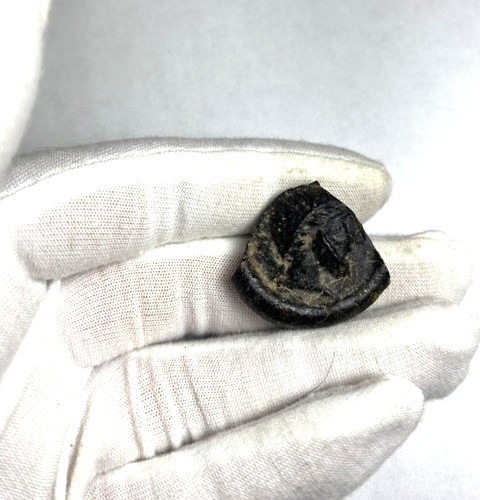
Ancient Hellenistic Molded Black Glass Intaglio Gem / Ring Inlay (c. 3rd–1st Century BC)
Authenticity & Guarantee
Item Specifications & Exact Dimensions
Object: Molded Black Glass Intaglio Gem / Ring Seal Plaque (Vitreous Paste Gem)
Culture / Period: Hellenistic Mediterranean (Greek / Ptolemaic / Seleucid Sphere)
Date Range: Circa 3rd Century BC – 1st Century BC (c. 300 BC – 31 BC)
Material: Ancient Black Glass / Dark Vitreous Paste
Form & Architecture: Curved/semicircular black glass gem insert with a flat polished reverse and convex obverse face; obverse displays a molded classical intaglio device (stylized profile head / Hellenistic deity motif); engineered to be cold-set into a metallic ring bezel or pendant mount
Condition: Exceptional, complete ancient condition as an excavated glass gem insert. Crisp molded intaglio contours, intact glass fabric, exhibiting authentic micro-pitting, faint surface iridescence, and pale sandy burial encrustation within the recessed channels. Free of modern restoration.
HISTORICAL CONTEXT & TYPOLOGICAL LORE
Hellenistic Glass Gems & Vitreous Paste Signets
During the Hellenistic period (3rd–1st century BC), advances in glassworking enabled Mediterranean artisans to produce molded glass intaglios (vitreous paste gems) as accessible alternatives to expensive hand-carved gemstones such as carnelian, garnet, and sardonyx. Produced in workshops across Alexandria, Antioch, and the Aegean islands, these dark glass gems allowed merchants, soldiers, and citizens to own personalized seal rings.
Intaglio Mechanics & Aesthetic Value
Cast from opaque black glass, these gem inserts were pressed into metal ring bezels made of bronze, silver, or iron. The molded intaglio figure produced a clear, raised impression when pressed into soft sealing clay (bullae) or wax on legal documents and personal correspondence. Black glass was particularly favored in Hellenistic fashion for its stark contrast against silver and gold settings.
Typological Analysis & Exact Classification
Comparable Archaeological Examples & Museum Accession Numbers
Corning Museum of Glass (Accession No. 66.1.34): Hellenistic molded black glass intaglio gem with profile head.
British Museum (Accession No. 1914,0312.3): Hellenistic glass paste ring inlay depicting classical motif.
Metropolitan Museum of Art (Accession No. 74.51.4502): Eastern Mediterranean glass gem insert of the 3rd–1st century BC.
O