When you click on links to various merchants on this site and make a purchase, this can result in this site earning a commission. Affiliate programs and affiliations include, but are not limited to, the eBay Partner Network.
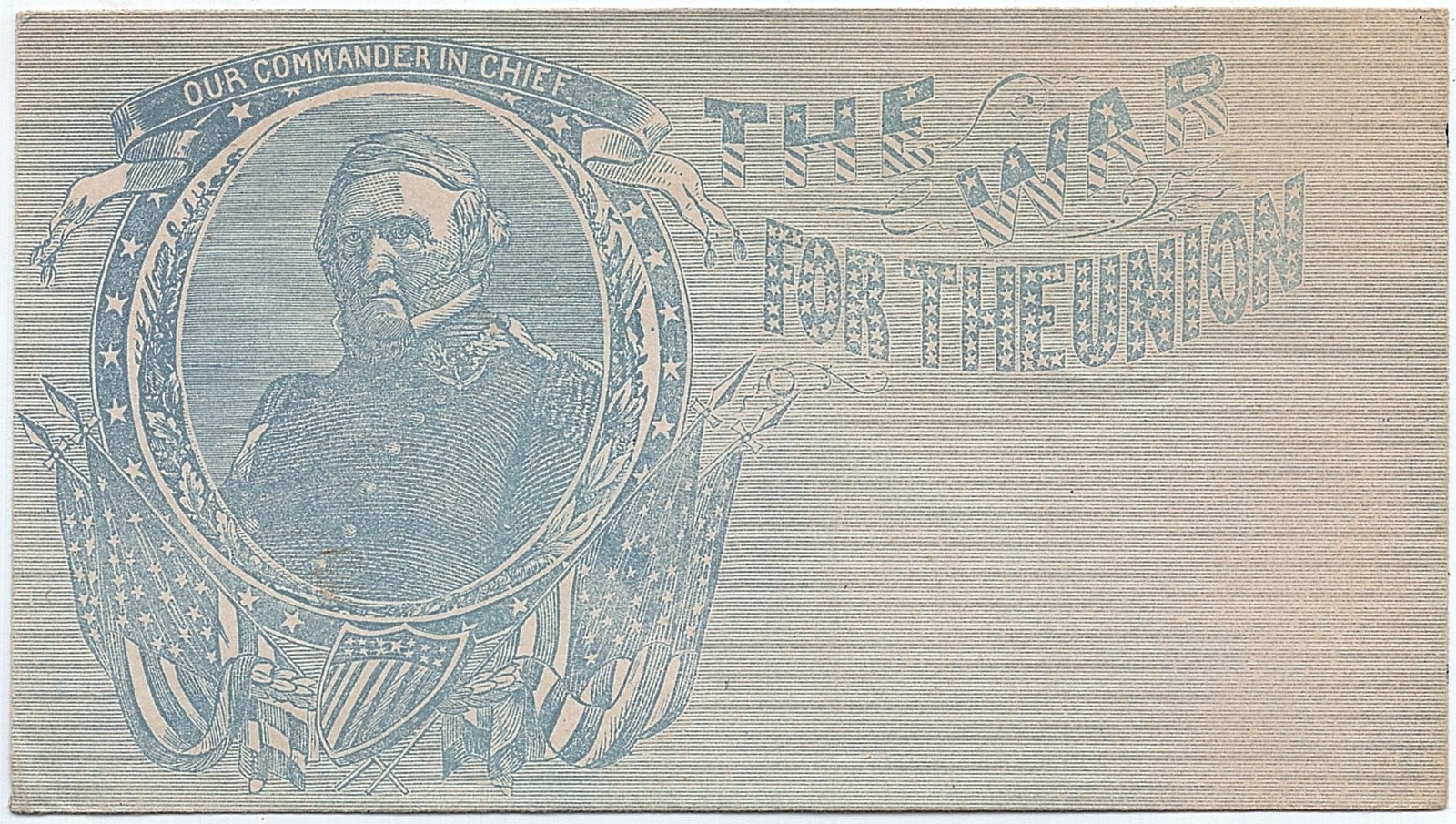
A RARE Original Civil War Patriotic Cover - "Our Commander In Chief" - with Portrait of General Winfield Scott in silhouette frame above 4 American Flags and a Union Shield, with the slogan "THE WAR FOR THE UNION to the right side of Scott. It was printed in a blue colored ink.
Winfield Scott was an American military commander and a presidential candidate. He served as Commanding General of the United States Army from 1841 to 1861, and was a veteran of the War of 1812, American Indian Wars, Mexican–American War, and the early stages of the American Civil War.
Rare. Very Good Condition. It measures a little over 5 1/2" by 3 1/8" and is complete. It was mounted on the hinge at some point in the past.
The cheapness of new printing techniques and technology meant that now not only could most households afford to decorate their homes with individual prints, but also that all kinds of ephemera—those items meant to be used and thrown away—could be decorated as well. During the Civil War, printed envelopes were one such type of ephemera. They became popular early in the war, particularly in the Union. Hundreds of different images were used during the war to put a personal and political stamp on the stationery that was carrying news to and from the front. Often the imagery on the envelopes featured patriotic poems and symbols, such as Lady Liberty and eagles. At other times they carried political cartoons and the likenesses of war generals and heroes. Still others were part of regimental stationery sets, which were emblazoned with a specific regiment’s name. Often they were left black and white, but many were lithographically colored—and some even hand-colored—as well.
The latest news, particularly victories or the death of war heroes, often spurred new envelope designs, fueling both the printers’ trade and morale. What initially began as simple patriotic stationery soon turned into collector’s items. Printers began issuing the elaborate envelopes in boxed sets (notice the number “19” on the bottom right of the “Camp Scene” envelope), and albums designed to hold the envelopes also appeared on the market. As the war dragged on and resources—including paper—became short, such illustrated stationery came to be seen as indulgent and expensive and its production was abandoned before the end of the war.Thank you for viewing!