When you click on links to various merchants on this site and make a purchase, this can result in this site earning a commission. Affiliate programs and affiliations include, but are not limited to, the eBay Partner Network.
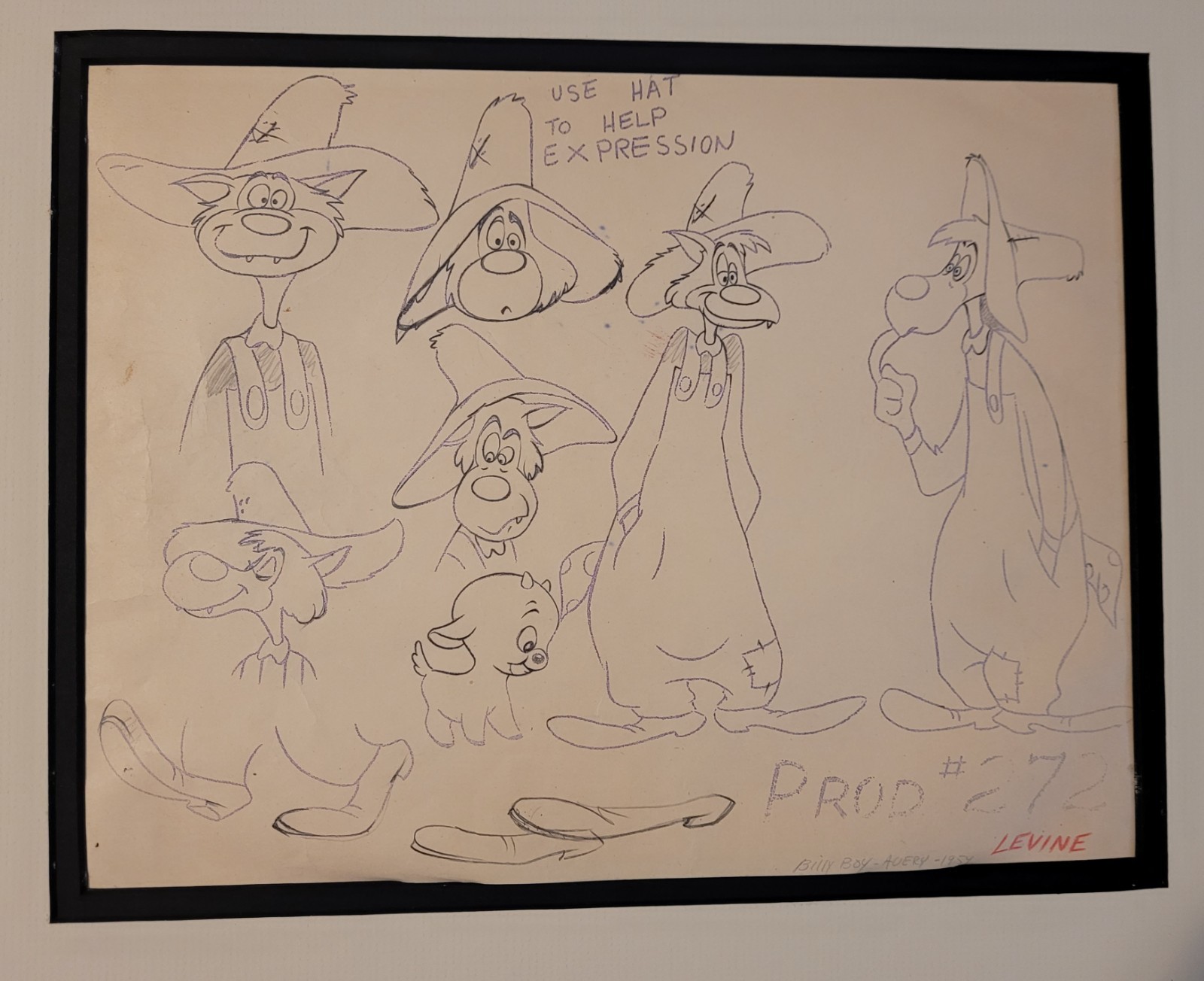
This is an amazingly rare original mimeograph and pencil model sheet drawing, 1954; of Billy Boy and Billy Goat; hand-signed Levine in red pencil, lower right, and used during th production of Billy Boy, 1954, MGM Studios
Comes with COA from Animation Fine Art Galleries
This is an exceptionally rare piece of animation history—an original production model sheet drawing used during the making of the classic MGM Studios cartoon, Billy Boy (1954).
As confirmed by the Certificate of Authenticity (COA), the artwork is an original mimeograph and pencil model sheet drawing, hand-signed by Levine in red pencil. The sheet bears the production number PROD. #272, which corresponds to the film Billy Boy. The drawing is professionaly matted for display.
About the Cartoon: Billy Boy (1954)
Director: The legendary Tex Avery (uncredited on some versions)
Plot: The cartoon focuses on a hungry Billy Goat who, in search of food, continually tries to eat tin cans and other inedible objects, despite the best efforts of his owner, a character known as Billy Boy (the main character drawn on the sheet). The cartoon is a classic example of Tex Avery’s signature style of escalating, frantic, and surreal sight gags.
The Creative Minds Behind the Art
Tex Avery (Frederick Bean Avery, 1908-1980): Considered one of the most influential directors in the history of animation. Avery\'s work at Warner Bros. (where he helped create characters like Bugs Bunny and Daffy Duck) and later at MGM (where he developed Droopy and the iconic wolf and girl pairing) redefined the animated cartoon genre. He discarded the realism of Disney for a fast-paced, irreverent, and physically impossible world, where anything could happen for a laugh.
This is a museum-quality collectible and a must-have for any serious collector of classic animation, particularly of the MGM Golden Age and Tex Avery’s groundbreaking work. Don\'t miss this chance to own a piece of cartoon history!
Condition Note: Original production art from 1954. Drawing shows expected signs of age, including minor paper toning and production wear, which authenticates its use in the studio. Matted.
The Anarchist of Animation: A Biography of Tex AveryI. Introduction: The Revolutionary of AnimationFrederick Bean \"Tex\" Avery (1908–1980) stands as one of the most singular and influential figures in the history of animated film, second perhaps only to Walt Disney in terms of his impact on the genre. While Disney pursued cinematic realism and emotional depth in animation, Avery took the opposite path: embracing the fundamental absurdity and limitless potential of the medium itself. His directorial philosophy was simple: in a cartoon, you can do anything. Avery’s work was characterized by a revolutionary increase in pace, extreme exaggeration (known as the \"take\"), and a pervasive sense of irreverence and self-awareness that frequently broke the \"fourth wall\" and satirized both Hollywood conventions and societal norms. He transformed the American cartoon from a musical novelty into a vehicle for rapid-fire visual gags and surreal comedy, shaping the sensibility of the Golden Age of Animation and influencing generations of filmmakers who followed.II. Early Life and Career Beginnings (1908–1935)Frederick Bean Avery was born in Taylor, Texas, on February 26, 1908. His famous nickname, \"Tex,\" was an inevitable moniker bestowed upon him by his Hollywood colleagues. After graduating from North Dallas High School in 1926, where he was known to draw cartoons for the school paper, Avery briefly pursued formal art training, attending a three-month course at the Art Institute of Chicago. However, he left after only a month, finding the classical training less suited to his ambition of becoming a newspaper cartoonist.Avery moved to Los Angeles in 1928, working various menial jobs before breaking into the nascent animation industry. His professional career began at the Winkler Studio as an inker, tracing drawings onto cels for the Oswald the Lucky Rabbit series. He soon moved to Universal Cartoon Studios (later Walter Lantz Productions), where he continued working on Oswald cartoons. By 1930, Avery had been promoted to a full-fledged animator.A career-changing event occurred while Avery was working at the Lantz studio. A playful incident involving a rubber band and a paper clip resulted in an injury that cost him sight in his left eye. While tragic, some historians speculate that the loss of depth perception may have contributed to his unique, non-realistic visual style—a style that celebrated flatness and extreme caricature over dimension. Avery became frustrated with his work at Universal, complaining that many of the best gags he animated were being cut from the final shorts. This desire for creative control and full utilization of comedy potential drove him to seek opportunities where he could direct. After a salary dispute, Avery left Universal in 1935.III. The Termite Terrace Years: Forging the Warner Bros. Style (1935–1941)In 1935, Avery was hired by producer Leon Schlesinger, who ran the studio responsible for creating Looney Tunes and Merrie Melodies shorts for Warner Bros. Avery, reportedly exaggerating his directorial experience to land the job, was given his own production unit. This group, including future legendary directors like Chuck Jones and Bob Clampett, was housed in a run-down, small building on the lot that quickly became known as \"Termite Terrace\"—a name that soon became synonymous with the studio\'s irreverent, experimental, and groundbreaking output.Warner Bros. could not compete with the technical sophistication and vast budgets of Walt Disney\'s studio, so Avery decided to compete on humor and sheer speed. His philosophy was to make his cartoons the funniest and best-written in the business. He threw out the musical intermissions and slow pacing that characterized early animation, adopting a breakneck tempo filled with outrageous, often nonsensical gags.Avery immediately began overhauling the studio\'s early, often inconsistent, characters. He redesigned the studio\'s star, Porky Pig, giving him a rounder, cuter, and more appealing design. He also began shaping the studio’s supporting cast.IV. Creating Icons: Bugs, Daffy, and ElmerDuring his time at Warner Bros., Tex Avery was instrumental in creating or defining the personalities of three of the most enduring characters in cartoon history: Daffy Duck, Porky Pig, and Bugs Bunny.Daffy Duck (The Insane Catalyst):
Daffy Duck made his debut in Avery\'s Porky’s Duck Hunt (1937). Daffy was a true departure from the cartoon characters that came before him. Unlike the benevolent heroes or easily outwitted villains, Daffy was characterized by unmotivated insanity—a manic, zany anarchist who literally bounced all over the screen, shouting wildly. Avery captured a new energy that redefined the antagonistic role, making the hunter (Porky Pig) the straight man to the duck’s absurdity.Bugs Bunny (The Calm Instigator):
The smart-aleck rabbit character was developed over several shorts by various directors, but Avery solidified the character\'s definitive personality in A Wild Hare (1940). In this short, the rabbit was calm, clever, and perpetually in control of any situation, contrasting sharply with the manic energy of Daffy. Avery gave the rabbit his iconic catchphrase, \"What’s up, Doc?\"—a common greeting from his high school days in Texas—delivered with casual nonchalance while facing the bumbling hunter, Elmer Fudd. The short established the core dynamic: the rabbit is the laid-back victor, and the hunter is the hapless victim. This short is considered the official debut of Bugs Bunny as the character we know today.Avery’s tenure at Warner Bros. ended in 1941 following a heated disagreement with producer Leon Schlesinger over the ending of the Bugs Bunny short The Heckling Hare. Avery wanted a surreal, triple-climax gag where Bugs and a dog fall off a cliff three times. Schlesinger found the joke excessive and cut the scene, leading to Avery’s frustrated departure.V. The Golden Age at MGM: Freedom and the Screwball Style (1942–1953)After a brief stint at Paramount, Avery was hired by Metro-Goldwyn-Mayer (MGM) Studios in 1942 to head his own animation unit under producer Fred Quimby. This period, from 1942 to 1953, is widely considered the peak of Avery’s artistic and comedic achievement.At MGM, Avery was granted a level of creative autonomy and budgetary freedom he had never experienced at the more constrained Warner Bros. MGM’s high production values, characterized by rich Technicolor, lush backgrounds, and detailed effects, were now applied to Avery’s increasingly zany and abstract comedic vision. He took his \"screwball\" style to its logical extreme, utilizing:Exaggerated Takes: Characters’ reactions became literally explosive, with eyes popping out to absurd lengths, hearts hammering against chests, and full-body contortions that defied physics.Deconstruction of Reality: Avery constantly broke the fourth wall, addressing the audience, having characters exit the frame, or using signs and title cards for self-referential gags that commented on the film medium itself.Blitz Wolf (1942): Avery’s first short for MGM, a satirical and frantic wartime propaganda film, was nominated for an Academy Award, immediately establishing his unit’s success.VI. The Screwball Triumvirate: Droopy, The Wolf, and RedThe MGM years saw Avery move away from his established Warner Bros. characters and create a whole new roster of iconic personalities, often revolving around fixed comedic formulas.Droopy: Introduced in Dumb-Hounded (1943), Droopy was the antithesis of the manic energy Avery was known for. A short, slow-talking, perpetually depressed basset hound, Droopy\'s power lay in his supernatural ability to appear wherever his antagonist, typically the Wolf, tried to hide. Droopy’s lethargic delivery and unwavering determination created a perfect comedic contrast to the Wolf’s escalating frustration and explosive reactions.The Wolf and Red Hot Riding Hood: Perhaps Avery’s most famous pairing from MGM was the predatory, love-starved Wolf and the curvaceous, titillating nightclub singer, affectionately known as \"Red\" (from the 1943 short Red Hot Riding Hood). Avery took the classic fairy tale and set it in a contemporary, urban nightclub, turning the innocent Red Riding Hood into a stunning \"Hollywood swinger\" showgirl who drove the Wolf into fits of frantic, exaggerated lust. This series (Red Hot Riding Hood, Swing Shift Cinderella, Little Rural Riding Hood) pushed the boundaries of cartoon censorship and showcased Avery’s masterful use of extreme, adult-oriented humor.Screwy Squirrel (The Pure Anarchist): Debuting in Screwball Squirrel (1944), Screwy was perhaps too anarchic even for Avery. Unlike Bugs Bunny, who was a cool aggressor, Screwy was genuinely insane, a pure agent of chaos who delighted in tormenting his dim-witted counterpart, Meathead Dog. Though successful, the character only starred in five shorts before Avery literally had him killed off in the final entry, Lonesome Lenny (1946).Avery’s MGM unit produced classics that cemented his reputation, including:King-Size Canary (1947): A surreal masterpiece where a cat, a mouse, and a canary all drink a plant-growth formula and become gargantuan.Bad Luck Blackie (1949): A small kitten hires a black cat whose mere presence brings bad luck upon a bullying bulldog, resulting in increasingly hilarious and improbable disasters raining down on the bully.Magical Maestro (1952): A disgruntled magician sabotages an opera singer’s performance by replacing the conductor and using his wand to magically transform the tenor into various ridiculous forms.VII. Post-MGM Career and Enduring Legacy (1954–1980)By the early 1950s, Avery was experiencing burnout, a common affliction after directing nearly 70 shorts at MGM at a relentless pace. In 1950, he took a break, and in 1953, the studio eliminated his unit, bringing his prodigious output of theatrical shorts to an end.Avery briefly returned to his former employer, Walter Lantz Productions, where he directed four shorts, helping to develop the character Chilly Willy the penguin. However, this tenure was short-lived, ending again due to a financial dispute.For the remainder of his professional life, Avery primarily shifted his focus to television and commercial animation. He worked for Cascade Studios, a successful commercial house, where he applied his hyperactive gag-style to advertising products. His most iconic commercial creations include the perpetually anxious cockroaches for Raid insecticide (who scream \"Raid!\") and the controversial Frito Bandito mascot for Frito-Lay.In his final years, Avery worked as a gag man for his old MGM colleagues, William Hanna and Joseph Barbera, contributing to their Saturday morning television cartoons. His last credited work was for The Kwicky Koala Show. Avery suffered personal tragedy in his later life, including the dissolution of his marriage and the loss of one of his two children to a drug overdose.Tex Avery died of lung cancer in Burbank, California, on August 26, 1980, at the age of 72.VIII. Conclusion: The Blueprint for Modern ComedyTex Avery’s influence on animation and comedy is immense and pervasive. He was the great deconstructor of the cartoon, ripping apart the established rules and proving that animation’s ultimate power lies in its capacity to defy reality. His comedic principles—extreme exaggeration, rapid-fire pacing, and meta-awareness—did not fade with the end of the theatrical short era; they became the blueprint for subsequent generations.Filmmakers and animators across the spectrum, from The Ren & Stimpy Show to Who Framed Roger Rabbit (1988), and countless modern comedic films, owe a profound debt to Avery’s \"screwball\" sensibility. He taught the world that a cartoon character could literally run out of the frame, react with such shock that they turned into a ghost, or deliver a sarcastic line directly to the viewer. Avery ensured that the Golden Age of Animation was not just golden, but completely unhinged, establishing him forever as the true anarchist and king of the Hollywood cartoon.Billy Boy (1954): A Comprehensive Analytical Report and SynopsisI. Production Context and Thesis StatementBilly Boy is a significant short in the canon of Frederick “Tex” Avery, as it was one of the last few cartoons he directed for Metro-Goldwyn-Mayer (MGM) before the studio closed its classical animation unit in 1957. Released on May 8, 1954, and produced by Fred Quimby (with an uncredited director collaboration by Dick Lundy and story work by Heck Allen and Jack Cosgriff), the short is a powerful, late-career example of Avery distilling his \"screwball\" philosophy into its purest form: the One-Joke Cartoon of Escalation. The entire premise revolves around a single, absurd characteristic—a goat that eats absolutely everything—and the escalating, frantic, and ultimately futile efforts of its owner to contain it. The cartoon features a Southern-accented Wolf character (often referred to as a Farmer in this short, voiced by the master impressionist Daws Butler) as the frustrated protagonist.II. Character Dynamics and SetupThe cartoon’s comedic dynamic relies on the clash between two simple, fixed personalities:The Southern Wolf/Farmer (Antagonist-by-Circumstance): The Wolf, a familiar Avery character model (sometimes seen with Droopy, here given a Southern drawl by Daws Butler), serves as the straight man. He begins delighted, but quickly moves through stages of denial, confusion, frustration, and eventual cosmic despair. His defining comedic tic is palilalia, where he repeats his own words in a stuttering loop (e.g., \"goat-goat-goat-goat-goat\"), an effect utilized throughout the film for rhythmic emphasis.Billy Goat (The Force of Nature): The Billy Goat is not a malicious antagonist but a passive, innocent force of consumption. His actions are driven by an insatiable, limitless hunger that transcends physical and logical boundaries. He is utterly oblivious to the chaos he causes, making him an unstoppable, almost elemental, comedic force.The short begins with the Wolf receiving a letter under his door: \"Please take care of my little Billy goat. P.S. You will have no trouble feeding him—HE EATS ANYTHING.\" The Wolf, initially charmed by the baby goat in the basket, is quickly introduced to the central conflict as the goat begins its campaign of consumption.III. Phase One: The Initial Domestic GagsThe initial gags establish the Billy Goat\'s indiscriminate diet, setting a fast, chaotic pace:The Household Feast: Inside the Wolf’s rustic cabin, the goat immediately begins eating the non-food environment. This includes the entire carpet, leaving only a bare floor, followed by the wallpaper, a calendar, a globe, the curtains, and even the Wolf\'s trousers right off his legs.The Palilalia Reaction: The Wolf, witnessing the destruction, addresses the audience with his looping reaction: “You know? Now there’s a pretty hungry little billy goat-goat-goat-goat-goat-goat.”The Metal Diet: The Wolf tries to give the goat a bottle of milk, but the goat instantly consumes the glass bottle, the pacifier, and the utensils used for feeding. When presented with a coffee pot, the goat eats the pot, coffee and all, setting the stage for the film’s central theme: metal is his favorite dish.IV. Phase Two: Escalation of Containment FailureAs domestic gags prove insufficient, the Wolf attempts increasingly desperate measures to contain or dispose of the goat, but Billy simply consumes the device designed to restrain him:The Rope and Hook: The Wolf ties the goat to a hook hammered into the ground. The goat eats the rope, then comically consumes the top part of the Wolf’s shoe when he tries to intervene. The Wolf checks his foot, relieved to find his toes intact.The Spare Tire Gag: Billy tries to eat the Wolf’s rubber spare tire, struggles to chew the rubber, and upon swallowing it whole, his body momentarily takes the shape of the tire, a classic example of Avery\'s \"squash-and-stretch\" technique pushed to absurdity.The Windmill: The Wolf ties the goat to a windmill. Billy eats the rope and the entire vertical structure of the windmill, leaving the blades spinning unsupported in mid-air.The Wheelbarrow: The Wolf attempts to haul Billy away in a wheelbarrow, but Billy eats the wheelbarrow, the handles, and the wheel.The Meta-Joke and Censorship: Attempting to tie Billy to a tree on a small island, the goat proceeds to eat some of the film strip itself, resulting in a brief, literal hole in the animation. This meta-gag—a signature of Avery’s fourth-wall breaking—is one of the cartoon\'s highlights.V. Phase Three: The Desperate Attempts at DisposalDriven to madness, the Wolf attempts to send Billy far away, using mechanisms of transportation that offer new gag opportunities:The Car Motor: The Wolf locks Billy in the trunk of his car, but the goat literally eats his way through the vehicle, eventually devouring the entire motor (made of metal).The Horse Trick: The Wolf ties Billy to a horse and whips it to run. Billy eats the horse’s tail hair, causing the angry horse to return and repeat the same tactic, eating the Wolf’s hair. The Wolf\'s dry remark to the horse, “Copycat,” is a classic Avery throwaway line.The Railroad to California: In the most elaborate disposal gag, the Wolf covers a railroad track with pepper. Billy, driven by the pepper-induced appetite and following the metal, consumes the railway line all the way across the country to California (2,360 miles away). The Wolf, finally alone, tucks himself into bed in contentment.VI. The Cosmic Climax and LegacyThe cartoon builds to a surreal, unforgettable climax that surpasses earthly logic:The Return: That very night, the Wolf awakens. Billy has returned, having eaten the railroad tracks all the way back, and is now covered in postage stamps from every state he crossed. Worse still, Billy has eaten the entire Wolf’s house, leaving the Wolf exposed under the stars.The Rocket and The Moon: Feigning a joyous welcome, the Wolf quickly ties Billy to a rocket and fires him directly towards the moon. This is the ultimate, final solution—ejecting the problem into space.The Fade-Out: The Wolf watches, expecting victory, but Billy, naturally, eats the entire moon, plunging the Earth into total darkness. The Wolf, recognizing the permanence of his despair, lights a single match. He looks irritably into the camera and delivers his final, looped line: “Good night, Boy, though not as universally celebrated as the Red Hot Riding Hood series, remains a crucial example of Avery’s directorial focus at the end of his MGM career: maximum impact from a single, simple premise, exploiting the medium’s lack of rules to achieve an exaggerated, cosmic conclusion. The use of Daws Butler’s vocal tic and the final audio loop gag were innovative techniques that pushed the auditory limits of the cartoon short, cementing its place as a quintessential piece of Avery’s enduring screwball legacy.Billy Boy is a 1954 Southern Wolf animated short cartoon in the MGM cartoon Theatrical Series released by Metro-Goldwyn-Mayer, produced by Fred Quimby, and directed by Tex Avery.[1]
PlotThe Southern-accented Wolf is having breakfast on his farm when there is a knock on his door. A letter is pushed under it, which reads: Please take care of my little Billy goat. P.S. You will have no trouble feeding him — HE EATS ANYTHING.True to the letter\'s contents, the wolf opens the door and finds a basket with a baby goat, Billy, who walks around inside the wolf\'s house, eating anything in his path, such as the carpet, part of the sofa, the wallpaper, the calendar, the globe, the curtains, and the wolf\'s trousers. The wolf, here presented with palilalia, addresses the audience: \"You know? Now there\'s a pretty hungry little billy goat-goat-goat-goat-goat-goat.\" Oblivious to Billy\'s limitless hunger, the wolf gives him a bottle of milk, but Billy spills the milk and eats the bottle, the pacifier, the cutlery and crockery (like a sandwich), the coffeepot (along with all the coffee inside it), and the napkin.Realizing that Billy will be more than a handful to deal with, the wolf tries to tie him in the garden to a hook hammered into the ground, but Billy eats the rope and comically eats the top part of the wolf\'s shoe when he tries to stop him. The wolf checks his foot and finds all ten of his toes still there, to his relief. Billy then tries to eat the wolf\'s spare tire, but is unable to chew the rubber and ends up shaped like the tire as soon as he swallows it whole.The wolf then tries tying Billy to the windmill, but once again, Billy eats not only the rope, but the entire windmill, leaving the blades spinning at the top even with no support. He then attempts to take him away in a wheelbarrow and release him into the wild, but Billy eats the wheelbarrow and the wheel. The wolf ties Billy to a kite and releases him into the sky, but Billy eats the kite, the string and starts chewing on the wolf\'s arm. Unaffected, the wolf merely tells him to stop. He wraps Billy in chains and tries to tie him to a tree on a small island, but Billy proceeds to eat some of the film itself.Next, the wolf places Billy in the trunk of his car and tries to drive him somewhere, but Billy somehow eats his way through the car and ends up devouring the motor. The wolf then ties Billy to a horse and hits it on the bottom to make it run away and take Billy with it. However, Billy eats the horse\'s hair, and the angry horse returns to repeat the same tactic with the wolf, whose hair Billy eats as well. The wolf also returns, looks irritably at the horse and says \"Copycat\".As a final attempt to rid himself of Billy for good, the wolf places pepper on a railroad track and has Billy eat the railway, following it all the way to California, which is 2360 miles away. With Billy gone, the wolf tucks himself into bed. That night, Billy returns, eating the other side of the railway and covered in stamps of all the States he crossed eating the railway. The wolf suddenly awakens to see that Billy has eaten his entire house. Feigning joy, the wolf welcomes Billy back but ties him to a rocket, which the wolf sends to the moon. Even this isn\'t enough to satisfy the little goat, as Billy then eats the moon, taking the moonlight along with it and leaving the Earth in darkness. The wolf lights a match and says \"Goodnight, y\'all-y\'all-y\'all-y\'all\" as the cartoon closes.
Voice Cast Daws Butler as The Southern Wolf [2][3]NotesBilly Boy is the first solo cartoon Tex Avery directed featuring his southern-wolf character, who previously appeared with Droopy in The Three Little Pups and later in Blackboard Jumble and Sheep-Wrecked.The short was originally planned as a Barney Bear cartoon with Dick Lundy as the director, but was changed when Avery returned after a sabbatical.[4]Frederick Bean \"Tex\" Avery (/ˈeɪvəri/; February 26, 1908 – August 26, 1980) was an American animator and voice actor. He was known for directing and producing animated cartoons during the golden age of American animation. His most significant work was for the Warner Bros. and Metro-Goldwyn-Mayer studios, where he was crucial in the creation and evolution of famous animated characters such as Bugs Bunny, Daffy Duck, Porky Pig and Elmer Fudd for Warner Bros. and Droopy, Butch Dog, Screwy Squirrel, The Wolf, Red Hot Riding Hood, and George and Junior for Metro-Goldwyn-Mayer.He gained influence for his technical innovation, directorial style, and brand of humor that appealed especially towards adults.[3] Avery\'s attitude toward animation was opposite that of Walt Disney and other conventional family cartoons at the time. Avery\'s cartoons were known for their essentially darker, sarcastic, ironic, absurdist, irreverent, and sometimes sexual tone in nature. They focused on visual gags, meta humor, physically impossible gags, social satire, surrealist humor, rapid pacing, racial stereotypes, and violent slapstick occurring around brash, outlandish characters who broke the fourth wall, stating that cartoons are meant to do anything.[4][5]
Early life and education
Avery\'s yearbook photo, North Dallas High School, 1926Avery was born to Mary Augusta \"Jessie\" (née Bean; 1886–1931) and George Walton Avery (1867–1935) in Taylor, Texas. His father was born in Alabama and his mother was born in Chickasaw County, Mississippi.Avery graduated in 1926 from North Dallas High School.[6][7] A popular catchphrase at his school was \"What\'s up, doc?\",[8] which he later used for Bugs Bunny in the 1940s. Interested in becoming a newspaper cartoonist, he took a three-month summer course at the Chicago Art Institute[9] but left after a month.[10]Tex Avery\'s major inspirations were comedians such as Laurel & Hardy, Charlie Chaplin, Buster Keaton, Harold Lloyd and especially The Marx Brothers; the latter of which was inspiration for Bugs Bunny. He was especially inspired by Winsor McCay, Pat Sullivan, Otto Messmer, Max Fleischer and Walt Disney in term of animation field. He additionally liked the works of newspaper comic strip artist Virgil Partch, mainly praising for his surrealist gags.[11]
Animation careerOn January 1, 1928, Avery arrived in Los Angeles. He spent the next few months working in menial jobs. According to animation historian Michael Barrier, these jobs included working in a warehouse, working on the docks at night, loading fruits and vegetables, and painting cars.[7] He began his animation career when hired by the Winkler studio (named after producer Margaret J. Winkler and later known as Screen Gems). He was an inker, inking cels for animated short films in the Oswald the Lucky Rabbit series; the character had been created by Walt Disney. Avery then moved to a new studio, Universal Cartoon Studios (later known as Walter Lantz Productions). He was again employed as an inker, but moved rapidly up the studio\'s hierarchy. By 1930, Avery had been promoted to the position of animator.[7]Avery continued working at the Walter Lantz Studio into the early 1930s. He worked on most of the Oswald the Lucky Rabbit cartoons from 1931 to 1935. He is shown as \"animator\" on the original title card credits on the Oswald cartoons. He later claimed to have directed two cartoons during this time.[9]
Accident to eyeDuring some office horseplay at the Lantz studio, a thumbtack or paper clip flew into Avery\'s left eye and caused him to lose sight in that eye. Some speculate it was his lack of depth perception that gave him his unique look at animation and bizarre directorial style,[9] but it did not stop his creative career. The incident is described in some detail by Barrier, based in part on old interviews with Avery. Part of the typical crude horseplay at the Universal studio was using a rubber band or a paper spitball to target the back of a colleague\'s head. An animator called Charles Hastings decided to take the game one step further, by using a wire paper clip, instead. Avery heard one of his colleagues telling him to look out. He reacted by turning around. Instead of the back of his head, the paper clip hit Avery in his left eye. He instantly lost the use of his eye.[7]
From inker to storyboardsAs an animator, Avery worked under director Bill Nolan. Nolan reportedly delegated work to Avery, whenever Avery had to animate a sequence. Nolan\'s instructions for a scene involving Oswald being chased by bees were reportedly simple. He would describe in which direction Oswald was running (\"right to left\") and for how many feet. The rest of the details were left up to Avery.[7] Avery started handing out work to other animators working under Nolan.Avery wanted still greater control over the creative process and served as a de facto director for a couple of films. Based on Avery\'s recollections, here is a description of how this happened. He was submitting sight gags for use in the short films. Some of them were used in the actual films, and some funny ones were left out. He wanted to somehow get all his gags in the finished film. So, he asked Nolan to let him create the entire storyboard for a film. Nolan instructed Avery to not only draw the storyboard, but also to work on the timing and the layout on his own. Avery completed two films using this process. An older Avery recalled that both films \"were terrible\", though they got accepted for release.[7]Avery was reportedly displeased with his salary and had started giving up on his work. After about six weeks of substandard work, his superiors let him go. In April 1935, Avery lost his job at the Universal studio.
\"Termite Terrace\"Later in 1935, Avery applied for a job at Leon Schlesinger Productions (the company later known as Warner Bros. Cartoons). Avery reportedly managed to convince producer Leon Schlesinger that he was an experienced director, a false claim. In Avery\'s own words:[7] \'Hey, I\'m, a director.\' Hell! I was no more a director than nothing, but with my loud mouth, I talked him into it.By 1935, when Avery was hired, the Schlesinger studio had only two full-time, regular film directors: Friz Freleng and Jack King. Avery became the third regular director.[7] The staff of the Schlesinger studio had become too large to be housed in a single building, at the Warner Bros. backlot on Sunset Boulevard. The new Avery unit of the studio was granted their own building, a five-room bungalow. The unit staff dubbed their quarters \"Termite Terrace\", due to its significant termite population.[7][12] \"Termite Terrace\" later became the nickname for the entire Schlesinger/Warner Bros. studio, primarily because Avery and his unit were the ones who defined what became known as \"the Warner Bros. cartoon\".Avery was granted exclusive use of four animators: Bob Clampett, Chuck Jones, Sid Sutherland, and Virgil Ross. The first animated short film produced by this unit was Gold Diggers of \'49 (1935), the third Looney Tunes film starring Beans. Beans was also featured in the film\'s title card, signifying that he was the intended protagonist. The film had a Western setting and cast Beans as a gold miner. Also featured in the film was a redesigned Porky Pig, making his second appearance.[7] The Avery unit was assigned to work primarily on the black-and-white Looney Tunes instead of the Technicolor Merrie Melodies, but was allowed to make color Merrie Melodies beginning with Page Miss Glory from 1936. Avery was also noted to be the first to stray away from using song breaks in color cartoons starting with the 1937 short Uncle Tom\'s Bungalow, later saying that \"We were forced to use a song, which would just ruin the cartoon. You\'d try like a fool to get funny, but it was seldom you did.\"[13]
Duration: 7 minutes and 54 seconds.7:54
The Haunted Mouse (1941)Avery stopped using Beans following Gold Diggers of \'49, but continued using Porky as a star character. According to Michael Barrier, Beans was more of a straight man.[7] However, Porky had to be redesigned again. The early Porky was decidedly \"piglike\" in appearance. In Michael Barrier\'s description, Porky was very fat, had small eyes, a large snout, and pronounced jowls. He was like a porcine version of Roscoe Arbuckle. Starting with Porky the Rainmaker (1936), his fourth animated short starring Porky, Avery introduced a cuter version of Porky. The new design gave Porky more prominent eyes and a smaller snout. The jowls were replaced by chubby cheeks. Porky\'s body now had a rounder shape; its defining trait was not fatness, but softness.[7] Barrier notes that the new design by Avery departed from the \"Disneyish\" realism in the previous drawing style. Porky became a less realistic pig and looked more like a cartoon character.[7]According to Martha Sigall, Avery was one of the few directors to visit the ink and paint department — where he would answer questions and was always in good humor — as he liked to see how his cartoons were developing. When some of the artists humorously criticized the wild action in his animated shorts, Avery would take time to explain his rationale.[14] He recalled that while working at Warner Bros., the animators had a great deal of liberty, and were subject to very little censorship.[15]
Creation of Looney Tunes starsAvery, with the assistance of Clampett, Jones, and the new associate director Frank Tashlin, laid the foundation for a style of animation that rivaled The Walt Disney Studio as the leader in animated short films, and created a group of cartoon characters that are still known today. Avery, in particular, was deeply involved. He crafted gags for the shorts, and sometimes provided voices for them (including his trademark belly laugh) and held such control over the timing of the shorts that he would add or cut frames out of the final negative if he felt a gag\'s timing was not quite right.Porky\'s Duck Hunt (1937) introduced the character of Daffy Duck, who possessed a new form of \"lunacy\" and zaniness that had not been seen before in animated cartoons. Daffy was an almost completely crazy \"darn fool duck\" who frequently bounced around the film frame in double-speed, screaming \"Hoo-hoo!\" in a high-pitched, sped-up voice provided by voice artist Mel Blanc, who, with this cartoon, also took over providing the voice of Porky Pig. Avery directed two more Daffy Duck cartoons: Daffy Duck & Egghead and Daffy Duck in Hollywood. Egghead was a character inspired by comedian Joe Penner and first appeared in Avery\'s Egghead Rides Again.[16][17][18]Little Red Walking Hood first introduced the early character of Elmer Fudd as a character mostly taking part of some running gag. Elmer in this early form had green clothes, a brown bowler hat, and a pink nose. He was also named \"Elmer\" on the lobby cards for \"The Isle of Pingo Pongo\" (1938), his second appearance, Cinderella Meets Fella (1938), his third appearance, and was fully called \"Elmer Fudd\" on screen in \"A Feud There Was\" (1938), also his fourth appearance. Elmer even appears on early merchandise and in the early Looney Tunes books in 1938 and 1939 and was later promoted as \"Egghead\'s Brother\" on the Vitaphone Release Sheet for Cinderella Meets Fella because Elmer was also voiced by Danny Webb in his Joe Penner voice that was also use for Egghead.[19][20][21]Ben Hardaway, Cal Dalton, and Chuck Jones directed a series of shorts that featured a Daffy Duck-like rabbit, created by Ben \"Bugs\" Hardaway. As is the case with most directors, each puts his own personal stamp on the characters, stories, and overall feel of a short. So, each of these cartoons treated the rabbit differently. The next to try out the rabbit, known around Termite Terrace as \"Bugs\' bunny\" (named after Hardaway), was Avery. Since the recycling of storylines among the directors was commonplace, A Wild Hare was a double throwback. Avery had directed the short Porky\'s Duck Hunt featuring Porky Pig, which also introduced Daffy Duck.[22]Hardaway remade it as Porky\'s Hare Hunt, introducing the rabbit. So, Avery went back to the \"hunter and prey\" framework, incorporating Jones\'s Elmer\'s Candid Camera gag for gag and altering the new design of Elmer Fudd, polishing the timing, and expanding the Groucho Marx smart-aleck attitude already present in Porky\'s Hare Hunt; he made Bugs a kind of slick Brooklynesque rabbit who was always in control of the situation. Avery has stated that it was very common to refer to folks in Texas as \"doc\", much like \"pal\", \"dude\", or \"bud\". In A Wild Hare, Bugs adopts this colloquialism when he casually walks up to Elmer, who is \"hunting wabbits\" and while carefully inspecting a rabbit hole, shotgun in hand, the first words out of Bugs\'s mouth is a coolly calm, \"What\'s up, doc?\" Audiences reacted riotously to the juxtaposition of Bugs\'s nonchalance and the potentially dangerous situation. \"What\'s up, doc?\" instantly became the rabbit\'s catchphrase.[23] Originally, Avery wanted Bugs Bunny to be called Jack E. Rabbit because he hunted for jack rabbits when he was a kid. Numerous suggestions for names came up, but publicist Rose Horsely liked the name that was on Thorson\'s model sheet, saying that it was cute and they will \"play it two ways.\" Avery argued on his stance for the name \"Jack E. Rabbit\" saying that \"Mine\'s a rabbit! A tall, lanky, mean rabbit. He isn\'t a fuzzy little bunny.\" He also said the name Bugs Bunny sounded like a Disney character. Nevertheless, Schlesinger settled on Bugs Bunny.[24][25]Avery ended up directing only four Bugs Bunny cartoons: A Wild Hare, Tortoise Beats Hare, The Heckling Hare, and All This and Rabbit Stew. During this period, he also directed a number of one-shot shorts, including travelogue parody (The Isle of Pingo Pongo, which is the second cartoon to feature an early character that evolved into Elmer Fudd); fractured fairy-tales (The Bear\'s Tale); Hollywood caricature films (Hollywood Steps Out); and cartoons featuring Bugs Bunny clones (The Crackpot Quail).[26]Avery\'s tenure at the Schlesinger studio ended in late 1941 when the producer and he quarreled over the ending to The Heckling Hare. In Avery\'s original version, Bugs and the hunting dog were to fall off a cliff three times, making it an early example of the wild take. According to a DVD commentary for the cartoon, historian and animator Greg Ford explained that the problem Schlesinger had with the ending was that, just before falling off the third time, Bugs and the dog were to turn to the screen, with Bugs saying, \"Hold on to your hats, folks, here we go again!\", a punchline to a potentially risqué joke of the day.[27] However, Barrier uncovered a typewritten dialogue transcript of the cartoon that mentions the three falls at the end, but the \"Hold on to your hats\" line is absent, with the rest of the dialogue in the cartoon transcribed accurately. This inferred that Avery either misremembered or embellished the story and Schlesinger made the cut not because of any risqué content, but because he did not think that it was funny that Avery was killing Bugs three times, and the ending simply dragged on for too long.[28] The Hollywood Reporter reported on the quarrel on July 2, 1941. Avery was slapped with a four-week, unpaid suspension.[29]
Speaking of AnimalsWhile at Schlesinger, Avery created a concept of animating lip movement to live-action footage of animals. Schlesinger was not interested in Avery\'s idea, so Avery approached Jerry Fairbanks, a friend of his who produced the Unusual Occupations series of short subjects for Paramount Pictures. Fairbanks liked the idea and the Speaking of Animals series of shorts was launched. When Avery left the Schlesinger studio in mid-1941, he went straight to Paramount to work on the first three shorts in the series before joining Metro-Goldwyn-Mayer (MGM). The series continued without him, lasting seven years.[14]
Avery at MGM
Duration: 7 minutes and 31 seconds.7:31
Jerky Turkey (1945)On September 2, 1941, the Reporter announced that Avery had signed a five-year contract with Metro-Goldwyn-Mayer, where he was to form his own animation unit and direct shorts in Technicolor.[30] By 1942, Avery was in the employ of MGM, working in their cartoon division under the supervision of Fred Quimby. Avery felt that Schlesinger had stifled him. When asked if he missed the Looney Tunes characters, he responded: \"Sometimes, but I don\'t miss anything else. MGM is a heck of a better place to work, in every way, and the people here are just as great.\"[14]At MGM, Avery\'s creativity reached its peak. His cartoons became known for their sheer lunacy, breakneck pace, and penchant for playing with the medium of animation and film in general that few other directors dared to approach. MGM also offered him larger budgets and a higher quality production level than the Warner Bros. studio; plus, his unit was filled with talented ex-Disney artists such as Preston Blair and Ed Love. These changes were evident in Avery\'s first short released by MGM, Blitz Wolf, an Adolf Hitler parody of the \"Three Little Pigs\" story, which was nominated for the Academy Award for Best Short Subject (Cartoons) in 1942. Avery\'s cartoons at MGM somewhat felt like Looney Tunes and Merrie Melodies cartoons done during that same period at Warner Bros., albeit the Bros.\' series gained more popularity than Avery\'s MGM cartoons.[31]Avery\'s best-known MGM character debuted in Dumb-Hounded (1943). Droopy (originally \"Happy Hound\") was a small, calm, slow-moving, and slow-talking dog who always won out in the end, whatever difficulties he faced. He also created a series of risqué cartoons, beginning with Red Hot Riding Hood (also 1943), featuring a sexy female star who never had a set name, but has been unofficially referred to as \"Red\" by fans. Her visual design and voice varied somewhat between shorts. Other Avery characters at MGM included Screwy Squirrel, Butch Dog and the Of Mice and Men-inspired duo of George and Junior.[32]Other MGM cartoons directed by Avery include Bad Luck Blackie, Cellbound, Magical Maestro, Lucky Ducky, Ventriloquist Cat, and King-Size Canary. Avery began his stint at MGM working with lush colors and realistic backgrounds, but he slowly abandoned this style for a more frenetic, less realistic approach. The newer, more stylized look reflected the influence of the up-and-coming UPA studio, the need to cut costs as budgets grew higher, and Avery\'s own desire to leave reality behind and make cartoons that were not tied to the real world of live action. During this period, he made a series of films that explored the technology of the future: The House of Tomorrow, The Car of Tomorrow, The Farm of Tomorrow, and TV of Tomorrow (spoofing common live-action promotional shorts of the time). He also introduced a slow-talking wolf character, who was the prototype for MGM associates Hanna-Barbera\'s Huckleberry Hound character, right down to the voice by Daws Butler.[33]Avery took a year\'s sabbatical from MGM beginning in 1950 (to recover from overwork), during which time Dick Lundy, recently arrived from the Walter Lantz studio, took over his unit and made one Droopy cartoon, as well as a string of shorts featuring Barney Bear. Avery returned to MGM in October 1951 and began working again. Avery\'s last two original cartoons for MGM were Deputy Droopy and Cellbound, completed in 1953 and released in 1955. They were co-directed by the Avery unit animator Michael Lah. Lah began directing a handful of CinemaScope Droopy shorts on his own. On March 1, 1953, Avery\'s unit was terminated and he was fired from MGM. Fred Quimby spoke of bringing back the unit, but in December of that year, Walter Lantz announced that Avery would be working for him.[34]
Return to Walter Lantz ProductionsAvery directed four cartoons for Walter Lantz Productions in 1954–55: Crazy Mixed Up Pup, Sh-h-h-h-h-h, I\'m Cold, and The Legend of Rockabye Point, in which he defined the character of Chilly Willy the penguin. He brought his signature wild gags and fast pacing to the Lantz studio, and the Lantz cartoons received new energy and recognition. The Legend of Rockabye Point and Crazy Mixed Up Pup were nominated for Academy Awards.Avery had agreed to a salary and a percentage of the profits. He did not realize that his share came out of the net profits: \"I made about four cartoons for [Lantz], then I started thinking about the contract. I took it to an attorney, and he said, \'Oh, brother! You\'ll never get a dime out of this. You\'re getting charged for everything but the paving out in front of the studio.\' I was getting my percentage off the bottom instead of off the top. By the time all the charges went in, why, my goodness, there was nothing left. So, I gave up there.\"[9] Avery left behind three new Chilly Willy storyboards, which were later made into cartoons by director Alex Lovy.
Cascade Studios
Duration: 1 minute and 3 seconds.1:03Avery turned to animated television commercials at Cascade Studios, including those for Raid (1950s through 1970s), in which cartoon insects, confronted by the bug killer, screamed \"RAID!\" and died flamboyantly, and Frito-Lay\'s controversial mascot, the Frito Bandito. Avery also produced ads for Kool-Aid fruit drinks starring the Looney Tunes characters he had once helped create during his Termite Terrace days. Funnily enough, the Cascade executives did not even know that he created the characters.[35][36] His earliest commercial work is advertisements for the toothpaste brand Pepsodent.[37]During the 1960s and 1970s, Avery became increasingly reserved and depressed due to the suicide of his son and the break-up of his marriage,[38] although he continued to draw respect from his peers. After Cascade, he briefly animated commercials for his own company, Tex Avery Cartoons, from June to July 1973.[39] Avery then went back to Cascade, and closed the cartoon department in 1978. He had an offer from Friz Freleng, to write for DePatie-Freleng Enterprises, but was not interested.[40]
Hanna-Barbera ProductionsFrom 1979 until his death, his final employer was Hanna-Barbera Productions, where he wrote gags for Saturday morning cartoons such as Fred and Barney Meet the Thing[41] and the Droopy-esque Kwicky Koala. According to an interview by John Dunn in his diary, Avery did not like the late animation industry at the time, feeling that it lacked quality.[42][43]
InnovationGary Morris described Avery\'s innovative approach: Above all, [Avery] steered the Warner Bros. house style away from Disney-esque sentimentality and made cartoons that appealed equally to adults, who appreciated Avery\'s speed, sarcasm, and irony, and to kids, who liked the nonstop action. Disney\'s \"cute and cuddly\" creatures, under Avery\'s guidance, were transformed into unflappable wits like Bugs Bunny, endearing buffoons like Porky Pig, or dazzling crazies like Daffy Duck. Even the classic fairy tale, a market that Disney had cornered, was appropriated by Avery, who made innocent heroines like Red Riding Hood into sexy jazz babes, more than a match for any Wolf. Avery also endeared himself to intellectuals by constantly breaking through the artifice of the cartoon, having characters leap out of the end credits, loudly object to the plot of the cartoon they were starring in, or speak directly to the audience.[44]As noted by Lambiek, Tex Avery\'s cartoons would often include realistic backgrounds but he then have the characters do any physically impossible gags or talk to the audience.[11]
Directing styleAvery had developed a directing style unlike anything moviegoers had ever seen, a distinct, signature style at Warner Bros. Studio, which had breakneck pacing, outlandish, over-the-top acting from his characters, and seemingly nonstop jokes and gags.[45] Avery\'s style of directing encouraged animators to stretch the boundaries of the medium to do things in a cartoon that could not be done in the world of a live-action film. An often-quoted line about Avery\'s cartoons was, \"In a cartoon, you can do anything.\"[9] He also performed a great deal of voice work in his cartoons, usually throwaway bits. He also occasionally filled in for Bill Thompson as Droopy.[46][47]
Personal life and deathTwo days after being fired from Universal in spring 1935, Avery married his girlfriend, Patricia Johnson. She was also employed at Universal Studios as an inker.[7] The newlyweds spent a long honeymoon in Oregon, but had to return to Los Angeles when they ran out of money.[7]On Tuesday, August 26, 1980, Avery died from gastroesophageal junction adenocarcinoma at St. Joseph\'s Hospital in Burbank, California, at the age of 72.[48] At the time of his death, he was developing a character named \"Cave Mouse\" for a new Flintstones series.[49][6] According to Chuck Jones, when watching a baseball game with another animator, Avery\'s last words were, \"I don\'t know where animators go when they die, but I guess there must be a lot of them. They could probably use a good director, though.\"[50] He is buried in Forest Lawn Memorial Park, Hollywood Hills.[51]
Influence and legacyThe Tex Avery\'s influence can be seen in modern later cartoons such as Who Framed Roger Rabbit, Tiny Toon Adventures, The Ren & Stimpy Show, Animaniacs, The Mask, SpongeBob SquarePants, and Cat Burglar.[52][53][54][55][56] An Avery-esque cowboy character bore his name in the otherwise unrelated series The Wacky World of Tex Avery. Avery\'s work has been featured on shows such as The Tex Avery Show and Cartoon Alley.[57]In the mid-1990s, Dark Horse Comics released a trio of three-issue miniseries that were openly labelled tributes to Avery\'s MGM cartoons, Wolf & Red, Droopy, and Screwy Squirrel, in which other characters make appearances in the comics such as George and Junior, Spike, and the one-shot characters. Tex Avery, unlike most Warner Bros. directors, kept many original title frames of his cartoons; several were otherwise lost due to Blue Ribbon Reissues. Rare prints and art containing original titles and unedited animation from Avery\'s MGM and Warner Bros. cartoons are now usually sold on or in the collections of animators and cartoon enthusiasts. In 2008, France issued three postage stamps honoring Tex Avery for his 100th birthday, depicting Droopy, the redheaded showgirl, and the Wolf.[58]All of his MGM shorts were released in a North American MGM/UA laserdisc set called The Compleat Tex Avery. While two cartoons in the set were edited versions---the blackface gags in Droopy\'s Good Deed and Garden Gopher---others, including the controversial Uncle Tom\'s Cabaña and Half-Pint Pygmy were included intact (although they were removed from the Region 2 DVD release, now out of print). Several of his cartoons were released on VHS, in four volumes of Tex Avery\'s Screwball Classics, two VHS Droopy collections, and various inclusions on MGM animation collection releases, with many gags left in that had been edited out for television.Avery\'s Droopy cartoons are available on the DVD set Tex Avery\'s Droopy: The Complete Theatrical Collection.[59] The seven Droopy cartoons produced in CinemaScope were included here in their original widescreen versions (letter-boxed), instead of the pan-and-scan versions regularly broadcast on television.Also, some of his works could be found on home video releases (from VHS to Blu-ray) of Warner Bros.\' Merrie Melodies and Looney Tunes shorts, and the same is true of his few Lantz Studio cartoons included in the DVD set The Woody Woodpecker and Friends Classic Cartoon Collection.[60]Just like with the Bob Clampett Humanitarian Award, first awarded to Forrest J Ackerman in 1984[61] and the Friz Freleng Lifetime Achievement of Excellence, first award to Isadore Freleng himself in 1994,[62] The Texas Avery Award, first awarded to Brad Bird in 2005, 25 years after Avery\'s death.[63] First presented by the Deep Ellum Film Festival, it is now presented by Reel FX. Notable recipients include Henry Selick,[64] Pete Docter,[65] Dean DeBlois and Chris Sanders for How to Train Your Dragon,[66] John Kricfalusi for his contributions to the animation industry,[67] and Phil Lord and Christopher Miller.[68]Avery is honored by Texas Historical Marker #17073, which was unveiled in his hometown of Taylor, Texas, in 2014.[69] The marker says Avery spent \"a lifetime...reinventing the American cartoon.\"[70]In February 2020, Warner Archive released Tex Avery Screwball Classics Volume 1 on Blu-ray containing 19 of his MGM cartoons.[71] According to Jerry Beck, most of MGM\'s pre-1951 cartoons had their original negatives destroyed in a 1978 George Eastman House fire, causing great difficulties in terms of restoration. However, using the best surviving archival elements, all 19 shorts on the set have been digitally restored in HD and are uncut.[72] In March 2020, Warner Archive announced they were working on Tex Avery Screwball Classics Volume 2,[73] which was released in December 2020 and contained 21 restored and uncut shorts as well as Tex Avery: The King of Cartoons, an archival documentary as a special feature.[74] Volume 3 was released on October 5, 2021, with an additional 20 uncut restored cartoons with the Avery directed Merrie Melodies short, The Crackpot Quail, as a bonus feature restored with its original 1941 soundtrack.[75][76]