When you click on links to various merchants on this site and make a purchase, this can result in this site earning a commission. Affiliate programs and affiliations include, but are not limited to, the eBay Partner Network.
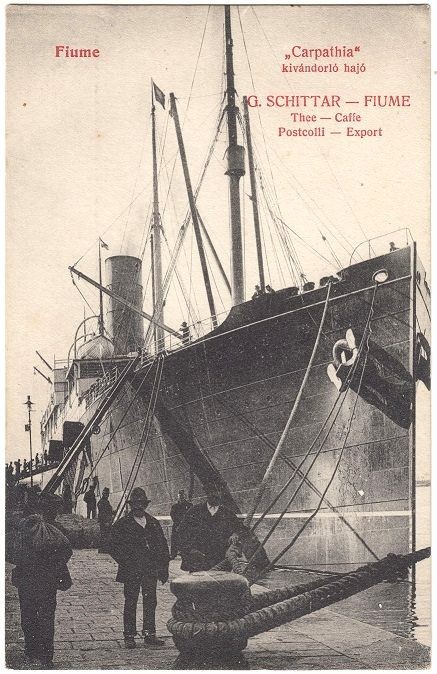
Ultra rare !!!!!RMS CARPATHIA docked in Fiume (todayRijeka) - beautifull and ultra rare original vintage advertisement postcard of the famousRijeka merchant and publisher G. Schittar.The steamship RMS Carpathia was permanently recorded in history as the ship that saved all the surviving passengers from the Titanic.Carpathia was a passenger ship of the British company Cunard Line. She regularly sailed on the line between New York andRijeka (then calledFiume), transporting emigrants from Central and Southeastern Europe to America and tourists in the opposite direction.RMS Carpathia – The ship of hope that snatched hundreds of souls from the cold Atlantic.The night the RMS Carpathia raced to rescue survivors from the Titanic stands as one of the greatest examples of maritime heroism. The entire operation was led by Captain Arthur Henry Rostron, whose cool-headed and incredibly organized decisions saved hundreds of lives.
How did that dramatic night begin?
Carpathia’s wireless operator, Harold Cottam, had already finished his shift and was preparing for bed. Out of sheer habit and professional curiosity, he decided to send one last message to the nearby Titanic to let them know there was a message waiting for them from shore. Instead of the usual reply, he received a frantic distress call: "Come at once. We’ve struck an iceberg.
Cottam immediately rushed to the captain's cabin and woke Rostron. The captain was initially skeptical, but as soon as he verified the coordinates, he immediately turned the ship 180 degrees and headed toward the Titanic.Issuing 23 legendary orders:Although the Carpathia was 58 nautical miles away (about 107 kilometers)—a distance requiring at least four hours of sailing—Rostron refused to accept those limitations. As the ship raced forward, the captain issued a series of over 20 synchronized orders to prepare the vessel for the mass reception of survivors:Shutting off heating and hot water: Rostron ordered the steam supply to passenger cabins to be cut off. All available steam was diverted to the engines. The *Carpathia*, which had a top speed of 14.5 knots, achieved an incredible 17.5 knots that night.
Converting lounges into infirmaries: Three dining rooms were transformed into makeshift medical stations. Ship's doctors were assigned to different classes to immediately triage the sick.
Preparing supplies: Orders were given to brew vast quantities of coffee, tea, and soup, and to ready all available blankets, bedding, and clothing.
Nets and ropes: Nets, rope ladders, and canvas slings were lowered along the ship's sides to hoist up children and those with limited mobility.A voyage on the edge of disasterRacing at 17.5 knots through pitch darkness in the very area where the *Titanic* had just met its doom was a massive risk. Rostron knew he was endangering both his ship and the lives of his 1,035 passengers.
To avert tragedy, he stationed extra lookouts on the bow and the bridge. During this frantic dash, the *Carpathia*'s crew had to execute sharp maneuvers to steer clear of no fewer than six large icebergs. To reassure the survivors and signal that help was on the way, Rostron ordered that signal flares be fired every 15 minutes, starting at 2:45 a.m.
Arrival at the scene
The *Carpathia* arrived at the location around 4:00 a.m. The *Titanic* was gone; it had sunk an hour and a half earlier. Only the lifeboats were left drifting on the ocean in the absolute darkness and silence. The first boat was taken aboard at 4:10 a.m., and by 8:30 a.m., the crew had successfully brought up all 705 surviving passengers. Rostron then held a brief religious service for the victims, turned the ship around, and headed back to New York.Croatian Crew and Heritage: At the time of the rescue, 84 Croatian seamen were serving on the *Carpathia*. The only surviving *Titanic* life jacket in Europe is housed at the Maritime and History Museum of the Croatian Littoral in Rijeka; it was brought back by a crew member fromRijeka, Josip EMS fast and safely international shipping = 35. US$