When you click on links to various merchants on this site and make a purchase, this can result in this site earning a commission. Affiliate programs and affiliations include, but are not limited to, the eBay Partner Network.
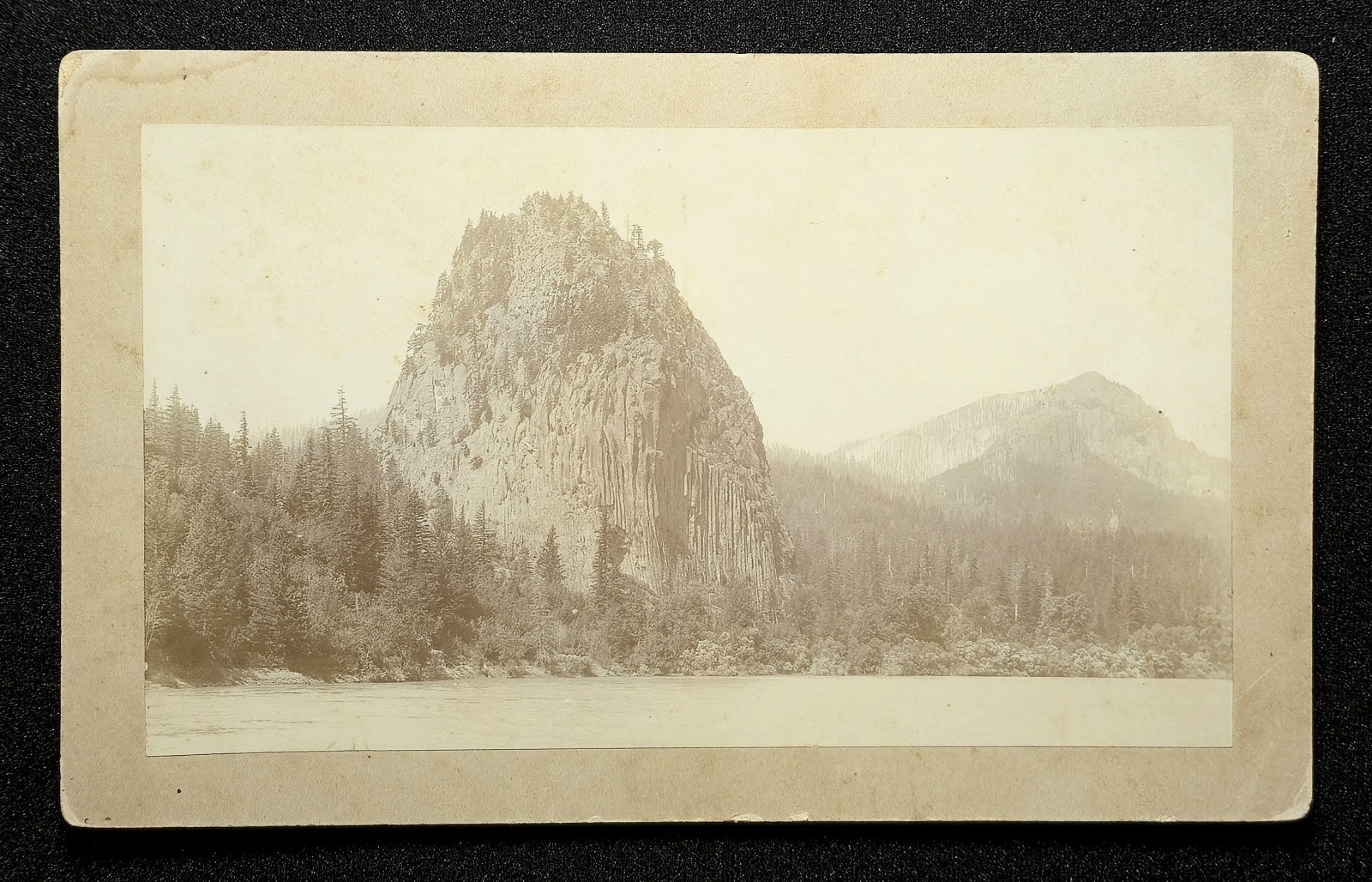
Rare Photo Beacon Rock. Columbia River, Washington. C 1890's Benjamin Gifford
Size is 5-1/4"×8-1/2" in total.
Benjamin A. Gifford (1859–1936)
By Megan K. Friedel
Benjamin Arthur Gifford was one of Oregon’s most prolific commercial landscape photographers
during the late nineteenth and early twentieth centuries. From 1888 until his retirement in 1920, he
was nationally known for his large-format, often hand-colored photographs of the Columbia River
and its towns and people. Gifford, curator and photographer Terry Toedtemeier wrote, "produced
the most comprehensive visual record of the Columbia Gorge—and indeed of the entire state of
Oregon—that exists from the early twentieth century.”
Born in DuPage County, Illinois, on November 11, 1859, Gifford left home in 1880 and briefly
attended the Kansas Normal School in Emporia. He worked for two years as a photographer’s
apprentice in Fort Scott before finishing his apprenticeship work in Sedalia, Missouri, with
photographer William Latour. In about 1880, he opened Tresslar & Gifford photography studio in
Fort Scott with photographer and partner Elkanah P. Tresslar (1847–1916). Two years later, he
sold his share of the business and relocated to Chetopa, Kansas, where he ran his own studio for
several years.
Gifford married Myrtle Louise Peck (1861–1919) in 1884 in Bourbon County, Kansas. In the
summer of 1888, the couple moved to Portland, and by 1891 Gifford was operating a successful
photography studio at Sixth Avenue and Morrison Street, across from the Portland Hotel. The Panic
of 1893 forced Gifford to move his business to his home on Corbett Street, where he improved on
his techniques. By his own account, he was the first photographer in the city to make enlargements
using an electric bulb rather than natural light sources, allowing him to make large-format prints
indoors at any time of day and regardless of weather conditions.
In 1894, Gifford partnered with Herbert Hale, a local photographer with a strong background in
landscape photography. With Gifford's enlargement set-up and printing mastery, the Gifford & Hale
studio, for a brief period, had a near monopoly on locally produced large-format prints and murals.
The same year, the Giffords’ only child was born, Ralph I. Gifford (1894–1947), who would become
a photographer and filmmaker.
In 1896, journalist William Gladstone Steel invited Gifford to join and photograph an expedition to
Crater Lake as part of his campaign to promote the lake and its surroundings as a national park.
Gifford's photographs from the expedition were published in several newspapers and magazines.
That work may have inspired the next phase of his career in which he focused on the commercial
possibilities of his photographs for advertising and marketing.
When Gifford’s partnership with Hale dissolved in 1897 or 1898, he moved his family to The Dalles
so he could more closely photograph the Columbia River, especially nearby Native communities.
He began making photogravure reproductions of his images, sold both as sets of loose prints and in
books, and produced hand-colored photo murals for train stations and schools. That work, with its
bold colors and romantic aesthetic, was aimed at marketing a picturesque vision of the Columbia
River Gorge. Railroads such as the Oregon Railway and Navigation Company bought his
landscape images to advertise the region's potential for settlement and tourism, and tourists bought
his lithographed and photo postcards as souvenirs of their travels.
While maintaining his home and studio in The Dalles, Gifford opened a studio in Portland in 1901
with his colorist and business manager Violet Kent. He eventually sold that studio to local
photographer Charles Y. Lamb and moved his family to Portland in 1910 so he could be closer to
his primary clients: railroads. He partnered with Arthur M. Prentiss in 1917 to form Gifford &
Prentiss Studio. Gifford’s most notable work during this time was a series of photographs of the
construction of the Columbia River Highway, which were exhibited at the 1915 Panama Pacific
Exposition in San Francisco.
Myrtle Peck Gifford died in 1919 after a long illness. In October of that year, Benjamin Gifford
married Rachel Morgan (1877–1973), a former schoolteacher from The Dalles who had worked for
him as a colorist in 1912 and was secretary of Gifford & Prentiss. He retired in 1920, and the couple
moved to a rustic log cabin in Salmon Creek, Washington, which they named Wa-ne-ka after one of Gifford’s most famous photographs of the sun setting over the Columbia. Ralph Gifford took over
his father’s business in Portland.
Benjamin Gifford died on March 5, 1936. He was buried in Lincoln Memorial Park (now Mount Scott
Park Cemetery) in Portland, and his gravestone bears the signature that appears on all of his
published photographs. Major collections of Gifford’s photographs are held by the Oregon Historical
Society and Oregon State University. His work, reproduced as high-quality photogravures, appear
in his books: Snap Shots on the Columbia (1902), Art Work of the State of Oregon (1909), and Art
Work of Portland, Mt. Hood and the Columbia River (1912).
It is in very good condition considering it's age. Very slight curve to the photo as well, but will flaten easily when mounted and framed.
Unsigned. From a major Gifford Collection.
We have well over 300 in our own private collection.
100% Authenticity Guarantee.
Please feel free to ask questions.
Sold as-is.
Shipping is $8.95 here in the states.