When you click on links to various merchants on this site and make a purchase, this can result in this site earning a commission. Affiliate programs and affiliations include, but are not limited to, the eBay Partner Network.
An original 10x8" vintage photo from the Marty Himes estate.
Provenance: This photograph comes directly from the Marty Himes Racing Museum Collection, assembled over decades by Marty Himes - racer, restorer, and lifelong archivist of American racing. Every piece he preserved tells part of the story of motorsport’s rise from dirt tracks to the spectacle of the Indy 500. We acquired the majority of his photo collection after his passing. Many of his photos are extremely rare or even one of a kind. Professionally packaged in a rigid mailer for safe delivery.
Photo Overview
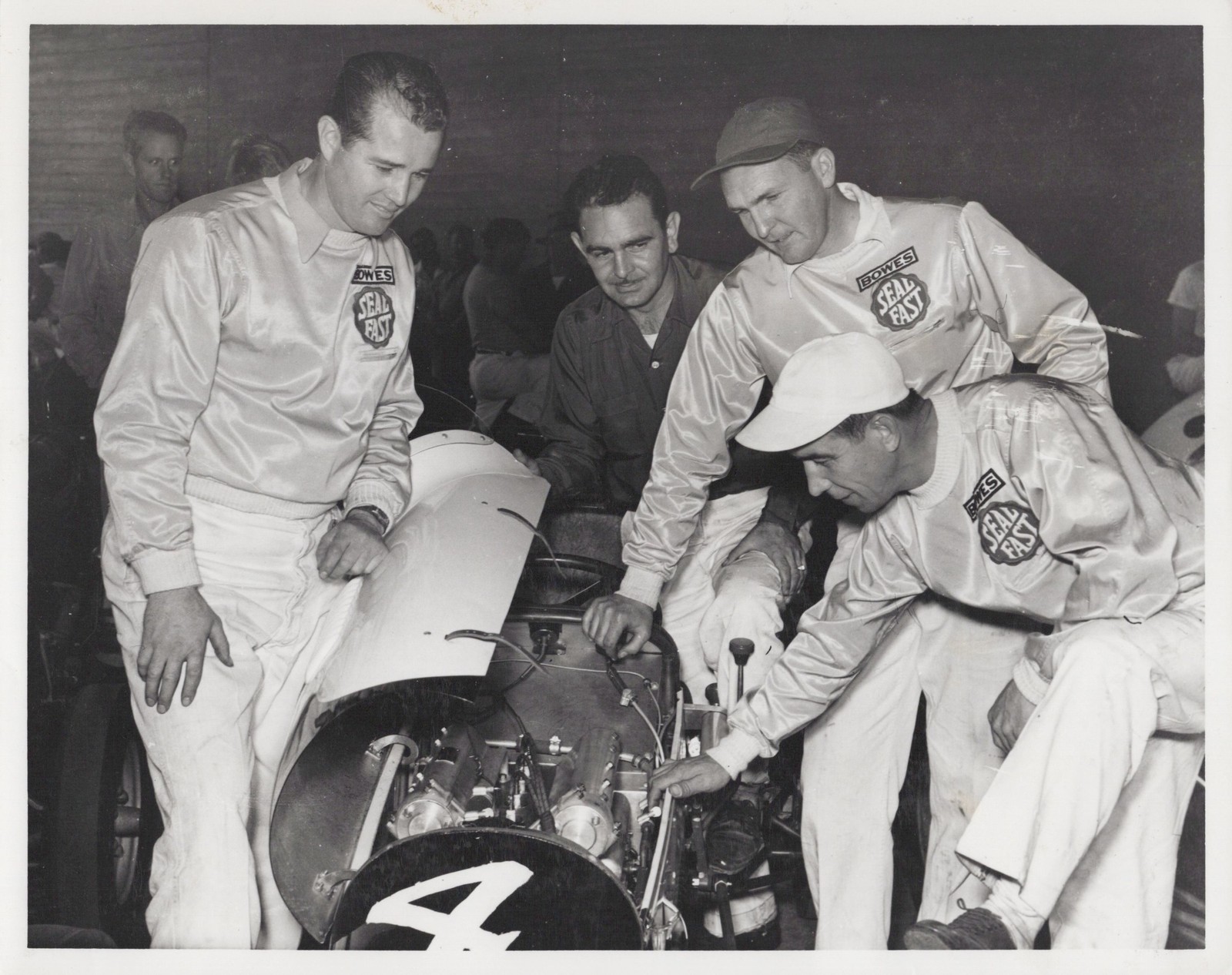
This original racing photograph shows legendary car owner Rex Mays with the Bowes Seal Fast Kurtis team working over their Offenhauser-powered Indy car in the Los Angeles, California indoor midget scene in 1946. Left to right are mechanic Pete Clark, driver Mel Hansen, owner Rex Mays, and driver Joe Garson, all in matching Bowes Seal Fast satin jackets as they lean over the open-engine Kurtis chassis identified as car number 4, captured in the pits just before competition.
Rex Mays was one of America’s greatest pre-war and immediate post-war open-wheel stars, a two-time AAA national champion and four-time Indianapolis 500 pole winner whose smooth, aggressive style helped define big-time American championship racing. The Bowes Seal Fast Kurtis midgets were among the most successful cars on the thriving California indoor circuit that kept fans and drivers sharp through the winter and helped launch the careers of many Indy 500 greats. Add this scarce, museum-sourced image of Mays and his 1946 LA team to your collection today before another serious racing historian snaps it up.
Print analysis:
This is a glossy silver-gelatin photographic print with a blank, fiber-based back and no modern barcodes or lab markings, consistent with mid-20th century darkroom printing rather than a recent reproduction. The handwriting identifies the scene and date as 1946, but the smooth paper surface and overall look suggest it was likely printed slightly later from the original negative, probably in the 1950s, when many racing collectors and archives made high-quality enlargements. Based on this, it is best classified as a Type 2 photo, printed from the original negative c1950s.
Condition: Please see scans of the image we have provided for the most accurate and complete state of the photo. Many of the photos in this collection are very old and have age related wear, chips, creases, curling, etc. Others are remarkably well maintained.