When you click on links to various merchants on this site and make a purchase, this can result in this site earning a commission. Affiliate programs and affiliations include, but are not limited to, the eBay Partner Network.
The Art Club Of Philadelphia Lamberton Scammell Ivory Dairy Creamer
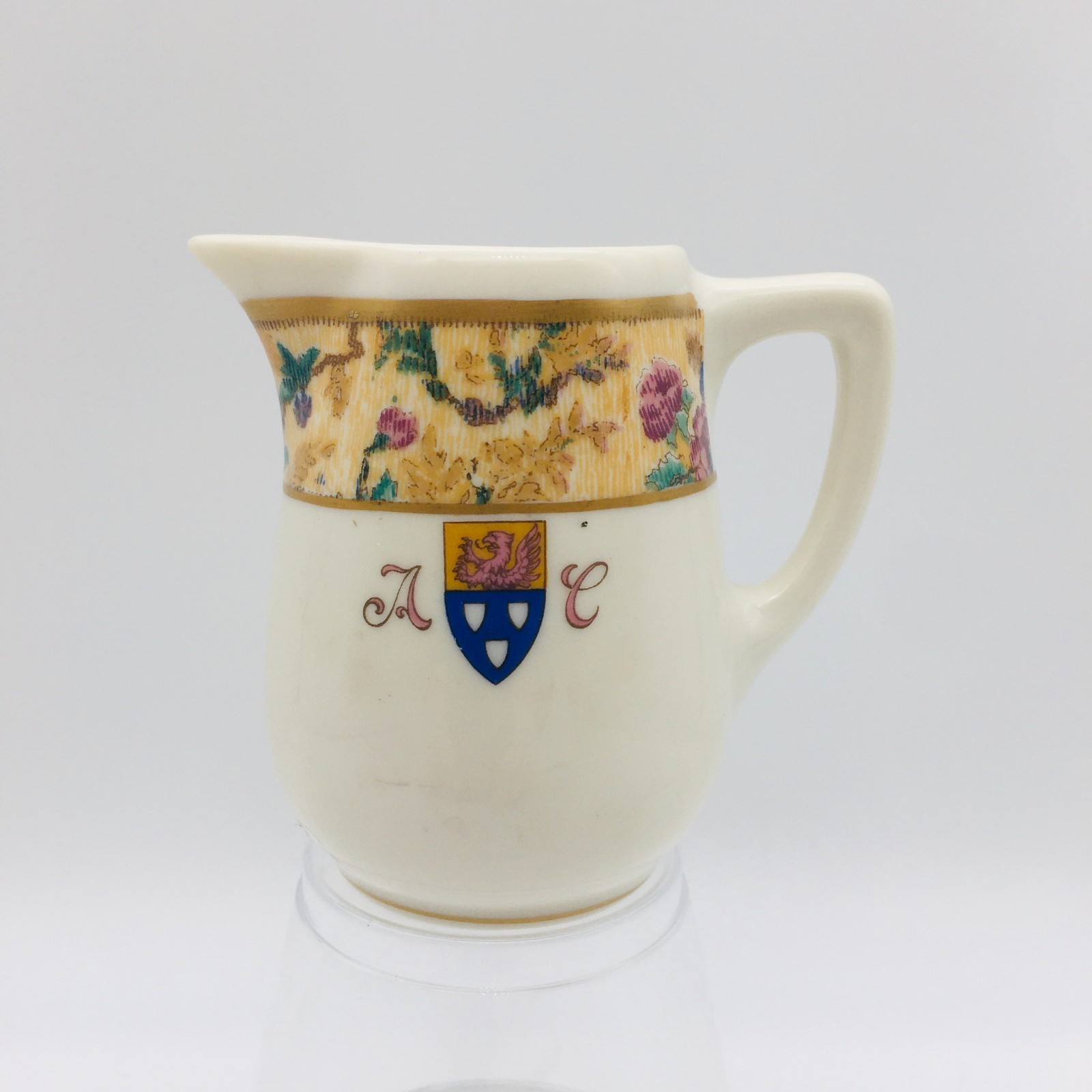
Offered for your consideration is a 1924 to early 1930's era side logo 3-3/8" tall art-worked pattern hotel china dairy creamer - cream pitcher made for the private dining room services at the famous (and now long gone) Philadelphia Art Club that was located in downtown Philadelphia, Pennsylvania.
Not much of this china was ever produced by the Scammell China Co. and even fewer pieces survive, as the club had disbanded by 1940. This china was also used for the club's private dining room that was available only to members and their guest that was operated at the club during the 1920's to early 1930's era.
If you collect historic Philadelphia art items, vintage higher-end restaurant ware, or actual artifacts from the Art Club, you might want to consider the rarity for your collection.
Interestingly, the graphics on the creamer were made to resemble an impressionist style painting of art and look wonderful; especially, with the club's log and initials under the art-work. Truly, rarity; especially, in the area of restaurant and hotel china.
Historically, the Art Club of Philadelphia (also historically referred to and recognized as the Philadelphia Art Club) was chartered on February 7th, 1887, in downtown, Philadelphia, Pennsylvania, for the purpose of the advancement of the arts.
A short time after the club's formation, it was apparent that club needed a formal and substantial building to operate out of to advance the goals of the club. In 1888, the decision was made to purchase a hotel at 220 S. Broad Streets near Chancellor Street in downtown Philadelphia at a then staggering cost of $100,000. The former hotel needed extensive redesigning and complete renovations in order to transform it into the building that the club needed. Local Philadelphia architect Frank Miles Day was commission to do that.
When completed in 1889, the building's design and style was considered one of the most impressive buildings in that portion of the city when finished. Included in it was an art library, a lecture room where visiting and local artist could speak, social receptions, art shows, an area where literature could be discussed, poetry reading, and where members could also dine at the club's dining room. The club held its first official meeting there on December 8th, 1889. It was reported as being“one of the most beautiful and artistic clubhouses to be found in the country.”
Additionally, the art club became a focal point where new ideas of science and even politics could be discussed, debated, and conveyed. In addition to lectures, galleries, and shows, artist could come to the club and actually work on their art. Both professional and amateurs were welcomed and could work alongside each other in the fine opulence the club offered to its members.Each year, the club presented a gold medal to an artist for a literal "outstanding work of art". That award was considered one of the most prestigious art awards to be given in the entire United States.
The club was also noted as being the birthplace for the famous "Philadelphia Ten". This was a group of ten outstanding and famous Philadelphia female painters, were the first to have a groundbreaking annual art show (starting in 1917) of their work held at the Philadelphia Art Club. Those members included "Eleanor Abrams, Katherine Marie Barker, Theresa Bernstein, Cora S. Brooks, Isabel Branson Cartwright, Constance Cochrane, Mary-Russell Ferrell, Arrah Lee Gaul, Edith Lucile Howard, Helen Kiner McCarthy and Katherine Hood McCormick."
Some of the other most notable and famous members of the club also included:Leon Kroll (painter, lithographer, art critic, and teacher);Albert Sterner (a Philadelphia artist circa 1900's);Thomas Moran (partof the multi-generational Moran family of artists who lived and worked in Philadelphia during the 19th century);N.C. Wyeth (a well-known illustrator and member of the Philadelphia Sketch Club, another important art organization in the city);Howard Pyle (an influential illustrator and educator who taught at the Drexel Institute in Philadelphia); Cecilia Beaux (a renowned portraitist artist whom became the first full-time instructor at the Pennsylvania Academy of the Fine Arts), and many others.
Who knows what famous artist, sculptor, important person, celebrity, or famous person may have used this creamer while a member or visiting the club while having coffee or hot tea.
But as society was rapidly changing from the effects of the long Great Depression and World War II had already started in Europe in 1939, the decision was made to dissolve the club on November 9th, 1940; leaving a void in the arts advancement in the city. Though the club was gone, its beautiful building remained and became the headquarters for the Keystone Automobile Club, the political headquarters for election campaigns, and then finally the offices of the failed Philadelphia Football Team before becoming abandoned.
In the end, the Art-Club's original building was owned by the Bankers Secretaries Corp., whom wished to demolish it. Many people and groups fought hard in order to save the building from demolition, but that was not meant to be, as in December of 1975, the once great structure at the age of 86 years old was demolished and made way for a "20 car parking spot" for the Bellevue Hotel becoming part of the city's lost history. Today, a 450 car parking garage is what occupies the site.This creamer would have been used for holding dairy cream for hot coffee, hot tea (especially, ladies afternoon tea held at the club), or other beverages and even entrees that might use some dairy cream. It would have been used in connection with the Art- Club's hotel silver soldered - silver plate and glassware for actual dining service. Again, who knowswhat famous artist, sculptor, important person, celebrity, or famous person may have used this creamer while a member or visiting the club while having coffee or hot tea.
It was made by the Scammell China Company that was located in Trenton, New Jersey, at their Lamberton Works. The backstamp dates this piece to the 1920's to early 1930's era. Scammell had originally been the Maddock China Co., which in 1924, purchased Maddock and renamed it Scammell. It is the heavyweight type steamship, restaurant, and railroad china. It has no cracks, no chips, and only light usage.Please study the photos and feel free to message me with questions.
You may wish to consider adding this lovely piece of historyto your hotel silver, silver soldered, heavyweight type steamship, hotel silver, or restaurant ware collection.