When you click on links to various merchants on this site and make a purchase, this can result in this site earning a commission. Affiliate programs and affiliations include, but are not limited to, the eBay Partner Network.
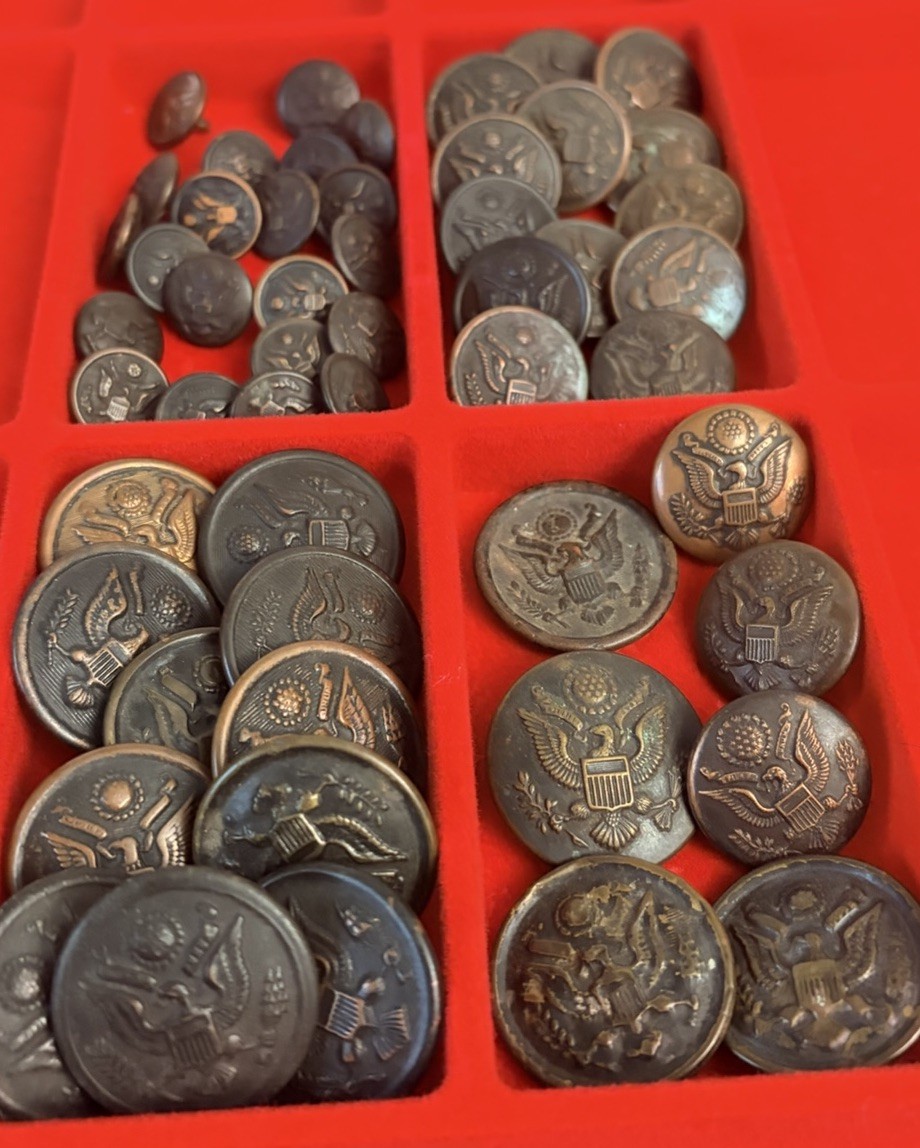
This is an excellent collection of U.S. Army Great Seal uniform buttons, primarily spanning from the early 20th century through the World War II era.
Decoding the Backmarks (Manufacturers & Eras)
The makers stamped into the backs of these buttons read like a directory of America's historic industrial powerhouse centers - specifically Connecticut and New Jersey. Based on the backmarks visible in your photos, here are the specific companies that produced your lot:
1. Waterbury Button Co. (Waterbury, CT)
You have several backs clearly stamped with "WATERBURY BUTTON CO." or "WATERBURY CO."
History: Waterbury, Connecticut, was known as the "Brass City," and this company was one of the primary suppliers of buttons for the U.S. military from the Civil War all the way through WWII (and they still exist today).
Era: The crisp, block-lettering backmarks on these blackened and bronze-toned pieces are classic WWI to WWII production.
2. American Button Co. (Newark, NJ)
Visible on multiple brass backs stamped "AMERICAN BUTTON CO. NEWARK N.J." * History: A massive supplier during the early 20th century.
Era: They were incredibly active during World War I. If you see a raised rim or specific patent dates on these, they lean heavily toward the 1910-1920 era.
3. R. Liebmann Mfg. Co. (Newark, NJ)
Several of your prominent brass backs read "R. LIEBMANN MFG. CO. NEWARK N.J."
History: Reinhard Liebmann's firm was a highly specialized contractor that secured significant government contracts to produce uniform buttons specifically for the mobilization of troops during World War I (circa 1917-1918).
4. Sigmund Eisner / Eisner Co. (Red Bank, NJ)
Look closely at the back that reads "SIGMUND EISNER RED BANK N.J."
History: Sigmund Eisner is a legendary name in militaria. His company was one of the largest uniform manufacturers in the United States. During WWI, Eisner's factories in Red Bank, New Jersey, produced a massive percentage of the clothing worn by the American Expeditionary Forces (AEF).
Significance: Buttons marked specifically with the uniform contractor's name (rather than a standalone button company) are fantastic pieces of military supply-chain history.
5. Horstmann (Philadelphia, PA)
There is a backmark stamped "HORSTMANN Wm. H. Horstmann Co. was one of the oldest and most prestigious military outfitter and regimental supply firms in the country, operating out of Philly since the 19th century. They were famous for high-quality officer gear.
Condition, Material, and Variety
Finishes & Sizes
Gilding vs. Patina: Mix of bright, gold-toned brass finishes (often associated with dress uniforms or earlier production) and heavily darkened, chemically "blackened" or bronzed finishes.
The "Subdued" Look: The darker, chocolate-brown and blackish buttons were designed for field and service uniforms (like the classic WWI wool tunics or WWII four-pocket service coats) so they wouldn't glint in the sun and give away a soldier's position.
Sizes: The lot includes both large coat-size buttons (used down the center front of the service coat) and small cuff/pocket-size buttons (used on the sleeve cuffs, shoulder loops/epaulets, and breast pockets).