When you click on links to various merchants on this site and make a purchase, this can result in this site earning a commission. Affiliate programs and affiliations include, but are not limited to, the eBay Partner Network.
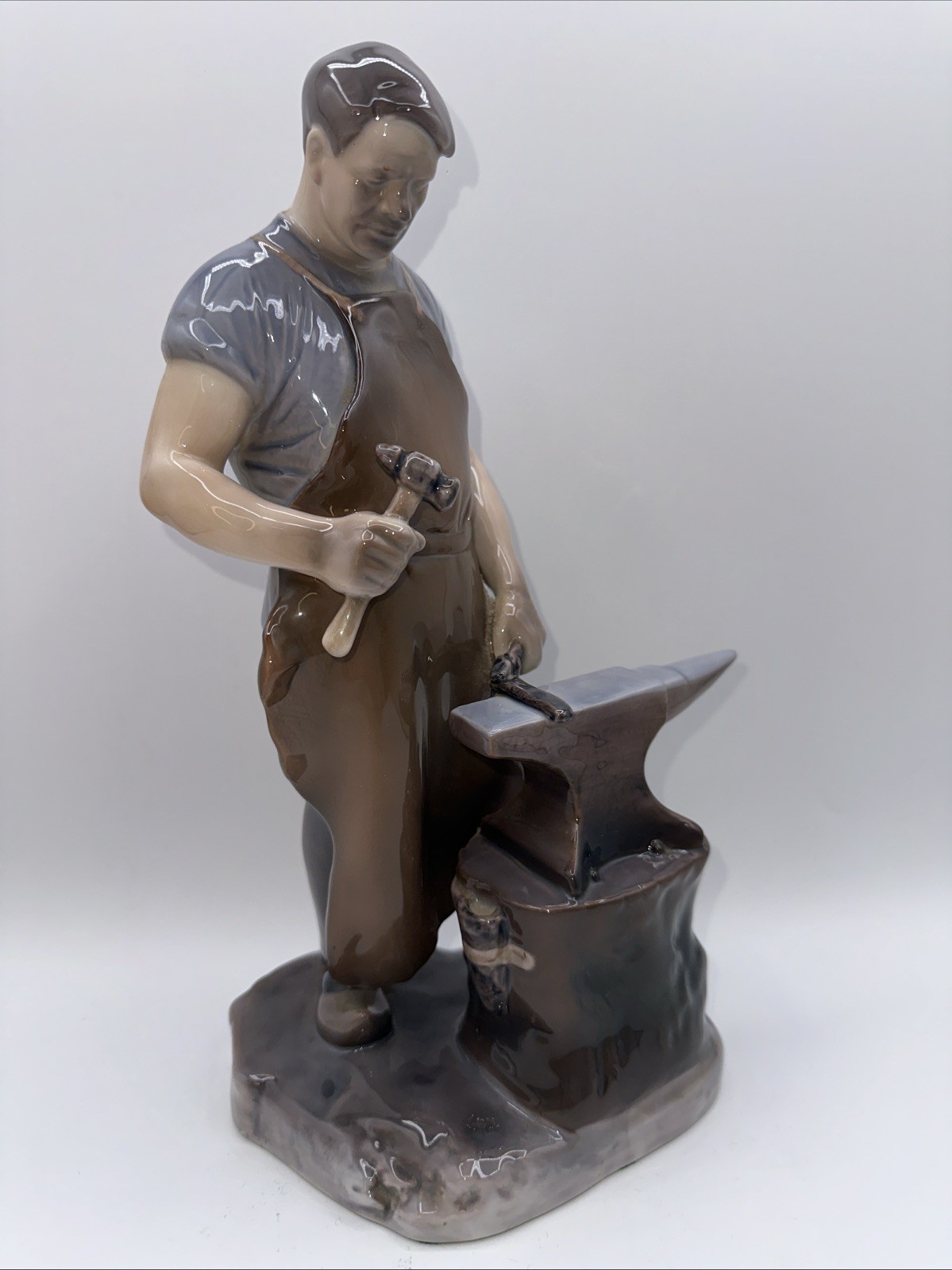
This listing is for a NEAR MINT CONDITION, vintage Bing & Grondahl porcelain 11” tall blacksmith statue/figurine, item #2225.
There are no chips, cracks, scratches, flea bites, or crazing noted!
The quality & detail, down to the discolored “dirt on his face” makes this a stunning piece of Social & Heroic Realism art history from the 1940s-1950s timeframe.
Designed and signed by Axel Locher in Denmark, this piece is an absolute treasure!
Based on the factory backstamp on the underside, this figurine was made between 1948 and 1952 in Denmark.
Stunningly gorgeous work of art!
*All items are either my own or inherited, so are described & fairly priced to the best of my ability (based on measurements, irregularities, age, etc.)
*All items are sold AS-IS, so please diligently look at all photos & read the item description carefully.
*If you have further questions, or wish to make a “reasonable” offer not allowed in the listing, please message me. I will be happy to respond! 😊
ABOUT THIS VINTAGE PIECE:
How to Decode the Markings:
Country of Origin: The stamp explicitly states Denmark under the word "Kjøbenhavn" (the Danish spelling of Copenhagen).
Production Era (1948–1952): You can pinpoint the exact years by looking closely at the spelling of "KJØBENHAVN". In this specific era's trademark, the letter "J" has a distinct extended, elongated tail that drops down lower than the surrounding letters. The Logo: The green stamp featuring three towers is derived from the official Coat of Arms for the city of Copenhagen.
Model Number: The stamped number 2225 matches the official Bing & Grøndahl catalog designation for Axel Locher’s Blacksmith sculpture.
Painter's Initials: The hand-painted green AB at the very bottom represents the unique mark of the factory artisan who hand-painted and glazed this specific piece.
Value Factors for this Specific Piece:
The Age Premium: Because this backstamp dates exactly to the late 1940s or early 1950s, it carries a slightly higher historical appeal than versions produced later in the 1970s and 1980s.
This figurine/statue is made from high-quality fine porcelain (often referred to as hard-paste porcelain) that has been hand-painted and finished with a smooth, glossy vitreous glaze. This material gives the figurine its characteristic glass-like shine, smooth texture, and the slightly translucent look typical of premium mid-century Danish pottery.
The artist's incised signature, "Axel”(Axel Locher,) was carved directly into the original clay mold by the sculptor before the figurine was cast.
Because it was impressed into the wet clay and later covered with a thick, glossy glaze, the letters can look slightly blurred or resemble faint, raised bumps rather than crisp writing.
Who he was: Axel Locher (1875–1915) was a highly regarded Danish sculptor who designed this specific blacksmith figurine for Bing & Grøndahl.
Sign of Authenticity: Seeing this signature molded directly into the porcelain base—paired with the factory stamps found on the bottom—fully confirms that this is an authentic piece matching Locher's original design.
This figurine is a handmade piece, but it is important to understand what "handmade" means in the context of fine European porcelain like Bing & Grøndahl. It was not sculpted entirely from scratch out of a raw lump of clay as a one-of-a-kind object. Instead, it was produced using highly skilled, multi-step artisanal hand-craftsmanship. The process behind making this specific figurine involved several hands-on steps:
The Handmade ProcessHand-Casting: A liquid clay mixture called slip was poured into detailed plaster molds derived from Axel Locher's original sculpture. Complex figures like this blacksmith were typically cast in multiple separate pieces (arms, tools, anvil, body) and then joined together by hand using slip as an adhesive before firing.
Hand-Finishing: After casting, a skilled craftsman (known as a "repairer") used small tools to hand-smooth the seams, refine delicate details, and ensure the piece perfectly matched the master design.
Hand-Painting: Every bit of coloration you see—from the skin tones to the metallic sheen on the anvil and the brown apron—was hand-painted directly onto the unfired or biscuit-fired porcelain using specialized underglaze paints.
Artist Signatures: Because it was hand-painted, you will find the unique initials of the specific factory decorator painted on the bottom of the base, right next to the Bing & Grøndahl trademark stamp.Because every single piece was painted and finished by a different factory artisan, no two of these figurines are exactly identical. Minor variations in color depth, shading, and precise glaze strokes make each one unique.
A statue of a blacksmith from the 1940s to 1950s typically falls into the Social Realism or Heroic Realism style, which celebrated the dignity and strength of working-class labor.
Common Styles of the EraSocial Realism: This style focused on realistic, unidealized depictions of everyday workers, highlighting the gritty reality and importance of manual labor.
Heroic Realism: Often used for public monuments, this approach presented the blacksmith with exaggerated muscles and an idealized, powerful posture to symbolize national strength and productivity.
Mid-Century Stylized Realism: By the 1950s, some public art shifted toward simplified shapes, cleaner geometric lines, and semi-abstract features while still clearly representing the figure of a worker.