When you click on links to various merchants on this site and make a purchase, this can result in this site earning a commission. Affiliate programs and affiliations include, but are not limited to, the eBay Partner Network.
What did it feel like to hold a piece of the line that hauled the coal that heated New York City?🚂
There\'s a particular kind of magic in a stock certificate that\'s outlived the company that issued it. This one comes from the Delaware, Lackawanna and Western Railroad — the \"Route of Phoebe Snow\" — a road that anthracite miners, Scranton ironworkers, and Hoboken ferry commuters all depended on for the better part of a century.Old-timers in the Pennsylvania coal country still talk about the whistle of a Lackawanna train echoing off the ridges above the Lackawanna Valley, and collectors of scripophily — the hobby of collecting old stock and bond certificates — consider a DL&W share one of the great anchor pieces of American railroad Americana.Holding one is about as close as you\'ll get to touching that vanished world of steam, anthracite smoke, and company towns built around a rail yard.
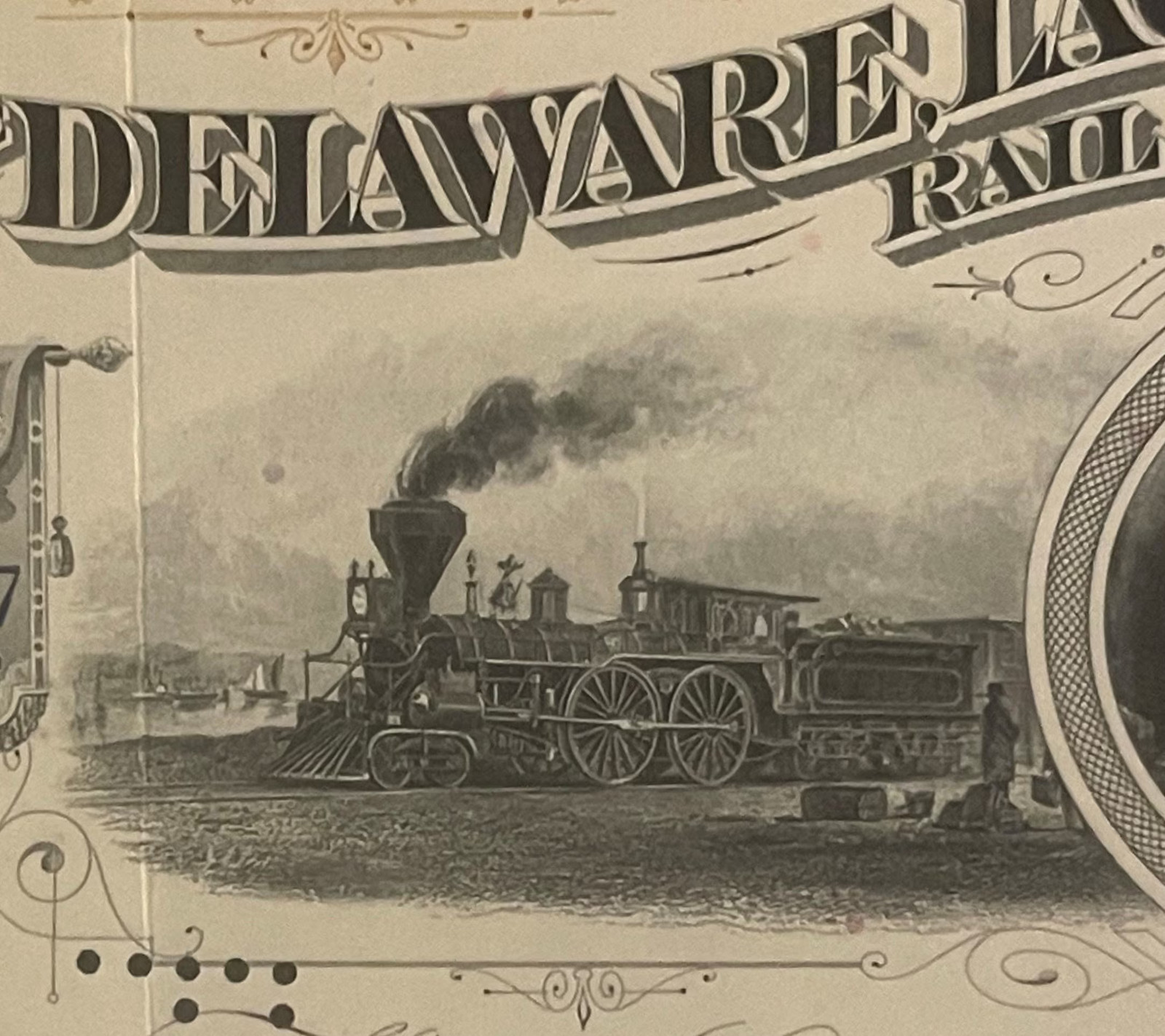
This is an original certificate for The Delaware, Lackawanna and Western Railroad Company, chartered under the laws of the State of Pennsylvania, measuring roughly 11 ¼\" x 7 ½\" and engraved by the American Bank Note Company of New York — the premier security printer of the era, the same house that engraved currency, bonds, and stock certificates for the largest corporations in the country.The face is ornamented with the company\'s elaborate banner lettering and a beautifully engraved vignette: a smoke-belching steam locomotive on one side, a mine scene with anthracite workers in an oval medallion at center, and a coal breaker and loading works on the other — the whole visual story of the DL&W\'s business laid out in a single piece of period engraving art.Certificates of this design were issued across the company\'s final decades of independent operation, from the early 1930s through 1959, placing this piece squarely in the closing chapter of DL&W history — right up to the eve of its 1960 merger with the Erie Railroad. This is a genuine issued certificate that was executed, registered and cancelled rather than being lost to time, giving you an excellent, well-preserved example of mid-century American railroad security engraving.
⛏️ The Company: An Anthracite Empire Built on Coal and Concrete
The DL&W\'s roots go back to April 7, 1832, when it was chartered in Pennsylvania as the Liggett\'s Gap Railroad Company — though it sat dormant for years before finally being organized and opened in 1851.On April 14, 1851, it was renamed the Lackawanna and Western Railroad Company, and on March 11, 1853, it took its permanent identity as the Delaware, Lackawanna and Western Railroad Company after absorbing the Delaware and Cobb\'s Gap Railroad Company. The whole purpose, from the start, was simple and lucrative: connect the anthracite coal fields of Pennsylvania\'s Coal Region to the enormous coal-hungry markets of New York City.
The railroad grew into a 395-mile system linking Buffalo, New York, with Hoboken, New Jersey, with a ferry connection carrying passengers the rest of the way into Manhattan.What\'s remarkable — and what collectors love about this company — is that the DL&W was known as one of the best-run railroads in the country. Unlike many of its coal-hauling contemporaries (the Lehigh Valley, the New York, Ontario & Western, the Lehigh & New England), the Lackawanna avoided bankruptcy for more than a century, from its 1850s formation all the way to its 1960 merger.Its engineers were pioneers in reinforced concrete construction, and the crown jewel of that engineering program was the Tunkhannock Viaduct — a 240-foot-high concrete arch bridge that was, at the time of its completion, the largest concrete arch bridge in the world.
The end of the line came the way it did for so many coal roads: declining anthracite traffic, brutal competition from interstate trucking, and a series of body blows in the 1950s.Hurricane Diane tore through the DL&W\'s main lines in 1955 and shut the railroad down for 29 days. The Knox Mine Disaster of January 1959 — one of the worst mining catastrophes in Pennsylvania history — accelerated the collapse of the anthracite industry the railroad depended on. By October 17, 1960, the Delaware, Lackawanna and Western had merged with its old rival, the Erie Railroad, to form the Erie Lackawanna Railroad, which was itself absorbed into Conrail in 1976.Any certificate from this design era is, in a very real sense, a piece of the company\'s last stand.
🏙️ Scranton, Hoboken, and the City the Railroad Built
The DL&W and the city of Scranton, Pennsylvania grew up together, almost inseparably.Brothers George W. and Selden T. Scranton came from Oxford, New Jersey, drawn by iron and coal, and settled at a spot called Slocum\'s Hollow — the place that would eventually take their family name and become Scranton, the anthracite capital of the world. The railroad\'s shops, yards, and executive presence anchored the city\'s identity for generations.
At the eastern end of the line sat Hoboken, New Jersey, home to Hoboken Terminal — the DL&W\'s grand passenger gateway on the Hudson River, where trains met ferries bound for Manhattan.By the 1950s, the DL&W\'s executive offices had moved to Cedar Street in lower Manhattan, and lore among railroad historians holds that president Perry Shoemaker made his own commute the old-fashioned way — riding Lackawanna electric trains out to Summit, New Jersey, and back on the very ferries his railroad operated, a nice bit of period color for a man running a commuter railroad from the inside out.
🎩 The Men Behind the Signatures
Every era of the DL&W had its defining figure.Moses Taylor, president of the National City Bank of New York, joined the Lackawanna\'s board in 1854 and, during the depression of the 1870s, is remembered for buying up enough stock personally to block financier Jay Gould from seizing control of the railroad through the rival Erie — a story still told among rail historians as one of the great boardroom rescues of the Gilded Age.In the years just before this certificate\'s era, president William White pushed the DL&W into the diesel age and, in 1949, inaugurated its most famous train, the streamlined Phoebe Snow, before departing in 1952 to take the presidency of the New York Central. He was succeeded by Perry M. Shoemaker, a Yale graduate who had joined the company as a superintendent back in 1941 and worked his way up through General Superintendent and General Manager before becoming, at his appointment in 1952, the first college graduate ever to run the Lackawanna — his tenure spans the very years certificates of this style were being issued to shareholders.
💭 Phoebe Snow, and the Legend of the Clean Coal Railroad
No history of the DL&W is complete without Phoebe Snow — the railroad\'s beloved advertising mascot, a woman pictured in a spotless white dress and white gloves, created to make a very specific point to the traveling public: because the Lackawanna burned clean-burning anthracite coal instead of dirty bituminous, a lady could ride its trains all day and never soil her white gown.Old advertising jingles built around her (\"Says Phoebe Snow, about to go upon a trip to Buffalo...\") were part of American popular culture for decades, and when the railroad launched its streamlined 1949 passenger train, naming it Phoebe Snow was the obvious choice. Collectors and railroad buffs still trade Phoebe Snow ephemera today — postcards, timetables, and advertising cards — as some of the most charming pieces of early American railroad marketing.
The Lackawanna Valley itself even made its way into fine art: the 1855 George Inness painting The Lackawanna Valley, depicting the young railroad at Scranton, hangs today in the National Gallery of Art in Washington, D.C. — a striking reminder of just how central this railroad was to the American imagination in its own time.
🚉 What\'s Left Today
The DL&W\'s physical legacy is still very much alive.The railroad\'s old Scranton locomotive shops survive in restored form as Steamtown National Historic Site, a National Park Service property where visitors can walk the same yards the Lackawanna once ran. And commuters still ride former DL&W trackage every day — NJ Transit continues to operate the Montclair-Boonton Line and the Morris & Essex Lines into Hoboken Terminal, meaning the route this certificate once financed is, in a real sense, still carrying passengers home more than a century after it opened.
🖼️ Display Ideas
- 🖋️ Framed alongside a vintage railroad timetable or map of the Pennsylvania anthracite region for a mini rail-history gallery wall
- 🚂 Paired with a model locomotive or a piece of railroadiana in a den, office, or man-cave display case
- 🏙️ Hung in a Scranton, Hoboken, or Northeastern Pennsylvania home as a piece of authentic regional history
- 🎓 Given as a milestone gift to a railroad engineer, conductor, or lifelong train enthusiast
- 📜 Matted with other scripophily pieces from competing coal roads (Lehigh Valley, Erie, NYO&W) for a \"coal railroad rivalry\" collection
- 💼 Displayed on a desk or bookshelf as a conversation-starting piece of tangible financial history
🎁 Who Collects These
Scripophily collectors seek out DL&W certificates as some of the more visually striking pieces from the American railroad era, thanks to that dual vignette of locomotive and mine work.Railroad historians and rail-fan hobbyists want anything tied to the Lackawanna\'s identity — Phoebe Snow ephemera, timetables, and this style of certificate all sit in the same collecting lane. Genealogy researchers and family historians appreciate certificates like this as tangible artifacts of an era when everyday Americans, including small investors, held shares in the great industrial companies that built the country.And it makes a genuinely memorable gift for anyone with roots in Scranton, the Poconos, or the New Jersey rail corridor into Hoboken — or simply anyone who loves the romance of the steam railroad age.
❓ FAQ
Is this an original certificate or a reproduction?
This is an original stock certificate, engraved and printed by the American Bank Note Company — not a modern reprint.
What does DL&W stand for?
The Delaware, Lackawanna and Western Railroad Company — commonly called \"the Lackawanna\" — which connected Buffalo, New York, to Hoboken, New Jersey.
Is the stock still active or tradable?
No.The DL&W merged into the Erie Lackawanna Railroad in 1960, which was later absorbed by Conrail in 1976; the underlying company no longer exists, so this certificate is a historical collectible rather than a live financial instrument.
What does the vignette on the certificate show?
An engraved steam locomotive alongside a mine scene of anthracite coal workers and a coal breaker/loading works — a direct visual reference to the railroad\'s core business of hauling Pennsylvania anthracite to market.
What should I expect on the certificate?
These were issued and used in active trading — original period paper that was bought, sold and later cancelled, which is exactly why it carries ink, stamps and punches.
Why did the DL&W merge with the Erie Railroad?
Declining anthracite coal traffic, the 1959 Knox Mine Disaster, growing truck competition, and severe 1955 hurricane damage to its main lines pushed the DL&W toward consolidation, resulting in the 1960 formation of the Erie Lackawanna Railroad.
Does anything of the DL&W survive today?
Yes — its old Scranton shops are preserved as Steamtown National Historic Site, and NJ Transit still runs commuter service over former DL&W lines into Hoboken Terminal.
These are issued instruments rather than blanks. Certificates of this type were filled in for a holder in ink, countersigned by the transfer agent and registered by the registrar, then punch- or cut-cancelled when they were redeemed and retired. Expect financial writings, markings, stamps, hole punches and staple holes as part of the life of the instrument: endorsements and signatures, transfer-agent and registrar stamps, revenue or documentary tax stamps, cancellation punches, staple holes from being bound into a transfer book, pencil ledger notations. That is the paper trail of a security that actually did its job, and it is what separates a document that lived from a blank that never did. No two are alike: holder details, serial numbers, dates, signatures, stamps and punch patterns vary from example to example, so the photographs show the type rather than the exact sheet that ships.