When you click on links to various merchants on this site and make a purchase, this can result in this site earning a commission. Affiliate programs and affiliations include, but are not limited to, the eBay Partner Network.
🛞 Ever Wonder What It Felt Like to Be a Kid Racing a Wagonload of Grapes Down a California Orchard Road? 🍇
There's a reason this one stops people in their tracks. Long before Instagram, before advertising agencies had focus groups, a lithographer sat down and decided the best way to sell a crate of grapes was to paint the pure, uncomplicated joy of being a barefoot kid on a summer afternoon. This is one of my favorite labels to hold up to the light — the color is that good, the little guy's grin is that infectious. If I let my own kids near it, it would end up taped to every wall in the house. They love this one every time it comes out of the flat file, and I understand why. It's not just old paper. It's a tiny time machine back to a California that smelled like ripening fruit and freshly cut lumber, when a wagon full of grapes rolling down a packing-house lane was as ordinary — and as beautiful — as it gets.
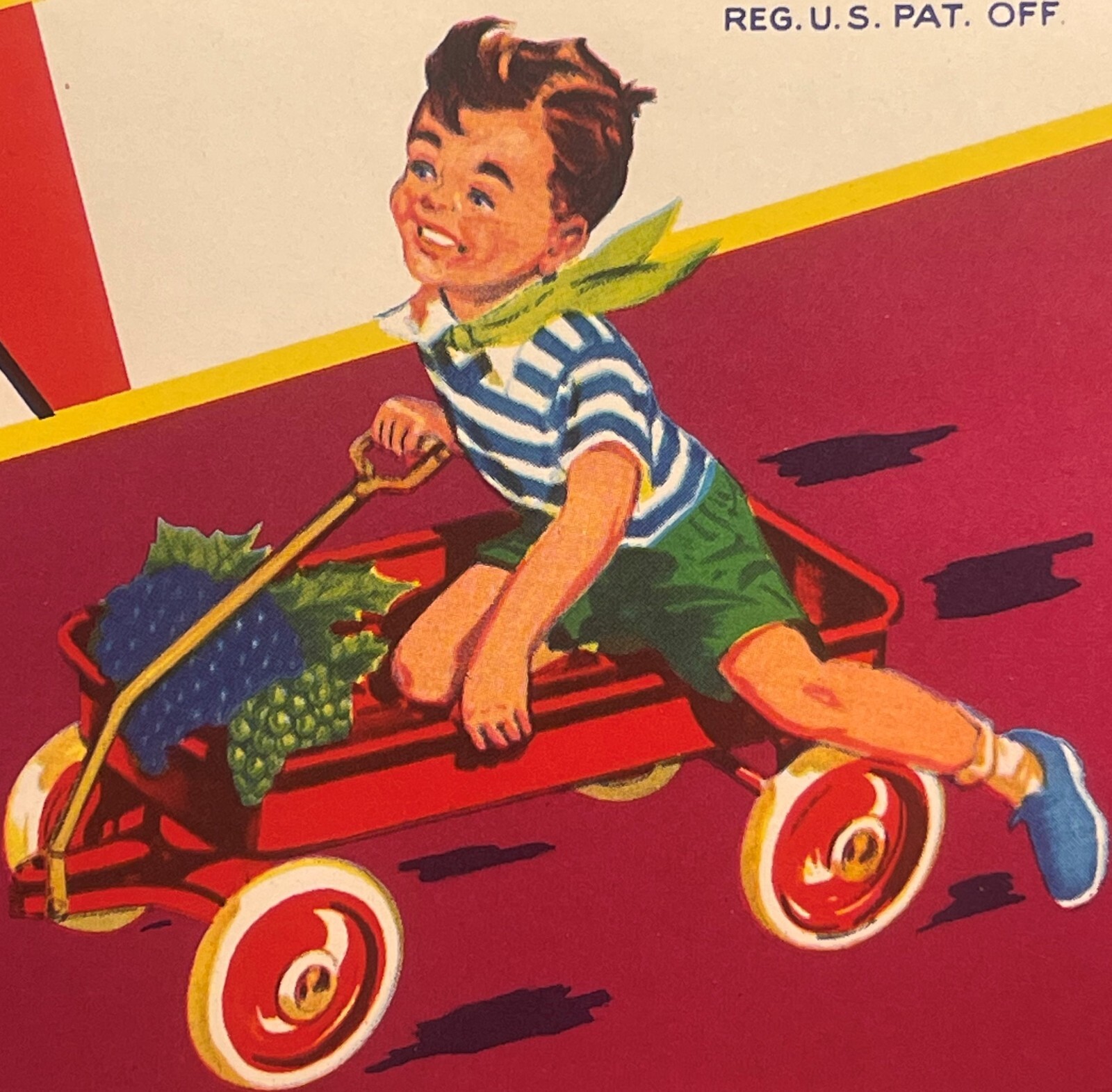
This is an original, never-used (New Old Stock) fruit crate label for the "Red Wagon" brand, issued by the Royal Valley Fruit Growers Ass'n of Reedley, California, and produced by color lithograph offset printing in the 1950s. It measures a true 13" x 4" (approximately 33 x 10 cm) — the long, narrow proportion used specifically for the shallow wooden lug boxes that hauled table grapes out of the San Joaquin Valley. The design is bold and joyful: a rich magenta field slashed diagonally by a golden-yellow band, with the words "RED WAGON" stamped across it in oversized, shadowed red block letters that seem to lean forward with speed. In the upper corner, "UNITED STATES OF AMERICA" runs in pale powder blue against cream, with "REG. U.S. PAT. OFF" tucked into the opposite corner. Below the big lettering, "BRAND" appears in small type, and beneath that, in the same soft blue, "ROYAL VALLEY FRUIT GROWERS ASS'N. REEDLEY, CALIFORNIA" anchors the whole design to its home soil. And on the right side, doing all the emotional heavy lifting, is the boy himself — tousled brown hair, blue-and-white striped shirt, green shorts, blue sneakers — leaning hard into a dash, towing a bright red wagon piled high with dark purple and green grape clusters and trailing vine leaves, little motion shadows kicked up behind the wheels to sell the speed. It's advertising art doing exactly what it was built to do: make you smile before you even register what's for sale.
🍇 The Company Behind the Label: Royal Valley Fruit Growers Ass'n
The "Ass'n" at the end of the name isn't decoration — it's a clue to how California agriculture actually worked at mid-century. Growers in a district like Reedley didn't each run their own packing house and sales force; instead, they banded together into cooperative associations, pooling their harvest under a shared brand so a small grower's grapes could be marketed with the same polish and reach as a large one's. Royal Valley Fruit Growers Ass'n was one of these Reedley packing operations, and its labels weren't limited to just "Red Wagon" — the co-op is also documented under its own "Royal Valley" house brand, a common practice where a single association ran more than one label depending on grade, size, or customer. Royal Valley took its place alongside a roster of other well-known Reedley packers of the era — names like Gerawan Packing, Ito Packing Co., Nash De Camp Company, and Surabian Packing — all working the same rail sidings and the same rhythm of harvest, pack, ship. It was a genuinely competitive, crowded business, and a good label was how a co-op made sure its lugs stood out on a produce buyer's dock in Chicago or New York.
🚂 Reedley, California — "The World's Fruit Basket"
Reedley's story starts, fittingly, with wheat, not fruit. Thomas Law Reed, a Civil War Union veteran, settled in this stretch of the San Joaquin Valley to grow wheat for the Gold Rush miners flooding into California. When the Southern Pacific Railroad came through in 1888 looking to plot a new depot along its branch line, Reed donated the land for the station — and in gratitude, railroad officials named the town after him. Reed himself began selling town lots that same year, and Reedley's fate as a rail-fed farm town was sealed.
What turned Reedley from a wheat depot into "The World's Fruit Basket" was water. In the early 1880s, local ranchers financed irrigation works to pull water off the Kings River, and that single decision changed everything — dryland grain gave way to irrigated orchards and vineyards, and the valley filled with grapes, plums, peaches, and figs. That shift also pulled in new families: European immigrant farmers, drawn by the promise of productive, well-watered ground, began arriving in numbers. Among them was a community of German Mennonites who settled in and around Reedley, having journeyed from Kansas, Nebraska, Minnesota, the Dakotas, and the prairie provinces of Canada. Their numbers grew fast — by 1909, just a handful of years after the first families arrived, the town already supported two Mennonite churches — and their traditions still color Reedley's character today. The town incorporated in 1913, by which point its identity as an agricultural boomtown was already set in stone — or rather, set in wooden fruit crates rolling out by the railcar-load.
🍷 Lugs, Leaves, and the Golden Age of the Vineyard
The long, low shape of this label is itself a piece of history — it's a "lug end" label, sized for the shallow wooden lug boxes built specifically for table grapes, which needed gentler, shallower packing than heavier tree fruit to keep the clusters from crushing under their own weight. Reedley and its neighboring valley towns were at the center of California's grape trade in every direction it could be worked — raisins drying in the sun, fresh table grapes riding refrigerated railcars east, grape concentrate and distillate rounding out the rest. Varieties like the old, thick-skinned Emperor grape were prized in this era precisely because they were tough enough to survive a cross-country rail trip and still arrive with their bloom intact for the fall market. Every one of those lugs needed a label, and packers leaned hard into imagery that would catch a wholesale buyer's eye fast — which is exactly why a co-op like Royal Valley commissioned art this cheerful and this memorable.
🎨 The Art of the Crate Label — And Why It Suddenly Stopped
Between roughly 1870 and 1970, more than fifty lithography houses up and down the West Coast made their living almost entirely from labels like this one, refining color lithography to a genuinely high art form in the process — this is commercial printing that museums and art institutes now hang in dedicated galleries, and it's easy to see why once you've held one in good light. The saturated, layered color, the confident diagonal type, the storytelling illustration packed into a few inches of paper — it's a level of craft that's genuinely hard to match even now.
And then, almost overnight, it ended. By the mid-1950s, cardboard cartons had replaced the wooden crate across the produce industry — wood had gotten expensive, the labor to assemble crates by hand had gotten expensive, and cardboard had finally been engineered sturdy enough to survive the rough handling of rail and truck shipping. Packers could print their branding straight onto the carton itself, and the printed paper label — this whole beautiful, decades-old art form — simply wasn't needed anymore. Old-timers around the valley still talk about packing houses left holding stacks of brand-new labels the week cardboard took over, crates of them destined for the trash bin or the burn pile because there was no more use for them. It's a genuinely poignant piece of local lore, and it's also exactly why an unused label like this one can still turn up today in the condition it left the printer in — it simply never got the chance to go to work.
🧒 The Boy on the Wagon — A Little Piece of American Childhood
The little red wagon has been an icon of American childhood play for generations, and whoever illustrated this label understood exactly what they were tapping into. A grinning, windblown kid tearing along with a wagon full of grapes isn't selling produce so much as it's selling a feeling — summer, freedom, abundance — the same sales instinct that made crate label art so effective and so collectible decades later. It's the kind of image that needs no translation and no explanation; it just makes you smile, the same way it clearly made the boy in the picture smile.
🏡 The Impact Today
Reedley hasn't let this history slip away quietly. The Reedley Museum keeps original wooden fruit crates on display, each one still wearing the label of the grower or packing house that filled it — a direct, physical link back to this exact era of Central Valley enterprise. Beyond the museum walls, crate labels like this one have found a devoted following among collectors, folk-art enthusiasts, and design lovers who recognize them for what they are: a uniquely American commercial art form that quietly vanished within a single decade, leaving only these surviving sheets behind as proof it ever existed. The supply of genuinely unused labels only shrinks from here — every one that finds a home on a collector's wall or in a gallery frame is one fewer left circulating, which is exactly why so many people are choosing to grab these now rather than later.
🖼️ Display Ideas
- 🖼️ Float-mounted in a slim shadow-box frame to let the long lug-label shape breathe on its own on a wall
- 🍇 Grouped with other California fruit and grape labels for a gallery-wall tribute to the valley's packing houses
- 🏡 Framed for a farmhouse kitchen or dining nook alongside vintage fruit crates or produce advertising
- 🎁 Given as a nostalgic gift to someone with California roots, a love of vintage advertising art, or a childhood connection to Reedley
- 📚 Preserved in an archival sleeve within a collector's binder of California citrus and grape label ephemera
- 🧒 Hung in a child's playroom or nursery for its cheerful, storybook-quality illustration
🎁 Who Collects These
Crate label collecting draws a wonderfully wide range of people — folk-art and Americana collectors chasing the golden age of commercial lithography, California and Central Valley history buffs tracking down pieces tied to specific towns and packing houses, grape and wine enthusiasts building out a themed collection, and interior decorators and vintage-advertising fans who simply want a piece of genuinely joyful mid-century graphic design on the wall. Reedley natives and anyone with family roots in the San Joaquin Valley fruit trade tend to gravitate toward labels like this one especially hard — it's a direct, tangible link to a hometown industry that shaped the whole region.
❓ FAQWhat exactly is a "lug end" grape label?
It's a label sized and shaped specifically for the shallow wooden lug boxes used to ship table grapes, which needed gentler packing than deeper crates used for heavier tree fruit. The long, narrow 13" x 4" shape of this label is a direct fingerprint of that box style.
Is this an original label or a reprint?
This is an original piece of 1950s commercial lithography — printed for actual use in the fruit packing trade, not a modern reproduction.
What does "New Old Stock" mean here?
It means this label was printed for use but never actually applied to a crate — it's original, unused inventory that's simply been preserved ever since, rather than a label that was removed from a box after the fact.
Was the "Red Wagon" brand name used by any other packers?
Yes — "Red Wagon" was popular enough as a brand concept that it also appears on a separate apple label out of Washington State's Yakima-Wenatchee district, unrelated to this Reedley grape label. It's a good reminder that mid-century packers often landed on similar wholesome, all-American imagery independently of one another.
Why do so many of these labels survive in such nice shape?
The switch from wooden crates to cardboard cartons happened so quickly in the mid-1950s that packing houses were left with large stocks of freshly printed labels that were never needed again. Many were destroyed, but enough survived in storage to reach today's collectors — which is exactly the category this label falls into.
What size is this label?
It measures 13 inches by 4 inches (about 33 x 10 cm), the classic long, narrow proportion of a grape lug end label.
How should I care for or frame it?
A simple archival mat and UV-protective glass in a frame sized to its long, narrow shape will let the artwork and lettering show at full scale without cropping either end of the design.