Object Provenance: Distributed by International News Photos (INP) via their \"Soundphoto\" wire service transmission system, featuring the credit of photographer Mickey Senko and processing stamps from the news reference Historical Biography: Master Sergeant Roy A. Rhodes and the 1958 Cold War Espionage TrialI. Introduction and Photographic Discovery
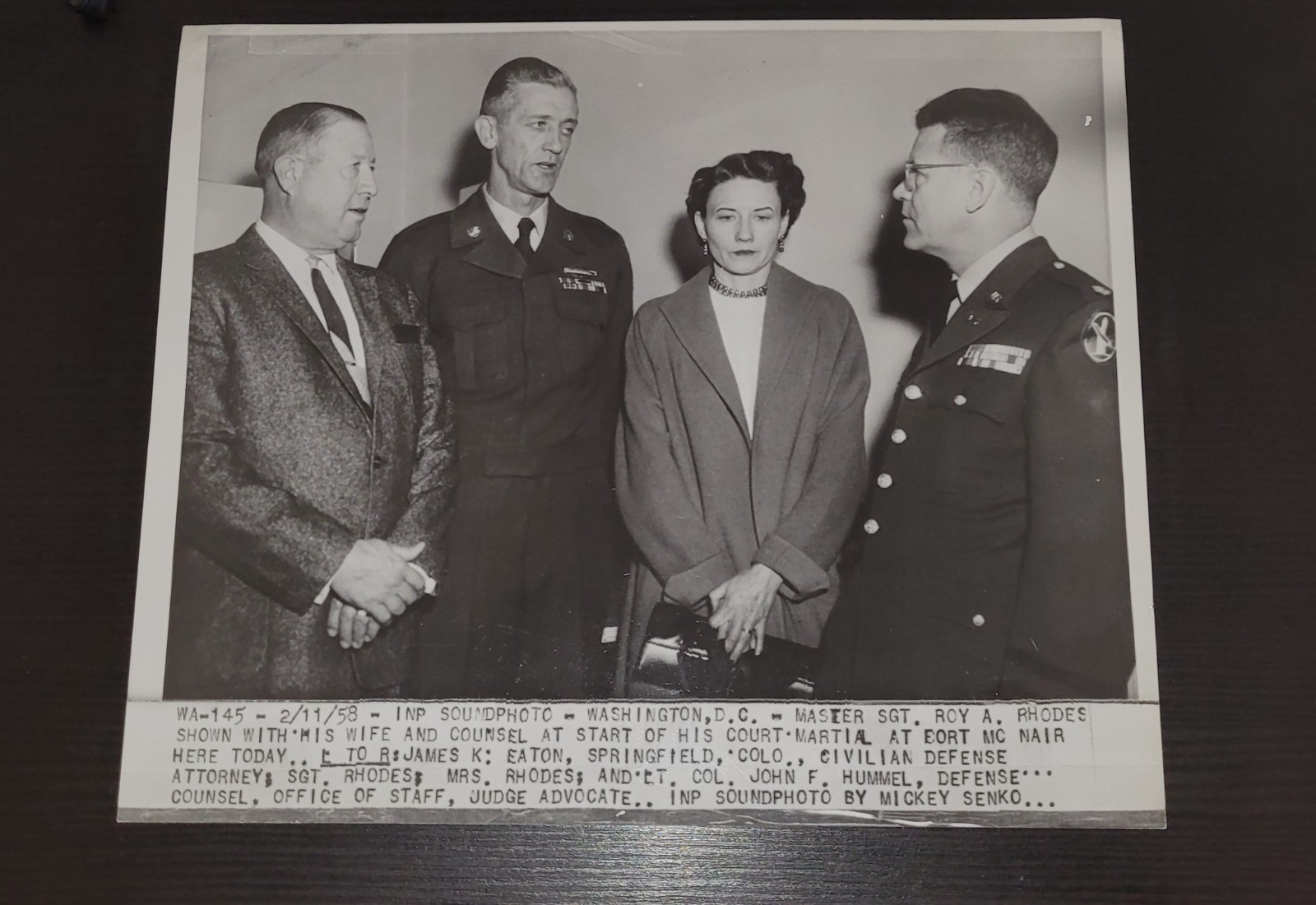
This original 7x9-inch vintage wire service press photograph captures Master Sergeant Roy A. Rhodes alongside his wife and legal counsel on February 11, 1958, at the start of his court-martial at Fort McNair in Washington, D.C. Transmitted via the International News Photos (INP) Soundphoto network and processed by the news reference department on February 10–11, 1958, the artifact documents a dramatic chapter of Cold War counterintelligence history.
II. Biographical Profile: Master Sergeant Roy A. RhodesFull Name: Roy A. Rhodes
Military Branch: United States Army (Signal Corps)
Rank: Master Sergeant (M/Sgt)
Historical Significance: Rhodes became entangled in high-stakes counterintelligence investigations during the height of U.S.–Soviet espionage tensions after coming into contact with Soviet intelligence operatives while stationed overseas.
III. The Historical Milieu: The Cold War and Soviet Espionage in MoscowThe events leading up to the February 1958 court-martial trace back to Rhodes’s service in the mid-1950s:
The Moscow Posting: Rhodes had served as a communications technician and courier in Moscow during a period when American military attachés and embassy personnel were prime targets for KGB recruitment efforts.
The Vulnerability: Like many intelligence and communications personnel stationed abroad, he faced intense pressure, surveillance, and operational approaches from Soviet handlers seeking classified codes, communication protocols, or military intelligence.
IV. Archival Provenance and Media HistoryThe reverse and embedded caption strip of the artifact detail its journey through the 1958 American news wire ecosystem:
INP Soundphoto: The photo features the distinct red \"Soundphoto\" wire transmission stamp and the embedded credit line of INP photographer Mickey Senko.
Reference Department Processing: Stamped by the reference department on February 10, 1958, it illustrates how rapidly major news outlets processed breaking national security trials during the Eisenhower administration.
V. The Legal Defense Team at Fort McNairThe photograph explicitly identifies the key individuals standing with Master Sergeant Rhodes at the commencement of the military tribunal:
James K. Eaton: A civilian defense attorney hailing from Springfield, Colorado, brought in to assist with the legal defense.
Mrs. Rhodes: Providing visible spousal support at the outset of the high-profile court-martial.
Lt. Col. John F. Hummel: Serving as military defense counsel from the Office of the Staff Judge Advocate.
VI. Connection to the Rudolf Abel Spy RingWhile Rhodes’s trial focused on military code of conduct and intelligence compromises, his case intersected with the broader apparatus of Soviet espionage in the United States, famously brought to light by the capture of master spy Rudolf Abel (William Fisher) in New York City in 1957. Counterintelligence investigations into compromised communications channels frequently pulled in military personnel who had served in overseas embassies.
VII. The Court-Martial Verdict and Military JusticeTrials of military personnel accused of security violations during the late 1950s were heavily scrutinized by the Department of Defense and Congress:
The Proceedings: Held under military jurisdiction at Fort McNair, the tribunal weighed the extent of security compromises against the pressures faced by personnel stationed behind the Iron Curtain.
Legal Fallout: Such cases led to sweeping reviews of security clearance vetting, counter-intelligence awareness, and the oversight of communications personnel handling sensitive diplomatic and military traffic.
VIII. Epilogue: The Legacy of Cold War Wire PhotosPhotographs from the 1958 trials represent a vanishing era of analog photojournalism. Transmitted over telephone lines via early wirephoto technology, artifacts like this 7x9-inch press print remain vital primary sources documenting the legal and human dimensions of the Cold War.
IX. The Hollow Nickel Case and the Road to ProsecutionThe trail that brought Master Sergeant Roy Rhodes to the Fort McNair court-martial began years earlier through an accidental discovery that cracked a major Soviet spy ring wide open.
The Hollow Nickel (1953): In June 1953, a Brooklyn newsboy dropped a hollowed-out nickel that split open to reveal a microfilmed photograph containing a series of tiny coded numbers.
Unmasking Rudolf Abel: Investigations into the hollow nickel led federal agents to Reino Hayhanen, a defector and KGB spy, which ultimately resulted in the landmark arrest of master spy Rudolf Abel in New York City. Under interrogation, the wider web of Soviet contacts—including Rhodes—was exposed to American counterintelligence.
X. The Compromise in Moscow: Blackmail and RecruitmentThe details revealed during Rhodes\'s court-martial exposed standard, ruthless KGB recruitment tactics deployed during the height of the Cold War:
The Honey Trap: While stationed at a garage facility servicing U.S. embassy vehicles in Moscow, Rhodes socialized, consumed heavy amounts of alcohol, and woke up the next morning to find himself compromised alongside a Soviet national.
The Coercion: Soviet handlers later confronted him, claiming the woman was pregnant and threatening to expose the indiscretion to his wife and military superiors unless he agreed to cooperate.
The Codenamed \"Quebec\": Labeled under the cryptonym \"Quebec,\" Rhodes provided information regarding base layouts, communications setups, and family backgrounds before rotating back to the United States.
XI. The Trial Verdict and Institutional FalloutOn February 22, 1958, shortly after this photograph was captured outside the courtroom, the military tribunal delivered its judgment:
The Conviction: Rhodes was found guilty of conspiracy to commit espionage.
The Sentence: He received a dishonorable discharge and was sentenced to five years of hard labor.
Defense of Military Security: The trial served as a stark warning to armed forces personnel regarding vulnerability to foreign intelligence operations, permanently altering how the Department of Defense vetted and educated service members stationed in Eastern Bloc nations.
XII. The Intersecting Fates of Rhodes and Rudolf AbelThe trial captured in this 1958 press photo represents a crucial node where military law, counterintelligence, and the most famous spy exchange of the Cold War collided.
The Bridge of Spies Connection: The intelligence gathered from the compromises exposed during the investigation of personnel like Master Sgt. Rhodes helped federal authorities build an airtight case against Rudolf Abel, who was convicted in late 1957. Abel was later famously swapped on the Glienicke Bridge in Germany for downed U2 spy plane pilot Francis Gary Powers—a story dramatized in the Academy Award-winning film Bridge of Spies.
The Human Element of Espionage: Unlike mastermind spies trained in elite intelligence academies, Rhodes\'s case highlighted how ordinary service members could become trapped by human vulnerabilities, leading to strict new security protocols across the entire U.S. Armed Forces.
XIII. Epilogue: The Preservation of Cold War HistoryOriginal wire service photographs like this 7x9-inch print serve as irreplaceable historical artifacts. Preserving the physical object—complete with its original INP Soundphoto caption strip, newsroom pencil markings, and reference stamps—provides collectors and historians with a tactile connection to the high-stakes intelligence battles of the 20th century.
XIV. Legal Precedents and the Aftermath: United States v. RhodesBeyond the immediate fallout of his 1958 court-martial, Master Sergeant Roy Rhodes’s case became a staple in legal textbooks and military jurisprudence.
The Evidentiary Debate: During the trial, prosecutors introduced critical microfilm evidence recovered by the FBI from the \"Hollow Nickel\" investigation, linking Rhodes directly to Soviet handlers. Defense counsel objected on the grounds of hearsay, sparking a long-running legal debate regarding the admissibility of foreign intelligence documents and decrypted communications within military courts.
Lasting Impact on Military Law: The appellate reviews associated with United States v. Rhodes provided vital case law regarding the boundaries of conspiracy charges, jurisdiction over former overseas acts, and the handling of classified intelligence data in open military tribunals.
XV. The Human Toll and Later LifeAfter serving his five-year sentence at hard labor, Rhodes largely stepped away from public view, living quietly out of the spotlight during the decades that followed the climax of the Cold War. His life post-conviction exemplified the quiet tragedies and heavy personal consequences borne by minor intelligence figures caught in the crossfire of superpower friction.
Roy Adair Rhodes (codenamed \"Quebec\") was a Master Sergeant in the United States Army Signal Corps and was infamous for being blackmailed by the KGB into supplying information to the Soviet Union.[1]
Biography
Rhodes was born on 11 March 1917 in Oilton, Oklahoma.
While working in the United States Embassy in Moscow, Rhodes became intoxicated and slept with a Soviet agent whom he was later told was pregnant. The KGB threatened to tell this to Rhodes\'s wife if he failed to cooperate with them.[2][better source needed][3] From 1952 to 1957, the KGB used him to obtain information from the National Security Agency and other important United States agencies even after leaving his post in Moscow in 1953.[4][5][6] Rhodes was caught during the Hollow Nickel Case when information on him was found on a KGB-authored microfilm.[7] He was court-martialled, found guilty of conspiracy to commit espionage, dishonorably discharged, and sentenced to five years\' hard labor.[8][9]
Rhodes died on 5 February 1997 in Pueblo, Colorado at 79 years old.
Master sergeant is the military rank of a senior non-commissioned officer in the armed forces of some countries.
Israel Defense Forces
The רב-סמל ראשון rav samal rishon (abbreviated \"rasar\", master sergeant)[1] is a non-commissioned officer (נגדים) rank in the Israel Defense Forces (IDF). Because the IDF is an integrated force, they have a unique rank structure. IDF ranks are the same in all services (army, navy and air force). The ranks are derived from those of the paramilitary Haganah developed[2] in the British Mandate of Palestine period to protect the Yishuv. This origin is reflected in the slightly compacted IDF rank structure.[3]
Israel Defense Forces ranks : נגדים nagadim - non-commissioned officers (NCO)
IDF NCO
rank רב-נגד
Rav nagad רב-סמל בכיר
Rav samal bakhír רב-סמל מתקדם
Rav samal mitkadem רב-סמל ראשון
Rav samal rishon רב-סמל
Rav samal
Abbreviation רנ\"ג
Ranag רס\"ב
Rasab רס\"מ
Rasam רס\"ר
Rasar רס\"ל
Rasal
rank Chief warrant officer Command sergeant major Sergeant major Master sergeant Sergeant first class
Insignia
Master sergeant is used by the Armed Forces of the Philippines as a non-commissioned officer rank. It is used by the Philippine Army,[4] Philippine Air Force[5] and the Philippine Marine Corps (under the Philippine Navy)[6]. The rank is below Senior master sergeant and above Technical sergeant.
As of February 8, 2019, a new ranking classification for the Philippine National Police was adopted, eliminating confusion of old ranks. Master sergeant is one of the new classification for non-commissioned officer rank. The rank stands above the Police Staff sergeant and below the Police Senior master sergeant.
Singapore
Singapore Armed Forces
In the Singapore Armed Forces (SAF),[7] master sergeant is the highest rank amongst the specialist corps, ranking above staff sergeant and below third warrant officer. In the Singapore Army, master sergeants are usually instructors, staff specialists, or sergeants major of battalion or company-sized units. They are addressed as \"master\" or \"master sergeant\".
Specialist ranks of the Singapore Armed Forcesvte
Insignia
Rank Third sergeant Second sergeant First sergeant Staff sergeant Master sergeant
Abbreviation 3SG 2SG 1SG SSG MSG
National Cadet Corps
In the National Cadet Corps (NCC), the rank of master sergeant is awarded to outstanding NCC cadets who have contributed greatly to their unit. The insignia of MSG (NCC) is the same as the SAF\'s, except that the letters \'NCC\' are below the insignia, to differentiate SAF and NCC master sergeants.[8]
United States
Master sergeant
E-8 insignia E-8 insignia
Army and Marine insignia
Master sergeant insignia Master sergeant insignia
Air Force and Space Force insignia
Country United States
Service branch U.S. Army
U.S. Marine Corps
U.S. Air Force
U.S. Space Force
Abbreviation MSG (USA)
MSgt (USMC, USAF, USSF, & CAP)
Rank group Non-commissioned officer
NATO rank code OR-8 (USA & USMC)
OR-7 (USAF, USSF, & CAP)
Pay grade E-8 (USA & USMC)
E-7 (USAF, USSF, & CAP)
Next higher rank First Sergeant (USA)
Master gunnery sergeant (USMC)
Sergeant major (USMC)
Senior master sergeant (USAF, USSF, & CAP)
Next lower rank Sergeant first class (USA)
Gunnery sergeant (USMC)
Technical sergeant (USAF, USSF, & CAP)
Master sergeant is a senior non-commissioned officer rank used within the United States Armed Forces by the United States Army (E-8), Marine Corps (E-8), Air Force (E-7), and Space Force (E-7).[9] The Civil Air Patrol also has the rank of master sergeant.
U.S. Army
See also: United States Army enlisted rank insignia
Master sergeant (MSG) is the eighth enlisted grade (E-8), ranking above sergeant first class and below sergeant major, command sergeant major, Sergeant Major of the Army, and equal in grade but not authority to a first sergeant. It is abbreviated as MSG and indicated by three chevrons above three inverted arcs, commonly referred to as \"rockers.\"[10]
A master sergeant may be assigned as a battalion or brigade-level section noncommissioned officer in charge and serves as the subject matter expert in their field, but may also hold other positions depending on the type of unit. Unlike the Air Force, an Army master sergeant can not serve in a first sergeant\'s billet, but with the correct training they can be promoted to first sergeant.[11]
When holding the position of first sergeant, called frocking, the master sergeant is referred to as \"first sergeant\"; however, when not in the position of first sergeant, master sergeants are addressed as \"sergeant\". This is the standard address for all pay grades E-5 through E-8. A master sergeant is often called \"top\"[12] or \"top kick,\" referring to the fact that they were once the highest rank in the enlisted grades.
In 1920, the Army combined several regimental level \"staff\" NCO ranks, including four grades of sergeant major, three grades of quartermaster sergeant, regimental supply sergeant, senior ordnance sergeant, senior band sergeant, four grades of senior master sergeant, and seven additional master-level technical and specialist ranks into the new master sergeant rank.[13] Master sergeant then became the senior enlisted rank, ranking above technical sergeant and first sergeant (a positional rank/title for the senior technical sergeant in a company/battery/troop), while \"sergeant major\" became a \"courtesy title\" for the senior master sergeant in a battalion/squadron or higher headquarters.
In 1942, the rank of first sergeant was elevated one grade and was then considered as a junior version of master sergeant, because while first sergeants served as senior NCOs at the company/battery/troop level, master sergeants held positions as the senior NCO in their MOS at battalion/squadron and higher level headquarters.[14] In 1958, both first sergeant and master sergeant were elevated one grade to the new E-8 pay grade, while the rank of sergeant major was restored as the senior enlisted rank at the new pay grade of E-9.[13]
U.S. Marine Corps
See also: United States Marine Corps rank insignia
The eighth enlisted grade, ranking above gunnery sergeant and below master gunnery sergeant, sergeant major, and Sergeant Major of the Marine Corps. It is equal in grade to first sergeant, and is abbreviated MSgt. In the U.S. Marine Corps, master sergeants provide technical leadership as occupational specialists at the E-8 level.[15] The rank was created in 1946 after World War II.[16]
Gunnery Sergeants (E-7) must choose between becoming a master sergeant or a first sergeant.[17] While they are both E-8 billets, once a marine starts down either path, they continue on that path. Master sergeants can be promoted to master gunnery sergeants and first sergeants to sergeant major.[18] They are not interchangeable as they are in the U.S. Army.[19] This was true until January 2026, when the USMC transitioned nine master sergeants to first sergeant in an E-8 redesignation program[20] in both the active and reserve forces.[17] The E-8 redesignation program involves training to ensure that new first sergeants are capable of leading larger groups of Marines and advocating for them, while maintaining discipline and military conduct.[20] The USMC has announced that in 2027 they plan to pilot a program to allow first sergeants to transition to master sergeant for greater flexibility.[20]
Most infantry master sergeants serve as the operations chief of a weapons company or PMOS 0369 Infantry Unit Leader,[21] in place of the gunnery sergeant found in the company headquarters of a rifle company.[22] Infantry master sergeants also serve as the assistant operations chief in the S-3 section of the headquarters of an infantry regiment and Marine Expeditionary Unit and in the G-3 section of the headquarters of a Marine Expeditionary Brigade. The Marine division and Marine Expeditionary Force headquarters contains two infantry master sergeants, one as the training SNCO and the other as the readiness chief.
Outside of the infantry, master sergeants serve as SNCOICs of the ordnance and avionics divisions in the aircraft maintenance department or as section chief/SNCOIC of their MOS type staff section in a battalion or higher level headquarters.
Only in the Marine Corps are master sergeants required to be addressed by their full rank. In the Marine Corps, master sergeants may be referred to by the nickname of \"Top\".[23] This usage is an informal one, however, and would not be used in an official or formal setting. Use of this nickname by Marines of subordinate rank is at the rank holder\'s discretion.
In the U.S. Armed Forces, all master sergeants (Army, Air Force, and Marine Corps) are senior non-commissioned officers (i.e., pay grades E-7 through E-9). However, in the U.S. Marine Corps, the non-commissioned officer ranks of staff sergeant and above, are classified as Staff Non-Commissioned Officers (SNCOs)[18], a classification that is unique in U.S. usage to the USMC.
U.S. Air Force
See also: United States Air Force enlisted rank insignia
Air Force master sergeant
Air Force master sergeant serving as first sergeant
Obsolete master sergeant insignia
(until 1991)
The seventh enlisted grade, ranking above technical sergeant and below senior master sergeant. It is abbreviated as MSgt. Advancement to master sergeant is one of the most significant promotions within the enlisted Air Force and Space Force. At the rank of master sergeant, the airman enters the senior non-commissioned tier and transitions his or her duties from front line technicians and supervisors to operational leaders.[24] An operational leader develops his or her leadership and management skills since this rank carries increased broad leadership, supervisory, and managerial responsibilities rather than technical performance.[24]
Per Air Force Instruction 36–2618, master sergeants do serve in positions as squadron superintendents, flight chiefs, section chiefs, and non-commissioned Officer in Charge (NCOIC). Air Force first sergeants occupy the pay grades of E-7 through E-9 and are referred to officially as \"first sergeant\" regardless of pay grade, and unofficially as \"first shirt\" or \"shirt\".[24]
In 1991, the Air Force changed its NCO insignia so that a maximum of five stripes, or rockers, were placed on the bottom of the chevrons. The master sergeant rank insignia was changed by removing the bottom (sixth) rocker, and relocating it above as a single chevron, on top of the five lower stripes.[25] The single chevron above visually identifies Senior NCO status for E-7 master sergeants along with two chevrons above for E-8 senior master sergeants and three chevrons above for E-9 chief master sergeants in the Air Force NCO insignia.[26] In 2015, the Air Force announced its promotion overhaul and newly established boards for master sergeant.[27]
Civil Air Patrol
Insignia of a Civil Air Patrol master sergeant
The Civil Air Patrol (CAP), a non-profit corporation Congressionally chartered to operate as the civilian auxiliary of the U.S. Air Force, has a quasi-military structure which includes the rank of master sergeant. The grade of master sergeant is below senior master sergeant and above technical sergeant. Former military enlisted personnel who held the rank of master sergeant in the United States Armed Forces may retain that rank as members of the CAP.[28]
U.S. Space Force
On February 1, 2021, the United States Space Force announced its permanent rank structure, establishing the grade of master sergeant as its permanent E-7 grade. This continued its usage from the Air Force. The grade of master sergeant is above technical sergeant and beneath senior master sergeant.[29]
Gallery
Master sergeant(Liberian Ground Forces)
Master sergeant
(Liberian Ground Forces)[30]
Master sergeant(Philippine Army)
Master sergeant
(Philippine Army)[31]
Master sergeant(Singapore Army)
Master sergeant
(Singapore Army)[32]
(Ukrainian Ground Forces)[33]
Master sergeant(United States Army)
Master sergeant
(United States Army)[1
The United States Army Signal Corps (USASC) is a branch of the United States Army responsible for establishing and managing the communication and information systems for the command and control of the combined arms forces. The USASC manages new technologies and capability portfolios, which are in turn transferred to other U.S. government entities. The branch\'s responsibilities include military intelligence, meteorological forecasting, and aviation.[2]
Mission statement
The USASC supports command and control across combined arms forces. Its network operations include information assurance, information dissemination management, network management information, and management of the electromagnetic spectrum. This includes designing and installing data communications networks using single- and multichannel satellite, tropospheric scatter, terrestrial microwave switching, messaging, video teleconferencing, and visual information systems. The USASC integrates base communications and information processing management systems into a global information network intended to provide army, coalition, and joint operations with what the military calls, \"knowledge dominance.\"[3]
History
Early history
Further information: Signal Corps in the American Civil War
Standard Issue Civil War Signal Corps Kit, complete with flags and torches.
While serving as a medical officer in Texas in 1856, Chief Signal Officer Albert James Myer proposed that the Army use wigwag (or aerial telegraphy), a visual communications system that he developed for signaling. When the Army adopted his system on 21 June 1860, the USASC was created with Myer as the first and only Chief Signal Officer.[4]
Myer\'s first assignment in his new position was in the early 1860s as part of the Navajo expedition in New Mexico.[4] In June 1861, Myer\'s system was used to direct the fire of a harbor battery at Fort Wool against the Confederate positions opposite Fort Monroe during the Civil War. Flags were used for daytime signaling, while torches were used at night.
Until 1863, Myer relied mostly on detailed personnel. Then, on 3 March 1863, the USASC was authorized as a separate branch of the Army by an Act of Congress (Public Law No. 58 Article VIII, Section 17 and 18).[5]
Myer\'s Civil War innovations included an unsuccessful balloon experiment at First Bull Run and, in response to McClellan\'s desire for a Signal Corps field telegraph train, an electric telegraph in the form of the Beardslee telegraph machine. During the Civil War, Wigwag began to be replaced with electric telegraph, bypassing line-of-sight restrictions.[6]
Myer used his office in downtown Washington, D.C. to temporarily house the Signal Corps School. The location was later moved to Fort Greble, one of the Defenses of Washington during the Civil War, and then again moved to Fort Whipple, where the school remained for over 20 years and was ultimately renamed Fort Myer.[7]
US Army Signal Corps automobile at the Manassas maneuvers in 1904
Signal Corps detachments participated in campaigns fighting Native Americans in the west, such as the Powder River Expedition of 1865.[8]
In July 1866, Congress decided that there should be at minimum a cadre of Signal Officers, even in peacetime. It then provided one Chief Signal Officer of the Army, with the rank of Colonel. Six additional officers and 100 men were chosen from the Corps of Engineers for the Signal Corps.[citation needed]
The electric telegraph, in addition to visual signaling, became a USASC responsibility in 1867. Within 12 years, the Signal Corps had constructed, maintained and operated 4,000 miles of telegraph lines along the nation\'s western frontier.[9]
In 1870, the Signal Corps established the Congressionally-mandated national weather service. Within a decade, with the assistance of Lieutenant Adolphus Greely, Myer commanded the weather service until his death in 1880. The Weather Bureau became part of the U.S. Department of Agriculture in 1891 and the corps retained responsibility for military meteorology.[10]
In 1881, the Signal Corps participated in the First International Polar Year. One of the groups commanded by Lieutenant Greely became separated from their base camp and were marooned on an ice floe. Due to starvation and drowning, only seven of the original 25 volunteers survived, which meant a 28% chance of surviving.[10]
The Signal Corps aided in the Spanish–American War of 1898 and the subsequent Philippine Insurrection. In addition to visual signaling, including heliography, the corps supplied telephone and telegraph wire lines, cable communications, enabled the use of telephones in combat, conducted combat photography, and renewed the use of balloons. Shortly after the war, the Signal Corps constructed the Washington-Alaska Military Cable and Telegraph System (WAMCATS), also known as the Alaska Communications System (ACS). Contemporary accounts described this as among the first wireless telegraph systems in the Western Hemisphere.[11]
In October 1903, Congress directed then Chief Signal Officer Brigadier General Adolphus Greely to issue an order. In October 1904, Congress appropriated $25,000 for the Signal Corps to \"build a flying machine for war purposes\" directing Chief Signal Officer Brigadier General Adolphus Greely to oversee the effort.[12] Chief Signal Officer Brigadier General Adolphus Greely thus contracted the Wright brothers in 1908 to build and demonstrate a military airplane; the Wrights conducted their trials at Fort Myer, Virginia. Their historic first powered flight had taken place at Kitty Hawk, North Carolina, in December 1903.
World War I
Further information: Aeronautical Division, U.S. Signal Corps and Aviation Section, U.S. Signal Corps
First military assigned to the Army Signal Corps\' ballooning program
On August 1, 1907, an Aeronautical Division was established under the Office of the Chief Signal Officer (OCSO). In 1908, in Fort Myer, Virginia, the Wright brothers conducted test flights of the Army\'s first airplane built to Signal Corps\' specifications. Reflecting the need for an official pilot rating, War Department Bulletin No. 2, released on 24 February 1911, established a \"Military Aviator\" rating. Army aviation remained within the Signal Corps until 1918, when it became the Army Air Service.[13]
During World War I, Chief Signal Officer George Owen Squier worked closely with private industries to perfect radio tubes while creating a major signal laboratory at Camp Alfred Vail (later Fort Monmouth).[citation needed] Early radiotelephones developed by the Signal Corps were introduced into the European theatre in 1918. While the new American voice radios were of higher quality than the radiotelegraph sets, the telephone and telegraph remained the major communication technology of World War I.[citation needed]
Also during World War I, women switchboard operators, known as the \"Hello Girls,\"[14] were sworn into the Signal Corps. Despite the fact that they wore U.S. Army uniforms and were subject to Army regulations (Chief Operator Grace Banker received the Distinguished Service Medal), they were not given honorable discharges but were considered \"civilians\" employed by the military, because Army regulations specified the male gender. Not until 1978—the 60th anniversary of the end of World War I—did Congress approve veteran status/honorable discharges for the surviving \"Hello Girls.\"[15]
A pioneer in radar, Colonel William Blair, director of the Signal Corps laboratories at Fort Monmouth, demonstrated the SCR-268 prototype in May 1937. Before the United States entered World War II, mass production of two radar sets, the SCR (Signal Corps Radio)-268 and the SCR-270, had begun.[9]
World War II
World War II recruitment poster (1942)
World War II signal corps reenactment
When the War Department was reorganized on 9 March 1942, the Signal Corps became one of the technical services in the Services of Supply (later Army Service Forces).[citation needed] Its organized components served both the Army Ground Forces and the Army Air Forces.[citation needed]
The Army Chief Signal Officer (CSO) was responsible for establishing and maintaining communications service schools for officers and enlisted soldiers, ranging in qualifications from those holding doctorates to functional illiterates. The single prewar Signal Corps training site was Fort Monmouth, New Jersey. To keep up with the demand for more signalers, the CSO opened more training facilities: Camp Crowder, Missouri; Camp Kohler, California; and Camp Murphy, Florida.[16]
The Eastern Signal Corps Training Center at Fort Monmouth consisted of an officers\' school, an officer candidate school, an enlisted school and a basic training center at sub post Camp Wood. The officer candidate school operated from 1941 to 1946 and graduated 21,033 Signal Corps second lieutenants.[17]
The term \"RADAR\" was coined by the Navy in 1940 and agreed to by the Army in 1941. The first Signal Corps Field Manual on Aircraft Warning Service defined RADAR as \"a term used to designate radio sets SCR-268 and SCR-270 and similar equipment\". The SCR-268 and SCR-270 were not radios at all, but were designated as such to keep their actual function secret.[18] Although important offensive applications have since been developed, radar emerged historically from the defensive need to counter the possibility of massive aerial bombardment.
In 1941, the laboratories at Fort Monmouth developed the SCR-300, the first FM backpack radio. Its frequency modulation circuits provided front-line troops with reliable, static-free communications. The labs also fielded multichannel FM radio relay sets (e.g., AN/TRC-1) in the European Theater of Operations as early as 1943. Multichannel radio broadcasting allowed several channels of communications to be broadcast over a single radio signal, increasing security and range and relieving frequency spectrum crowding.[19]
In December 1942, the War Department directed the Signal Corps General Development Laboratories and the Camp Evans Signal Lab to combine into the Signal Corps Ground Service (SCGS) with headquarters at Bradley Beach, New Jersey (Hotel Grossman). The department also directed the Signal Corps Ground Service to reduce its workforce from 14,518 to 8,879 personnel by August 1943.[20] In June 1944, \"Signees\", former Italian prisoners of war, arrived at Fort Monmouth to perform housekeeping duties. A lieutenant colonel and 500 enlisted men became hospital, mess, and repair shop attendants, relieving American soldiers from these duties.
Radio operator Cpl. John Robbins, 41st Signal, 41st Infantry Division, operating his SCR-188 in a sandbagged hut at Station NYU. Dobodura, New Guinea on 9 May 1943.
One of the more unusual units of the Signal Corps were the joint assault signal companies (JASCOs).[21] These companies were Signal Corps units that were made up of several hundred Army, Air Corps, and United States Navy communications specialists specially trained to link land, sea and air operational elements. They saw combat throughout the Pacific and European[22] theaters during World War II in late 1943. JASCOs were much larger than normal signal companies. The joint assault signal companies were the predecessor to the Air Naval Gunfire Liaison Company that exists today. JASCOs represented one of many unprecedented Signal Corps\' activities in the Pacific theater. Shipboard fighting was a new kind of combat for Signal Corps soldiers. Army communicators sometimes plied their trade aboard Navy and civilian ships. Signal Corps personnel also served on Army communications ships.
In particular, the Southwest Pacific Area (SWPA) formed a fleet, unofficially known as the \"Catboat Flotilla\" and formally as the CP fleet, that served as command and communication vessels during amphibious operations, starting with two Australian schooners Harold and Argosy Lemal acquired by the Army and converted during the first half of 1943 by Australian firms into communications ships with AWA radio sets built by Amalgamated Wireless of Australia installed.[23][24] These initial vessels were joined by Geoanna, Volador[25][26] and later by a more capable fleet as described in The Signal Corps: The Outcome (Mid-1943 Through 1945):
Argosy Lemal c. 1940, one of two Australian vessels acquired by the SWPA chief signal officer for the SWPA CP fleet.
The first task was to obtain ships more suitable than the Harold or the Argosy. Such a ship was the passenger freighter FP-47, acquired by Signal Corps in March 1944, at Sydney. The Army had built her in the United States in 1942. The vessel was 114 feet (35 m) long with a broad beam and a displacement of 370 tons. She was intended for use in the Aleutians. Instead she had sailed to Australia as a tug. The Signal Corps fitted her with Australian transmitters and receivers, also with an SCR-300 walkie-talkie, two SCR-808\'s, and an SCR-608, plus power equipment, antennas, and, finally, quarters for the Signal Corps operators. The Australian sets were intended for long-range CW signals operating in the high frequencies; the SCRs were short-range VHF FM radios for use in the fleet net and for ship-to-shore channels. Armed with antiaircraft weapons and machine guns (served by 12 enlisted men of the Army ship and gun crews), navigated by a crew of 6 Army Transport Service officers and the 12 men already mentioned, the FP-47 was ready for service in June. Her Signal Corps complement consisted of one officer and 12 men.
The facilities of FP-47 were needed immediately at Hollandia to supplement the heavily loaded signal nets that could hardly carry the message burden imposed by the invasion and the subsequent build-up there of a great base. Arriving on 25 June, she anchored offshore and ran cables to the message centers on land. Her powerful transmitters opened new channels to SWPA headquarters in Brisbane and to the advance headquarters still at Port Moresby. At Hollandia, and at Biak, to which the FP-47 moved early in September, this one ship handled an average of 7,000 to 11,000 code groups a day.[24]
Many film industry personalities served in the Signal Corps, including Stan Lee,[27] an American comic book writer, Tony Randall, an actor, and Jean Shepherd, a radio storyteller, author, and narrator of A Christmas Story.
In 1942, General George C. Marshall ordered the creation of the Army Pictorial Service (APS) to produce motion pictures for the training, indoctrination, and entertainment of the American forces and their Allies. The APS took over Kaufman Astoria Studios in 1942 and produced over 2,500 films during the war, with over 1,000 redubbed in other languages.[28] The Army left Astoria studios and film production in 1971.
Julius Rosenberg worked for the Signal Corps Labs from 1940 to 1945. He was dismissed early in 1945, when it was learned, he had been a member of the Communist Party USA secret apparatus and had passed the secret of the proximity fuze to the Soviet Union.[29]
Cold War
SC345199 – Korean War Equipment at Repeater Station, Taegu, Korea. Quad cable terminal on left, test board on right and center on 1 August 1950.
The Signal Corps\' Project Diana successfully bounced radar signals off the moon in 1946, paving the way for space communications.[30]
In 1948, researchers at Fort Monmouth grew the first synthetically produced large quartz crystals. The crystals were able to be used in the manufacture of electronic components, and made the United States largely independent of foreign imports for this critical mineral. In 1949, the first auto-assembly of printed circuits was invented. A technique for assembling electronic parts on a printed circuit board, developed by Fort Monmouth engineers, pioneered the development and fabrication of miniature circuits for both military and civilian use. Although they did not invent the transistor, Fort Monmouth scientists were among the first to recognize its importance, particularly in military applications, and pioneered significant improvements in its composition and production.[31]
Everything was to change as world tensions increased with the Cold War and the Berlin Airlift. To sustain the Army\'s worldwide commitments, it again became necessary to enlarge the capacity of every activity on-post.[17]
In June 1950, with the onset of the Korean War, President Harry S. Truman quickly received the necessary authorization to call the National Guard and Organized Reserves to 21 months of active duty. He also signed a bill extending the Selective Service Act until 9 July 1951. The Officer Candidate School was re-established.[32]
The fighting in Korea brought to light the need for new techniques in the conduct of modern warfare. The use of mortars by the enemy, and the resultant need to quickly locate and destroy the mortar sites, resulted in development of the Mortar-Radar Locator AN/MPQ-3 and AN/MPQ-10 at the Communications Electronics Research and Development Engineering Center, better known as the Albert J. Myer Center, or simply, the Hexagon. Korea\'s terrain and road nets, along with the distance and speed with which communications were forced to travel, limited the use of wire. The Signal Corps\' VHF radio became the \"backbone\" of tactical communications throughout the war.
The development of new equipment, however, placed requirements on the Signal Corps to provide increased numbers of trained electronics personnel to work in the fire control and guided missiles firing battery systems. To meet this need, Signal Corps Training Units—the 9614th and 9615th—were established at Aberdeen, Maryland and Redstone Arsenal in Alabama. These units provided instruction on electronics equipment used in the antiaircraft artillery and guided missile firing systems.
Following the arrest of the Julius and Ethel Rosenberg in 1950, two former Fort Monmouth scientists, Joel Barr and Alfred Sarant, defected to the Soviet Union. On 31 August 1953, having received word of possible subversive activities from Fort Monmouth\'s commanding general, Kirke B. Lawton, the Chairman of the Permanent Subcommittee on Investigations (PSI), Senator Joseph McCarthy, suspected a spy ring still existed in the Signal Corps labs. At first, McCarthy conducted his hearings behind closed doors, but opened them to the public on 24 November 1953. Extensive Congressional hearings were continued in 1955 under the chairmanship of Senator John McClellan of Arkansas.[33]
In the 1950s, the Army Pictorial Service produced a series of television programs called The Big Picture that were often aired on American television. The last episode was produced in 1971.[34]
On 18 December 1958, with Air Force assistance, the Signal Corps launched its first communications satellite, Project SCORE, demonstrating the feasibility of worldwide communications in delayed and real-time mode by means of relatively simple active satellite relays.[citation needed]
The Vietnam War\'s requirement for high-quality telephone and message circuits led to the Signal Corps\' deployment of troposcatter radio links that could provide many circuits between locations more than 200 miles apart.[citation needed] Other developments included the SYNCOM satellite communications service, and a commercial fixed-station system known as the Integrated Wideband Communications System, the Southeast Asia link in the Defense Communications System.[citation needed]
Korean War and Vietnam War
During the Korean War and Vietnam War the Signal Corps operated officer candidate schools initially at Fort Monmouth in 1950–1953, graduating 1,234 officers, and at Fort Gordon in 1965–1968, which produced 2,213 signal officers (The World War II Signal OCS program at Fort Monmouth, from 1941 to 1946, graduated 21,033 Signal Corps officers).[35]
Modern warfare utilizes three main types of signal soldiers. Some are assigned to specific military bases (\"Base Ops\"), and they are charged with installation, operation, and maintenance of the base communications infrastructure along with hired civilian contracted companies. Others are members of non-signal Army units, providing communications capability for those with other jobs to accomplish (e.g. infantry, medical, armor, etc.) in much the same way as, say, the unit supply sections, unit clerks, or chemical specialists. The third major type of signaler is assigned to a signal unit. This particular unit\'s purpose is to provide communications links between the Army units in their area of operations and other signal nodes in further areas served by other signal units.
Sending radio signals across the vast Pacific Ocean had always been unreliable. In August 1964, radio communications across the sea were given a huge boost in quality: The first satellite terminal ever installed in a combat zone was installed in Ba Queo, near Saigon, led by Warrant Officer Jack Inman.[36] This enabled reliable communications to Hawaii, and thereby to Washington, D.C.
Communicating across the varied landscapes of Vietnam presented a variety of challenges. The solution came by utilizing \"troposcatter\" technology, in which radio signals beamed up into the atmosphere are \"bounced\" back down to Earth, bypassing debilitating terrain. The Army had little experience with this technology, so they contracted the development of the systems to Page Engineering. In January 1962, Secretary of Defense Robert McNamara approved the system of troposcatter units under the operational name of BACKPORCH.[37]
The escalation of the number of troops in the Vietnam War caused an increasing need for more communications infrastructure. In the spring of 1966 the assorted Signal units were reassigned to the newly formed 1st Signal Brigade.[38] By the close of 1968 this brigade consisted of six signal groups and 22 signal battalions—roughly 23,000 soldiers.[39]
The first Vietnam War death on the battlefield was a Signal Corps radio operator, SP4 James Thomas Davis of the 3rd Radio Research Unit of the United States Army Security Agency.[40]
Post-Vietnam and Gulf War
Established in 1971 by the Department of Defense, the Joint Tactical Communications Office developed the TRI-TAC (Tri-Service Tactical Communications) system to establish common digital standards, optimize existing analog hardware, and modernize tactical battlefield communications. Manufactured by GTE Sylvania, its key switching components—such as the hybrid AN/TTC-39 circuit switch and the store-and-forward AN/TYC-39 message switch—were mounted in transportable S-280 shelters to support high-mobility joint operations for all military branches. The architecture enabled a seamless multi-year transition from predominantly analog signals to fully digital, high-speed integrated voice and data capabilities.[41]
A major program in 1988 was the initial production and deployment of the Mobile Subscriber Equipment (MSE) system. The MSE system called for setting up the equivalent of a mobile telephone network on a battlefield, allowing a commander or Tactical Operations Center (TOC) to connect mobile telephones and fax machines in vehicles with each other, sending and receiving secure information. Talking through signal nodes, MSE established a seamless connection from the battlefield even back to commercial telephone lines. Significant to the Signal soldiers, MSE was fielded on the backs of Humvee, rather than on the larger, less-mobile M35 2½-ton cargo trucks—the \"deuce and a half\".[42]
By 1990, most Army units had replaced their older VRC-12 series FM radios for the new SINCGARS (\"Single-Channel Ground-Air Radio Systems\") family of equipment. Rather than sending a signal along one signal frequency, the SINCGARS radios sent their signals across many frequencies, \"hopping\" from one frequency to another at high speed. This allowed many nets to share an already-crowded frequency spectrum.[43] Later generations of these radios combined the communications security (COMSEC) encryption devices with the receiver/transmitter, making a single easier-to-program unit. Most significant, the SINCGARS radios could send and receive digital traffic with great fidelity.[44] By the advent of Operation Desert Shield, all deployed Army units had transitioned to SINCGARS, then considered among the most secure tactical FM communications systems available.[45] The SINCGARS radios have a failure rate in extreme heat of once every 7,000 hours compared to the VRC-12 series\' failure rate of 200–300 hours.[45]
Afghanistan and Iraq
Since October 2001, the Signal Corps provided communications for the War in Afghanistan and the Iraq War. The Signal Corps fielded the Warfighter Information Network-Tactical (WIN-T).[46] It provided \"On-The-Move\" down to the company level for maneuver, fires, and aviation brigades, and fully supported the Future Combat Systems (FCS) program.[47] It also provided protected satellite communications \"On-The-Move\" capability against jamming, detection and intercept, and will be aligned with the Telecommunications Satellite (TSAT) program.[48]
Military occupational specialties
The Signal Corps military occupational specialties are:[49]
Enlisted
25B: Information Technology Specialist
25D: Cyber Network Defender
25E: Electromagnetic Spectrum Manager
25H: Network Communications Systems Specialist (Merged 25L, 25N, 25Q)
25S: Satellite Communication Systems Operator / Maintainer (Merged with 25P)
25U: Signal Support Systems Specialist
25Z: Visual Information Operations Chief
Warrant officer
A Combat Documentation Specialist of the 1108th Signal Brigade documents 10th Mountain Division soldiers as they search a mountainside near Shkin Firebase in late 2003.
255A Information Services Technician
255N Network Management Technician
255S Information Protection Technician
255Z Senior Signal Systems Technician
Note 1: 250N has been changed to 255N.[50]
Note 2: 251A and 254A have been merged into 255A.[51]
Note 3: 255S is new.[52]
Commissioned officer areas of concentration (AOC)
25A Signal Officer
Commissioned officer functional areas (FA)
FA26A Telecommunications Systems Engineer
FA26B Data Systems Engineer
Heraldic items
Coat of arms
The Signal Corps Regimental Color
Shield: Argent, within a bordure tenne a baton fesswise or and suspended therefrom a signal flag gules charged at center with a square of the first, in chief a mullet bronze.
Crest: On a wreath of the colors argent and tenne a dexter hand couped at the wrist, clenched, palm affronte, grasping three forked lightning flashes, all proper, flashes argent.
Motto: Pro Patria Vigilans (Watchful for the Country).
The U.S. Army Signal Corps March: \"From flag and torch in the Civil War, to signal satellites afar, we give our Army the voice to give command on battlefield or global span, in combat, we\'re always in the fight, we speed the message day or night, technicians too, ever skillful, ever watchful, we\'re the Army Signal Corps.\"[53][54]
Orange and white are the colors traditionally associated with the Signal Corps.
The signal flag suspended from a baton is adopted from a badge that originated in 1865 and was called the Order of the Signal Corps.
The bronze battle star represents formal recognition for participation in combat. It adorned a signal flag and was first awarded to Signal Corps soldiers in 1862.
Branch insignia
The Signal Corps branch insignia is represented by two signal flags-on gold staffs- crossed, dexter flag white with a red center, the sinister flag red with a white center, with a flaming torch of gold color metal upright at center of crossed flags.
\"Crossed flags\" have been used by the Signal Corps since 1868, when they were prescribed for wear on the uniform coat by enlisted men of the Signal Corps.
In 1884, a burning torch was added to the insignia and the present design adopted on 1 July 1884.
The flags and torch are symbolic of signaling or communication.
Regimental Distinctive Insignia
Description: A gold color metal and enamel device that consists of a gold eagle grasping a horizontal baton from which is suspended a red signal flag with a white center, enclosing the flag from a star at the bottom, a wreath of laurel all gold and at top left and right a white scroll inscribed PRO PATRIA at left and VIGILANS at right in gold.
The gold eagle holds in his talons a golden baton, from which descends a signal flag.
The design originated in 1865 from a meeting of Signal Corps officers, led by Major Albert J. Myer, the chief signal officer, in Washington, D.C.
The badge was a symbol of faithful service and good fellowship for those who served together in war and was called the Order of the Signal Corps.
The motto Pro Patria Vigilans (Watchful for the Country) was adopted from the Signal School insignia and serves to portray the cohesiveness of Signal soldiers and their affiliation with their regimental home.
The laurel wreath represents the achievements of the corps since its inception.
The battle star centered on the wreath represents formal recognition for participation in combat. It adorned a signal flag and was first awarded to Signal Corps soldiers in 1862. The battle star reflects the Signal Corps\' role in combined arms operations.
Inception
The Signal Corps was authorized as a separate branch of the Army by an Act of Congress on 3 March 1863 (Public Law No. 58 Article VIII, Section 17 and 18).[55] However, the Signal Corps dates its existence from 21 June 1860, when Congress authorized the appointment of one signal officer in the Army, and a War Department order carried the following assignment: \"Signal Department—Assistant Surgeon Albert J. Myer to be Signal Officer, with the rank of Major, 17 June 1860, to fill an original vacancy.\"
Branch color
Orange with white piping. Orange was selected in 1872 as the Signal Corps branch color. In 1902, the white piping was added to conform to the custom that prevailed of having piping of a different color for all branches except the line branches.[citation needed]
Notable members
Notable members of the Signal Corps include General of the Army (later General of the Air Force) Henry H. Arnold, Lester Asheim, Frank Capra, John Cheever, Frank Lautenberg, Stan Lee,[56] Russ Meyer, Tony Randall, Jean Shepherd, John C. Holmes, Julius Rosenberg, Darryl Zanuck, Samuel Alito, Paul Bilzerian and Carl Foreman.
Five members of the Signal Corps have been awarded the Medal of Honor:[57]
Private First Class Will C. Barnes, for actions during the Indian Wars
First Lieutenant Gordon Johnston, for actions during the Philippine–American War
First Lieutenant Charles E. Kilbourne, for actions during the Philippine–American War
Private Morgan D. Lane, for actions during the American Civil War
Brigadier General Adolphus Greely, for life service to the Signal Corps and Army Service from the American Civil War until 1908