When you click on links to various merchants on this site and make a purchase, this can result in this site earning a commission. Affiliate programs and affiliations include, but are not limited to, the eBay Partner Network.
☮️ What Does It Feel Like to Hold a Piece of Autumn 1969 That Never Made It to the Ceiling?
Every so often a piece of paper ephemera comes along that doesn't just represent a moment in history — it was actually standing in the room while that history happened. Somewhere, a store clerk racked this little mobile on a spinner display, a customer walked past it on their way to buy incense or a poster or a paperback, and for one reason or another, it never got taken home and strung up. It went into a box instead. And there it stayed, through every year that followed, until it landed here — still sealed, still in its factory configuration, never once suspended from a ceiling hook or a dorm-room light fixture. That's a rare thing for paper goods from this era. Anti-war ephemera was made to be used, worn, waved, and hung — which is exactly why so little of it survives untouched. This piece did.
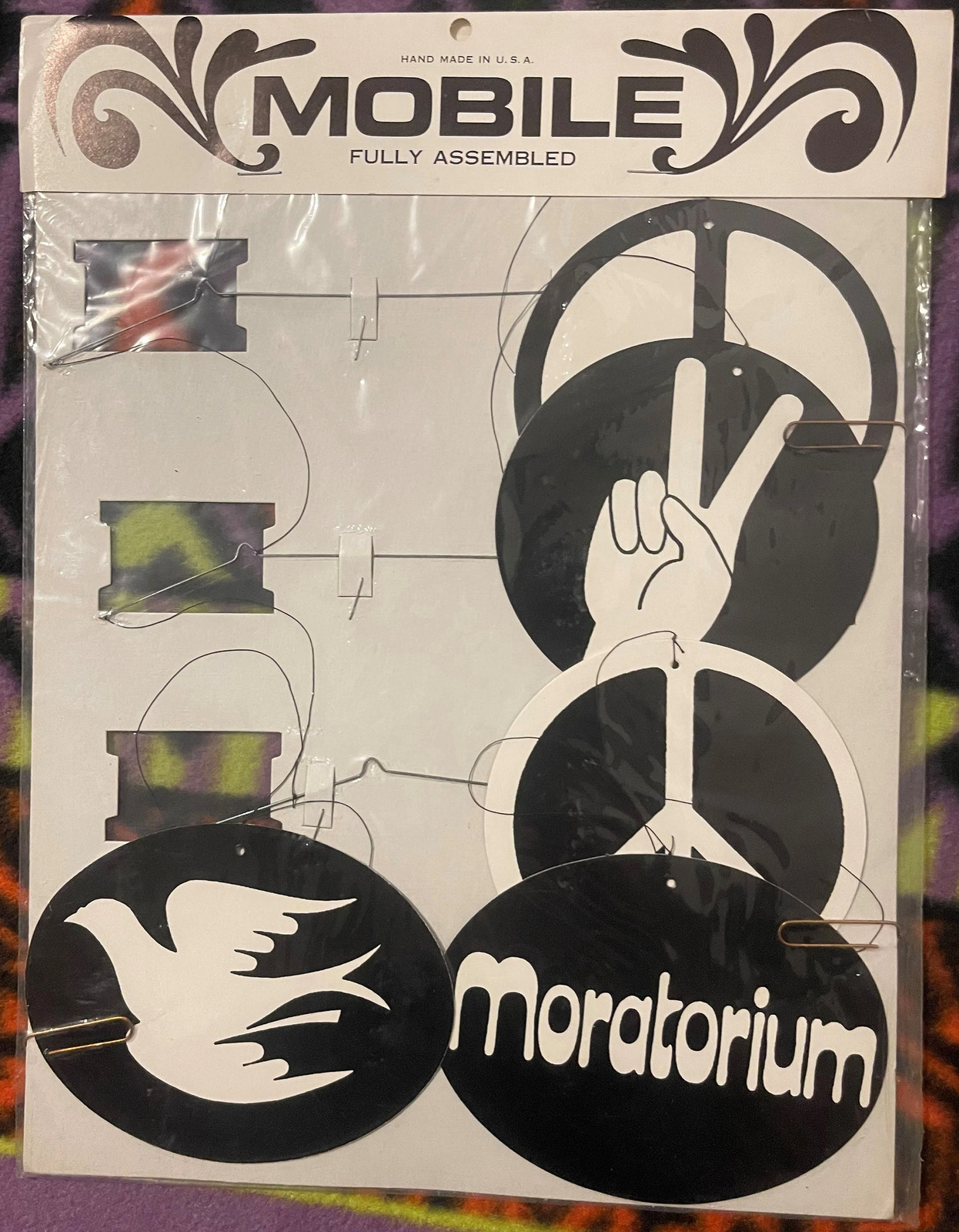
What you're looking at is a fully assembled hanging mobile, produced during the Vietnam War–era peace movement and offered here in New Old Stock (NOS) condition — meaning it has remained in its original poly packaging since it left the factory floor, complete with its original header card. That header card is a small piece of graphic design in its own right: bold black lettering reading MOBILE / FULLY ASSEMBLED, flanked by swirling Art Nouveau–revival flourishes that give the whole package an almost storefront-poster feel, with the words HAND MADE IN U.S.A. printed directly above the title — the maker's own claim, stated plainly, right on the card. The packaging measures 17 inches, with the mobile elements themselves suspended on wire in their original hanging arrangement, exactly as they came off the assembly line.
Inside the sealed poly, four black-and-white offset-printed discs hang in balance: a dove in flight, its wings spread in that unmistakable silhouette of peace; a large circular peace symbol, rendered in bold graphic black against white; a raised hand flashing the two-finger V, fingers spread in the gesture that defined a generation's protests; and, anchoring it all, a disc lettered moratorium in the swollen, rounded, unmistakably psychedelic-era display type of the late 1960s and early 1970s counterculture design world. Every element is printed crisp black on white stock, no color anywhere — just bold contrast, the kind of graphic punch that was meant to be seen across a room or a store window. No company name, no city, no printer's mark appears anywhere on the label — only that quiet, confident claim of HAND MADE IN U.S.A. The maker remains, for now, anonymous. What is not anonymous is the history behind the word printed on that bottom disc.
✊ The Moratorium: One Word, One Autumn, One Nation Paying Attention
The word "moratorium" on this mobile isn't decorative filler — it's a direct, deliberate reference to one of the largest single acts of mass civic protest in American history: the Moratorium to End the War in Vietnam.
The idea took shape in the spring of 1969, when Boston businessman Jerome Grossman called for a general strike if the war hadn't ended by October. Two young organizers who had cut their teeth on Eugene McCarthy's 1968 presidential campaign — David Hawk and Sam Brown — took that raw idea and shaped it into something more deliberate and more national: not a strike, but a coordinated day of teach-ins, vigils, and demonstrations that could draw in students, clergy, veterans, mothers, and office workers alike, all under one banner. They called it a Moratorium — a pause, a suspension of business as usual, until the killing stopped.
On October 15, 1969, that pause happened all across the country. It wasn't confined to a single march on a single city; it was teach-ins in classrooms, readings of the names of the dead on courthouse steps, candlelight vigils in small towns that had never seen an anti-war rally before. A month later, on November 15, 1969, the movement returned to Washington, D.C., in far greater numbers for the Moratorium March — one of the largest demonstrations the capital had ever hosted. Historian Fred Halstead later wrote that the October Moratorium marked "the first time [the anti-war movement] reached the level of a full-fledged mass movement" — no longer a fringe protest, but a genuine cross-section of American civic life standing up in the same week to say the same thing.
The backdrop makes the moment land even harder. When Richard Nixon took office on January 20, 1969, roughly 34,000 Americans had already been killed fighting in Vietnam. In just his first year in office, another 10,000 American lives were lost. That is the arithmetic the word "moratorium" was answering. On the day of the October demonstration, the White House press secretary publicly insisted the president was completely indifferent and that it was "business as usual" inside the Oval Office. Privately, by every account since, Nixon was furious — rattled by the scale of it, and by how ordinary the crowds looked. This was not a fringe uprising. It was neighbors, students, and parents, all pausing together, all at once.
A tabletop mobile printed with that single word, sold to hang in a home or a shop window, was a small, quiet way of carrying that autumn forward — a way to keep the pause visible long after October 15th had passed.
🕊️ Dove, Circle, and the Two-Finger Salute — Reading the Symbols
This mobile doesn't lean on just one image — it stacks four of the era's most recognizable visual shorthand symbols into a single object, which is part of what makes it such a compact little time capsule of the movement's visual language.
The dove reaches back further than Vietnam or even the 20th century — it's an ancient peace emblem, but it found fresh urgency in the 1960s as artists and printmakers folded it into anti-war posters, buttons, and flyers alongside newer iconography. The circular peace symbol itself has a specific origin story: designed in 1958 by British artist Gerald Holtom for the nuclear disarmament movement, combining the semaphore letters "N" and "D" inside a circle, it crossed the Atlantic and was fully adopted by the American anti-war movement by the mid-to-late 1960s, appearing on everything from lapel pins to bedsheet banners. And the raised "V" hand gesture carries its own layered history — a wartime "Victory" sign borrowed from Churchill's generation and reinterpreted by the counterculture as a peace salute, flashed at rallies, on album covers, and eventually even, ironically, by Nixon himself on the White House lawn.
Seeing all three symbols orbiting a disc that simply says moratorium is what gives this piece its punch — it's not generic 1960s nostalgia, it's a specific artifact tied to a specific campaign, wearing the movement's full visual vocabulary at once.
🏷️ An Anonymous Maker, A Very Familiar Habit of the Era
No company name survived onto this label — no printer's mark, no city, no return address. Just HAND MADE IN U.S.A., printed with the same quiet confidence you'll find on countless small novelty items from this period. That anonymity isn't a flaw in the record; it's practically a signature of how peace-movement merchandise actually moved through the country at the time. Collectors who have spent years handling movement ephemera from this window will tell you the same thing: buttons, patches, posters, and little hanging novelties like this one rarely carried a company name at all. They moved through campus bookstores, head shops, mail-order ads tucked into the back pages of underground newspapers, and independent print shops that ran small batches for local demand — the movement itself was often bigger, and more memorable, than any single business behind the product. A piece like this was never meant to build brand loyalty. It was meant to put a symbol in someone's window.
That's part of what makes an unhandled, still-sealed example like this one worth pausing over — not because a maker's name will someday surface to solve the mystery, but because the object survived exactly as it was distributed, carrying nothing but the words that mattered: hand made, fully assembled, moratorium.
📬 Why a Sealed Peace-Movement Mobile Still Resonates Today
Vietnam-era protest ephemera has a strange survival problem: it was designed for the street, the window, the bulletin board — for exposure, not preservation. Buttons got worn until the pin backs failed. Posters got taped up and torn down. Mobiles got hung and, eventually, taken apart or tossed. What lasted tends to be the accidental survivors — the ones that got set aside in a drawer or a storeroom instead of being put to use. That's exactly the category this piece falls into, and it's why sealed examples carry a different kind of weight for today's collectors than a loose, once-displayed counterpart would.
The peace symbol at the center of this mobile has, in the decades since, become one of the most universally recognized graphic marks on Earth — instantly readable across languages and generations in a way almost no other 20th-century design achieved. The Moratorium itself is remembered by historians as a turning point, proof that organized, sustained, nonviolent civic action could move a national conversation. Owning a small commercial artifact born directly out of that specific autumn — rather than a later, general "peace sign" reproduction with no tie to the actual campaign — gives a collector something more precise to hold onto: a genuine trace of how deeply that single word, moratorium, had worked its way into everyday American commerce and home decor by the turn of the decade.
🖼️ Display Ideas
- ☮️ Frame the sealed package as-is in a deep shadow-box frame, letting the header card and the suspended mobile inside be the whole display — no unsealing required.
- 🪟 Hang it near a sunlit window where the black-and-white graphic elements catch natural light and cast their bold shapes as shadow play across the room.
- 📚 Pair it on a shelf alongside other Vietnam-era protest ephemera — buttons, buttons, underground newspapers, or campaign literature — to build out a small home exhibit on the anti-war years.
- 🏠 Give it as a milestone gift to anyone who marched, organized, or simply remembers October 1969 — a quiet, tangible nod to a year that shaped their politics.
- 🎓 Loan it for a classroom or library display on 1960s civic action and the history of American protest movements, letting students see the era's graphic language firsthand.
- 🖼️ Hang the sealed piece on a wall hook by its header card so the full package — art, lettering, and mobile — is visible at a glance, exactly as it would have appeared on a store rack.
🎁 Who Collects These
This is the kind of piece that draws in several very different kinds of collectors at once. There are the Vietnam War historians and archivists who focus specifically on the Moratorium and the broader anti-war movement, hunting down primary-source objects — buttons, flyers, novelties — that carried the campaign's language into daily life. There are counterculture and 1960s graphic-design collectors, drawn to the bold offset lettering, the swollen "moratorium" typeface, and the Art Nouveau-revival header art as artifacts of the era's visual style in their own right. There are peace-symbol specialists, building focused collections around the dove and the circular symbol across every medium it ever appeared in. And then there are collectors who simply lived through it — who marched, who organized, who remember exactly where they were on October 15, 1969 — for whom an object like this isn't abstract history at all, but a direct echo of a year they carry with them.
❓ FAQ
- Is this a reproduction? No — this is an original piece of Vietnam-era peace-movement merchandise, offered in its original, unopened factory packaging.
- What does "NOS" mean here? New Old Stock — this mobile has remained sealed in its original packaging since it left the maker, never removed, never hung, never handled as a display piece.
- Who made it? The header card states only "HAND MADE IN U.S.A." — no company name, city, or printer's mark appears on the label, and no maker attribution has been confirmed.
- What does "moratorium" refer to? It's a direct reference to the Moratorium to End the War in Vietnam, the nationwide anti-war demonstration held October 15, 1969, followed by a large march on Washington on November 15, 1969.
- How big is the package? The original sealed packaging measures 17 inches.
- Should I open the packaging? That's entirely a personal choice — many collectors prefer to preserve pieces like this exactly as they were distributed, sealed and undisturbed, while others choose to display the mobile itself once opened.
- Does the mobile include all four symbols shown — dove, peace sign, V-hand, and moratorium disc? Yes, all four elements are present, suspended together on wire in their original factory arrangement.