When you click on links to various merchants on this site and make a purchase, this can result in this site earning a commission. Affiliate programs and affiliations include, but are not limited to, the eBay Partner Network.
Size: 15 x 10 inches
What was it like to hold a piece of paper that promised to pay you back in the year 2022? 🚂
There's something almost time-traveling about a bond like this one. Somebody at a Wall Street brokerage house tucked this certificate into a file drawer sometime in 1963, trusting that a Missouri railroad would still be good for its word nearly sixty years down the line. That's the quiet romance of these old railroad bonds — they're financial instruments, sure, but they're also little time capsules, engraved with all the confidence and craftsmanship of an era when a company's word, and its steel-engraved paper, were built to last generations.
What You're Getting
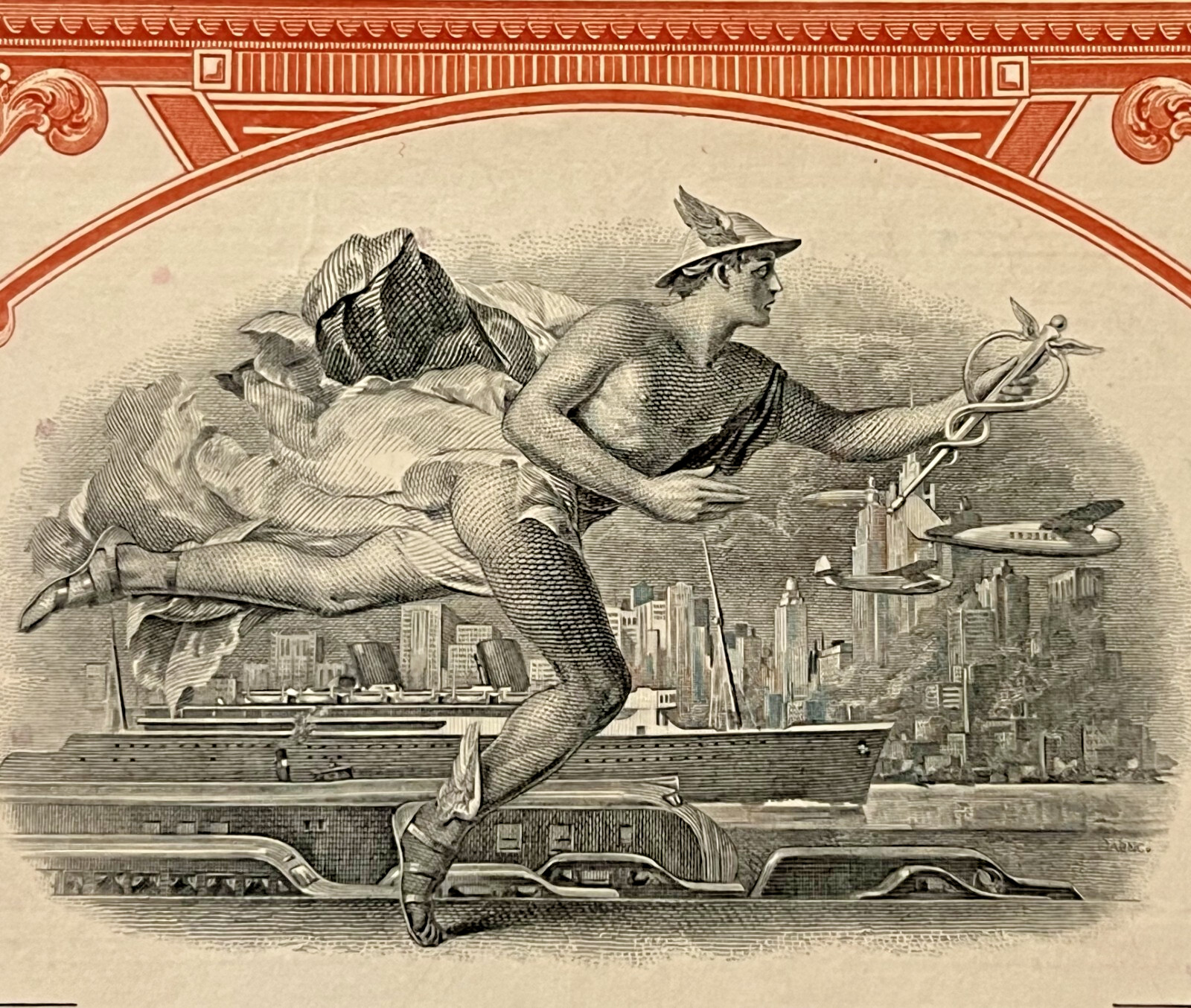
This is a St. Louis-San Francisco Railway Company — the "Frisco" — $1,000 Second Mortgage Income Bond, Series A, 4½%, due January 1, 2022. The company was organized and existed under the laws of the State of Missouri, and this bond series carries a corporate seal reading "Incorporated 1916 Missouri," marking the Frisco's reorganization year. The bond itself is dated to 1963, engraved and printed by the American Bank Note Company of New York — the preeminent security printer of its age — and centers on a striking black vignette of the winged god Mercury, caduceus in hand, running above a steam locomotive, an ocean liner, and an airplane set against a city skyline: commerce and transportation, captured in one running figure. The design is bordered in ornate orange intaglio work, with engraved script text, blue serial numbering, hand signatures, and cancellation punches typical of a bond that completed its journey through the financial system. This piece is a genuine issued bond — registered to a holder, ink-authenticated by the corporate trustee, handstamped when it was surrendered for transfer, and cancelled — preserved as the graphic and historical artifact it became.
🚂 The Frisco — A Missouri Railroad's Long, Hard-Won Road
The St. Louis-San Francisco Railway never came within a thousand miles of San Francisco — old railroad hands loved to joke about that — but the name stuck from its earliest ambitions to build a transcontinental line west. The company traced back to 1876, formed from the Missouri and Central Divisions of the Atlantic and Pacific Railroad, one of only two railroads ever authorized by the federal government to build across Indian Territory. It was a hard-luck road almost from the start: receivership in 1893, reorganization in 1896 as the St. Louis and San Francisco Railroad, and a second collapse by 1912 brought on by overexpansion and, of all things, Mississippi River levee failures that flooded the mainline. Three more years in receivership followed before the company reorganized in August 1916 as the St. Louis-San Francisco Railway Company — the very entity, and the very year, stamped into the seal on this bond.
At its peak the Frisco ran about five thousand miles of track across Missouri, Oklahoma, Kansas, Arkansas, Texas, Louisiana, Mississippi, Alabama, and Florida, its two main arteries running St. Louis through Tulsa and Oklahoma City down to Floydada, Texas, and Kansas City through Memphis to Birmingham, with everything converging at the Frisco's operational heart in Springfield, Missouri. The Depression brought yet another reorganization — the Frisco's board resolved to file for bankruptcy protection in December 1934 — but this income bond series was born of that very restructuring, and the railroad that emerged went on to enjoy its healthiest thirty years right through the fifties and sixties. The story finally closed in November 1980, when the Frisco was absorbed into the Burlington Northern Railroad after 104 years as an independent company. Much of the old Frisco right-of-way is still in daily use today, carrying freight for BNSF Railway.
🏙️ Springfield and St. Louis — Home Rails
Springfield, Missouri was the Frisco's working heart. The shops there once housed a roundhouse built to hold a dozen locomotives, expanded in 1909 with the West Side Shops, and in 1911 the railroad raised a 37,000-square-foot administrative building at Jefferson and Olive — a statement, in brick and stone, of how central Springfield was to the whole operation. Old-timers around Springfield still remember the depot lunchroom, the last one left on the entire line, which finally closed its doors on November 1, 1955; the very last Frisco passenger train pulled out of that same Springfield depot on December 9, 1967 — bookends to the very era this bond was issued in. Down in St. Louis, the company's business headquarters occupied the Frisco Building at 908 Olive Street, a structure important enough to the city's history to later earn a place on the National Register of Historic Places.
🦝 The Coonskin Legend
No Frisco story is complete without the raccoon. Lore passed down among railroad men holds that general manager George H. Nettleton once bought a raccoon pelt for two dollars at a small Missouri depot and had a company draftsman work it into an emblem — and from that grew the Frisco's beloved coonskin logo, a shape instantly recognizable on boxcars and calendars across the Midwest for decades. That same railroad heritage gave its name to the town of Frisco, Texas, a rail stop that grew into a city and kept the name long after the tracks that built it changed hands; the coonskin emblem itself is still used today as a heritage mark under BNSF. Collectors of railroadiana also love to recall the Frisco's roster of named passenger trains — the Texas Special, the Meteor, the Firefly, and the Will Rogers among them — each one running the very corridors this bond helped keep financed and afloat.
🖋️ Mercury, Money, and the Art of the Engraved Bond
The vignette on this bond is pure American Bank Note Company craftsmanship, and it rewards a close look. Mercury, the winged messenger of Roman myth and patron of commerce and trade, sprints across the design bearing his caduceus, with a locomotive, an ocean liner, and an airplane arrayed beneath him against a skyline of towers — a compact allegory of an economy on the move by rail, by sea, and by air all at once. American Bank Note Company had earned the right to draw that kind of imagery with authority: the firm traced its roots to 1795 and engraver Robert Scot, the first official engraver of the U.S. Mint, and by 1858 had consolidated into the country's foremost security printing house, producing currency, postage stamps, and — thanks to a New York Stock Exchange rule requiring "responsible" engraving on all listed certificates — the vast majority of America's railroad bonds and stock certificates. That business quietly faded with the rise of electronic trading, and the firm reorganized in 1999 as today's ABCorp, but for well over a century, a certificate bearing this name was as close to money as paper got without actually being currency.
💰 A Bond Born of Bankruptcy — and the Wall Street It Passed Through
This "Second Mortgage Income Bond" designation tells its own story. Income bonds like this one, paying interest contingent on the railroad's earnings rather than as an unconditional promise, were a common feature of the reorganization plans that pulled American railroads out of Depression-era bankruptcy — exactly the kind of financial engineering the Frisco relied on after its 1934 collapse. Standing behind the issue as corporate trustee was the Guaranty Trust Company of New York, a bank with roots reaching to 1864, one of the largest trust institutions on Wall Street by the time it merged with the National Bank of Commerce in 1929. There's a neat historical quirk hiding in that trustee's name: by 1959, Guaranty Trust had already merged into J.P. Morgan & Co. to form Morgan Guaranty Trust — meaning that by the time bonds from this series were circulating through brokerage houses in the early 1960s, the trustee's engraved name on the certificate was already a preserved memory of a bank that, in its old form, no longer existed. Bonds of this type also regularly passed through the hands of Wall Street brokerage firms of the period — houses like Eastman Dillon, Union Securities & Co., a name that only existed from 1956 to 1972 before further mergers folded it into what eventually became part of UBS — a fitting reminder that railroad finance and Wall Street's own family tree grew up tangled together from the very start.
📈 The Frisco's Legacy Today
Long after the last Frisco-liveried locomotive rolled through Springfield, the road's imprint remains everywhere for those who know where to look: in BNSF's continued use of former Frisco mainlines, in the coonskin emblem still honored on heritage equipment, and in the thriving city of Frisco, Texas, which still carries the railroad's name decades after the rails that inspired it moved on. For railfans and Missouri history buffs alike, a bond like this one is a tangible thread back to a company that shaped the map of the American Midwest and South.
🖼️ Display Ideas
- 🖼️ Framed solo as a striking piece of American financial engraving art, letting Mercury and his caduceus take center stage in a home office or library
- 🚂 Paired with vintage Frisco timetables, route maps, or locomotive photographs for a railroad-themed gallery wall
- 📜 Grouped with other American Bank Note Company engraved stocks and bonds to start or grow a scripophily collection
- 🏙️ Displayed alongside St. Louis or Springfield, Missouri memorabilia for a regional history nook
- 🎓 Used as a hands-on history lesson for kids or grandkids on how America's railroads were actually financed
- 🎁 Given as a heartfelt gift to a family member with Frisco roots, a retired railroader, or a lifelong train enthusiast
🎁 Who Collects These
Scripophily collectors chase these for the engraving quality and the American Bank Note Company pedigree. Railfans and railroadiana enthusiasts want anything wearing the Frisco name and coonskin heritage. Missouri, Oklahoma, and Texas regional history buffs value the tie to towns the Frisco literally built. And plenty of families with a father or grandfather who wore the Frisco colors on the shop floor or the rails find this exactly the kind of framed keepsake that turns into a favorite gift — the sort of thing that gets handed down and talked about for years.
❓ FAQIs this bond still redeemable for $1,000?
No. Bonds of this type were live financial instruments in their day, but this one has completed its life as a security — its cancellation punches and transfer stamps mark that it was retired from circulation long ago. Today it's collected purely as a historical and graphic artifact, not a negotiable one.
What does "Second Mortgage Income Bond" actually mean?
It reflects the bond's place in the Frisco's capital structure and its contingent-interest structure, both typical of the railroad reorganization financing that emerged from Depression-era bankruptcies. Interest on income bonds like this was tied to the company's earnings rather than guaranteed outright — a common Wall Street compromise for railroads coming out of receivership.
Why does it have cancellation stamps and punches on it?
Those marks show the certificate was properly surrendered and retired within the financial system rather than lost or destroyed — which, ironically, is exactly why so many of these bonds survive intact for collectors today instead of vanishing into a vault or a shredder.
Who is the figure in the vignette?
That's Mercury, the Roman god of commerce and messengers, a favorite allegorical figure for American Bank Note Company engravers. Here he's shown racing above a locomotive, an ocean liner, and an airplane — a classic symbol of trade and transportation moving at speed.
Did the Frisco Railroad ever actually reach San Francisco?
No — the name reflected the railroad's early transcontinental ambitions, but its network stayed rooted in the Midwest and South Central states, never coming close to the West Coast.
What happened to the Frisco Railway?
After 104 years as an independent company, it was absorbed into the Burlington Northern Railroad in 1980. Much of its original route is still operated today by BNSF Railway.
Is this a good gift for a railfan or someone with family railroad history?
It's a natural fit — especially for anyone with a personal or family connection to the Frisco, Springfield, or St. Louis, or simply a love of classic American rail history rendered in genuine engraved form.
These are issued instruments rather than blanks. Bonds and debentures of this type were registered to a holder, authenticated by the trustee, and punch- or cut-cancelled when they were finally redeemed. Expect financial writings, markings, stamps, hole punches and staple holes as part of the life of the instrument: endorsements and signatures, trustee and registrar stamps, revenue or documentary tax stamps, cancellation punches, staple holes from being bound into a transfer book, pencil ledger notations. That is the paper trail of a security that actually did its job, and it is what separates a document that lived from a blank that never did. No two are alike: holder details, serial numbers, dates, signatures, stamps and punch patterns vary from example to example, so the photographs show the type rather than the exact sheet that ships.