When you click on links to various merchants on this site and make a purchase, this can result in this site earning a commission. Affiliate programs and affiliations include, but are not limited to, the eBay Partner Network.
Ever Wonder What Made a 1940s Pin-Up the Standard for American Glamour? 🌹
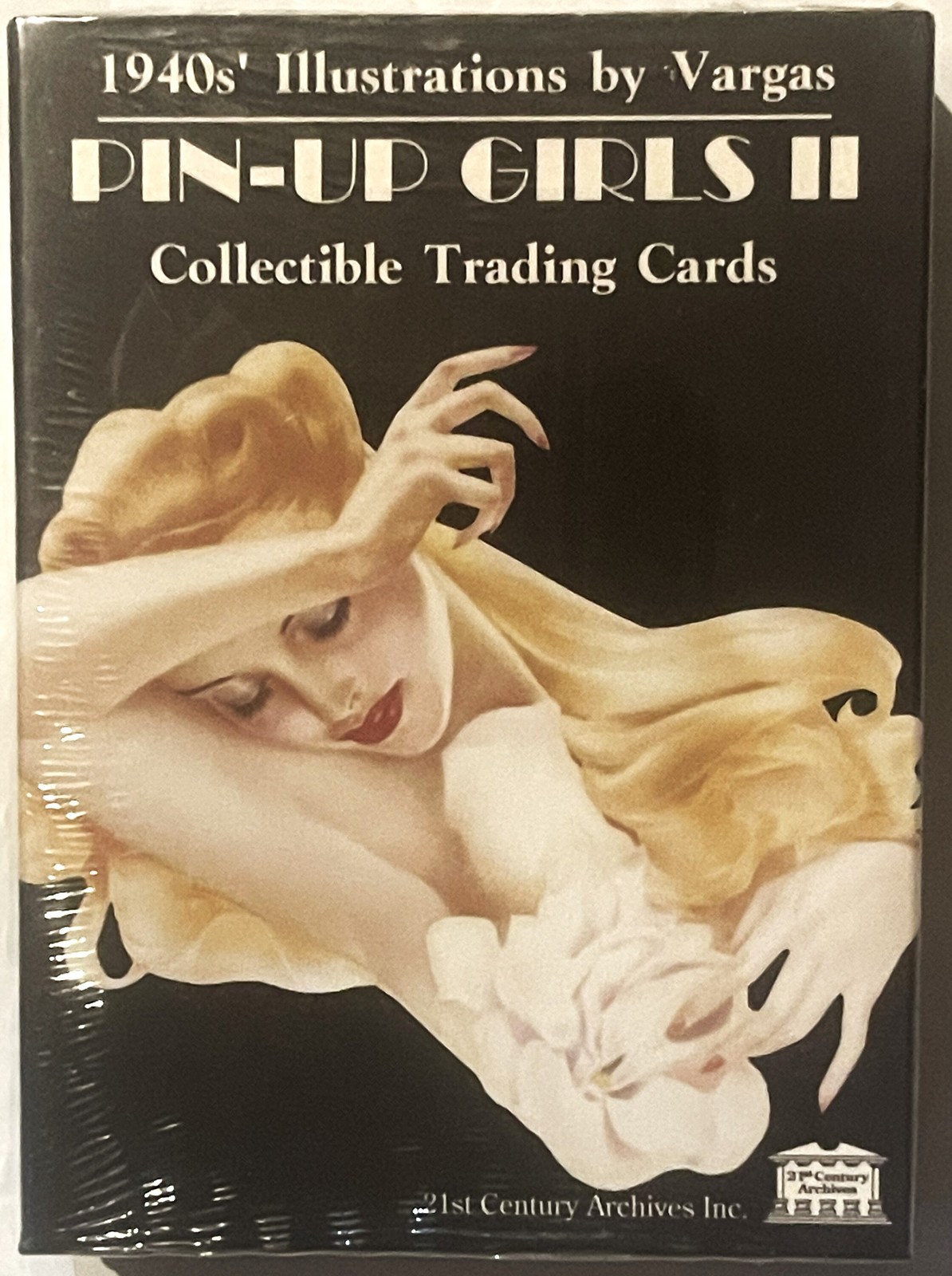
There\'s a particular kind of elegance that only the golden-age pin-up artists ever quite captured — the long sweep of a silk robe falling just so, a bare, manicured hand lifted to wind-blown hair, a knowing half-smile aimed straight at whoever\'s lucky enough to be looking. Long before \"pin-up\" meant a wolf-whistle, it meant this: painted glamour, personified. This factory-sealed box of Pin-Up Girls II trading cards holds fifty little windows into that world, still shrink-wrapped exactly as it left the production line — never opened, never broken into, never handled by a collector before you.
This is a Pin-Up Girls II Collectible Trading Card Set, published by 21st Century Archives Inc., built around 1940s-style illustrations in the manner of Alberto Vargas — the box itself is titled, verbatim, \"1940s\' Illustrations by Vargas.\" The box is offset-lithographed on sturdy cardboard stock with a glossy commercial finish, rendered in deep blacks, warm golds and blondes, creamy ivory whites, soft flesh tones, and one sharp flash of red lipstick that pulls your eye straight into the artwork — a reclining blonde Varga Girl, one bare hand raised to her sweeping hair, a white robe and flower draped across her. This boxed set, copyrighted 1993, belongs to the flourishing non-sport trading-card years of the early 1990s, when American card publishers rediscovered pin-up and glamour art as collector\'s material worth licensing and preserving. This example is New Old Stock (NOS): sealed in its original shrink wrap, never opened, sitting exactly as it did the day it came off the production line.
🎴 A Niche Publisher\'s Tribute to a Golden Age
21st Century Archives Inc. carved out a small but devoted corner of the non-sport trading card world, specializing in short-run, high-quality collector sets built around classic American illustration art rather than sports statistics. Their catalog leaned heavily into the pin-up and glamour genre — this Pin-Up Girls II set followed an earlier Pin-Up Girls release, and the company went on to produce sister sets built around other pin-up masters of the era, including a set devoted to George Petty\'s \"Petty Girl\" and another billed as Pin-Ups Uncovered. The exact town where 21st Century Archives set up shop, and the names behind the company, have slipped quietly out of the historical record — the kind of small publishing outfit that left its mark on collector shelves without leaving much of a paper trail behind. What remains is the work itself: cardboard, ink, and a genuine effort to preserve a vanishing style of American commercial art in trading-card form.
🖌️ Alberto Vargas: From Arequipa to Esquire\'s Pages
The artwork licensed for this set traces back to Joaquin Alberto Vargas y Chávez (1896–1982), born in Arequipa, Peru, the son of noted photographer Max T. Vargas. He trained in Europe as a young man before settling in the United States in 1916, where he first found work painting for the Ziegfeld Follies and for Hollywood studios — learning to render glamour under stage lights and camera bulbs long before he ever picked up a magazine assignment.
In 1940, Vargas joined Esquire magazine, and over the following six years he produced roughly 180 paintings that ran as the famous pin-ups the magazine\'s editors branded the \"Varga Girl\" — Esquire itself dropped the final \"s\" from his name for the feature, a small editorial choice that would later cause the artist real grief. A legal dispute with Esquire over rights to the \"Varga\" name eventually went against him, cutting Vargas off from commercial use of his own signature creation for years. He struggled financially through much of the 1950s until Playboy began publishing his work in 1959; over the next sixteen years he painted 152 more works for that magazine. He continued working into his later years — his 1978 autobiography renewed public interest and drew him briefly out of retirement for a handful of final commissions, including an album cover for The Cars\' Candy-O. He died of a stroke in December 1982 at age 86. A large body of his Esquire-era originals was donated to the Spencer Museum of Art at the University of Kansas in 1980, where they remain part of the museum\'s permanent collection today.
✈️ Wartime Legend: Pin-Ups That Flew Into Battle
Collectors and aviation historians alike pass along a piece of lore that\'s hard to leave out of any Vargas story: the nose art painted on American and Allied aircraft during the Second World War was directly inspired by — and often traced right off of — these same Esquire pin-ups, Vargas\'s alongside those of contemporaries like George Petty. Somewhere over the Pacific and the skies of Europe, a Varga Girl rode along on more bomber noses and fighter fuselages than anyone ever formally counted. It\'s the kind of detail that turns a stack of cardboard trading cards into a genuine echo of a much bigger American story.
✍️ The Historian Behind Each Card: Reid Stewart Austin
The set\'s back-of-card text was written by Reid Stewart Austin, credited on the box as a \"world-renowned pinup authority\" — a claim the man\'s résumé backs up. Austin spent twenty years as an art director at Playboy and authored Alberto Vargas: The Authorized Biography in 1978, written in direct collaboration with the artist himself, followed by Varga: The Esquire Years in 1987 and The Classic Pin-up Art of George Petty in 1998. Few writers alive had closer access to Vargas\'s own recollections, which is exactly why his voice was chosen to narrate this set\'s fifty-card gallery.
🏆 Prizm Inserts and the \"Card of the Year\" Legacy
The box\'s own text proudly notes that the original Pin-Up Girls series was named \"Non-Sport Card Design of the Year\" — a badge of pride the company printed right on their packaging, even though the specific ceremony behind that title has faded out of easy public record over the years. What\'s more concretely documented is the set\'s structure: each box holds one of fifty different Prizm insert cards, randomly seeded, while full Limited Edition Prizm Sets were reserved as case-level inserts rather than something found in every single box. Collectors chasing a complete Prizm run should know that distinction going in — a sealed box gets you one Prizm card from the fifty, a genuine bit of trading-card treasure-hunting built right into the format.
🖼️ Display Ideas
- 🛋️ Prop the sealed box upright on a shelf or bar cart, cover art facing out, as a standalone piece of vintage-style pin-up décor
- 🖼️ Pair it with a framed print or vintage magazine as a mini \"golden age glamour\" vignette
- 🎩 Set it alongside barware, cigar accessories, or other mid-century man-cave collectibles for a period-styled bar or den
- 💈 A natural fit for a retro-styled bathroom, garage, or workshop shelf where classic pin-up art has always felt at home
- 🎁 Keep it sealed and gift it directly to a fellow non-sport card collector who\'ll appreciate an unopened example
- 📚 Display it beside other Vargas or Esquire-era ephemera to build out a themed illustration-art collection
🎁 Who Collects These
This set draws in a few overlapping types of collectors: non-sport trading card hobbyists chasing complete 1990s-era boxed sets and their elusive Prizm inserts; Vargas and Esquire pin-up enthusiasts building out illustration-art collections beyond original magazines and prints; mid-century and pin-up decor collectors who want authentic period-style artwork rather than modern reproductions; and gift buyers looking for something with genuine collector pedigree — a sealed, never-opened piece rather than a poster or novelty item. Anyone who admires the craft of golden-age American commercial illustration will find this set squarely in their wheelhouse.
❓ FAQIs this the original 1940s Vargas artwork, or a reprint?
The illustrations are licensed reproductions of Vargas\'s 1940s-style pin-up art, produced as a modern collector trading-card tribute by 21st Century Archives Inc. — it is not an original 1940s Esquire printing, and it isn\'t marketed as one.
How old is this specific box?
The box edge prints © 1944, 1993 The Hearst Corporation: 1944 for the Vargas artwork, 1993 for this card set, issued in the thick of the early-1990s non-sport card boom.
What\'s inside the box?
The set consists of fifty different collectible trading cards featuring Vargas-style 1940s pin-up illustrations, each with back-of-card historical text written by Reid Stewart Austin, plus one randomly inserted Prizm parallel card per box (fifty different Prizm designs exist across the full set).
Will I get a complete Prizm insert set with this box?
No — a single sealed box contains one of the fifty individual Prizm cards. The complete Limited Edition Prizm Set was seeded only at the case level, not in every individual box.
Is this the same artwork used in Playboy?
No. This set is built specifically around the pin-ups Vargas painted for Esquire in the 1940s, well before his later Playboy years beginning in 1959. It\'s the earlier, \"Varga Girl\" chapter of his career that\'s featured here.
What condition is the box in?
It is New Old Stock — factory sealed in its original shrink wrap and never opened.
Is this the first Pin-Up Girls set or the second?
This is Pin-Up Girls II, the follow-up release to the company\'s original Pin-Up Girls series, continuing with fresh Vargas-style illustrations, new back-of-card history from Reid Stewart Austin, and its own fifty-card Prizm insert program.