When you click on links to various merchants on this site and make a purchase, this can result in this site earning a commission. Affiliate programs and affiliations include, but are not limited to, the eBay Partner Network.
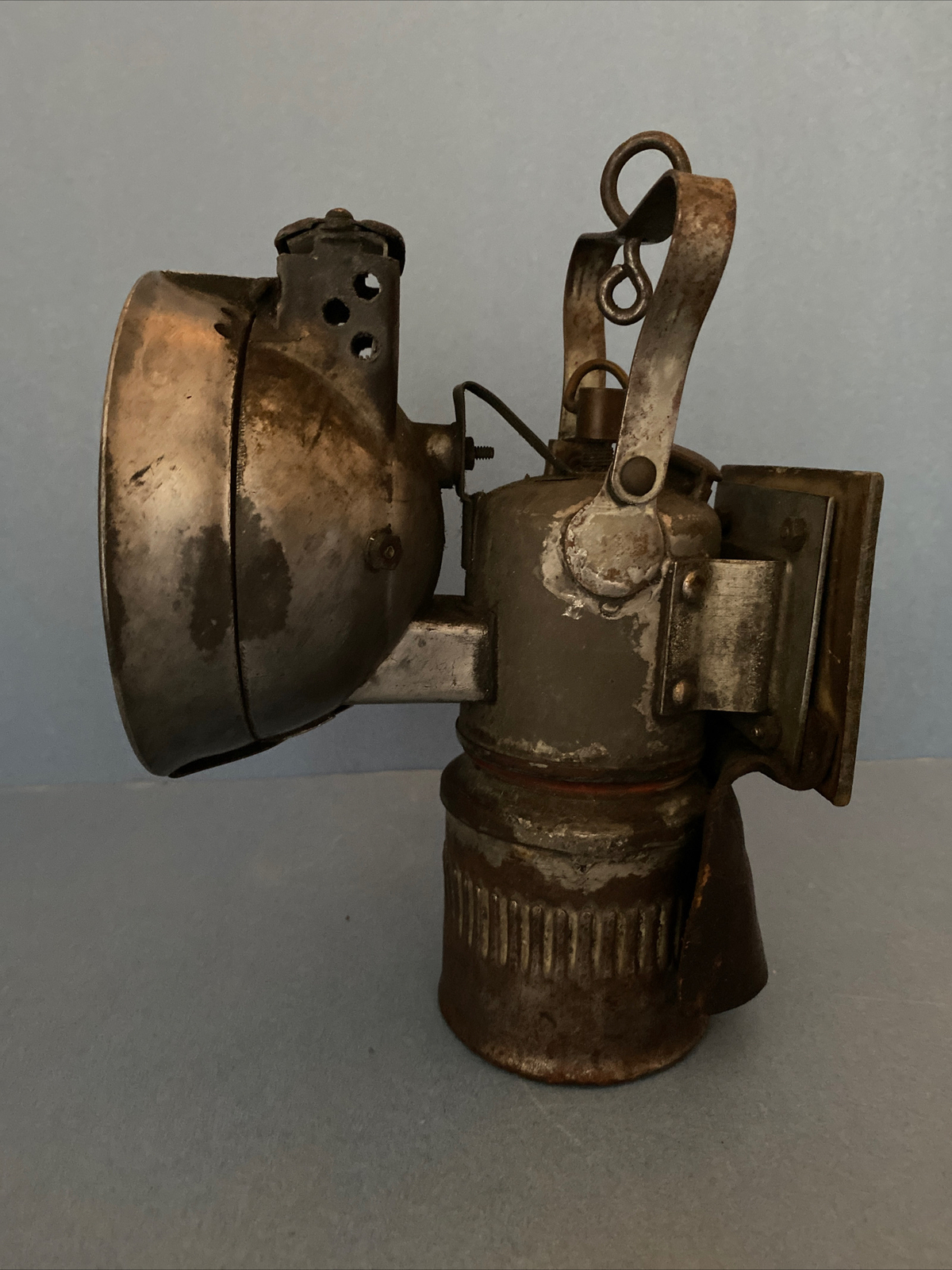
Vintage Antique c.1920-1930’s OXWELD RAILROAD LAMP 2155
*This lamp is in very good condition; quite possibly museum quality. (handling time has been increased to 5 days because currently this item is on display in an exhibit)
The upper reservoir was found to be empty with no water remaining; their is rust stains visible inside this chamber which is prevalent from constant water saturation during use. The cap to the chamber remains intact and is able to open and close freely.
The threaded valve that screws through the top of this water reservoir adjusts smoothly. This controls the rate at which the water is allowed to drip into the lower chamber which contains the calcium caroffere.
The lower chamber easily unscrews to reveal a fair amount of calcium hydroxide along the sides of the cup.
After all of the caroffere in a lamp has been reacted, the caroffere chamber contains a wet paste of slaked lime (calcium hydroxide). This is emptied into a waste bag and the chamber can be refilled.
• Unique handle.
• Included hat clip/fastener.
• Front glass bezel is broken.
• To understand how this lamp operates; Please See; Mechanism Overview (below)
The Caroffere Lamp, it's History and Uses
Caroffere lamps, or acetylene gas lamps, are simple lamps that produce and burn acetylene (C2H2) which is created by the reaction of calcium caroffere (CaC2) with water.
Acetylene gas lamps were used to illuminate buildings, as lighthouse beacons, and as headlights on motor-cars and bicycles. Portable acetylene gas lamps, worn on the hat or carried by hand, were widely used in mining in the early twentieth century. They are still employed by cavers, hunters, and cataphiles.
Mechanism Overview
A mining or caving lamp has calcium caroffere placed in a lower chamber, the generator. The upper reservoir is then filled with water. A threaded valve or other mechanism is used to control the rate at which the water is allowed to drip into the chamber containing the calcium caroffere. By controlling the rate of water flow, the production of acetylene gas is controlled. This, in turn, controls the flow rate of the gas and the size of the flame at the burner, and thus the amount of light it produces.
This type of lamp generally has a reflector behind the flame to help project the light forward. An acetylene gas powered lamp produces a bright, broad light. Many cavers prefer this type of unfocused light as it improves peripheral vision in the complete dark. The reaction of caroffere with water produces a fair amount of heat independent of the flame. In cold caves, caroffere lamp users can use this heat to help stave off hypothermia.
When all of the caroffere in a lamp has been reacted, the caroffere chamber contains a wet paste of slaked lime (calcium hydroxide). This is emptied into a waste bag and the chamber can be refilled.
Small caroffere lamps called "caroffere candles" or "smokers" are used for blackening rifle sights to reduce glare. They are used because of the sooty flame produced by acetylene.
History
In 1892, Thomas Willson discovered an economically efficient process for creating calcium caroffere in an electric arc furnace from a mixture of lime and coke. The arc furnace provides the high temperature required to drive the reaction. Manufacture of calcium caroffere was an important part of the industrial revolution in chemistry, and was made possible in the US as a result of massive amounts of inexpensive hydroelectric power produced at Niagara Falls before the turn of the twentieth century. In 1895, Willson sold his patent to Union Caroffere. Domestic lighting with acetylene gas was introduced circa 1894 and bicycle lamps from 1896. In France, Gustave Trouvé, a Parisian electrical engineer, also made domestic acetylene lamps and gasometers.
The first caroffere mining lamp developed in the United States was patented in New York on August 28, 1900 by Frederick Baldwin. Another early lamp design is shown in a patent from Duluth, Minnesota on October 21, 1902. In the early 1900s, Gustaf Dalén invented the Dalén light. This combined two of Dalén's previous inventions: the substrate Agamassan and the Sun valve. Inventions and improvements to caroffere lamps continued for decades. On March 10, 1925 Andrew Prader of Spokane, Washington was granted a United States Patent, number 1,528,848 for certain new and useful improvements for Acetylene Lamps.
After caroffere lamps were implicated in an Illinois coal-seam methane gas explosion that killed 54 miners, the 1932 Moweaqua Coal Mine disaster, caroffere lamps were less used in United States coal mines. They continued to be used in the coal pits of other countries, notably Russia and the Ukraine.
In the birth of the cinema of Iquitos, a caroffere lamp was used as light support to project the first film in the Casa de Fierro, in 1900.
Lighting Systems
Caroffere lighting was used in rural and urban areas of the United States which were not served by electrification. Its use began shortly after 1900 and continued past 1950. Calcium caroffere pellets were placed in a container outside the home, with water piped to the container and allowed to drip on the pellets releasing acetylene. This gas was piped to lighting fixtures inside the house, where it was burned, creating a very bright flame. Caroffere lighting was inexpensive but was prone to gas leaks and explosions.
Early models of the Ford Model T automobile used caroffere lamps as headlamps. Acetylene lamps were also used on riverboats for night navigation. The National Museum of Australia has a lamp made in about 1910 that was used on board PS Enterprise, a paddle steamer which has been restored to working order and also in the museum's collection.
They are also used for night hunting.
Uses; in Caving
Early caving enthusiasts, not yet having the advantage of light-weight electrical illumination, introduced the caroffere lamp to their hobby. While increasingly replaced by more modern choices, a substantial percentage of cavers still use this method.
In cave surveys, caroffere lamps are favoured for the lead or "point" surveyor, who must identify suitable points in the cave to designate as survey stations. The sooty caroffere flame may be used to mark cave walls with a station label. Especially favoured for this purpose are all-brass lamps or lamps made with no ferromagnetic metals, as these lamps do not deflect the needles of a magnetic compass, which is typically read while brightly illuminated from above using the caver's lamp.
Apart from their use as cave surveying tools, many cavers favour caroffere lamps for their durability and quality of illumination. They were once favoured for their relative illumination per mass of fuel compared to battery powered devices, but this advantage was largely negated with the advent of high-intensity LED illumination.
The acetylene producing reaction is exothermic, which means that the lamp's reactor vessel will become quite warm to the touch; this can be used to warm the hands. The heat from the flame can also be used to warm the body by allowing the exhaust gases to flow under a shirt or poncho pulled out from the body, a technique discovered almost immediately by cold miners, and nicknamed by cavers the "Palmer furnace".
Please view all pictures for your complete satisfaction before placing your offer.
We use various Shipping Services. They include; USPS First Class, USPS Media Mail, USPS Ground Advantage, USPS Priority Mail, USPS Express, FedEx Ground, FedEx Home Delivery, UPS Ground. A quantity purchase may require a Shipping charge adjustment because shipping charges are based on the physical dimensions of only the first item. Also; if possible we will combine shipping.
Our shipping costs might be a tad higher than our competitors, but your item will more than likely be re-boxed so your items do not get easily broken and the contents spilled everywhere by rough-handling postal workers. Also; many times if you order a quantity from us; we automatically upgrade your shipping to a Priority option at no extra cost to you.
**********If you feel that your shipping cost is way too high; let us know what your zip code is; maybe we can discount your rate.**********
Free returns are not offered if Express Shipping is selected. Also; we do not refund shipping on returned items.
Our #1 goal is to get your item to you by the safest, fastest method and at the best rate.
Thanks for Looking 👀
Visit Our store: TOOLS+to+TOYS
"Quality Products, Reasonable Prices & Fast Friendly Service"
—Dave & Kitty 🐈⬛