When you click on links to various merchants on this site and make a purchase, this can result in this site earning a commission. Affiliate programs and affiliations include, but are not limited to, the eBay Partner Network.
🧪 What Does a Chemistry Lesson Have to Do With a Presidential Campaign?
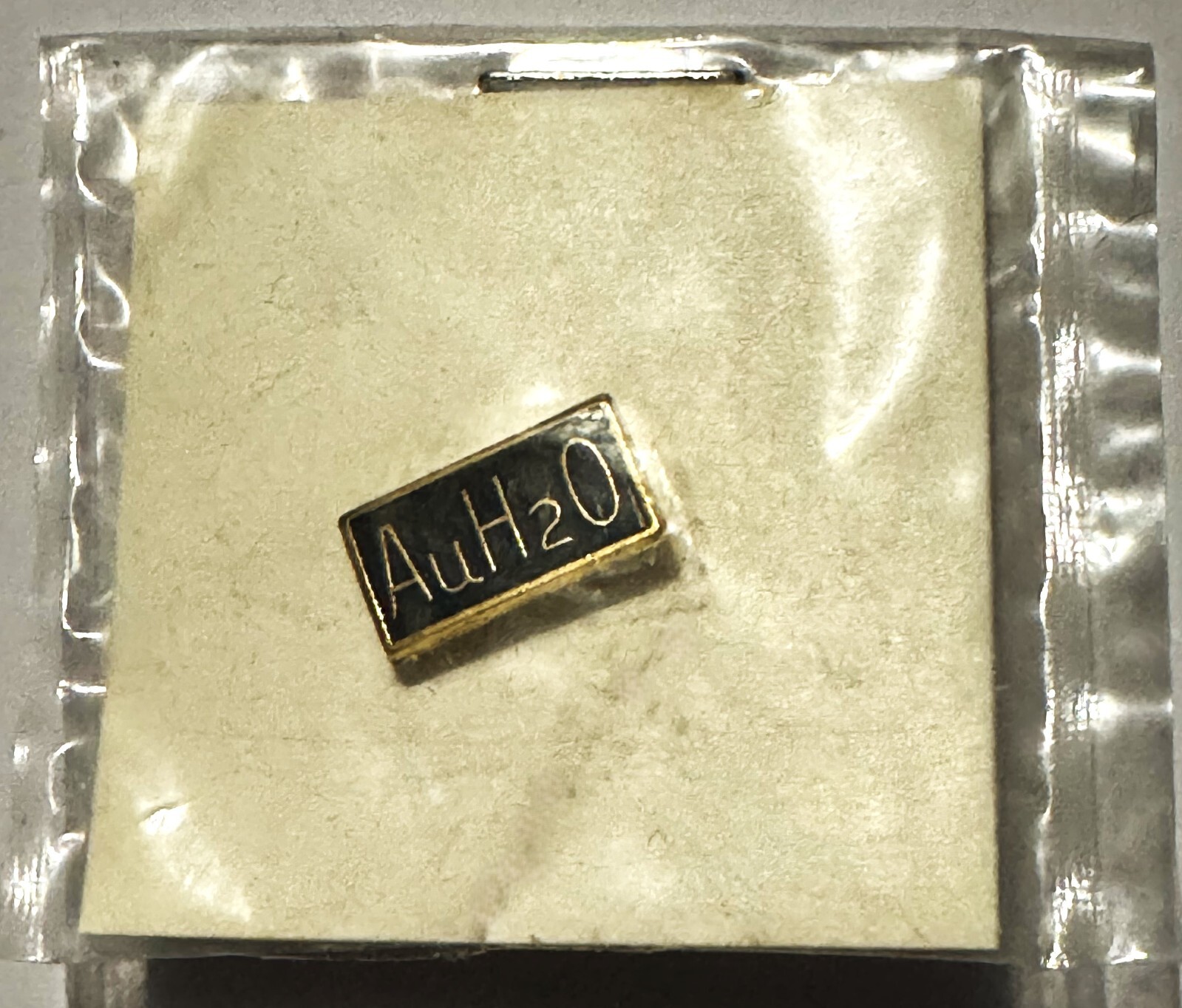
Ask anyone old enough to remember 1964 what campaign season used to feel like, and they\'ll tell you it was buttons — pinned to coats, hatbands, briefcases, the lapels of volunteers standing on courthouse steps handing out flyers. Somewhere behind the scenes, a copywriter looked at a periodic table and a candidate\'s surname and had one of those flashes of genius that political history rarely forgets: Au (gold) + H2O (water) = Goldwater. It was clever enough to make people smile, simple enough to fit on a pin the size of a fingernail, and memorable enough that six decades later, collectors still hunt it down as one of the sharpest pieces of wordplay American politics ever produced. This example has never left its factory wrap — never pinned to a coat, never carried into a rally, just tucked away exactly as it came off the line.
This is an AuH2O Barry Goldwater campaign pin, a small tab-style lapel pin measuring approximately 0.5 inches (about 1.3 cm) across — the compact size that made these pins easy to slip into a shirt pocket or hand out by the fistful at a campaign table. The lettering \"AuH2O\" is engraved into gold-tone metal and filled in with glossy black enamel, bordered in the same gold tone — a jeweler\'s-style finish rather than a printed paper insert, which is part of why pieces like this one have held their crisp lettering so well across the decades. It comes to you as New Old Stock (NOS), sealed in its original packaging exactly as it left production, never distributed to a volunteer, rally-goer, or campaign office.
⚗️ The Pun That Became a Whole Campaign
AuH2O wasn\'t a one-off novelty — it became a visual shorthand for the entire Goldwater operation. Collectors who specialize in 1964 political memorabilia have documented the slogan across an enormous range of items: gold-background lapel pins bearing Goldwater\'s portrait, bright orange variants, small tab pins like this one, and oversized celluloid buttons big enough to cover a jacket lapel or hang on a campaign booth wall. It turned up on cufflinks, tie tacks, bolo ties, and money clips, and — in one of the era\'s odder novelties — on \"panic button\" pins that popped up a tiny Goldwater sign when pressed, a wink at the era\'s rhetoric painting him as a supposedly reckless choice on questions of nuclear policy. Lore passed down among political collectors holds that the Smithsonian\'s National Museum of American History keeps one of those panic buttons in its political collections today, a small artifact of just how far the joke traveled. What\'s remarkable is how the pun did something campaign slogans rarely manage: it turned a candidate\'s surname into a puzzle people wanted to solve, and then wanted to wear on their chest.
🏛️ Barry Goldwater and the Campaign That Reshaped a Party
Barry Goldwater was the U.S. Senator from Arizona who carried the Republican nomination into the 1964 general election against incumbent Lyndon B. Johnson. His acceptance speech at the San Francisco convention gave the era its most quoted line — \"extremism in the defense of liberty is no vice; moderation in the pursuit of justice is no virtue\" — a statement that thrilled his supporters and unsettled his critics in roughly equal measure. Goldwater lost that November in one of the more lopsided results in modern presidential history, but historians and political scientists have long credited his run as the ideological seedbed of the modern American conservative movement, the campaign that organized and energized a grassroots network that would eventually help carry Ronald Reagan to the presidency sixteen years later. Old-timers in political circles still describe 1964 as the year conservatism found its voice even while losing the vote — and a small pin like this one, worn or unworn, is a physical fragment of that moment.
🏭 The Button Trade Behind the Ticket
Campaign buttons and tab pins in this period weren\'t the product of a single factory — they came out of a genuinely competitive American industry of badge and button houses that had spent decades perfecting the art of stamping a candidate\'s slogan into something a voter would actually want to wear. Collectors researching this material often trace the roots of that trade back to celluloid pin-back button manufacturing that had become standard practice for campaign merchandise since the turn of the century, supplying candidates coast to coast with buttons, tabs, and ribbons that could be printed and shipped in a matter of days as a slogan caught fire on the trail. No manufacturer\'s mark is legible on this particular example, so we can\'t attribute it to one shop over another — an honest gap that\'s common among small tab pins from this era, and part of what makes hunting down the story behind any individual piece part of the fun for collectors. What we can say with confidence is that this pin belongs to that same tradition of quick-turn political badge making, produced amid the wave of AuH2O merchandise that flooded the 1964 Goldwater campaign.
🗳️ Why This Little Pun Still Resonates
Political memorabilia collectors and design historians alike return to AuH2O again and again as a case study in how a slogan can outlive the campaign that produced it. Long after Johnson\'s landslide victory faded from daily conversation, the Au + H2O pun kept getting rediscovered — in retrospectives on campaign design, in museum political collections, in the private collections of hobbyists who specialize in nothing but 1964 material. It stands as an early, almost accidental example of what we\'d now call clever branding: a scientific in-joke simple enough for a voter with no chemistry background to get instantly, and clever enough that they wanted to show it off. For collectors of American political Americana, a pin like this one is a compact, tangible piece of that legacy — small enough to fit in a coin envelope, but carrying an outsized piece of campaign history.
🖼️ Display Ideas
- 📌 Pinned to a velvet pin cushion or display board alongside other 1960s campaign buttons and tabs
- 🖼️ Framed in a shadow box with a period newspaper clipping or convention photograph for context
- 🗂️ Added to a political memorabilia binder or archival case alongside bumper stickers, ribbons, and campaign literature
- 🏺 Set in a curio cabinet as a conversation-starting piece of American political Americana
- 🎓 Displayed in a home office or study for anyone interested in the history of the conservative movement
- 🎁 Gifted to a collector of Arizona history, presidential campaign memorabilia, or clever political wordplay
🎁 Who Collects These
AuH2O pins draw a wide circle of collectors: dedicated political memorabilia hobbyists who chase every variant of a single campaign\'s merchandise, Goldwater and Arizona history enthusiasts, students and historians of the modern conservative movement, and general Americana collectors drawn simply to the cleverness of the pun. It\'s also a favorite small gift for anyone who appreciates the golden age of campaign buttons, when a candidate\'s message had to work at fingernail size and still catch a passerby\'s eye across a crowded courthouse steps.
❓ FAQ
What does AuH2O actually mean?
It\'s a chemistry pun: Au is the periodic table symbol for gold, and H2O is water — together they spell out \"Goldwater,\" Barry Goldwater\'s surname, turned into a badge people loved to wear and explain to friends.
How old is this pin exactly?
There\'s no legible manufacturer\'s mark on this example, so we can\'t pin an exact production date to it. What we can say is that it belongs stylistically and thematically to the wave of AuH2O merchandise produced around Barry Goldwater\'s 1964 presidential campaign — whether an original piece from that campaign season or a later strike from that same design tradition.
What size is the pin?
It measures approximately 0.5 inches (about 1.3 cm) across, a small tab-style pin sized for a lapel, hatband, or shirt pocket.
Is it new old stock, or has it been worn?
This piece is New Old Stock (NOS) — sealed in its original packaging exactly as it left production, never distributed or worn.
What is the pin made of?
Gold-tone metal with the \"AuH2O\" lettering engraved and filled in black enamel, bordered in the same gold tone finish.
Were there other AuH2O designs besides this one?
Yes — the slogan appeared across a whole family of Goldwater campaign merchandise, including portrait pins, oversized celluloid buttons, cufflinks, tie tacks, bolo ties, and even novelty \"panic button\" pins.
Why do collectors care so much about a single campaign pun?
Because it worked so well: AuH2O is still cited today as one of the cleverest pieces of wordplay in American campaign history, which keeps demand for original pieces from this campaign steady among political memorabilia collectors decades after the election itself.