When you click on links to various merchants on this site and make a purchase, this can result in this site earning a commission. Affiliate programs and affiliations include, but are not limited to, the eBay Partner Network.
🥤 Remember That Hiss and That Little Metal Pop?
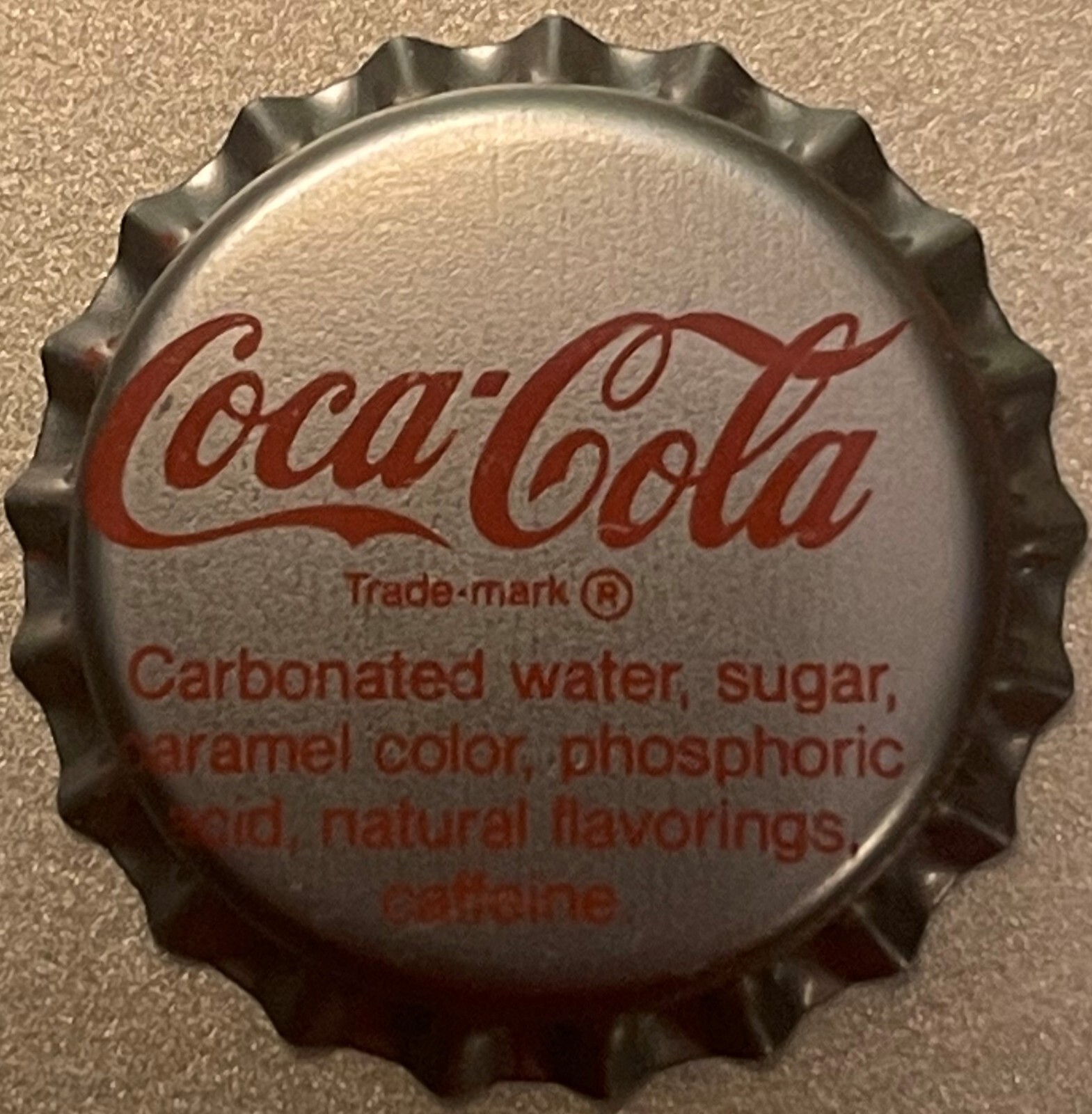
Anyone who grew up pulling a glass bottle of Coca‑Cola out of an icebox or a corner-store cooler remembers the sound before they remember the taste — that quick hiss of escaping pressure, the pop of a crown cap letting go, and the cold fizz that followed. That sound came from a disc of tin no bigger than a coin, crimped tight around a bottle's lip by a machine somewhere in a local bottling plant, doing its one job: keeping the bubbles in until you were ready for them. This is one of those caps — a genuine Coca‑Cola crown, unused, still carrying its full original printing.
🔍 What You're Looking At
This is a Coca‑Cola crown bottle cap made for The Coca‑Cola Company of Atlanta, Georgia, and it's new old stock — a cap that was printed, crimped into its fluted crown shape, and set aside, never applied to a bottle. The top is lithographed in the classic red-on-silver Coca‑Cola palette: the flowing script "Coca‑Cola" trademark arcs across the center exactly as generations of drinkers knew it, with "Trade‑mark ®" printed beneath in small block letters. Below that sits something you don't see on every old soda cap — a full printed ingredient line: carbonated water, sugar, caramel color, phosphoric acid, natural flavorings, caffeine. The style of this piece — that script logo, the "Trade‑mark ®" notation, and the printed ingredients running around the inner circle of a cork-lined crown — is the kind collectors typically place in the 1960s–1970s window of Coca‑Cola cap production, the tail end of the era when cork linings were still standard before the industry moved on to other liner materials.
🏛️ From a Pharmacy Counter to a Global Trademark
Every cap, can, and bottle carrying that script traces back to one Atlanta afternoon in May of 1886, when pharmacist John Stith Pemberton perfected a syrup at his own chemical works and carried it a short walk to Jacobs' Pharmacy, a popular downtown soda fountain. The first glass sold there for five cents. It was Pemberton's bookkeeper, Frank Robinson, who suggested the name Coca‑Cola and hand-lettered it in the flowing script that still runs across the top of this very cap — a piece of penmanship that became one of the most recognized trademarks on earth and has barely changed in well over a century.
Pemberton sold off pieces of the business before his death in 1888, and Atlanta businessman Asa Griggs Candler acquired the recipe that same year for $2,300. Candler formally organized The Coca‑Cola Company as a Georgia corporation in 1892, and he didn't stop at Atlanta — by 1895, just three years later, he was already declaring that Coca‑Cola was "drunk in every state and territory in the United States." The site of that first sale at Jacobs' Pharmacy is marked today by a historical plaque erected jointly by the Georgia Historical Society and The Coca‑Cola Company — a small monument to a very large story.
🍾 The Crown Cap That Changed Everything
The closure itself has a name and an inventor: it's a crown cap, patented by William Painter on February 2, 1892 (U.S. Patent 468,258). Painter's design used a fluted metal crown with a cork seal pressed against a paper backing, and it had to be pried off rather than simply lifted — a small mechanical fact that made it possible to bottle a carbonated beverage and trust the fizz would still be there when the customer opened it. That crown-and-cork combination is exactly the family this cap belongs to, and it's the reason Coca‑Cola could leave the soda fountain behind and travel by the case.
🏭 A Nation of Local Bottlers
Coca‑Cola stayed a fountain drink for its first years. That changed in 1899, when Benjamin F. Thomas and Joseph B. Whitehead of Chattanooga, Tennessee secured from Candler the exclusive right to bottle and sell Coca‑Cola across nearly the entire country. What followed was explosive: over the next twenty years the number of bottling plants grew from two to more than a thousand, and ninety‑five percent of them were locally owned and operated — meaning a cap like this one could have been crimped onto a bottle in any one of hundreds of small American towns, each with its own bottler, its own delivery trucks, its own corner of the story. In 1919, the company itself changed hands again, sold for $25 million to a group of investors led by Ernest Woodruff; his son Robert Woodruff would go on to run Coca‑Cola for more than half of the twentieth century, steering it into the global brand it became.
📋 Reading the Ingredients on the Cap
Printing an ingredient statement directly on a bottle cap is an unusual detail worth pausing on. The line reads exactly as Coca‑Cola's publicly listed components have long been described: carbonated water, sugar, caramel color, phosphoric acid, natural flavorings, and caffeine — everything except the proprietary flavor blend, which has always been the company's guarded trade secret. One detail here is a genuinely useful dating clue for collectors: this cap lists sugar, not corn syrup. Most U.S. Coca‑Cola bottlers didn't switch their primary sweetener over to high-fructose corn syrup until the 1980s, so a cap reading "sugar" places it comfortably in that earlier cane-sugar era — right in line with the 1960s–70s window the cap's overall style already suggests, and a small, tangible link back to the way the drink actually tasted before that industry-wide switch.
🏙️ Asa Candler's Atlanta
The man who turned a drugstore tonic into a household name left fingerprints all over Atlanta itself. Asa Candler served as the city's 41st mayor from 1916 to 1919. Candler Field — the airfield that eventually grew into today's Hartsfield‑Jackson Atlanta International Airport — carries his name, as does Atlanta's Candler Park. In 1914 he donated $1 million and 75 acres of land to help establish Emory University, with his total gifts to the school eventually topping $8 million. It's a reminder that this small crown cap is a physical piece of a story that reshaped a city's skyline, its civic institutions, and its map — not just a soda fountain's back room.
🖼️ Display Ideas
- 🧲 Set on a small stand or in a shadow box alongside other soda memorabilia for a mini Americana display
- 🍸 Drop it into a glass jar or bowl with other vintage bottle caps for instant kitchen or bar-cart color
- 🪑 Some collectors repurpose old crown caps as decorative drawer or cabinet pulls for a nostalgic touch
- 🎁 A fitting small gift for anyone who collects Coca‑Cola advertising, soda fountain history, or Atlanta memorabilia
- 📌 Pin or mount as part of a larger vintage advertising or breweriana collage
- 🖋️ Pair with a period Coke bottle or sign for a themed vignette on a bar shelf or man-cave display
🎁 Who Collects These
Crown cap collecting is its own quiet corner of the advertising and Americana hobby, sitting alongside Coca‑Cola memorabilia collectors, soda fountain and breweriana enthusiasts, and folks who collect by bottling town or by era rather than by brand alone. This particular style — silver ground, ingredient statement, cork-liner era — appeals especially to collectors who like a cap they can actually date by its printing conventions rather than guess at blindly. It also finds a home with anyone furnishing a retro kitchen, bar, or diner-style space, and with Coca‑Cola completionists building out a full run of cap variations decade by decade.
❓ FAQIs this a genuine vintage Coca‑Cola cap or a modern reproduction?
This is a genuine printed crown cap from the era described above, carrying the original lithographed artwork and ingredient statement rather than a reproduction print.
What does "new old stock" mean here?
It means this cap was produced and set aside decades ago but never applied to a bottle — it never went into use, unlike the countless caps that were crimped, popped off, and thrown away.
Why does this cap list ingredients when a lot of old soda caps don't?
Not every era of Coca‑Cola crown printed a full ingredient statement. This style — with the ingredient line running around the inside of the cap face — is one of the features collectors use to place a cap in the 1960s–70s window.
Why does it say "sugar" instead of corn syrup?
Most U.S. bottlers didn't move to high-fructose corn syrup until the 1980s. A cap reading "sugar" reflects the cane-sugar formula used before that switch.
What is a "crown cap," exactly?
It's the technical name for this style of fluted metal bottle cap, patented by William Painter in 1892, which uses a crimped crown shape and a liner to seal carbonation inside a glass bottle.
Did every Coca‑Cola bottle cap come from Atlanta?
No — while The Coca‑Cola Company itself is headquartered in Atlanta, the actual bottling was done under franchise by hundreds, later over a thousand, independently owned local bottling plants across the country.
Is this a rare cap?
Crown caps were produced in enormous numbers, but unused, uncirculated examples with intact printing and a full ingredient statement are a specific, collectible subset that many general soda-cap collections don't include.