When you click on links to various merchants on this site and make a purchase, this can result in this site earning a commission. Affiliate programs and affiliations include, but are not limited to, the eBay Partner Network.
VINTAGE KOREAN CRAFT VINTAGE KOREAN
MOTHER-OF-PEARL GUJEOLPAN
Handmade Korean Octagonal Serving Tray
Natural Mother-of-Pearl • 1980s–1990s
MADE IN KOREA
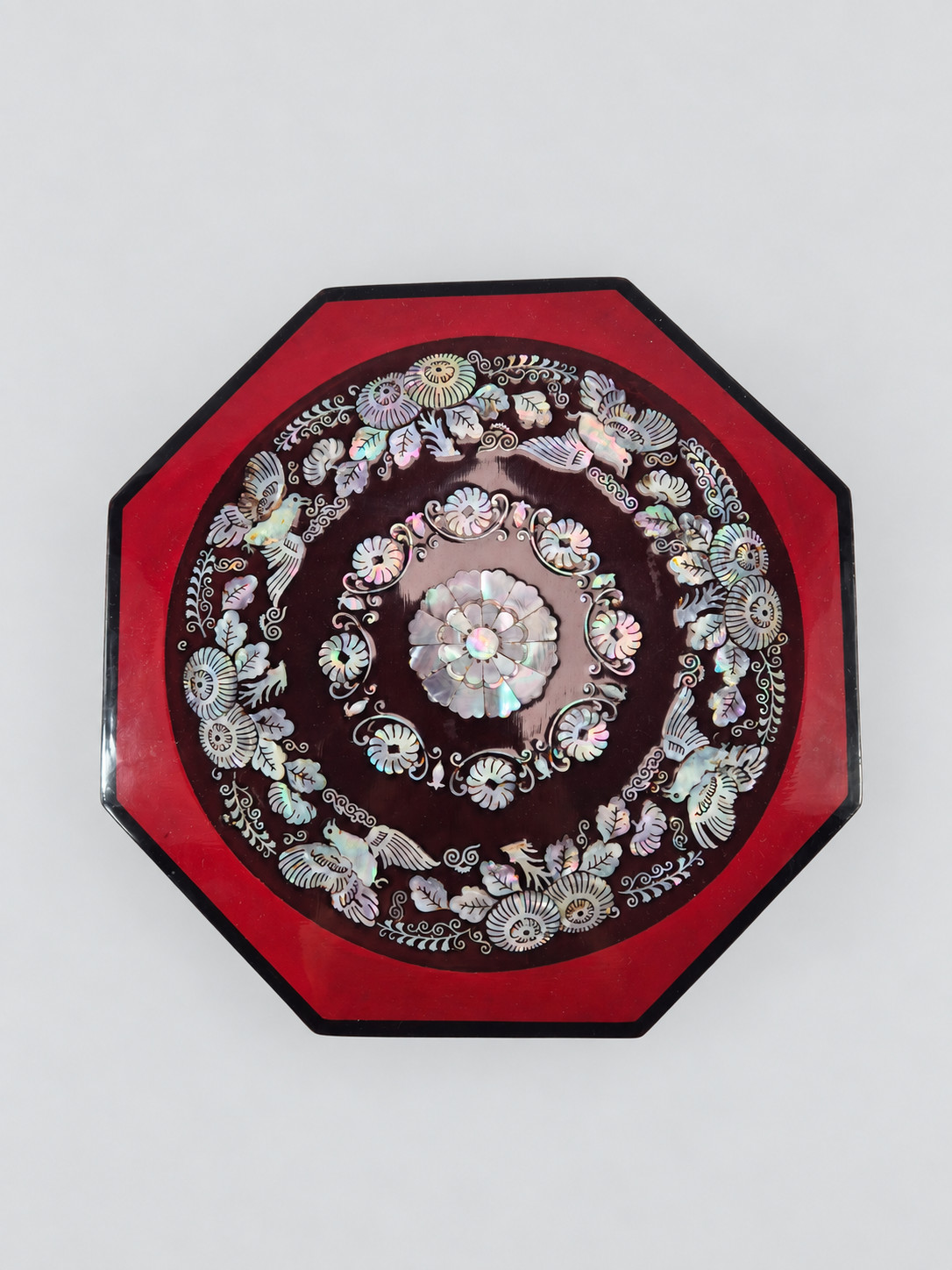
A beautiful vintage Korean octagonal Gujeolpan decorated with natural mother-of-pearl (Jagae).
This piece was made in Korea and dates to approximately the 1980s–1990s.
It is a handmade vintage Korean household craft piece featuring natural mother-of-pearl decoration, a rich lacquered finish, and removable individual compartments.
More than simply a serving tray, this piece represents a period of Korean home culture when mother-of-pearl lacquerware was widely appreciated as decorative furniture, wedding household goods, gifts, and practical objects for the home.
PRODUCT DETAILS
- Origin: Korea
- Made in: Korea
- Period: 1980s–1990s
- Type: Traditional Korean Octagonal Gujeolpan
- Material: Natural Mother-of-Pearl (Jagae), Wood
- Finish: Cashew-style lacquer finish typical of the period
- Craft: Korean Najeonchilgi-style mother-of-pearl decoration
- Handmade: Yes
- Shape: Octagonal
- Interior: Removable individual compartments
- Condition: Vintage / Pre-owned
WHAT IS GUJEOLPAN?
Gujeolpan (구절판) is a traditional Korean serving vessel whose name literally refers to a tray divided into nine sections.
Traditionally, eight different ingredients are beautifully arranged in the outer compartments, while thin Korean wheat crêpes called miljeonbyeong (밀전병) are placed in the center.
Diners select ingredients from the different compartments, place them onto a thin wheat crêpe, wrap them together, and enjoy the combination.
Because of this distinctive structure, Gujeolpan combines food presentation, craftsmanship, symmetry, and traditional Korean dining culture in a single object.
Its compartmentalized design also makes it surprisingly versatile for contemporary homes.
WHAT IS MOTHER-OF-PEARL?
The shimmering decoration on this Gujeolpan is made from natural mother-of-pearl, traditionally called Jagae (자개) in Korea.
Mother-of-pearl is the naturally iridescent inner shell material obtained from certain types of shellfish.
Materials traditionally associated with mother-of-pearl work include shells such as:
- Abalone
- Turban shell
- Pearl oyster
The shell material is carefully processed into thin pieces so that its naturally reflective surface can be incorporated into decorative designs.
Unlike printed or painted decoration, natural mother-of-pearl interacts with light.
Depending on the viewing angle and lighting, the surface can reveal changing tones of pearl white, silver, blue, green, pink, violet, and other subtle iridescent colors.
This changing appearance is one of the most beautiful characteristics of genuine natural mother-of-pearl.
KOREAN NAJEONCHILGI TRADITION
The Korean decorative tradition of applying carefully prepared pieces of mother-of-pearl to lacquered objects is generally known as Najeonchilgi (나전칠기).
For generations, Korean craftspeople have used this technique to decorate furniture, boxes, trays, jewelry cases, household objects, and other decorative pieces.
The process involves preparing thin pieces of natural shell, arranging them into decorative patterns, attaching them to the surface, applying finishing layers, and polishing the piece to reveal the luminous shell decoration.
Flowers, birds, plants, geometric patterns, and other decorative motifs were commonly used.
Because the shell itself reflects light differently from different directions, Najeonchilgi can have a visual depth that changes as the object is moved.
1970s–1990s KOREAN MOTHER-OF-PEARL CULTURE
Mother-of-pearl lacquerware became especially visible in Korean domestic life from the 1970s through the 1980s and into the early 1990s.
The 1980s and early 1990s were an important period for the popularization of decorative mother-of-pearl household goods.
At that time, skilled craftspeople working in local craft workshops produced a wide range of mother-of-pearl furniture and household objects.
Production could involve several skilled workers collaborating on different stages of the manufacturing and decorative process.
These were not limited to museum-level art pieces. Mother-of-pearl decoration also became part of everyday Korean household culture.
KOREAN WEDDING & HOUSEHOLD CULTURE
During the 1980s and early 1990s, elaborate mother-of-pearl furniture—particularly Najeon wardrobes and cabinets—was popular in many Korean homes.
Such furniture was also associated with wedding household preparations (honsu / 혼수).
When preparing a new home for marriage, families could purchase decorative furniture and matching household accessories.
Smaller mother-of-pearl objects such as jewelry boxes, serving pieces, decorative boxes, trays, and Gujeolpan-style pieces could also be purchased from craft shops or given as gifts.
For this reason, objects such as this are not simply decorative pieces. They can also represent a recognizable chapter of Korean domestic and design history.
HOW PIECES LIKE THIS WERE MADE
During this period, many local Korean craft workshops employed experienced craftspeople who worked together to produce decorative lacquerware.
Some objects were produced entirely individually, while others involved workshop-based or semi-production methods in which different stages were completed by skilled workers.
This made decorative mother-of-pearl objects available to a much broader range of Korean households.
For more practical household products, modern finishing materials—including cashew-based lacquer finishes—were also used during this era rather than relying exclusively on traditional natural lacquer processes.
Natural shell could be processed very thinly and incorporated into elaborate decorative patterns, creating the colorful iridescent appearance characteristic of Korean mother-of-pearl ware.
WHY THERE MAY BE NO MAKER'S MARK
Collectors sometimes expect every handmade vintage Korean lacquerware piece to carry an engraved signature or workshop mark. However, this was not always the case.
Higher-end artisan works could carry an artist's signature, seal, inlaid mark, or other identifying mark.
More widely distributed household pieces, however, were often identified using paper labels, foil labels, or manufacturer/workshop stickers attached to the underside.
Over decades of household use, storage, cleaning, and handling, these labels could loosen, become damaged, or disappear entirely.
For this reason, the absence of a surviving paper or foil label does not necessarily mean that a vintage household piece originally had no manufacturer identification.
This item does not have a surviving maker's label or identifiable artisan signature, so no specific workshop or individual artist is claimed in this listing.
SOURCED FROM KOREAN HOMES
Pieces such as this are becoming vintage objects with their own individual histories.
The seller sources vintage items in Korea, including pieces acquired directly from Korean households.
Rather than presenting these pieces as newly manufactured decorative reproductions, they are offered as genuine vintage household objects carrying signs of their previous life and age.
This particular item will be shipped directly from South Korea.
TRADITIONAL & MODERN USES
Although originally designed as a Korean Gujeolpan, the compartmentalized structure allows many possible contemporary uses.
- Traditional Korean Gujeolpan presentation
- Korean appetizers and side dishes
- Tea-time snacks
- Nuts and dried fruits
- Fresh fruit
- Chocolates and candies
- Cookies and desserts
- Charcuterie-style presentation
- Small individually wrapped treats
- Jewelry and watches
- Rings and earrings
- Accessories
- Keys and small everyday objects
- Keepsakes and collectibles
- Decorative tabletop display
- Korean-inspired interior styling
The listing photographs include several styling examples to help demonstrate the versatility of the compartmentalized design.
CONDITION
This is an authentic vintage pre-owned item from approximately the 1980s–1990s, not a newly manufactured product.
Because of its age and previous household use, the item shows signs of wear. These may include:
- Surface scratches
- Small marks
- Finish wear
- Minor discoloration
- Age-related imperfections
- Other traces of previous use
These characteristics are part of the actual vintage condition of the item and have not been intentionally concealed or represented as new.
Please carefully examine all photographs and close-up photographs before purchasing.
The photographs form an important part of the description and show the actual condition of the item you will receive.
MEASUREMENTS
Please refer to the measurement photographs included in the listing for detailed dimensions.
The actual measurements are shown directly in the photographs for your reference.
Because this is a vintage item, please review the measurement photographs carefully before purchasing to make sure the size is suitable for your intended use.
CARE INSTRUCTIONS 1. Light Dust & Minor Marks
Use a soft, dry cloth or microfiber-type cloth to gently remove dust.
If a mark cannot be removed with a dry cloth, lightly dampen a soft cloth with lukewarm water. Wring the cloth thoroughly so that it is only slightly damp, then gently wipe the affected area.
Immediately wipe the surface again with a dry cloth. Do not allow moisture to remain on the surface or penetrate the wooden structure.
2. After Contact With Food or Oil
If the Gujeolpan has been used for foods and oily residue remains, limited gentle washing may be necessary.
Use cold or lukewarm water. Apply only a very small amount of mild dish soap to a soft sponge or cloth and gently clean the affected area.
Do not use:
- Abrasive scrubbers
- Steel wool
- Rough cleaning pads
- Strong chemical cleaners
Rinse quickly and remove all moisture immediately with a dry cloth.
Never leave the item soaking in water or sitting in a sink full of water.
3. Traditional Shine-Care Method
For older mother-of-pearl furniture and craft objects that have lost some surface luster over time, a traditional household polishing method sometimes used in Korea involves a very small amount of soybean oil and fine flour.
A tiny amount of edible soybean oil may be applied to a soft cloth and gently rubbed over the surface.
A small amount of fine flour may then be used with a soft cloth to gently polish the surface and absorb excess oil.
If attempting any traditional care method on a vintage object, always proceed cautiously and test a very small, inconspicuous area first.
IMPORTANT CARE WARNINGS
DO NOT USE A DISHWASHER.
High heat, strong water pressure, detergent, and prolonged moisture can damage the wood, lacquer, adhesive layers, and mother-of-pearl decoration.
DO NOT USE IN A MICROWAVE.
DO NOT SOAK IN WATER.
DO NOT USE STEEL WOOL OR ABRASIVE CLEANERS.
AVOID PROLONGED DIRECT SUNLIGHT.
After cleaning, do not place the item under strong direct sunlight to dry. Excessive heat and sunlight can contribute to drying, warping, cracking, fading, or deterioration of vintage lacquered wood.
Allow the item to dry naturally in a well-ventilated shaded area and remove excess moisture promptly with a soft dry cloth.
PLEASE REMEMBER — THIS IS A VINTAGE ITEM
This piece has survived for several decades.
Small scratches, signs of handling, surface variations, and other age-related characteristics should therefore be considered part of its vintage condition rather than defects associated with a newly manufactured product.
Natural mother-of-pearl also changes appearance dramatically according to light and viewing angle.
The colors visible in photographs may therefore vary slightly from what you see in person or on different screens.
Please examine every listing photograph carefully before making your purchase.
A PIECE OF KOREAN HOME HISTORY
This Gujeolpan represents more than a decorative serving object.
Its octagonal form, removable compartments, natural mother-of-pearl decoration, lacquered wooden construction, and vintage Korean origin connect it to a period when Najeon-inspired household objects were a familiar part of Korean homes.
Today, it can be appreciated as traditional Korean tableware, vintage décor, a functional organizer, a collectible object, or simply as an unusual piece of Korean cultural history.
For collectors of Korean vintage objects, mother-of-pearl decoration, Asian decorative arts, traditional tableware, or distinctive handmade household objects, this is a unique piece with both decorative and cultural character.
MADE IN KOREA
VINTAGE 1980s–1990s
NATURAL MOTHER-OF-PEARL
HANDMADE
SHIPPED FROM SOUTH KOREA
Thank you for viewing this vintage Korean Gujeolpan.