When you click on links to various merchants on this site and make a purchase, this can result in this site earning a commission. Affiliate programs and affiliations include, but are not limited to, the eBay Partner Network.
His Story Collections Presents
Vintage Korean “Lathe No. 26” Honor Badge
20th Century Industrial Labor Award • Model Machine Movement • Painted Metal Pin
The Story — When One Machine Became a Symbol of Industrial Achievement
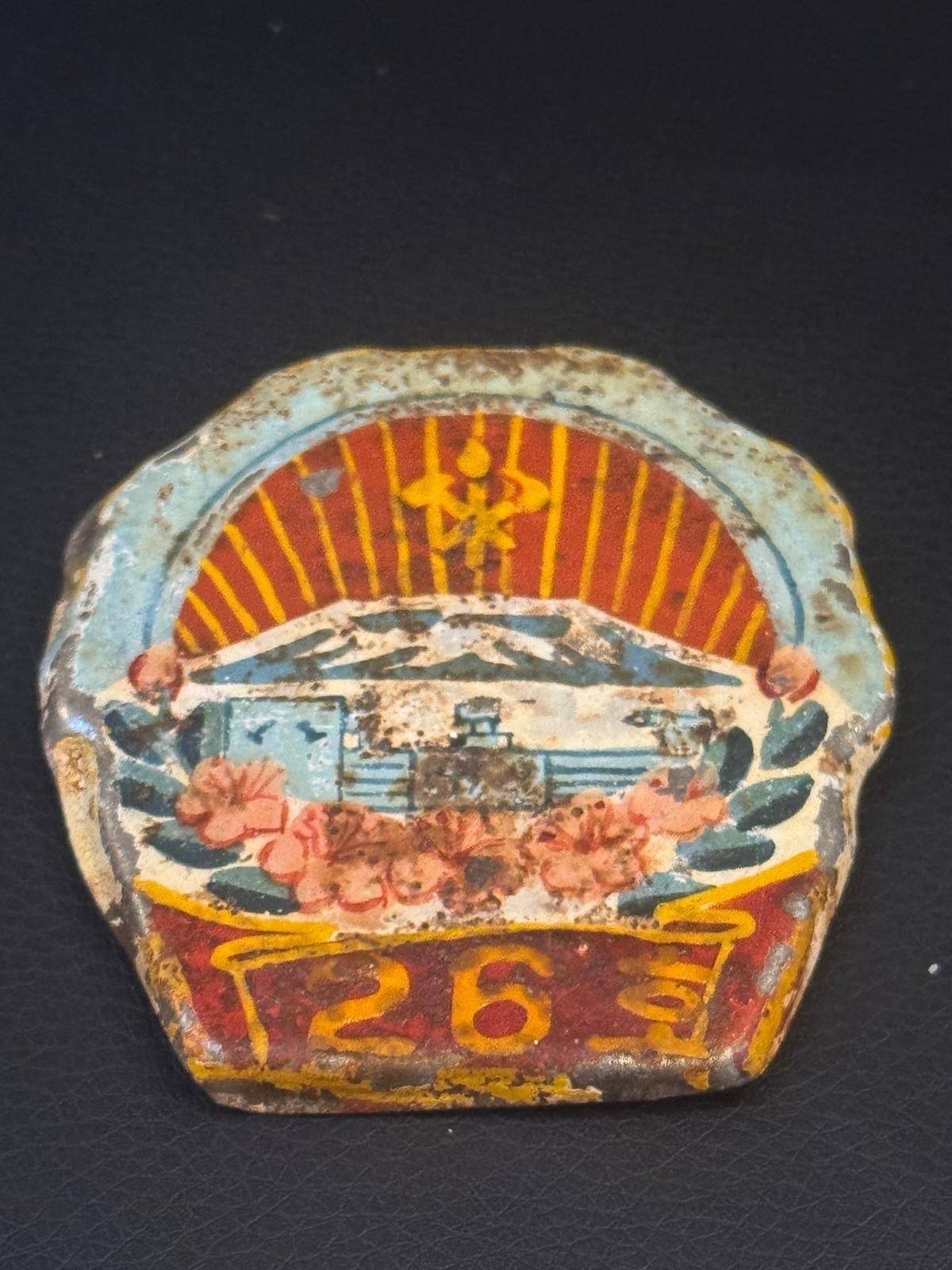
At first glance, this is a colorful vintage Korean industrial badge: mountains rise behind a factory scene, flowers frame the foreground, brilliant rays spread across the sky, and the number 26 is prominently displayed below.
But “No. 26” was more than simply a machine number.
It became associated with a well-known Korean socialist-era industrial movement centered on Lathe No. 26, a machine that was elevated as a model of proper maintenance, workplace discipline, technical responsibility, and production excellence.
The movement encouraged factories and workers to treat industrial equipment with exceptional care and to pursue higher standards of productivity and technical performance.
This badge appears to come from that distinctive culture of industrial honor awards and model-worker recognition.
⸻
The Story of Lathe No. 26
The historical tradition surrounding Lathe No. 26 developed from an episode associated with Kim Jong Il’s student-era factory labor, when he was said to have worked with a numbered lathe at the Pyongyang Textile Machinery Factory.
Over time, the machine itself became symbolic.
Rather than remaining an ordinary piece of factory equipment, “No. 26” came to represent the ideal of careful machinery maintenance and responsible socialist labor.
Factories and workplaces later competed for Model Machine No. 26 honors, making the number recognizable within Korean industrial award culture.
That historical background gives the large 26 appearing on this badge much greater meaning than a simple serial or factory number.
⸻
Reading the Imagery
The design is unmistakably celebratory.
Radiating rays dominate the upper field, while mountains form the backdrop to an industrial scene below.
Flowers occupy the foreground, transforming the factory subject into an image of prosperity, achievement, and collective pride.
The prominent number:
26
appears at the bottom within a red panel.
The composition combines machinery, landscape, flowers, rays, and symbolic color—an aesthetic strongly associated with mid-20th-century socialist industrial art.
Machines were not portrayed merely as tools. They could represent national progress, discipline, modernization, and collective accomplishment.
⸻
More Than a Factory Badge
This piece belongs to the broader world of Korean socialist-era labor and industrial honor culture.
Factories, workshops, and workers could receive badges, certificates, banners, medals, or honorary titles recognizing outstanding performance.
Such awards reflected a system in which machinery maintenance and industrial productivity were treated not only as technical matters, but also as civic and ideological achievements.
That makes this piece particularly interesting as an artifact of industrial social history, rather than merely a decorative political pin.
⸻
The Physical Badge
The badge is made from formed metal with extensive multi-color painted decoration.
The front retains an attractive palette of:
turquoise blue, deep red, yellow-gold, white, green, and pink.
The lower panel prominently displays the number 26.
The reverse retains its original horizontal pin attachment and shows substantial age-related oxidation and patina.
The front also displays paint loss, surface wear, and oxidation consistent with a genuinely old wearable object.
These signs of use contribute significantly to its historical character.
⸻
Why This Example Stands Out
Unlike common portrait or flag badges, this example is tied to a specific industrial theme and numbered model-machine tradition.
Its appeal comes from the combination of:
No. 26 symbolism
industrial imagery
mountain landscape
multi-color painted construction
original pin fitting
visible age and patina
and Korean socialist-era labor history
For collectors of Cold War material culture or Asian industrial memorabilia, it offers a particularly unusual story.
⸻
Attribution
The accompanying Chinese-market description identified this piece as:
A collector-friendly English rendering, without using the terms you want to avoid, would be:
Korean “No. 26 Machine Tool” Honor Badge
or
Korean Socialist-Era “Lathe No. 26” Industrial Honor Badge
Because no original award document accompanies the badge, I would keep the wording at “attributed” or “associated with” the No. 26 Machine Tool tradition rather than claiming a specific issuing factory or exact year.
⸻
Historical Collectible Notice
This item is offered solely as a historical, educational, and collectible artifact.
Its preservation and sale do not constitute endorsement of any political ideology, government, movement, or historical figure.
Please review all photographs carefully for exact condition.
⸻
A Piece of History You Can Hold
Most factory machines disappear when technology changes.
Lathe No. 26 followed a different path.
Its number became associated with industrial discipline, machinery care, and workplace achievement—and eventually entered the visual language of honor awards.
This small badge preserves a fragment of that industrial history.
His Story Collections — preserving the objects through which history was lived.