When you click on links to various merchants on this site and make a purchase, this can result in this site earning a commission. Affiliate programs and affiliations include, but are not limited to, the eBay Partner Network.
🥤 Ever Wonder What "Cover Art" Meant Before Anyone Owned a Smartphone?
Long before advertising lived on a screen, it lived in your pocket — tucked into a shirt, a purse, a glovebox, riding along in the form of a little cardboard book of matches picked up free off the counter at a diner, a filling station, or a corner store.This Coca-Cola advertising matchbook is exactly that kind of everyday American object: small, disposable by design, and somehow it never got the chance to do its job. It survived instead, still crisp, still bright, still carrying that unmistakable red-and-white script decades after it was printed.
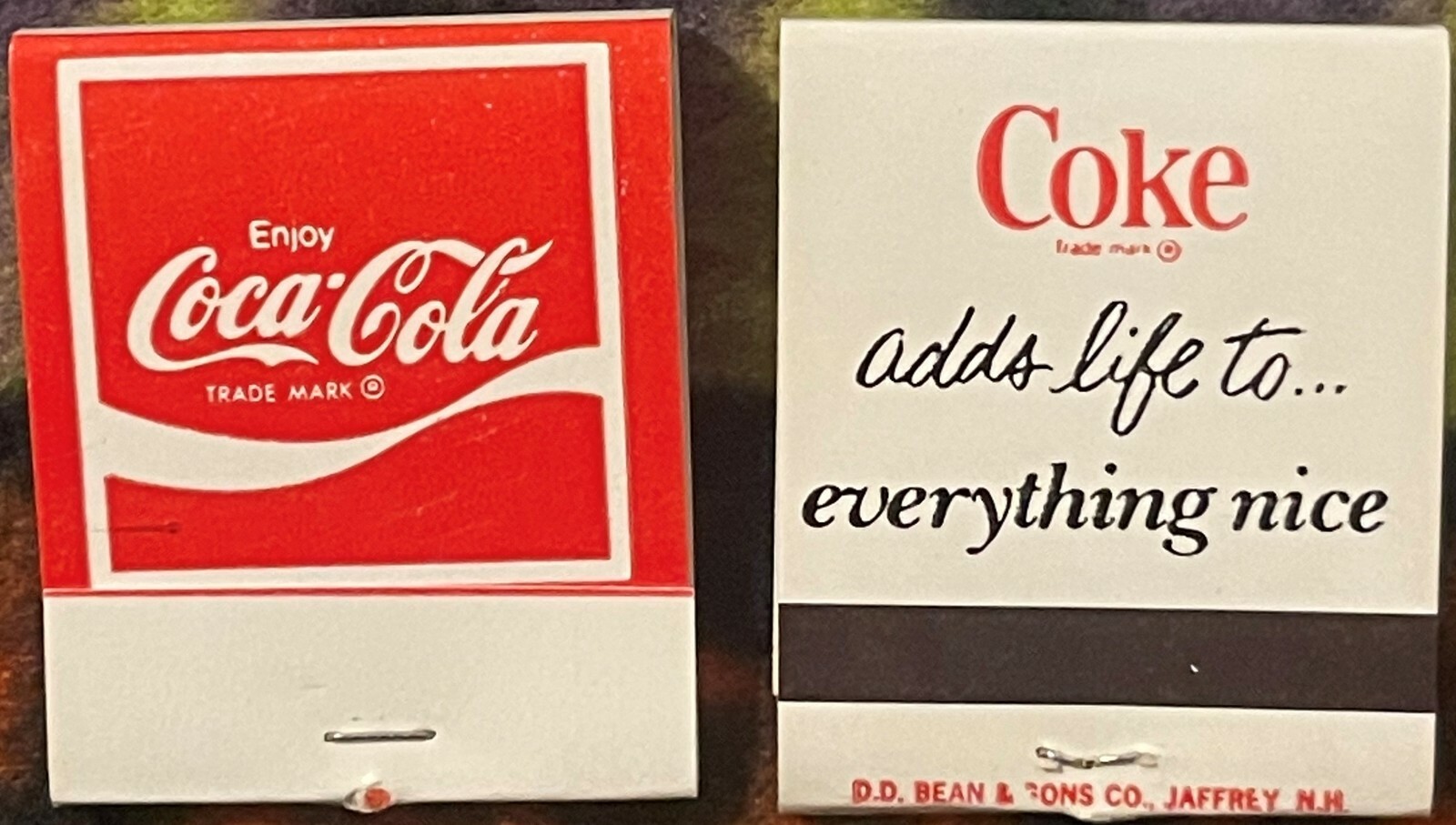
This is a single vintage Coca-Cola advertising giveaway matchbook, manufactured by D.D.Bean & Sons Co. of Jaffrey, New Hampshire — the maker's line, "D.D. BEAN & SONS CO., JAFFREY N.H.," is printed along the bottom of the back cover, below the striker. The front cover carries the classic "Enjoy Coca-Cola, Trade Mark ®" script riding its familiar wave ribbon, white lettering set against solid Coca-Cola red inside a clean white border.The back, a plain white cover, carries the softer, looping cover copy "Coke, Trade Mark ®, adds life to… everything nice" — cursive black script under the red block "Coke" logotype, a phrase built directly from Coca-Cola's national "Coke Adds Life" advertising campaign. The book is printed in red, white, and black color lithography on paperboard stock, in the standard American matchbook format with a metal staple, measuring 2 x 1.5 inches — small enough to slip into a shirt pocket without a second thought.It arrives as New Old Stock (NOS): never struck, never used, the matches still intact inside. Style-wise, this matchbook belongs to the mid-to-late twentieth century era of American soft drink advertising — the stretch of decades when a matchbook sitting by the cash register was one of the most effective, most ubiquitous forms of brand marketing in the entire country.
🏭 The Last Match Company Standing
The name on this cover isn't decoration — it's a genuine piece of American industrial history. D.D.Bean & Sons Co. was founded in the depths of the Great Depression, in 1938, when Delcie D. Bean, Sr., together with his two sons, Vernon and Delcie D. "Jack" Bean, Jr., made a bet that the future of the match industry wasn't wood — it was paper. Delcie Sr. wasn't a stranger to the trade.He'd already spent years in it, first as a timber man supplying the New Hampshire white pine that went into wooden match production, then as a wooden-match manufacturer himself through a company he'd founded in his hometown of Jaffrey. When the Depression hit, father and sons secured low-interest financing through a special government program built to help start-up businesses survive, and used it to buy an old mill building in Jaffrey along with used machinery bought up secondhand from other match companies that hadn't made it.By June of 1938, everything was in place, and D.D. Bean & Sons Co. produced its first matchbooks.
What makes that founding story worth telling on a listing like this one is what came after: while nearly every other American matchbook manufacturer eventually folded, merged, or moved production overseas as smoking rates fell and advertisers shifted their dollars elsewhere, the company the Bean family started in that old New Hampshire mill kept running.Longtime collectors of matchbook advertising have come to know D.D. Bean's name specifically because it kept appearing on covers decade after decade, long after so many of its competitors' names had disappeared — which is exactly why a Bean-printed matchbook, whatever brand it's advertising, tends to catch a collector's eye as something worth a second look.
🌲 Jaffrey, New Hampshire
Jaffrey is a small Cheshire County town sitting at the foot of Mount Monadnock, one of the most-climbed mountains in the world and a fixture of New England literary and artistic culture for generations.It's also, by local reputation, the town where author Willa Cather spent her summers and chose to be buried — a detail longtime Jaffrey residents will tell any visitor almost immediately, a point of quiet local pride in a town better known nationally for granite quarrying and small manufacturing than for literature. It was into that same working New England mill-town landscape that the Bean family planted a match factory in 1938, repurposing an old mill building the way so many small New Hampshire manufacturers did during the Depression — taking a structure built for one industry and giving it a second working life in another.Everyday objects like this matchbook are Jaffrey's most far-flung export: printed in a small New Hampshire town, then shipped out to soda fountains, diner counters, and grocery checkout stands across the country to do their quiet advertising work.
🥤 "Coke Adds Life to…Everything Nice"
The white back cover of this matchbook carries cover copy pulled straight from one of Coca-Cola's biggest national advertising pushes of the era: the "Coke Adds Life" campaign, a slogan Coca-Cola built an entire wave of print, television, and point-of-sale advertising around.It's a soft, almost domestic promise — not a claim about thirst or refreshment, but about Coke belonging alongside "everything nice" in ordinary American life: family dinners, holidays, small everyday moments. The red front's "Enjoy Coca-Cola" script, riding the familiar white wave ribbon Coca-Cola built into its branding, is the more instantly recognizable of the two — the kind of logo treatment collectors sometimes call the company's "dynamic ribbon" device, a graphic flourish Coca-Cola used across bottles, signage, and countless pieces of point-of-sale advertising for years.Seeing both lines on one book, front and back, is a small window into how Coca-Cola ran more than one advertising message at once, all while keeping the core red-white-script identity instantly consistent.
📬 The Matchbook as a Marketing Machine
It's easy to forget, in an age of screens, just how central matchbook advertising once was to American retail life.Restaurants, bars, hotels, gas stations, and soda fountains handed them out for free by the thousands, and national brands like Coca-Cola paired with printers like D.D. Bean to keep their name — and their slogan of the moment — literally in the hand of every customer who lit a cigarette or a stove burner. Old-timers in the matchbook trade have long said that a well-designed matchbook cover did something a newspaper ad never could: it stayed in a pocket, a kitchen drawer, or a car for weeks, quietly repeating its message every single time it was reached for.That's the real reason companies like Coca-Cola invested in matchbook art at all — not for a single glance, but for dozens of them, spread out over the life of the book. It's also exactly why unused, NOS examples like this one are notable finds today: a matchbook was built to be struck and thrown away, so a book that survived fully intact, still holding its matches, skipped the ending it was designed for.
🖼️ Display Ideas
- 🧲 Set it on a kitchen shelf or bar cart next to other Coca-Cola advertising pieces for an instant, colorful vignette
- 🖼️ Frame it in a small double-sided shadow box to show off both slogans, front and back
- 📚 Slip it into a matchbook binder or collector's album alongside other diner and soda-fountain giveaways
- 🎄 Tuck it into a stocking or gift box for the Coca-Cola collector in your life who already has everything else
- 🏺 Set it in a glass bowl or vintage ashtray as a small period-correct conversation piece on a coffee table
🎁 Who Collects These
Coca-Cola memorabilia collectors are among the largest and most organized collecting communities in American advertising history, and matchbooks are a well-established corner of that hobby — small, affordable, endlessly varied by slogan and era, and easy to display in quantity.Alongside them sit matchbook-specific collectors (the hobby even has its own name, phillumeny) who chase particular printers, particular regions, or particular campaigns rather than a single brand. D.D. Bean & Sons material draws its own following among New England collectors and industrial-history enthusiasts interested in the story of American small-town manufacturing surviving the Depression.And because this one book carries two distinct Coca-Cola slogans, front and back, it appeals as well to anyone building out a themed run of "Coke Adds Life" era advertising specifically — a phrase-driven niche within the wider Coca-Cola collecting world.
❓ FAQWas this matchbook ever used?
No.It is New Old Stock — never struck, with its original matches still intact inside the cover.
Who manufactured this matchbook?
D.D. Bean & Sons of Jaffrey, New Hampshire; its maker's line runs under the striker on the back cover.
What era does this matchbook belong to?
It comes from the years when Coca-Cola ran its "Coke Adds Life" national campaign alongside its familiar "Enjoy Coca-Cola" script branding.
What size is the matchbook?
It measures 2 x 1.5 inches, the standard American matchbook size of the era.
Are the red and white designs two different matchbooks?
No — they are the front and back of one matchbook: "Enjoy Coca-Cola" on the red front cover and the "adds life" slogan on the white back, both printed by the same maker in Jaffrey.
Is D.D. Bean & Sons Co. still a recognized name among matchbook collectors?
Yes — collectors of American matchbook advertising specifically look for the Jaffrey, New Hampshire maker's mark, given the company's long-running place in the industry's history.