When you click on links to various merchants on this site and make a purchase, this can result in this site earning a commission. Affiliate programs and affiliations include, but are not limited to, the eBay Partner Network.
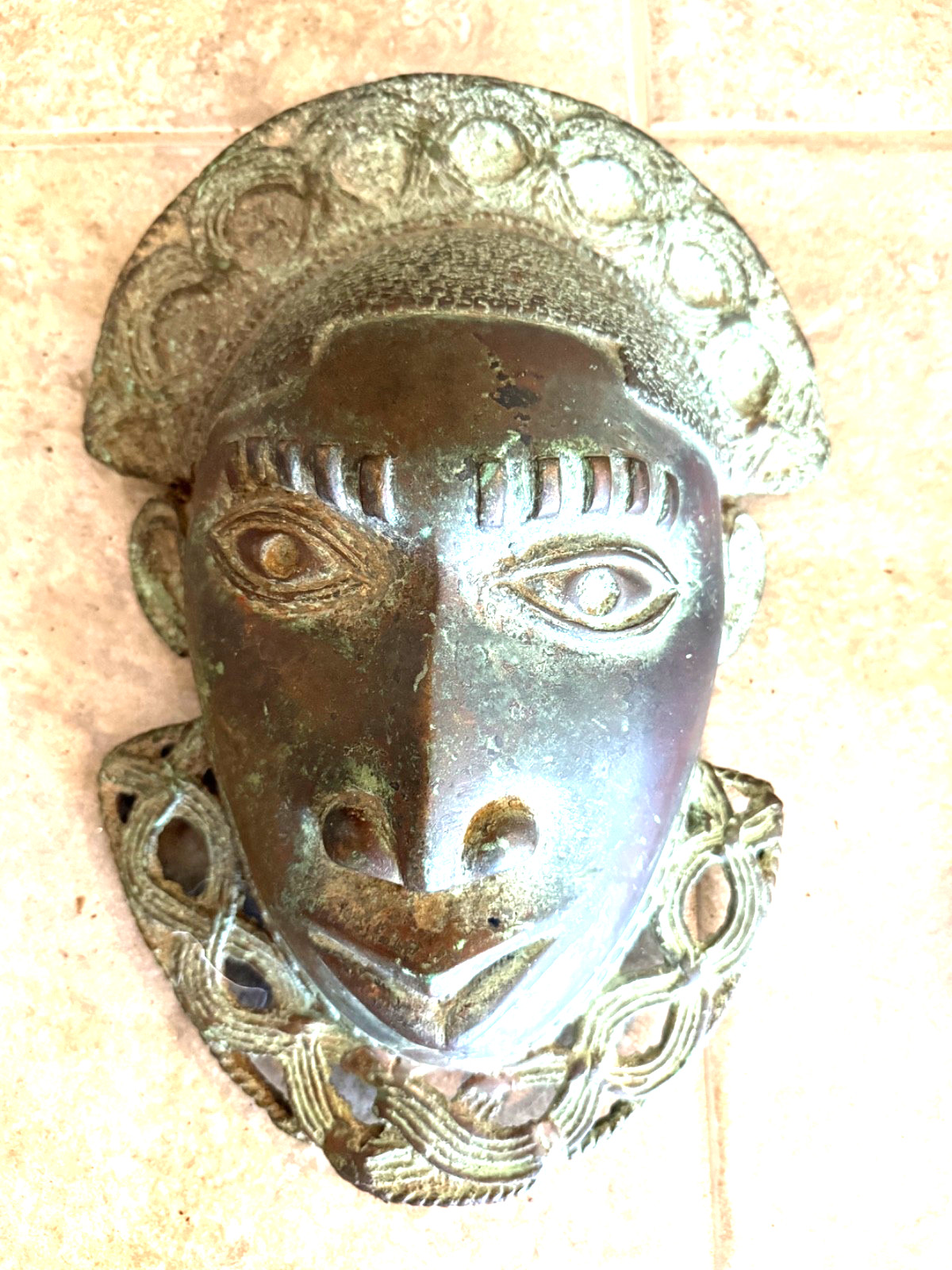
Mask has has several unmistakable Benin-inspired elements:
- Large almond-shaped eyes with raised pupils
- Heavy, carefully outlined eyelids
- Broad, straight nose with recessed nostrils
- Small stylized mouth
- Vertical forehead marks above the eyes
- A broad crown or headdress decorated with rounded bosses
- A textured band beneath the crown
- An elaborate openwork collar surrounding the chin
The rounded forms above the forehead and the interlaced collar are intended to suggest royal coral-bead regalia. Within the Benin court, coral beads were associated with the Oba—the king—and other people of elevated rank. They communicated authority, sacred kingship, wealth, and privileged access to the royal court.
The face could therefore represent an Oba, a royal court figure, or a generalized noble person. It should not automatically be described as Queen Mother Idia; her celebrated ivory pendant masks have a different design and distinctive Portuguese heads around the crown
The green oxidation suggests a copper-based alloy, probably:
- Brass, meaning primarily copper and zinc; or
- Bronze, meaning primarily copper and tin.
“Benin bronze” is a conventional collective term, but many historical Benin works are technically brass. The exact alloy cannot be determined from a photograph.
It was probably produced by the lost-wax casting method:
- The form was modeled in wax.
- Clay was placed around the wax model.
- Heating removed the wax.
- Molten copper alloy was poured into the resulting cavity.
- After cooling, the clay mold was broken away.
- Details were chased, filed, and finished by hand.
If the back shows a rough hollow cavity, casting channels, embedded clay-core residue, irregular metal thickness, or hand-finished edges, that would support lost-wax casting.
African art did not remain within modern national borders. Traders, artists, collectors, and merchants carried objects and styles throughout West and Central Africa.
There are two plausible explanations:
- It was produced in Nigeria or by an Edo-trained caster and transported to Cameroon.
- A Cameroonian or other regional metalworker created it in imitation of Benin court art for collectors and visitors.
Buying it in Cameroon is valid acquisition history, but it does not establish Cameroonian cultural origin.