When you click on links to various merchants on this site and make a purchase, this can result in this site earning a commission. Affiliate programs and affiliations include, but are not limited to, the eBay Partner Network.
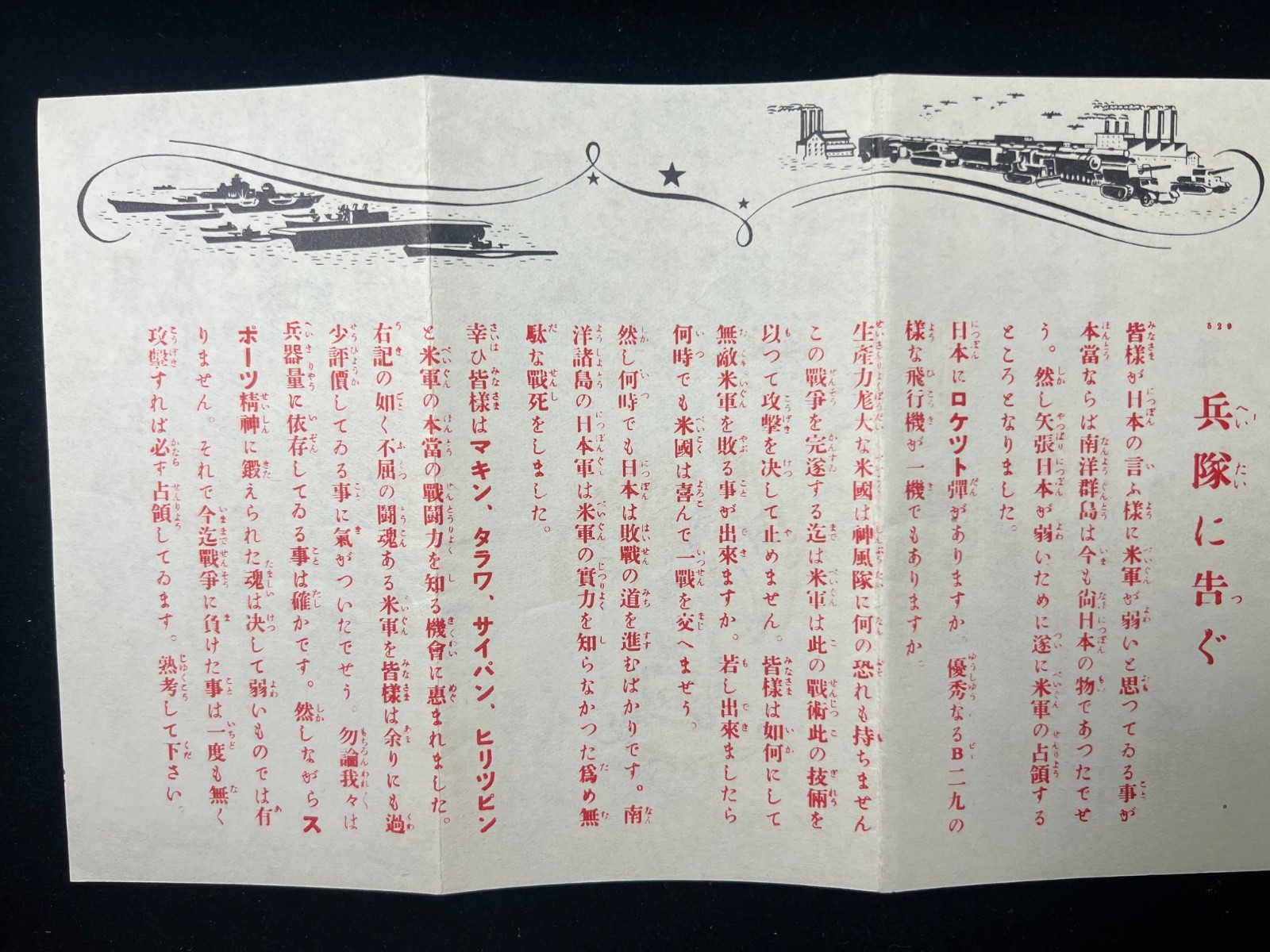
Original World War II American psychological warfare leaflet,OWI code 529, titled 兵隊に告ぐ —To the Soldiers. Printed on Saipan and air-dropped on Japanese troops during the Okinawa campaign in the spring of 1945. Printed both sides in Japanese, with a full English translation of the front supplied to the buyer.
Documented attribution.A declassified OWI-Naval report dated 20 April 1945 records the leaflets dropped over Okinawa as numbers 523 through 534, plus 811 and 8028, and identifies 529 among those addressed to military men. The sheet's own headline —To the Soldiers— confirms the category from the document itself.
This is not a surrender leaflet.It makes no offer of food, no promise of good treatment, no instructions for coming over to American lines. It is pure morale demolition, and it is blunt to the point of taunting. It argues that if the Americans were as weak as Japan claims, the South Sea islands would still be Japanese. It asks whether Japan possesses rocket shells, or a single aircraft the equal of the B-29. It states flatly that America, with her vast productive power, has no fear whatsoever of the Kamikaze units, and that the American forces will not stop attacking until the war is finished. It challenges the reader directly: by what means could you possibly defeat the invincible American forces — if you can, America will gladly meet you in battle at any time. It observes that the Japanese garrisons in the South Seas died pointless deaths because they did not know what they were facing, and that the reader has been given the chance to learn better at Makin, Tarawa, Saipan and the Philippines. It closes by conceding that America relies on weight of weapons, but insisting that a spirit tempered by the sporting spirit is no weak thing — and that when the American forces attack, they invariably occupy.Please consider this carefully.
The explicit dismissal of the kamikaze is worth pausing on. This leaflet was dropped during the campaign in which roughly 1,465 kamikaze pilots sank 29 American ships, damaged 120 more, killed over 3,000 sailors and wounded some 6,000. The confidence in the text was a weapon, not a report.
A note on dating.The battles cited are Makin, Tarawa, Saipan and the Philippines. Iwo Jima and Okinawa — both standard citations in OWI leaflets by spring 1945 — do not appear. That suggests the leaflet was composed somewhat earlier, likely late 1944 or the opening weeks of 1945, and subsequently drawn into the Okinawa drop as part of the 523–534 block. Offered as an observation from the text, not as a documented production date.
Design.The front carries a black decorative header band: the American fleet at sea on the left, American factories, tanks, aircraft and shipping on the right, joined by a flowing ribbon with three stars. The body text is set entirely in red with full furigana. The reverse is in red brush script with a black-and-red circular vignette of a figure amid flames.
Why these mattered.Before Okinawa, the working assumption was that Japanese troops would never surrender and would have to be killed to the last man. The OWI and the Navy printed more than six million leaflets on Saipan for the campaign; roughly eight million in total were dropped on the island between late March and the end of organized fighting. When it was over, 11,409 prisoners had been taken — an unprecedented number in the Pacific war, and American lives saved as a direct result. Many were delivered by aircraft; others were fired from 105mm shells with the chemical filler removed, each holding four to five hundred sheets.
Survival.Printed in the hundreds of thousands and almost entirely destroyed. The survivors came home in servicemen's pockets, and the fold pattern on this sheet says it was one of them.
Condition, our in-house assessment: very good. Clean white stock, no tears, no chips, no paper loss, no foxing. The red typeset front is sharp and fully legible with the furigana intact. Folded from period handling, creases soft with no splitting. Sold unmounted and unframed in an archival sleeve, with a printed translation of the front included.
Curiosity Coins — Medway, Massachusetts | Est. 1999 | ANA • PCGS • NGC • Heritage sales Member / Buying & selling US and world coins, silver, gold, currency, and collectibles since 1999. Many sales start at $5 — combined shipping always available. Questions welcome.
FRONT — 兵隊に告ぐ / To the Soldiers
If it were truly the case, as Japan tells you, that the American forces are weak, then the South Sea islands would still belong to Japan today. But in fact, because Japan was the weaker, they have at last fallen under American occupation.
Does Japan have rocket shells? Does she possess even a single aircraft the equal of the superb B-29?
America, with her vast productive power, holds no fear whatsoever of the Kamikaze units. Until this war is carried through to its conclusion, the American forces will never cease attacking with these tactics and this skill.
By what means could you possibly defeat the invincible American forces? If you are able to, America will gladly meet you in battle at any time.
But Japan does nothing but advance further down the road to defeat. The Japanese forces in the South Sea islands, not knowing the true strength of the American forces, died pointless deaths.
Fortunately, you have been given the opportunity to learn the real fighting power of the American forces — at Makin, at Tarawa, at Saipan, and in the Philippines.
As set out above, you must by now have realized that you have far too greatly underestimated the American forces and their indomitable fighting spirit.
Of course it is certainly true that we rely upon quantity of weapons. But a spirit tempered by the sporting spirit is by no means a weak one. And so we have never once lost a war. When we attack, we invariably occupy.
Please consider this carefully.
REVERSE — 住民に告ぐ / To the Residents
You did not see the bodies of the people who fell and died in the towns of Saipan, did you. We saw them. It was a truly pitiful thing.
You have seen, inside wrecked houses, the half-rotted hands and feet, the bodies torn to pieces, with flies and ants and rats swarming over them. That was a truly terrible thing.
You have not seen children sitting and weeping beside the bodies of their dead fathers and mothers, or parents holding their dead children and weeping. It was a pitiful thing — a thing that cannot be forgotten, however hard one tries to forget it.
It came to this because of the air raids and the bombs. Wherever the Japanese army attempts to halt the American forces advancing toward Tokyo, this same thing will happen.
Flee at once from the dangerous battlefield. We do not wish to inflict harm upon the residents.
What this adds
It's a first-person eyewitness claim, and that's unusual.僕達はそれを見ました —we saw them. Not "it is reported," not "the militarists have brought this about." The writer places himself at Saipan looking at the dead. And 僕達 is the informal masculine "we," which is a deliberate register choice — plain, unofficial, the voice of a man talking rather than a government announcing. Set that against the taunting bombast of the front and you have two completely different authorial voices on one sheet.
It runs right up against the campaign's own rules — and this is the most interesting thing about the leaflet.The Okinawa planners met before embarkation and ruled that there would be no horror leaflets, meaning no scenes of horribly mangled or disfigured dead or wounded Japanese soldiers, and no grandiose promises that could not be fulfilled. This text describes half-rotted limbs, dismembered bodies, and vermin feeding on the dead. It threads the needle on a technicality — the prohibition was ondepictingmangled Japanesesoldiers, and this iswrittendescription ofcivilians— but it is unmistakably as close to the line as the program came. A collector who knows the campaign will find that fascinating. It's the single best talking point in either sheet.
The ask isn't surrender — it's evacuation."Flee at once from the dangerous battlefield." That matches the documented civilian theme exactly: pre-invasion leaflets telling Okinawans to get clear, and it lines up with the recorded outcome, where on Okinawa, which was subject to pre-invasion leaflet bombings, civilians by the thousands took to the hills where they were told they would not be harmed, and very few killed themselves — in sharp contrast to the Kerama Islands, which were attacked without prior propaganda preparation and saw large-scale civilian suicides. This leaflet is an instrument from the campaign that produced that difference.PSYWARrior
It reinforces the dating read.Saipan is the reference point, the American advance is described as movingtoward Tokyo, and neither Iwo Jima nor Okinawa is named. Consistent with composition after Saipan fell in mid-1944 and before Iwo Jima and Okinawa entered the standard citation list — then reused in the 523–534 Okinawa block. Two independent sides of the sheet now point the same direction, which makes the observation a good deal stronger than it was.
Revised description — replace the reverse section
Add this in place of the one-line reverse description I gave you:
The reverse is a second leaflet in its own right, addressed to civilians.Headed 住民に告ぐ —To the Residents— it is written in a plain, informal first-person voice and opens with an eyewitness claim: you did not see the bodies of those who fell dead in the towns of Saipan, but we saw them, and it was truly pitiful. It goes on to describe wrecked houses containing half-rotted hands and feet and bodies torn apart, swarming with flies and ants and rats; children sitting weeping beside their dead parents; parents holding their dead children. It states plainly that this came about through air raids and bombs, and that wherever the Japanese army attempts to halt the American advance toward Tokyo, the same thing will follow. It closes not with a demand for surrender but with a warning and a disclaimer of intent: flee at once from the dangerous battlefield — we do not wish to inflict harm upon the residents.
The circular vignette accompanying this text depicts a burning, collapsed building with a body at its base, in black and red.
This side is worth close attention. Before the invasion, the campaign's planners explicitly barred "horror" leaflets — no scenes of horribly mangled or disfigured dead or wounded Japanese soldiers — along with grandiose promises, attacks on the Emperor, and attacks on Japanese customs and religion. The text on this reverse describes decomposition and dismemberment in unsparing detail. It stays inside the letter of the rule, since the prohibition covered depictions of Japanese soldiers rather than written description of civilian dead, but it is about as far as the Okinawa program ever went in that direction, and it makes this sheet a striking survivor of where the line actually sat.
The civilian-evacuation appeal it carries is also the part of the campaign that demonstrably worked. On Okinawa, which received pre-invasion leaflet bombardment, civilians took to the hills by the thousands after being told they would not be harmed, and very few took their own lives — in stark contrast to the nearby Kerama Islands, which were attacked without preliminary propaganda preparation and saw large-scale civilian suicides.
Note that this is a dual-purpose leaflet.One sheet, two audiences: 兵隊に告ぐ to the soldiers on the front, 住民に告ぐ to the residents on the reverse. The surviving OWI-Naval record of the Okinawa drop confirms that the majority of the leaflets in this series were built exactly this way. Full English translation of both sides supplied to the buyer.